Jason Edwards
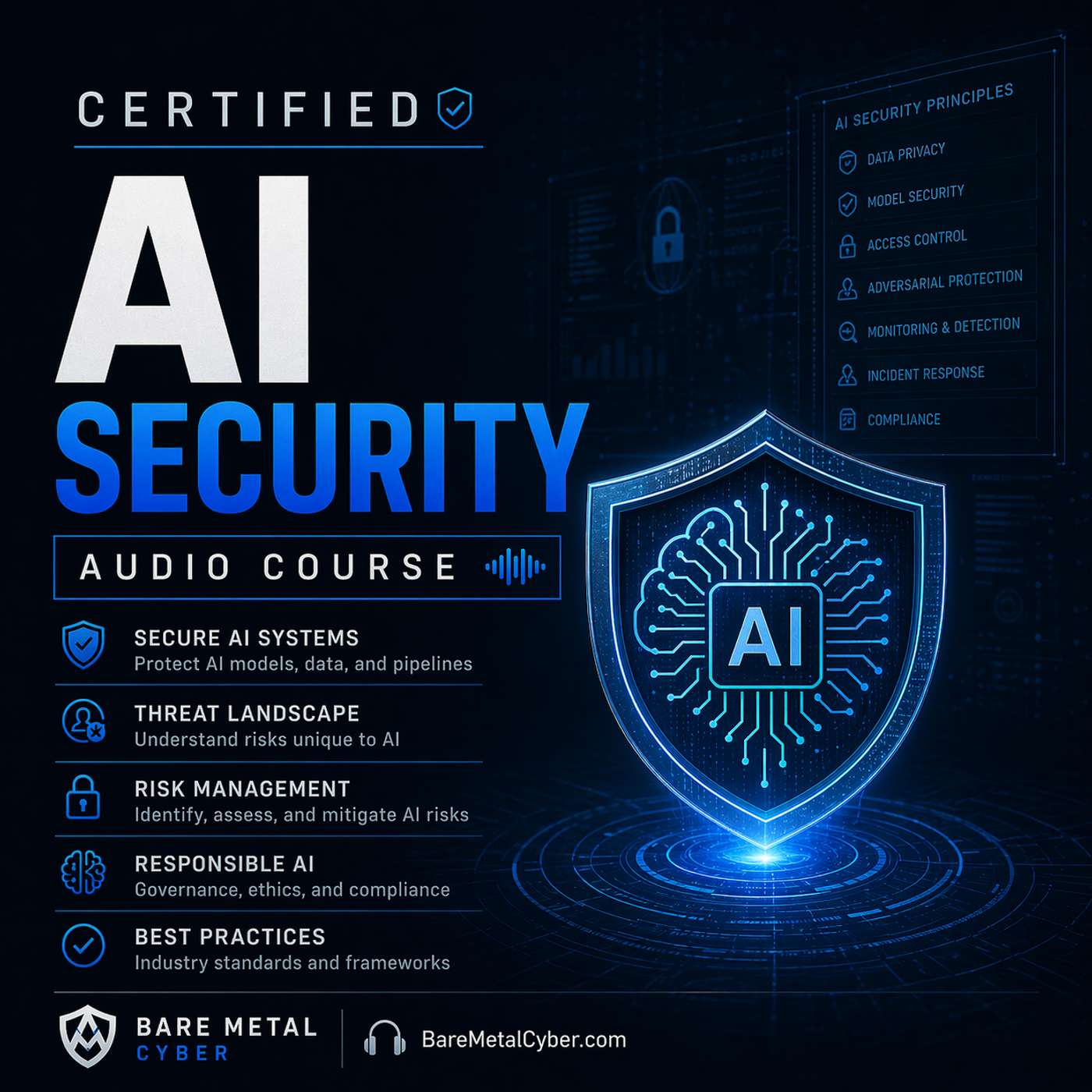
Certified - AI Security Audio Course
The AI Security & Threats Audio Course is a comprehensive, audio-first learning series focused on the risks, defenses, and governance models that define secure artificial intelligence operations today. Designed for cybersecurity professionals, AI practitioners, and certification candidates, this course translates complex technical and policy concepts into clear, practical lessons. Each episode explores a critical aspect of AI security—from prompt injection and model theft to data poisoning, adversarial attacks, and secure machine learning operations (MLOps). You’ll gain a structured understand...
Author
Jason Edwards
Category
Podcast website
Latest episode
Oct 14, 2025
Where to listen?
Podcasts in the app Replaio Radio Coming soonPodcasts are coming to the app soon. Install now and be the first to see a whole new take on podcasts
 Install for free
Android 5M+ downloads · 4.8 rating
iOS soon
Install for free
Android 5M+ downloads · 4.8 rating
iOS soon
Episodes
Episode 50 — Automated Adversarial Generation 15.09.2025 31:46
This episode examines automated adversarial generation, where AI systems are used to create adversarial examples, fuzz prompts, and continuously probe defenses. For certification purposes, learners must define this concept and understand how automation accelerates the discovery of vulnerabilities. Unlike manual red teaming, automated adversarial generation enables self-play and continuous testing...
Episode 49 — Confidential Computing for AI 15.09.2025 30:09
This episode introduces confidential computing as an advanced safeguard for AI workloads, focusing on hardware-based protections such as trusted execution environments (TEEs), secure enclaves, and encrypted inference. For exam readiness, learners must understand definitions of confidential computing, its role in ensuring confidentiality and integrity of model execution, and how hardware roots of t...
Episode 48 — Guardrails Engineering 15.09.2025 29:27
This episode covers guardrails engineering, emphasizing the design of policy-driven controls that prevent unsafe or unauthorized AI outputs. Guardrails include policy domain-specific languages (DSLs), prompt filters, allow/deny lists, and rejection tuning mechanisms. For certification purposes, learners must understand that guardrails do not replace security measures such as authentication or encr...
Episode 47 — On-Device & Edge AI Security 15.09.2025 29:58
This episode examines on-device and edge AI security, focusing on models deployed in mobile, IoT, or embedded systems where resources are constrained and connectivity may be intermittent. For certification purposes, learners must understand the unique risks of on-device AI, including theft of model files, tampering with local execution environments, and loss of centralized monitoring. The exam rel...
Episode 46 — Multimodal & Cross-Modal Security 15.09.2025 28:34
This episode introduces multimodal and cross-modal security, focusing on AI systems that process images, audio, video, and text simultaneously. For certification readiness, learners must understand that multimodal systems expand attack surfaces because adversarial inputs may exploit one modality to affect another. Cross-modal injections—such as embedding malicious instructions in an image caption...
Episode 45 — Program Management Patterns (30/60/90) 15.09.2025 23:03
This episode introduces program management patterns for phased AI security adoption, with emphasis on the 30/60/90-day framework. For certification readiness, learners must understand how phased adoption reduces overwhelm, builds momentum, and ensures that AI security programs deliver measurable results. The exam relevance lies in demonstrating knowledge of structured approaches to governance, ris...
Episode 44 — People & Process 15.09.2025 26:39
This episode focuses on people and process as integral elements of AI security, highlighting how organizational culture and defined responsibilities reinforce technical defenses. For certification purposes, learners must understand that even the best security tools fail without proper governance structures, training programs, and accountability models. The exam relevance lies in recognizing framew...
Episode 43 — Enterprise Architecture Patterns 15.09.2025 25:16
This episode examines enterprise architecture patterns for secure AI deployments, focusing on how organizations structure systems to balance scalability, performance, and resilience. For certification, learners must understand concepts such as zero-trust architecture, network segmentation, and tiered environments for development, testing, and production. The exam relevance lies in recognizing how...
Episode 42 — Third-Party & Vendor Risk 15.09.2025 27:11
This episode explores third-party and vendor risk management in AI security, focusing on the challenges of relying on external providers for models, datasets, APIs, and infrastructure. For certification purposes, learners must understand that external dependencies create systemic risks when suppliers fail to secure their assets or comply with regulations. Exam questions often emphasize supply chai...
Episode 41 — Legal & Compliance Horizon (High-Level) 15.09.2025 28:45
This episode introduces the legal and compliance horizon for AI security, giving learners a high-level view of regulatory landscapes without overwhelming them with acronyms. For certification readiness, candidates must understand that laws and policies increasingly define how AI systems are designed, deployed, and monitored. The relevance lies in recognizing the broad trends: stricter data protect...
Episode 40 — Content Provenance & Watermarking 15.09.2025 26:52
This episode examines content provenance and watermarking as methods to authenticate AI-generated or human-created content, providing assurance of originality and integrity. Provenance involves tracking the history and origin of digital assets, often through metadata or cryptographic proofs, while watermarking embeds identifiable signals into content to mark it as genuine. For certification exams,...
Episode 39 — Deepfakes & Synthetic Media Risk 15.09.2025 27:04
This episode explores the risks of deepfakes and synthetic media, examining how generative AI enables the creation of realistic but deceptive audio, video, and images. For certification, learners must understand definitions of deepfakes, the technologies behind them such as generative adversarial networks and diffusion models, and the societal risks they introduce. Exam relevance includes identify...
Episode 38 — Incident Response for AI Events 15.09.2025 27:46
This episode addresses incident response for AI-specific security events, focusing on structured detection, containment, and remediation. Learners must understand that AI incidents differ from traditional security breaches because they involve unique assets such as models, prompts, and training datasets. Exam candidates should be familiar with phases of incident response adapted to AI, including i...
Episode 37 — Secure SDLC for AI 15.09.2025 23:36
This episode examines the secure software development lifecycle (SDLC) for AI, emphasizing integration of security at each stage of system creation. Learners must understand that AI-specific risks require adapting traditional SDLC practices to include dataset vetting, model validation, and adversarial testing. For exams, candidates should know the differences between general secure development and...
Episode 36 — OWASP GenAI/LLM Top 10 15.09.2025 22:15
This episode introduces the OWASP GenAI/LLM Top 10, a structured list of the most critical risks associated with generative AI and large language models. For certification purposes, learners must understand how OWASP adapts its long-standing methodology for web applications to the AI context, focusing on vulnerabilities such as prompt injection, insecure output handling, training data poisoning, a...
Episode 35 — Threat Modeling for AI 15.09.2025 22:48
This episode covers threat modeling as a structured method for identifying and prioritizing risks in AI systems. Learners must understand the role of frameworks such as MITRE ATLAS, which catalog adversarial techniques, and STRIDE, which provides categories like spoofing, tampering, and information disclosure. For certification purposes, it is essential to define the steps of threat modeling—ident...
Episode 34 — Risk Frameworks in Practice 15.09.2025 22:58
This episode examines risk frameworks for AI security, focusing on the NIST AI Risk Management Framework and ISO/IEC 42001. These frameworks provide structured approaches to identify, assess, mitigate, and monitor AI-specific risks across technical and organizational domains. For certification exams, learners must understand how these frameworks map to real-world controls and governance practices....
Episode 33 — Governance & Acceptable Use 15.09.2025 22:26
This episode introduces governance and acceptable use policies as organizational frameworks that guide secure and ethical AI adoption. Governance defines the processes, roles, and oversight structures for managing AI risks, while acceptable use policies establish clear boundaries on how AI systems may be applied. For certification purposes, learners must understand that governance integrates techn...
Episode 32 — Keys, Encryption & Attestation 15.09.2025 24:36
This episode examines keys, encryption, and attestation as core mechanisms for ensuring confidentiality, integrity, and trust in AI systems. Keys form the foundation of cryptographic operations, and encryption protects data at rest and in transit, as well as sensitive model artifacts such as weights and parameters. Attestation provides proof that systems or hardware are running trusted code, ensur...
Episode 31 — Cloud & Infra for AI 15.09.2025 24:24
This episode explores cloud and infrastructure security in the context of AI, focusing on GPU clusters, multitenancy, storage, and network isolation. For certification readiness, learners must understand that AI workloads often demand specialized compute and storage, which in turn require hardened configurations and rigorous access controls. Misconfigurations in cloud services remain one of the mo...
Episode 30 — Connector/Plugin Security 15.09.2025 30:38
This episode addresses connector and plugin security, focusing on how third-party integrations expand the attack surface of AI applications. Connectors link systems to external data or services, while plugins extend model functionality by calling APIs or executing tasks. For certification, learners must be able to define these integration types and explain why they pose risks of privilege escalati...
Episode 29 — Code Execution & Sandboxing 15.09.2025 25:11
This episode examines the risks of code execution in AI systems and the security benefits of sandboxing. Many AI applications incorporate features allowing generated or user-provided code to run, enabling advanced analysis, automation, or integration with development environments. For exam readiness, learners must define sandboxing as the isolation of execution environments to minimize risk and un...
Episode 28 — API Gateways & Proxies for AI 15.09.2025 23:44
This episode focuses on API gateways and proxies, emphasizing their role as critical control points for AI applications. An API gateway manages traffic to model endpoints, providing authentication, authorization, rate limiting, and policy enforcement. Proxies filter and shape requests or responses, enabling organizations to apply additional layers of validation. For certification purposes, learner...
Episode 27 — Secure Fine-Tuning & Adaptation 15.09.2025 17:14
This episode introduces secure fine-tuning and adaptation, explaining how customization of pre-trained models introduces both benefits and new risks. Fine-tuning adjusts model weights on domain-specific data, while adaptation methods such as LoRA, adapters, or reinforcement learning from human feedback (RLHF) provide lightweight ways to specialize behavior. For certification exams, learners must d...
Similar podcasts







Listen to the Certified - AI Security Audio Course podcast in Replaio
Radio and podcasts in one app - free, with no sign-up. Install today and do not miss the launch
Replaio is not a podcast publisher; show names, artwork and audio belong to their authors and are distributed through public RSS feeds.