Jason Edwards
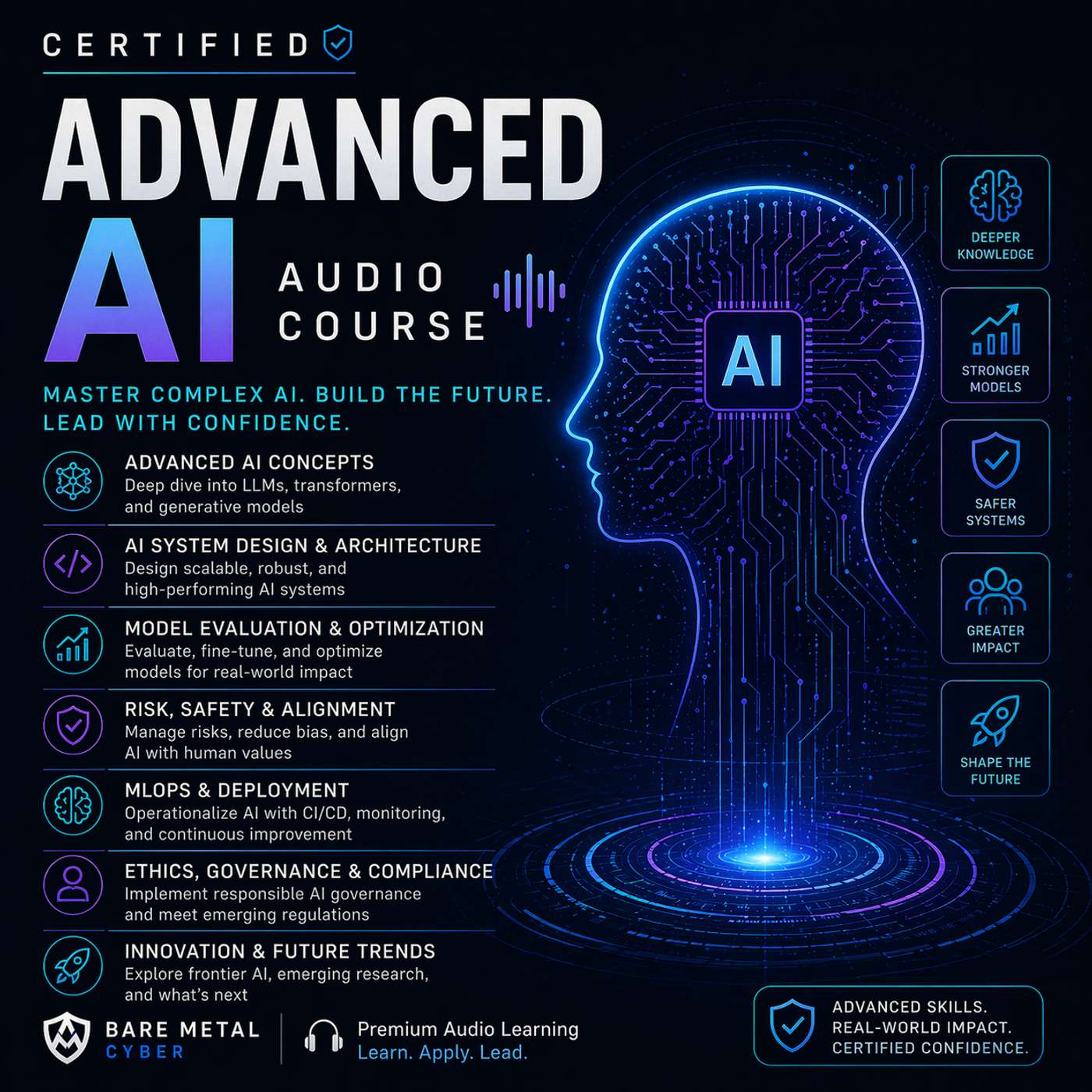
Certified - Advanced AI Audio Course
The Advanced Artificial Intelligence Audio Course is a focused, audio-first series that takes you deep into the technical foundations and emerging challenges of modern AI systems. Designed for professionals, students, and certification candidates, this course explains advanced AI concepts through clear, structured narration—no slides, no filler, just direct, practical learning. Each episode unpacks core topics such as neural architectures, model embeddings, optimization, interpretability, and evaluation, showing how these elements come together to create powerful and reliable AI systems. Wheth...
Where to listen?
Podcasts in the app Replaio Radio Coming soonPodcasts are coming to the app soon. Install now and be the first to see a whole new take on podcasts
 Install for free
Android 5M+ downloads · 4.8 rating
iOS soon
Install for free
Android 5M+ downloads · 4.8 rating
iOS soon
Episodes
Episode 50 — Optimization & Decision Intelligence: Linear Programming, Constraints, and Trade-Offs 14.09.2025 24:53
This episode covers optimization and decision intelligence, which focus on choosing the best possible actions under constraints. Optimization techniques such as linear programming define objectives and constraints mathematically, allowing systems to find efficient solutions. Decision intelligence expands this into broader frameworks that integrate models, data, and human judgment for complex envir...
Episode 49 — Causal Inference for Practitioners: Experiments, A/B Tests, and Uplift 14.09.2025 27:09
This episode introduces causal inference, which seeks to determine not just correlations but true cause-and-effect relationships. For certification purposes, learners should understand the difference between correlation and causation, as well as tools such as randomized controlled trials, A/B testing, and uplift modeling. These methods are vital for evaluating whether interventions like marketing...
Episode 48 — Time Series & Forecasting: Trends, Seasonality, and Drift 14.09.2025 27:43
This episode explains time series analysis and forecasting, which focus on predicting values that evolve over time. Key concepts include trends, which capture long-term movements; seasonality, which reflects repeating cycles; and drift, which occurs when patterns change unexpectedly. For certification exams, learners should understand how time-dependent data differs from static datasets, requiring...
Episode 47 — Recommender Systems: Ranking, Diversity, and Feedback Loops 14.09.2025 28:51
This episode introduces recommender systems, one of the most visible applications of AI in daily life. Recommenders filter and rank content or products based on user preferences, behaviors, and similarities across populations. Core approaches include collaborative filtering, which relies on similarities between users, and content-based filtering, which analyzes attributes of items. Hybrid systems...
Episode 46 — Working with Vendors: Questions to Ask, SLAs to Watch 14.09.2025 30:44
This episode explores the realities of working with AI vendors, a critical skill as few organizations build every component in-house. Vendor relationships require careful evaluation of offerings, service-level agreements (SLAs), and long-term commitments. For certification exams, learners should understand the importance of due diligence, contract clarity, and performance monitoring. Key questions...
Episode 45 — Building with Ethics: Practical Guardrails for Projects 14.09.2025 31:32
This episode focuses on embedding ethics into AI development through practical guardrails. While high-level principles such as fairness and accountability provide guidance, practitioners need concrete methods to implement them in projects. Guardrails include governance structures, bias audits, red-teaming, and impact assessments. For certification learners, recognizing how to move from abstract va...
Episode 44 — Agents & Tool Use: When Models Act on Your Behalf 14.09.2025 32:17
This episode examines AI agents, which extend models beyond text generation into action. Agents use planning and tool integration to execute tasks on behalf of users, such as querying databases, calling APIs, or chaining steps to solve complex problems. Certification exams may test whether learners can identify the difference between static model responses and dynamic agent behavior. Core concepts...
Episode 43 — Edge & On-Device AI: Privacy, Latency, Offline Use 14.09.2025 30:34
This episode explores edge and on-device AI, where models run locally on hardware rather than in centralized cloud servers. Edge AI provides advantages in privacy, since data remains on the device; latency, because processing happens close to the source; and offline functionality, which supports scenarios with limited connectivity. For certification exams, learners should understand why edge deplo...
Episode 42 — AI in Healthcare & Finance: Safety-Critical Considerations 14.09.2025 29:44
This episode addresses the unique challenges of deploying AI in safety-critical sectors such as healthcare and finance. In these domains, errors can cause significant harm, from misdiagnosis in medicine to systemic risks in financial markets. Certification exams emphasize these areas to highlight the importance of reliability, explainability, and compliance. Learners should understand that in sens...
Episode 41 — AI in Cybersecurity: Detection, Triage, Automation 14.09.2025 31:28
This episode explores the growing role of AI in cybersecurity, where the scale and speed of modern threats demand advanced detection and automation. AI techniques support intrusion detection, malware classification, phishing analysis, and anomaly monitoring. Detection focuses on identifying suspicious patterns quickly, triage involves prioritizing alerts for response, and automation accelerates co...
Episode 40 — AI in Operations & IT: Forecasting and Anomaly Detection 14.09.2025 34:02
This episode addresses AI in operations and IT, focusing on forecasting and anomaly detection. Forecasting uses historical patterns to predict future values, such as demand or resource usage. Anomaly detection identifies unusual patterns that may signal problems such as system failures or security incidents. Certification exams emphasize these topics because they illustrate AI’s value in maintaini...
Episode 39 — AI in Marketing & Sales: Personalization and Scoring 14.09.2025 32:17
This episode explores how AI transforms marketing and sales functions through personalization and scoring. Personalization involves tailoring recommendations, messages, or offers based on customer data. Scoring applies predictive models to rank leads, prioritize outreach, or estimate customer lifetime value. Certification exams often test whether learners can connect these applications with underl...
Episode 38 — AI in Customer Support: Chatbots, Agents, Escalations 14.09.2025 28:07
This episode examines AI in customer support, one of the most common enterprise applications. Chatbots and virtual agents handle routine inquiries, while escalation paths route complex cases to human representatives. For certification purposes, learners should understand how these systems improve efficiency but must be designed carefully to maintain customer satisfaction. Core concepts include nat...
Episode 37 — Organizational Roles: Who Does What on an AI Team 14.09.2025 31:08
This episode explores the organizational roles necessary for building and sustaining AI systems. Teams often include data scientists, data engineers, machine learning engineers, product managers, ethicists, and business stakeholders. Understanding how these roles collaborate is essential for certification exams, which may test recognition of responsibilities and dependencies. Clear division of lab...
Episode 36 — Change Management: Helping Teams Adopt AI 14.09.2025 30:53
This episode examines change management in the context of AI adoption. AI systems are not just technical tools but organizational shifts, and their success depends heavily on how teams accept and integrate them. Change management involves preparing stakeholders, addressing resistance, and ensuring alignment between technology and workflows. For certification purposes, learners should recognize tha...
Episode 35 — Metrics That Matter: Measuring Value, Not Hype 14.09.2025 31:41
This episode addresses the critical task of evaluating AI systems beyond raw performance metrics. While accuracy and loss functions matter during development, organizations ultimately need to measure value — the tangible impact of AI on business or mission outcomes. Certification exams emphasize this perspective, testing whether learners can identify metrics that align with objectives rather than...
Episode 34 — Legal & Policy Landscape: Copyright, Consent, Compliance 14.09.2025 32:24
This episode covers the legal and policy environment surrounding AI, an area increasingly tested in certification exams. Copyright concerns arise when models are trained on copyrighted material, raising questions about fair use and derivative works. Consent issues appear in datasets that include personal information, requiring explicit permission or lawful basis for processing. Compliance refers t...
Episode 33 — AI Security Primer: Threats and Defenses 14.09.2025 31:13
This episode introduces the security challenges unique to artificial intelligence systems. Unlike traditional software, AI models can be attacked through their training data, architecture, or outputs. Threats include data poisoning, where adversaries manipulate inputs to corrupt models; evasion, where attackers craft adversarial examples to fool predictions; and model theft, where proprietary mode...
Episode 32 — Data Privacy & Governance: Responsible Data Use 14.09.2025 31:42
This episode covers data privacy and governance, critical areas for both ethical practice and regulatory compliance. Data privacy refers to protecting individual information from misuse, while governance involves managing data with policies, standards, and oversight. For certifications, learners should understand how responsible data use underpins trustworthy AI systems. Regulations such as GDPR o...
Episode 31 — MLOps Essentials: Monitoring, Drift, and Lifecycle 14.09.2025 33:00
This episode introduces MLOps, the discipline of applying operational best practices to machine learning systems. While data science focuses on building models, MLOps ensures they can be deployed, maintained, and monitored reliably in production. Core concepts include monitoring model performance over time, detecting drift when data or context changes, and managing the full lifecycle from developm...
Episode 30 — Productizing AI: From Prototype to Production (No Code) 14.09.2025 32:48
This episode examines the journey from experimental AI prototypes to fully deployed production systems, emphasizing that success requires more than technical accuracy. Productizing AI involves integration into workflows, scaling for reliability, and ensuring maintainability. With the rise of no-code and low-code platforms, non-specialists can now build and deploy AI applications, expanding accessi...
Episode 29 — Human-in-the-Loop: People + AI for Better Outcomes 14.09.2025 31:14
This episode introduces the human-in-the-loop approach, where human oversight complements automated AI processes. Instead of leaving systems to operate entirely on their own, humans provide feedback, corrections, and judgment in critical points of the workflow. This hybrid approach improves performance, reduces risks, and ensures accountability. For certification exams, learners should understand...
Episode 28 — Explainability & Transparency: Opening the Black Box 14.09.2025 31:05
This episode addresses explainability and transparency, two qualities increasingly demanded of AI systems. Explainability refers to the ability to clarify how a model reached a decision, while transparency involves openness about system design, data use, and limitations. These factors are critical for building trust, meeting regulatory requirements, and supporting accountability. Certification exa...
Episode 27 — Safety, Bias, and Fairness: What Can Go Wrong and Why 14.09.2025 32:13
This episode focuses on safety, bias, and fairness, essential dimensions of responsible AI development. Safety refers to preventing harmful or unpredictable behavior. Bias occurs when models inherit unfair patterns from training data, producing skewed outcomes. Fairness is the goal of ensuring equitable performance across groups and contexts. Certification exams frequently cover these areas, both...
Similar podcasts







Listen to the Certified - Advanced AI Audio Course podcast in Replaio
Radio and podcasts in one app - free, with no sign-up. Install today and do not miss the launch
Replaio is not a podcast publisher; show names, artwork and audio belong to their authors and are distributed through public RSS feeds.