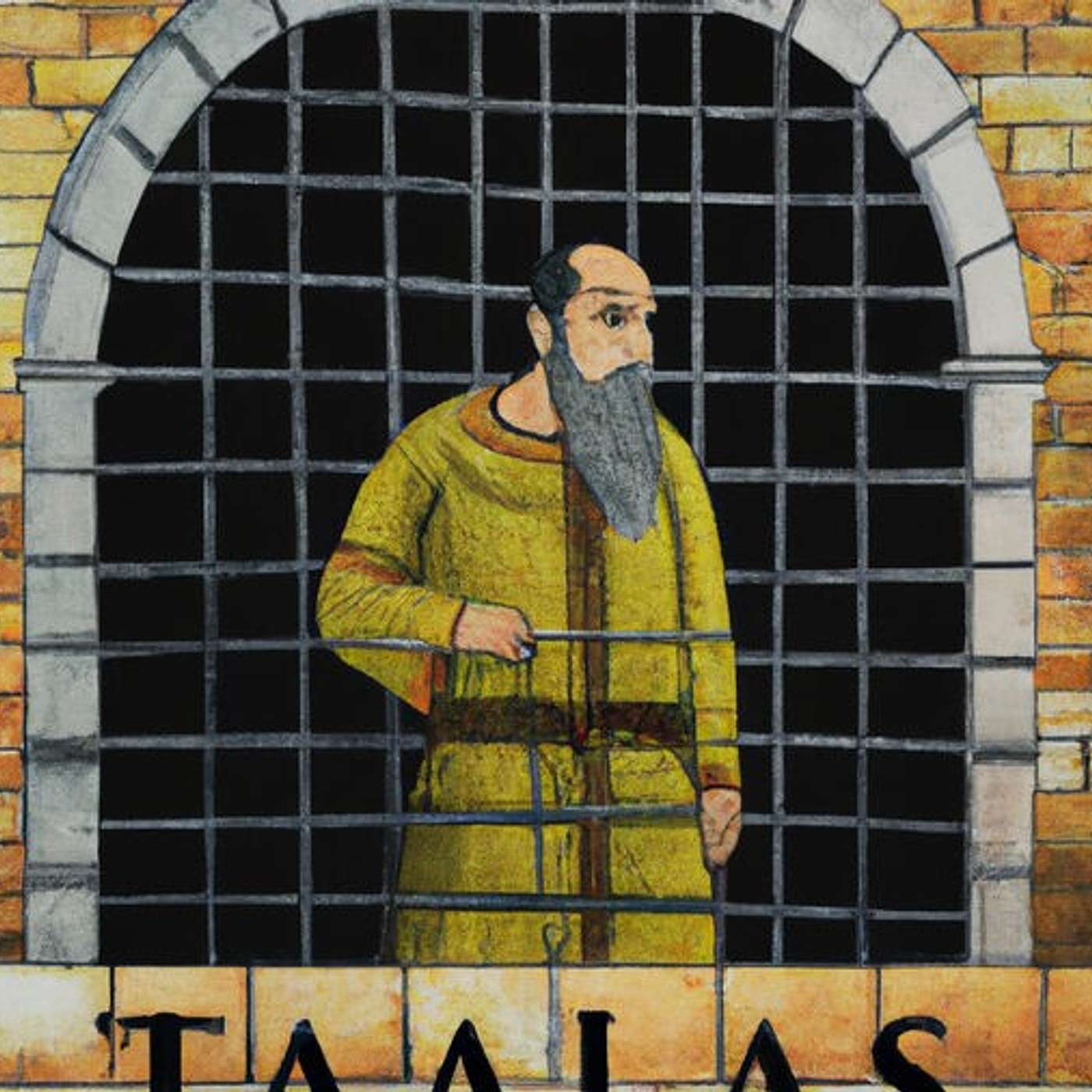
Dr. Thomas Constable, Plano Bible Chapel SonicLight.com
Bible Study with Dr. Thomas Constable
These are extremely informative and entertaining bible study lectures that have blessed many seekers of knowledge and faith over the last 20 years or more. Dr. Thomas L. Constable is a prominent theologian and former professor of Bible Exposition at Dallas Theological Seminary. He is also a pastor at Plano Bible Chapel in Plano, Texas, where he has served for over 50 years. Dr. Constable is widely known for his Bible commentary series, SonicLight.com, which includes Notes on the Bible, Notes on the Minor Prophets, and Notes on Revelation. He is also the author of several books, including "Talk...
Be sure to visit the podcast's website and support the creator: SonicLight.com
Author
Dr. Thomas Constable, Plano Bible Chapel SonicLight.com
Category
Podcast website
Latest episode
Aug 10, 2026
Where to listen?
Podcasts in the app Replaio Radio Coming soonPodcasts are coming to the app soon. Install now and be the first to see a whole new take on podcasts
 Install for free
Android almost 10M downloads · 4.7+ rating
iOS soon
Episodes
Mark 12:1-17, The Tenants and Caesar's Coin 19.07.2026 36:24
Chapter 12 is a series of controversies in the temple courts — the authorities' attempts to trap Jesus and His responses that silence each challenge in turn. The parable of the tenants (12:1-12) is Jesus's most explicit allegorical presentation of Israel's history and His own role in it. The vineyard owner (God) plants a vineyard (Israel, echoing Isaiah 5:1-7), rents it to vine-growers (the religi...
Mark 11:20-33, The Withered Fig Tree and Jesus's Authority Questioned 19.07.2026 41:06
The fig tree's withering (11:20-26) frames the temple incident and provides the occasion for teaching on faith. The morning after the cleansing, 'they saw the fig tree withered from the roots up' (11:20). Peter's observation — 'Rabbi, look, the fig tree which You cursed has withered' (11:21) — receives a teaching on faith rather than an explanation of the enacted parable. 'Have faith in God. Truly...
Mark 11:1-19, The Triumphal Entry and Cleansing of the Temple 19.07.2026 40:23
Chapter 11 opens the passion week and introduces the fig tree and temple as interrelated symbols of fruitless religion. The triumphal entry (11:1-11) is carefully orchestrated by Jesus: He sends two disciples ahead to find a colt 'on which no one yet has ever sat' (11:2), with instructions for responding to any who question them ('The Lord has need of it'). The specific arrangement demonstrates Je...
Mark 10:46-52, Bartimaeus 19.07.2026 35:33
The healing of blind Bartimaeus (10:46-52) is the final healing miracle in Mark before the passion narrative — and Constable identifies it as a deliberate structural counterpart to the blind man of Bethsaida (8:22-26). The Bethsaida healing opened the central section (8:22-10:52) with a staged healing that previewed the disciples' partial sight; the Bartimaeus healing closes the section with an in...
Mark 10:32-45, The Third Passion Prediction and James and John 19.07.2026 31:08
The third and most detailed passion prediction (10:32-34) occurs on the road to Jerusalem — a journey Constable identifies as the theological center of Mark 10. 'They were on the road going up to Jerusalem, and Jesus was walking on ahead of them; and they were amazed, and those who followed were fearful' (10:32). Constable draws the visual of Jesus walking ahead: He leads, and the disciples follow...
Mark 10:17-31, The Rich Young Ruler 19.07.2026 35:43
The rich young man (10:17-22) provides the most economically direct teaching on wealth and salvation in Mark. The man comes running and kneels before Jesus — urgency and reverence combined — with the question 'Good Teacher, what shall I do to inherit eternal life?' (10:17). Jesus's first response — 'Why do you call Me good? No one is good except God alone' (10:18) — is not a denial of His goodness...
Mark 10:1-16, Teaching on Divorce and the Children 19.07.2026 41:59
Chapter 10 is structured around the third passion prediction (10:32-34) with contrasting episodes on both sides demonstrating the disciples' ongoing misunderstanding of kingdom values. The teaching on divorce (10:1-12) is one of Jesus's most carefully argued positions. The Pharisees' test question — 'Is it lawful for a man to divorce his wife?' (10:2) — is answered with a counterquestion: what did...
Mark 9:30-50, The Second Passion Prediction and Teaching on Servanthood 19.07.2026 31:52
The second passion prediction (9:30-32) continues the pattern established in 8:31: Jesus and the disciples pass secretly through Galilee, He teaches them 'The Son of Man is to be delivered into the hands of men, and they will kill Him; and when He has been killed, He will rise three days later' (9:31). The disciples 'did not understand this statement, and they were afraid to ask Him' (9:32) — the...
Mark 9:14-29, The Healing of the Demon-Possessed Boy 19.07.2026 29:32
The healing of the boy with the mute spirit (9:14-29) immediately follows the Transfiguration's mountaintop glory and provides one of the most emotionally raw healing encounters in Mark. The three disciples on the mountain descend to find the other nine unable to cast out the demon, surrounded by a crowd and the scribes arguing with them. The father's description of his son's condition is specific...
Mark 9:1-13, The Transfiguration 19.07.2026 45:56
The Transfiguration (9:1-13) is the Gospel's supreme visual revelation of Jesus's divine identity — the direct answer to Peter's confession and the immediate vindication of Jesus's passion prediction. It occurs six days after Peter's confession (9:2) — a detail suggesting the Transfiguration is the fulfillment of the preceding promise: 'some of those who are standing here who will not taste death...
Mark 8 Continued — The Turning Point of the Gospel 19.07.2026 49:03
This session draws together the theological significance of Mark 8 as the pivotal chapter of the Gospel. Constable identifies 8:27-38 as the structural center in several respects: it is the geographical midpoint (Caesarea Philippi, the northernmost point of Jesus's Galilean ministry), the confessional midpoint (Peter's recognition of Jesus as the Christ), and the missiological midpoint (Jesus turn...
Mark 8:22-38, Peter's Confession and the First Passion Prediction 18.07.2026 43:56
Mark 8:22-30 is the structural center of the Gospel — the turning point after which the narrative focuses increasingly on Jerusalem and the cross. The healing of the blind man at Bethsaida (8:22-26) is uniquely Markan and is deliberately placed as a preview of what follows: the disciples are spiritually blind; the blind man's staged healing (he first sees 'trees walking around' and then clearly af...
Mark 8:1-21, Feeding the 4,000 and the Yeast of the Pharisees 18.07.2026 30:19
Chapter 8 opens with the feeding of the four thousand (8:1-10) — a second feeding miracle that Matthew and Mark both record while Luke and John omit it. Constable addresses the question of why Mark records two feeding miracles and why the disciples respond to Jesus's concern about the crowd (8:2-4) with the same apparent forgetfulness they showed before the feeding of five thousand ('Where will an...
Mark 7:24-37, The Syrophoenician Woman and the Deaf-Mute 18.07.2026 35:20
The second half of chapter 7 records two healings that together demonstrate the expansion of Jesus's mission beyond Israel. The Syrophoenician woman (7:24-30) is one of the most challenging exchanges in the Gospels: Jesus withdraws to the region of Tyre (Gentile territory) and enters a house, 'not willing to let anyone know of it, and yet He could not escape notice' (7:24). A Gentile woman whose l...
Mark 7:1-23, Clean and Unclean 18.07.2026 40:28
Chapter 7's controversy about defilement (7:1-23) is one of the most theologically significant passages in Mark for understanding Jesus's relationship to the Mosaic Law. Pharisees and scribes from Jerusalem challenge Jesus: why do His disciples not wash their hands according to 'the tradition of the elders' (7:3)? Mark parenthetically explains Jewish handwashing customs for his Gentile audience (7...
Mark 6 Continued — The Gennesaret Healings 18.07.2026 43:56
This session covers the Gennesaret landing (6:53-56) and draws together the theological themes of chapter 6's power encounters. When Jesus and the disciples land at Gennesaret, the people recognize Him immediately and run to bring their sick on mats to wherever they hear He is. 'Wherever He entered villages, or cities, or countryside, they were laying the sick in the market places, and imploring H...
Mark 6:30-56, Feeding the 5,000 and Walking on Water 18.07.2026 33:22
The feeding of the five thousand (6:30-44) and walking on water (6:45-52) form a single theological unit in Mark — both events centered on Jesus as the divine shepherd and provider, and both connected by Mark's unusual editorial comment: 'they had not gained any insight from the incident of the loaves, but their heart was hardened' (6:52). The feeding begins when the apostles return from their mis...
Mark 6:1-29, Rejection at Nazareth, Mission of the Twelve, Death of John 18.07.2026 37:16
Chapter 6 opens with the only explicit statement of Jesus's limitation in Mark: at Nazareth, 'He could do no miracle there except that He laid His hands on a few sick people and healed them. And He wondered at their unbelief' (6:5-6). Constable treats this with theological care: the 'could not' (ouk edynato) is not an absolute limitation of divine power but a chosen non-exercise of miraculous powe...
Mark 5:21-43, Jairus's Daughter and the Woman with the Hemorrhage 18.07.2026 41:31
Mark's famous 'sandwich' structure reaches its most artfully crafted expression in 5:21-43 — the story of Jairus's daughter and the woman with the hemorrhage interleaved. Jairus, a synagogue official (one of the highest-status figures in Jewish community life), falls at Jesus's feet and implores Him to heal his twelve-year-old daughter who is at the point of death (5:22-23). Jesus begins to go wit...
Mark 5:1-20, The Gerasene Demoniac 18.07.2026 34:42
The healing of the Gerasene demoniac (5:1-20) is the most dramatically detailed exorcism account in the Gospels — and the only one set in fully Gentile territory (Decapolis, east of the Jordan). The description of the man's condition before healing is vivid and specific (5:2-5): he lives in the tombs (unclean in Jewish reckoning), no one can bind him (chains and shackles have been broken), no one...
Mark 4:35-41, Calming the Storm 18.07.2026 25:27
The calming of the storm (4:35-41) is the first of four miracle accounts in 4:35-5:43 that Constable identifies as demonstrating Jesus's authority over four domains: nature (4:35-41), demons (5:1-20), disease (5:25-34), and death (5:21-24, 35-43). The Sea of Galilee setting is specific: the disciples and Jesus cross 'to the other side' (4:35) — from Jewish territory toward Gentile territory, a geo...
Mark 4:21-34, Kingdom Parables 18.07.2026 39:13
Four more parables follow the sower: the lamp and the lampstand (4:21-23), the measure (4:24-25), the secretly growing seed (4:26-29), and the mustard seed (4:30-32). The lamp parable (4:21-23) addresses the purpose of revelation: 'A lamp is not brought to be put under a basket, is it, or under a bed? Is it not brought to be put on the lampstand?' (4:21). Constable explains the logic in context: t...
Mark 4:1-20, The Parable of the Sower 18.07.2026 43:32
Chapter 4 is Mark's only extended discourse — the parable chapter — and the parable of the sower (4:1-20) is the gateway parable that Jesus identifies as the key to understanding all parables. The setting is characteristic Mark: such a large crowd gathers at the sea that Jesus has to sit in a boat while the crowd stands on the shore. The parable (4:3-8) describes a sower whose seed falls on four k...
Mark 3:20-35, The Beelzebul Controversy and Jesus's True Family 17.07.2026 43:35
Chapter 3's second half (3:20-35) contains two of Mark's most theologically significant teachings, woven together by his characteristic 'sandwich' structure (A-B-A): the Beelzebul controversy (A, 3:22-30) is embedded within the family's concern for Jesus (B, 3:20-21 and 3:31-35). The family episode (3:20-21) is unique to Mark: 'His own people... set out to take custody of Him; for they were saying...
Mark 3:1-19, Healing on the Sabbath and the Choosing of the Twelve 17.07.2026 35:43
The fifth conflict story (3:1-6) resolves the 2:1-3:6 section with the most dramatic Sabbath confrontation: a man with a withered hand in the synagogue, Pharisees watching to see if Jesus heals on the Sabbath so they can accuse Him. Jesus asks the man to come forward and poses the ethical question: 'Is it lawful to do good or to do harm on the Sabbath, to save a life or to kill?' (3:4). The silenc...
Similar podcasts






Listen to the Bible Study with Dr. Thomas Constable podcast in Replaio
Radio and podcasts in one app - free, with no sign-up. Install today and do not miss the launch
Replaio is not a podcast publisher; show names, artwork and audio belong to their authors and are distributed through public RSS feeds.