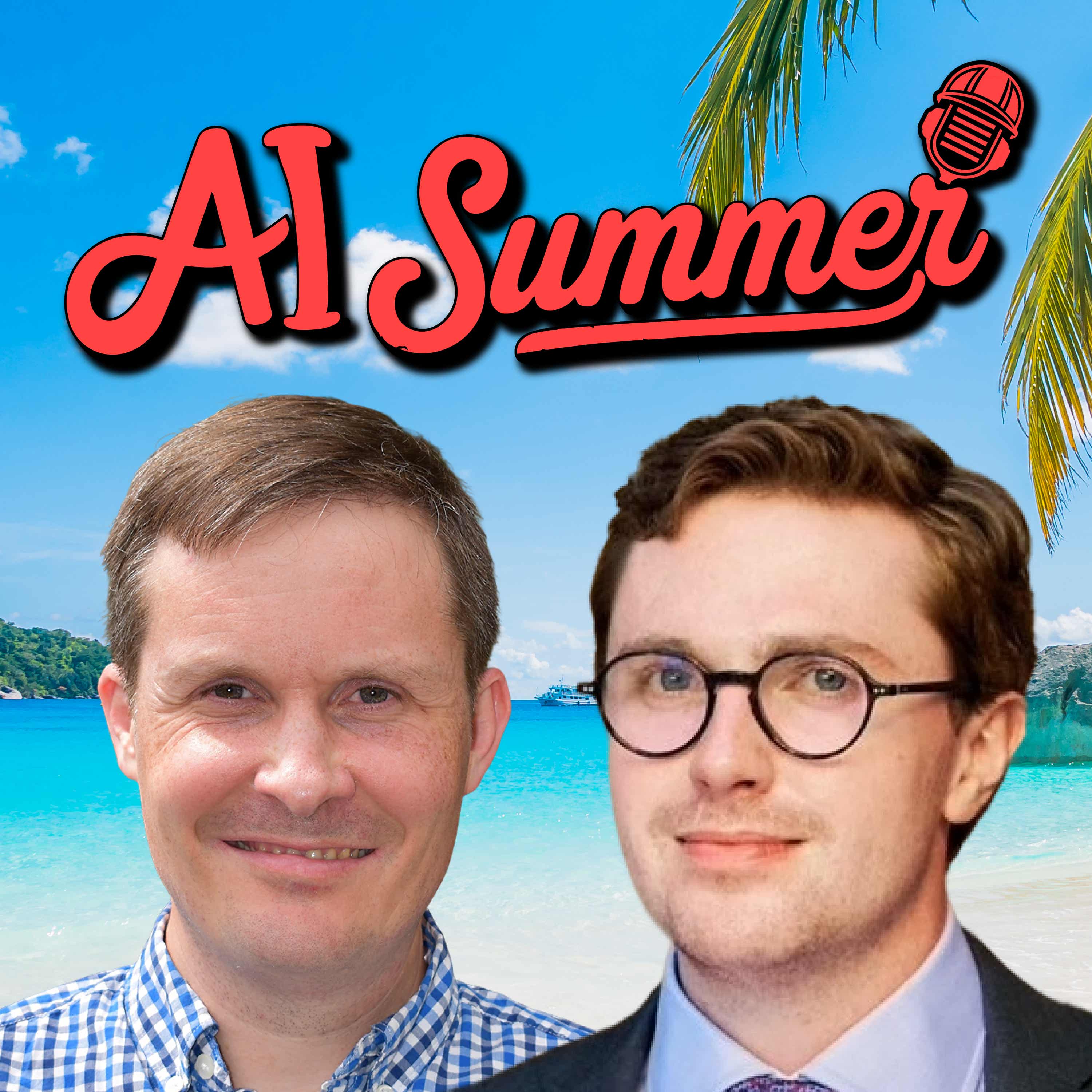
Timothy B. Lee and Dean W. Ball
AI Summer
Tim Lee and Dean Ball interview leading experts about the future of AI technology and policy. www.aisummer.org
Author
Timothy B. Lee and Dean W. Ball
Category
Podcast website
Latest episode
Jun 22, 2026
Where to listen?
Podcasts in the app Replaio Radio Coming soonPodcasts are coming to the app soon. Install now and be the first to see a whole new take on podcasts
 Install for free
Android 5M+ downloads · 4.8 rating
iOS soon
Install for free
Android 5M+ downloads · 4.8 rating
iOS soon
Episodes
Robert Wright on the global implications of powerful AI 22.06.2026 1:07:06
Robert Wright, author of the Nonzero newsletter and host of the Nonzero podcast , is a veteran journalist who interviewed Geoffrey Hinton about neural networks back in 1983. He joined the podcast to talk about his new book The God Test , which is due out on Tuesday, June 23. Wright describes his own journey from AI skeptic to someone who no longer dismisses even “sci-fi doomer” scenarios. A key in...
Alan Rozenshtein on Friday's shocking shutdown of Claude Fable 5 15.06.2026 55:48
Last night, I called University of Minnesota law professor Alan Rozenshtein and asked him to help me decode the Commerce Department’s surprise decision to impose export controls on Anthropic’s Claude models. Late on Friday, the Commerce Department ordered Anthropic to prevent any foreign national from accessing its Fable and Mythos models. This effectively forced the company to pull both offline f...
James Grimmelmann explains how AI is changing copyright 11.06.2026 54:10
I’m organizing a happy hour on June 23 for listeners of AI Summer and readers of my newsletter, Understanding AI . It’ll run from 5:30 to 8:00pm at The Crown & Crow in Washington DC. I will be there, along with past guests Kai Williams and Andy Masley , and friend of the show Abi Olvera . If you are planning to come, or thinking about it, I’d appreciate it if you could fill out this form to let me...
Andy Masley on the data center backlash 02.06.2026 57:38
Over seven years teaching high school physics, Andy Masley learned how to explain abstract quantities like watt-hours in an accessible way. That skill has made him one of the most effective critics of the growing environmental panic over data centers. Data centers really do produce noise and air pollution, and large construction projects do occasionally disrupt nearby water supplies. But Masley wo...
Sophia Tung on the state of autonomous vehicles 25.05.2026 54:20
I don’t know anyone who has ridden in more different kinds of robotaxis than Sophia Tung. A YouTuber and the author of the RideAI newsletter , she is one of the most knowledgeable experts on the contemporary autonomous vehicle sector. She is also our first return guest. Across multiple trips to China, Sophia has taken rides in the three leading Chinese services — Apollo Go, WeRide, and Pony. In th...
Divyansh Kaushik on the robotics race between China and the US 13.05.2026 1:05:32
I talk to Divyansh Kaushik , a Carnegie Mellon machine learning PhD turned national-security advisor at Beacon Global Strategies , about the robotics race between the US and China and why winning the race matters for national security. We dig into the state of robotic AI models—particularly vision-language-action (VLA) architectures—and why training them is harder than training LLMs. There's no in...
Alex Imas explains why AI (probably) won't put everyone out of work 29.04.2026 1:02:36
Alex Imas is an economist at the University of Chicago Booth School who argues that the most important thing about an AI-saturated economy won’t be what machines can produce—it’ll be what humans still want from each other. Imas’s central claim, laid out in his essay “What Will Be Scarce,” is that when AI can replicate every cognitive and physical task, demand for human provenance becomes the econo...
Sayash Kapoor on Claude Mythos as normal technology 13.04.2026 57:41
Last week Anthropic stunned the AI world by announcing Claude Mythos Preview—and then refusing to release it. Princeton’s Sayash Kapoor, co-author of the newsletter AI as Normal Technology , joins Tim and Kai Williams to make sense of the moment. Kapoor argues that Mythos’ vulnerability-finding prowess, including unearthing a 27-year-old OpenBSD bug, fits a familiar pattern: fuzzing tools triggere...
Nat Purser explains how progressives are thinking about AI 03.04.2026 1:17:44
Tim talks to Nat Purser, a tech policy advocate at Public Knowledge and a veteran of Democratic campaigns, about how policymakers on the left side of the political spectrum view AI. Purser describes a Democratic landscape split between those who see AI as a real but threatening force and those who dismiss it as another crypto-style bubble. She traces how Sen. Bernie Sanders broke from the pack by...
Ryan Avent on self-driving cars and the future of the labor market 22.03.2026 1:05:18
Author Ryan Avent joins Tim to revisit a bet they made 16 years ago —and to ask whether the lessons of self-driving cars apply to modern AI. Back in 2010, Avent wagered that his newborn daughter would never need a driver’s license thanks to self-driving cars. Tim bet she would and ultimately won $500. But he was right for the wrong reasons. Tim assumed regulation would be a major obstacle to progr...
Joel Becker on METR's famous time horizons chart 14.03.2026 57:48
METR’s time horizons chart has become one of the most discussed metrics in AI. It estimates the difficulty of tasks — measured in human work hours — that a model can complete about 50% of the time. By this measure, frontier models have been doubling their capabilities about once every seven months. But in this conversation, recorded on March 2, METR researcher Joel Becker explained that two most r...
Pete Hegseth's war on Anthropic (with Alan Rozenshtein and Kevin Frazier) 09.03.2026 55:25
Tim and Dean team up with Scaling Laws hosts Alan Rozenshtein and Kevin Frazier for a joint episode on the fight between Anthropic and the Department of Defense. In this episode, recorded on March 4, they analyze the Pentagon’s decision to declare Anthropic a supply-chain risk. Dean frames this as an assault on private property rights with no clear limiting principle, while Kevin digs into the sha...
Dean on the AI Action Summit in India 26.02.2026 51:21
Dean joins from London after attending the AI Impact Summit in India. Dean and Tim unpack the summit’s central tension: “middle power” nations like India, Indonesia, and Nigeria pushing a vision of AI focused on public service delivery, agriculture, and affordable open-source models, while largely dismissing the frontier-AI questions Dean considers most urgent—lab auditing, recursive self-improvem...
Kai Williams on the many masks LLMs wear 22.02.2026 46:35
With Dean away, Tim invites his Understanding AI colleague Kai to unpack the surprising ways chatbot personalities can go wrong, a topic Kai covered in a recent article . Every LLM starts as a base model capable of playing countless characters, but AI companies try to keep chatbots in a “helpful assistant” lane. Kai walks us through the Grok “MechaHitler” debacle, in which xAI’s attempts to make i...
AI safety in India, AV operators in the Philippines 16.02.2026 1:03:49
Dean recorded this episode as he was preparing to attend the India AI Impact Summit — the fourth iteration of an annual gathering that has transformed from an intimate AI Safety Summit with heads of state to something resembling a tech industry trade show. The shift in branding, from “safety” to “action” to “impact,” reflects a broader vibe shift in how elites talk about AI risk, and Dean worries...
Dean is back! 08.02.2026 1:00:13
Dean Ball is back. In April 2025, Dean left the podcast to join the White House Office of Science and Technology Policy, where he spent four months working on the Trump administration’s AI policies—including executive orders, the AI action plan, and AI geopolitics. He’s since returned to independent writing and research, and at the end of 2025, he and his wife welcomed their first child. In this e...
Dean Ball is leaving the podcast 16.04.2025 57:54
This week Dean began a new job : senior policy advisor for AI in the Trump White House. I will miss having him as a co-host and wish him the best in his new role. In this episode, recorded last Friday, we speculate about how AI could change the world over the next 25 to 50 years. We discuss what makes human beings unique, whether humans can maintain control, and how we’ll find meaning in an increa...
Charles Yang on AI and Science 07.04.2025 1:01:58
This week, Dean and Tim talk to Charles Yang, a former staffer at the Department of Energy who now writes the Rough Drafts newsletter. Tim has written extensively about AI in science, concentrating especially on the potential of AI to transform materials science. His work has focused not just on models, but on building robotic, “self-driving” labs to accelerate scientific research. The conversatio...
James Grimmelmann on the copyright threat to AI companies 19.03.2025 53:07
James Grimmelmann is a professor of law at Cornell University and a leading expert on copyright law. Grimmelmann walks through the complex process courts use to determine whether training AI models on copyrighted materials—like OpenAI using New York Times articles—is infringement or fair use. He highlights key precedents like the Google Books case, emphasizing how courts weigh transformative uses...
Andrew Lee on running an AI email startup 27.02.2025 1:01:14
Andrew Lee is the co-founder of Shortwave, an AI-powered email app. He’s also Tim’s brother. Andrew shares how Shortwave evolved from a conventional email app into a multi-LLM system that automates inbox organization, drafts messages, and performs advanced search via agentic reasoning. He explains how recent improvements in model performance have dramatically changed what is possible for an app li...
Dean and Tim on Deep Research and the Paris Summit 21.02.2025 1:03:29
In this episode, Dean and Tim discuss Dean’s trip to Paris for the AI Action Summit, including Vice President Vance’s speech on AI. They talk through the European outlook on AI regulation, European resentment toward America, and the stark shift in policymaker attitudes toward AI safety. Then they turn to OpenAI’s new Deep Research agent, chatting about their experience with the product and reflect...
Kashmir Hill on falling in love with ChatGPT 12.02.2025 52:14
Kashmir Hill is a reporter at the New York Times who focuses on the social impacts of new technology. In this episode, she describes how users are customizing chatbots like ChatGPT to fulfill emotional and even erotic needs, often bypassing built-in safeguards. These fantasy conversations are usually harmless, but there are potential pitfalls—especially where children are involved. Kashmir also di...
Sophia Tung on riding a self-driving taxi in China 05.02.2025 1:03:16
Tim and Dean chat with Sophia Tung, an entrepreneur, engineer, and now YouTuber, about her recent experience in a Chinese self-driving taxi from Apollo Go, a subsidiary of Baidu. Apollo Go is a bit like China’s Waymo, but Sophia found the experience of riding in an Apollo Go taxi to be far worse than riding in a Waymo. We talk about her experience in China as well as the broader implications: is C...
Dean and Tim on DeepSeek and AI progress 29.01.2025 57:11
Dean and Tim discuss DeepSeek’s r1 release and what it means. We talk export controls, whether the model is a true technical breakthrough, and what “reasoning” models like r1 and o1 mean for the pace of AI progress going forward. This is our first episode with just Dean and Tim chatting, but we hope to do more such episodes in the future. This is a public episode. If you would like to discuss this...
Nathan Labenz on the future of AI scaling 27.01.2025 1:18:56
Nathan Labenz is the host of our favorite AI podcast, the Cognitive Revolution . A self-described “AI scout,” Nathan uses his podcast to explore a wide range of AI advancements, from the latest language models to breakthroughs in medicine and robotics. In this episode, Labenz helps us understand the slowdown in AI scaling that has been reported by some media outlets. Labenz says that AI progress h...
Similar podcasts







Listen to the AI Summer podcast in Replaio
Radio and podcasts in one app - free, with no sign-up. Install today and do not miss the launch
Replaio is not a podcast publisher; show names, artwork and audio belong to their authors and are distributed through public RSS feeds.