Micah
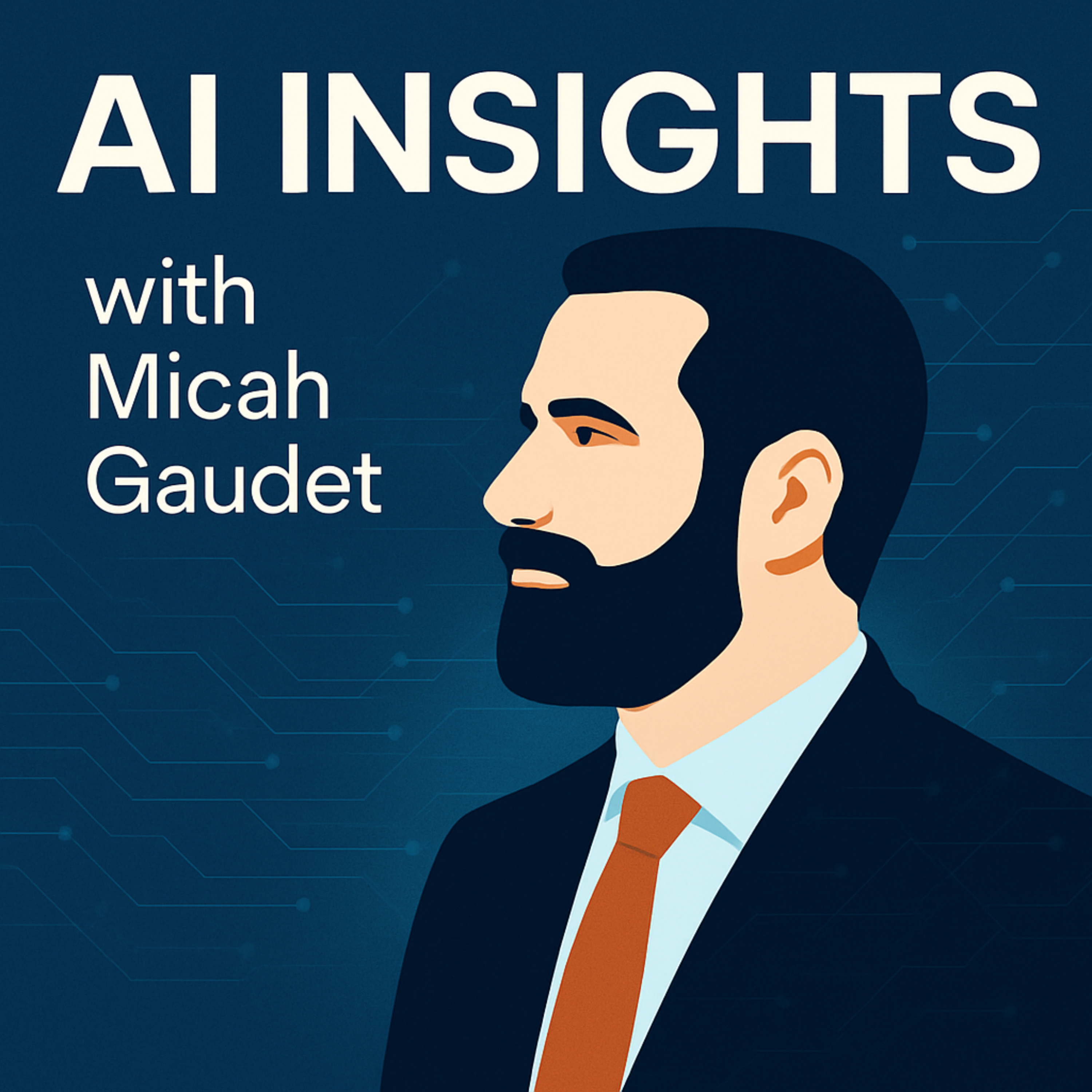
AI Insights with Micah Gaudet
AI Insights with Micah Gaudet is where local government leaders, staff, and innovators get clear, practical takes on how artificial intelligence is reshaping public service. Each episode cuts through the hype to deliver actionable insights on how cities, towns, and counties can use AI today — from grant writing and budgeting to public safety, HR, and economic development. Listeners will love it because it’s not abstract theory or tech jargon — it’s a practitioner’s perspective. With years of experience inside city management and a front-row seat to the latest AI tools, Micah brings you the re
Be sure to visit the podcast's website and support the creator: podcasters.spotify.com
Where to listen?
Podcasts in the app Replaio Radio Coming soonPodcasts are coming to the app soon. Install now and be the first to see a whole new take on podcasts
 Install for free
Android almost 10M downloads · 4.8 rating
iOS soon
Install for free
Android almost 10M downloads · 4.8 rating
iOS soon
Episodes
The Barriers to AI Adoption 04.07.2026 23:47
A LinkedIn thread asking one simple question turned into one of the most honest conversations on AI adoption in local government. Local government professionals, GovTech founders, and vendors weighed in, and nearly every barrier they named traced back to the same root: a lack of clarity, not a lack of technology. This episode breaks down what that thread revealed: misunderstanding driving fear, em...
We have an AI Policy Problem 04.07.2026 27:42
Most AI policies look like governance but don't function as one. This episode traces the problem back to its roots: AI policy inherits its DNA from IT acceptable-use policies and cybersecurity frameworks, built for tools that behave predictably, not systems that generate new outputs every time. We break down seven assumptions baked into nearly every AI policy in circulation, from treating AI a...
Attitudes and Perceptions in AI Adoption 23.11.2025 17:15
The AI revolution isn’t unfolding the way the headlines claim. New data from Pew, Gallup, OpenAI, and Anthropic reveals a far more contradictory story—one where rapid adoption collides with deep skepticism, and where AI’s most common uses are surprisingly ordinary. In this episode, we break down five findings that challenge the popular narrative: • Younger adults are the biggest AI skeptics. • Mos...
Deepfakes in Disasters 15.11.2025 14:31
In this episode, we explore how synthetic media—specifically deepfakes—are no longer just online hoaxes but are fast becoming a critical operational threat for emergency management. Drawing on Micah Gaudet’s piece “Deepfakes in Disasters: The New Operational Threat for Emergency Management,” we examine how disasters rely on speed, trust, and clear communication—and how manipulated audio-visual con...
The AI Threat No One Is Talking About 15.11.2025 18:40
This episode breaks down a risk almost no one is talking about: what happens when AI works . Not when it fails—when it quietly reshapes judgment, accountability, and trust without anyone noticing. Micah Gaudet explains why AI’s “uninsured risk” isn’t bias or bad outputs, but the slow erosion of human oversight as organizations automate what used to depend on presence, discretion, and relationships...
How do We Spend the Time AI Saves? 14.11.2025 16:03
AI promises to save us time—automating emails, summarizing meetings, and taking routine work off our plates. But history shows the opposite happens: every hour saved gets filled again. Productivity goes up, but rest, focus, and creativity go down. In this episode, we explore the paradox at the heart of modern work: why efficiency rarely leads to freedom. We unpack how our attention spans collapsed...
When AI Becomes Political 16.10.2025 12:53
Artificial Intelligence is reshaping how governments work—from automating services to predicting needs before they arise. But along with the promise of greater efficiency and accountability come real risks: bias, loss of transparency, and erosion of public trust. In this episode, we explore how cities and nations are using AI to improve decision-making, service delivery, and oversight—and what hap...
Stop Selling Sci-Fi - Why Gov AI should be Boring 16.10.2025 13:35
Public sector AI is often sold like a sci-fi movie—glowing data lines, futuristic skylines, robotic hands. But the real barriers aren’t cinematic. They’re structural. In this episode, we unpack why AI in government still feels distant and unrelatable. The problem isn’t the tech—it’s the story we tell and the systems we ignore. We explore why the real goal isn’t to master AI, but to use it quietly...
The Collapse of Clicks: How AI Changes Public Information 11.09.2025 16:23
AI-generated summaries at the top of search results are quietly reshaping how residents get their information. Instead of clicking through to articles—or even city websites—many stop at the AI overview. That behavior shift is collapsing referral traffic for publishers and raising new challenges for local governments that depend on clarity, accuracy, and trust. In this episode, we focus on the impl...
GPT-5 for Government Leaders 03.09.2025 19:52
OpenAI’s GPT-5 is here—and it changes more than you think. While the leap from GPT-4 to GPT-5 may look incremental, the impacts on government workflows, prompting strategies, and governance are anything but small. This episode unpacks what GPT-5 actually brings: router-style architecture, verbosity and reasoning controls, free-form function calling, improved memory, reduced hallucinations, and mor...
An AI-Ready Culture 25.08.2025 21:40
AI is transforming public governance—streamlining operations, reshaping service delivery, and opening new possibilities for accountability and oversight. But alongside these opportunities come profound risks: bias, privacy breaches, transparency gaps, and declining public trust. In this episode, we unpack the dual role of government as both regulator and user of AI, drawing on global examples from...
What if AI works? 22.08.2025 15:33
This episode unpacks Micah Gaudet’s argument that AI is not just another efficiency tool for city halls—it’s more like a new species introduced into an ecosystem. Drawing from his book Fragile Systems: An Ecological Approach to AI in Government and supporting articles, Gaudet warns that the greatest danger isn’t AI failure, but misalignment: when the technology’s outputs don’t fit the true goals o...
Chasing Perfect Prompts 22.08.2025 15:22
This episode dives into Micah Gaudet’s pragmatic approach to generative AI in city halls and counties, built around the idea that AI is no longer a side project—it’s an indispensable tool for everyday governance. Drawing from his book 1001 Prompts for Unlocking Generative AI in Local Government and his article Stop Worshipping Perfect Prompts , Gaudet outlines how to move past the obsession with “...
Post-Google Search Age 22.08.2025 9:22
This episode examines how AI is reshaping local government operations—and why we may be entering a “post-Google search age.” Drawing on real-world use cases from Civic. AI, we look at how advanced tools like Perplexity AI are shifting from being simple “answer engines” to acting as on-demand analysts. With features like live citations, audit trails, and transparent sourcing, these tools promise go...
Faster towards what? 22.08.2025 13:05
This episode explores Micah Gaudet’s argument for treating public institutions not as machines to be tuned but as living systems to be tended . Drawing from his book Fragile Systems and article Faster Toward What? , Gaudet challenges the prevailing narrative that “faster is always better” when it comes to AI in government. Instead, he makes the case that trust—not efficiency—is the foundation of h...
Deep Research Tools for Local Government 21.08.2025 11:57
AI isn’t just for big cities with research departments — smaller governments can use it right now to make faster, better decisions. In this episode of AI Insights with Micah Gaudet , we explore how deep research tools like ChatGPT, Perplexity, and Google Gemini can help local governments analyze data, compare policies, and improve workflows. You’ll learn: Why structured prompts are the key to reli...
Similar podcasts







Listen to the AI Insights with Micah Gaudet podcast in Replaio
Radio and podcasts in one app - free, with no sign-up. Install today and do not miss the launch
Replaio is not a podcast publisher; show names, artwork and audio belong to their authors and are distributed through public RSS feeds.