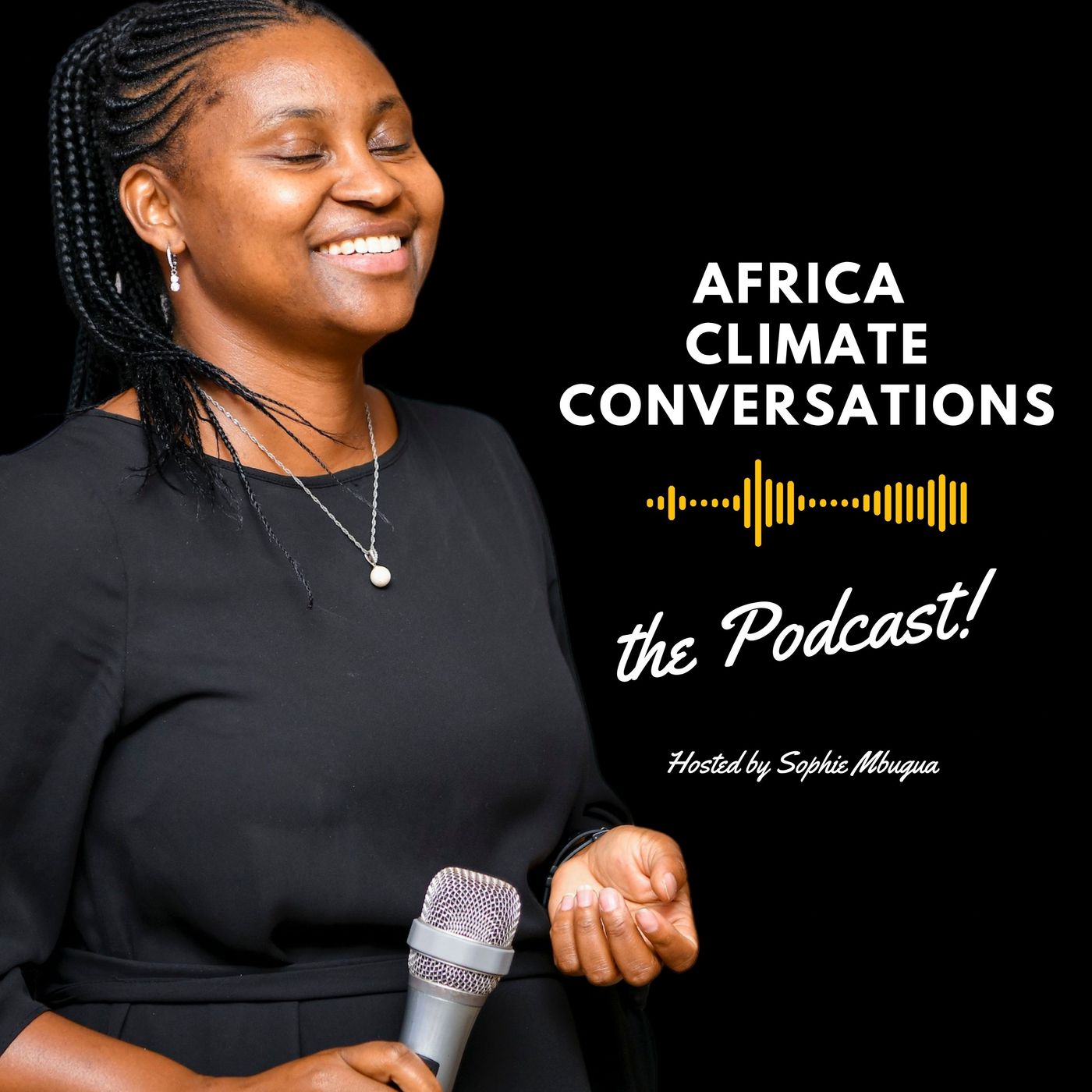
Sophie Mbugua
Africa Climate Conversations.
We tell climate and environmental stories from an African perspective. Using this podcast and Africa Climate Conversations YouTube, we share these stories through expert in-depth conversations and human interest stories from the field. Hello, and welcome. My name is Sophie Mbugua, and I am from Kenya. I am an environmental journalist passionate about Africa, my motherland, nature, and travel. I started this podcast in 2022 after reporting for numerous international, local, and regional media outlets on climate change and the environment. But over the years, I have noted huge gaps in reporting...
Be sure to visit the podcast's website and support the creator: afripods.com
Where to listen?
Podcasts in the app Replaio Radio Coming soonPodcasts are coming to the app soon. Install now and be the first to see a whole new take on podcasts
 Install for free
Android almost 10M downloads · 4.8 rating
iOS soon
Install for free
Android almost 10M downloads · 4.8 rating
iOS soon
Episodes
What Are the Hidden Environmental Costs of Solar Energy? 18.12.2025 13:03
Wind, solar, hydro, geothermal, and biofuels are some of the renewable energy resources. They are said to be green because they come from natural sources, are constantly replenished, and produce fewer greenhouse gas emissions compared to coal, oil, and gas. But, if these technologies end up in open landfills after their life, with the minerals thy are made of polluting water, and soils, are t...
The untold story of Kenya's Lake Naivasha floods. 02.12.2025 18:08
The area around Kenya's Lake Naivasha, including Kihoto, is considered part of the broader Lake Naivasha wetland ecosystem, as it is within its riparian land. On this episode we look into the history of flooding in Lake Naivasha and how settlements like Kihoto came about, as well as why this wetland is of huge importance. But first, what are wetlands, and why are they important?
Weaving for Survival. 10.07.2025 20:21
As the climate crisis continues, come with me to Syethe village, southeast of Kenya's capital, Nairobi where we meet a group of women earning a living by weaving and selling handbags in addition to farming. With these easily accessible skills, materials and capitalising on technologies such as WhatsApp how are they helping breed a new culture of #resilience in times of changing agricultural fortun...
Legislative Frameworks: The Key to an Energy Transition Focused on Human Rights 20.08.2024 36:27
Clear frameworks for community benefit sharing in the mining and renewable energy sectors are essential. However, Manson Gwanyanya, the researcher and representative for South and Anglophone Africa at the Business & Human Rights Resource Centre, told the African Climate Conversations podcast that implementing these existing frameworks is key to delivering a shared prosperity for the communitie...
How can airlines help bridge existing weather data gaps? 06.08.2024 29:41
Sensors on aeroplanes measure wind speed, humidity, and temperature, which is crucial for weather forecasting. As climate-related extreme events increase in frequency and intensity, effective weather-related infrastructure is critical not just for the agriculture sector but also development sectors such as agriculture, industries, and communities, which require timely, accurate data to adapt to th...
Meet a Kenyan teacher teaching children crucial environmental skills. 11.06.2024 18:01
Our children are the next generation. We, as humans, pass on our legacy to them, whether good or bad. The environment underpins humans' survival today and tomorrow. As the world warms, it's important to remember the vital role the environment's natural resources, such as forests, play in balancing human activities such as the burning of coal and other fossil fuels and reducing the amount of...
How WhatsApp transformed 70-year-old Kenyan woman's beaded basket sales 28.05.2024 15:24
This week, I was visiting a town in Makueni County, located in the southeastern part of Kenya. About an hour's drive from Makueni's capital town Wote, I met a 70-year-old lady who, after a severe three-year drought hit the village, learned how to weave beaded baskets. She is relying on WhatsApp, her family, and Facebook to make sales. Have a listen to our conversation.
Critical Minerals: has Africa learned from its past experience? 14.05.2024 18:39
African nations are blessed with 30% of the world's critical minerals. Mineral that the world needs to develop solar panels, wind turbines, renewable energy storage, electric vehicles, defence infrastructures, communication infrastructure, digital economy and many more. However, past mining activities since colonial era has taught Africa taught lessons. Minerals, particularly diamonds, are widely...
Human Greed: The Silent Destroyer of Nature's Fragile Balance 23.04.2024 23:17
Humanly speaking, forests, minerals, oceans, water bodies, and other natural resources are seen as infinite by the human eye. Infinite in the sense that there are more resources to be mined or prospected for, more land to be utilized, a vast ocean and waterbodies that can handle enormous levels of pollution, vast underground water resources that can never be drained, and billions of fish to be cau...
Why planting mangroves is not the solution. 09.04.2024 42:00
Mangroves are versatile and flexible forests that can cope with enormous disturbances. Dr. Judith Okello, a senior research scientist and mangrove ecologist at the Kenya Marine and Fisheries Research Institute, says that when sedimentation occurs, the mangroves can form a new cable rooting system and migrate when there is space on land. However, due to human influence, global temperatures continue...
Empowering Women, Revitalizing Mangroves: A Story from Kenya 26.03.2024 21:38
Featured today are a group of ladies who are establishing a livelihood by planting mangroves. About sixty kilometres south of Mombasa in Kwale County, in the small fishing town of Msambweni, a group of fifteen women from the Munje village joined together during the COVID-19 outbreak. A community-based organisation with 30 members has developed out of them after around four years. They are planting...
Meet a Kenyan community saving the coral reefs. 05.03.2024 34:01
Today we meet a Kenyan community saving the coral reefs along the Kenyan coast. Coral reefs along the Lamu-Kiunga area in Lamu County, a small archipelago north of Mombasa in Kenya, have degraded over the years. Pate Island, the largest island in the Lamu Archipelago, lies between the towns of Lamu and Kiunga, which depend on fishing. However, fishery productivity depends on healthy corals....
Spring water changing lives in Kenya. 13.02.2024 18:06
Women in Olailamutia, a town in Kenya's Narok County, have had problems with diarrhoea, stomachaches, and skin rashes for many years. Having access to clean drinking water from a spring is helping to get rid of these problems. Families here got water to drink from a river where they also took baths. The river in question has been contaminated due to chemical use, upstream intensive irrigation, and...
Cabins made of plastic helping keep Kenya's Masai Mara clean. 30.01.2024 20:39
In today's episode, we meet Isaac Macharia, a Kenyan social entrepreneur who makes cabins out of plastic to keep Kenya's Masai Mara clean. In 2015, Macharia was on his usual tour-guiding routine at the Masai Mara in Kenya. It bothered him. He decided to construct cabins using not only plastic bottles, but also stashing and hiding every non-biodeg...
Meet a young Kenyan lady repurposing waste glass at Masai Mara. 17.01.2024 15:17
Picture this. It's a lovely evening. You and your loved one are seated somewhere, enjoying some juice or beer from a glass made out of liquor bottles collected from a dumping site. How does that sound? On today's episode, meet a young Kenyan lady – Mary Njoki, repurposing waste glass at Masai Mara.
"Africa needs to create It's specific facility for climate action" says AGN. 14.12.2023 22:08
For effective climate action in Africa to take shape, the African Group of negotiators lead negotiator on finance, Ambassador Mohamed Nasr, told the Africa Climate Conversations that the continent must self-assess and work on its own modalities to achieve climate action. Among the things the continent should work on is creating an Africa-specific platform outlining specific projects and programs f...
COP28: How can Africa solve the climate finance access challenge? 04.12.2023 31:15
The climate finance needs of developing countries have risen way beyond the 100 billion USD promised by developed countries 15 years ago. The recent UN 2023 adaptation gap report estimates the cost of adaptation at US$215 billion per year this decade. Access to finance, including means of implementation that are technology and capacity, is a catalyst not just for development bu...
COP28 kicks off with high promises to deliver on finance. 30.11.2023 14:43
COP28 takes place against the backdrop of increased financial needs to address climate change adaptation, mitigation, as well as loss and damage. Just to mention, the 2023 UNEP adaptation gap report estimates the cost of adaptation in developing countries at US$215 billion per year this decade. For Africa, the continent requires at least $56 billion annually for adaptation alone by 2030. Between 2...
African Lead Negotiator: "I hope the loss and damage fund does not become a bargaining chip at COP28." 20.11.2023 31:18
A 24-member transitional committee on loss and damage issued a proposal for a new loss and damage fund ahead of the 28th UN Climate Summit (COP28) taking place in Dubai this November. According to Alpha Oumar Kaloga, the African group's lead negotiator on loss and damage, the final decision was made in a tense atmosphere; thus, there is a need to understand the status of the final decision, as the...
Lake Ol' Bolossat community volunteers saving Kenyan endangered bird. 31.10.2023 26:46
Lake Ol' Bolossat is the only lake in the Kenyan highlands, situated in Nyandarua County, about a three and a half-hour drive from Kenya's capital, Nairobi. The lake is situated in the valley between the northwestern slopes of the AberdareRange of Mountains and Dundori Ridge. The lake forms the head waters of the Ewaso Ngiro North Basin, Kenya's largest basin, offering a variety of habitats r...
Loss and Damage Fund must be fair and just. 03.10.2023 16:21
Economic and non-economic loss and damage associated with the extreme event are increasing in developing countries. Extreme events such as droughts, floods, cyclones, tropical storms, and forest fires have significantly increased globally in intensity, frequency, and scope. The devastating floods and landslides in Bangladesh caused an estimated loss of USD 176.0 million in housing, an estimated da...
71% of African conservation NGOs say global partnerships need reforms. 19.09.2023 36:13
Not only are local communities and organisations essential for conservation but also for addressing issues of sustainability, poverty reduction, and economic development in Africa. However, local organisations collaborate with international organisations to assist these communities in protecting the biodiversity they inhabit, conserving fauna, adapting to climate change, and enhancing their social...
Global Stocktake: African climate needs should be smart and measurable. 31.08.2023 39:35
During the 28th United Nations climate summit, hosted by the Government of the United Arab Emirates (UAE) in December 2023, the first global stocktake, which is intended to map out the path to achieving the Paris Agreement's main objectives, will conclude. The global stocktake, which is anticipated to occur every five years, will assess the world's progress in reducing greenhouse gas emissions, en...
How have religion, colonialism, and education affected Barotse Floodplain conservation? 08.08.2023 26:47
"After colonialism, religion depicted that we "Africans" lived in a satanic manner," argues Florence Monde. Mwauluka, a woman of 85 years old, founded the Limulunga la Makuwa craft women's club in the Mongu district of Zambia's Western Province. In today's episode, Mwaluka recalls her childhood before colonialism and the introduction of Christianity to her Lozi people, who have resided in the Baro...
Barotseland: where women protecting the floodplain has nothing to show financially. 25.07.2023 22:59
Meet Florence Monde. Mwauluka is an 85-year-old woman popularly known here as Auntie Flo. She is the founder of the Limulunga la Makuwa craft women's club in Mongu district, Western Province, Zambia. Here, 10 women join up to weave mats, mattresses, hats, and baskets, as well as mould pots used as cooking pots, refrigerators, and water purifiers. These products are made from natural materials such...
Similar podcasts







Listen to the Africa Climate Conversations. podcast in Replaio
Radio and podcasts in one app - free, with no sign-up. Install today and do not miss the launch
Replaio is not a podcast publisher; show names, artwork and audio belong to their authors and are distributed through public RSS feeds.