C. Michael Patton
Through the Church Fathers
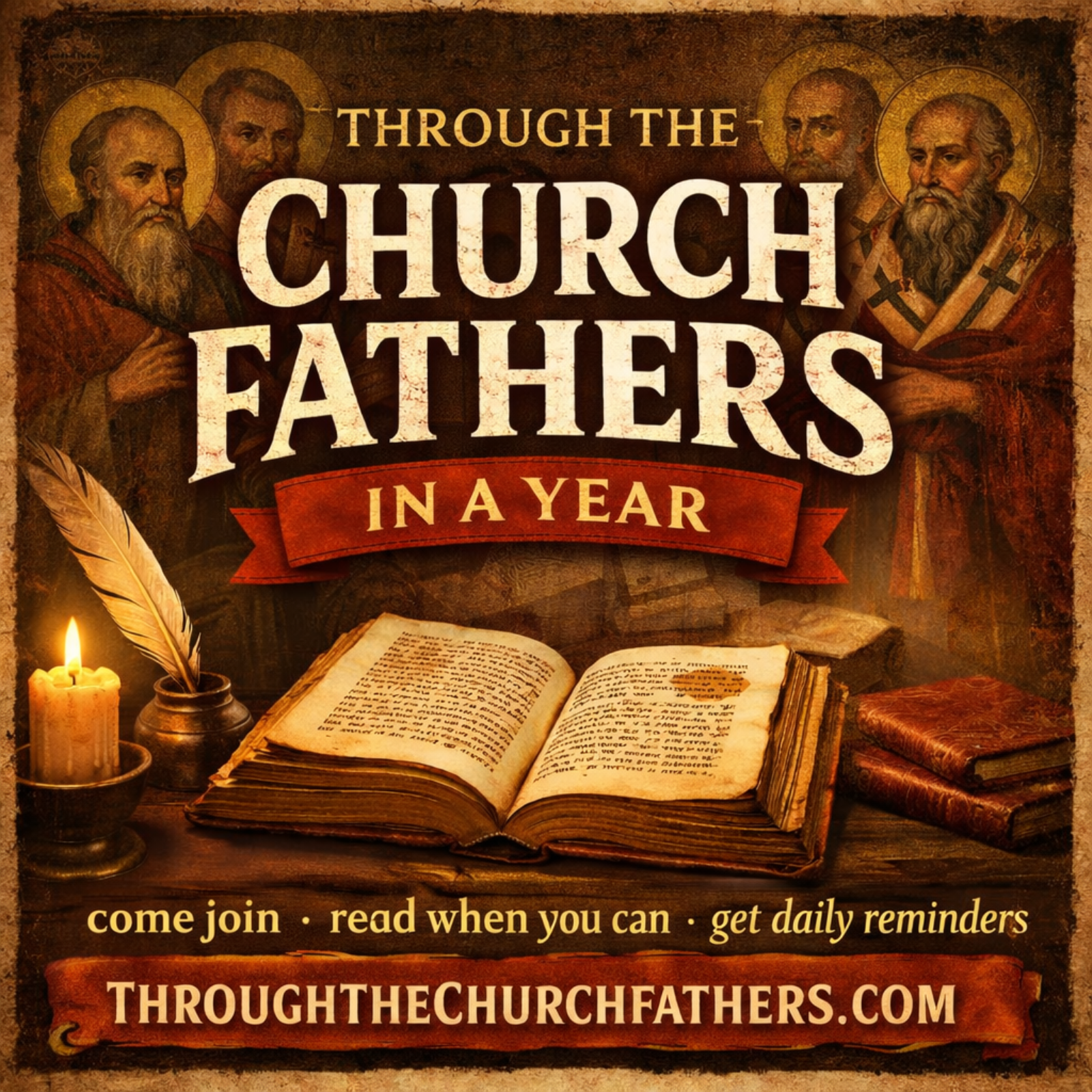
Join Through the Church Fathers , a year-long journey into the writings of the early Church Fathers, thoughtfully curated by C. Michael Patton. Each episode features daily readings from key figures like Clement, Augustine, and Aquinas, accompanied by insightful commentary to help you engage with the foundational truths of the Christian faith. Join Our Community: Read along and engage with others on this journey through the Church Fathers. Visit our website . Support the Podcast: Help sustain this work and gain access to exclusive content by supporting C. Michael Patton on Patreon at patreon.co...
Bezoek zeker de website van de podcast en steun de maker: patreon.com
Auteur
C. Michael Patton
Categorie
Website van de podcast
Nieuwste aflevering
19 nov. 2026
Waar luisteren?
Podcasts in de app Replaio Radio Binnenkort beschikbaarPodcasts komen binnenkort naar de app. Installeer nu en zie als eerste een compleet nieuwe kijk op podcasts
 Gratis installeren
Android 10 mln+ downloads · beoordeling 4,7+
iOS binnenkort
Afleveringen
Through the Church Fathers: November 19 19.11.2026 13:00
Even the smallest affairs become great when they touch justice, charity, and the eternal destiny of souls—whether a preacher speaks of a cup of cold water or a Christian seeks the true sense of Scripture. In On Christian Doctrine , Augustine insists that the Christian orator deals constantly with great matters, since everything said from the place of authority concerns eternal salvation rather tha...
Through the Church Fathers: November 18 18.11.2026 13:25
Augustine insists that the Christian teacher must pray before he speaks, for success comes more from piety than from gifts of oratory. Human directions are not to be despised even though God is the true teacher; Paul himself gave directions to Timothy and Titus. He then recalls the threefold division of styles: little things in a subdued style, moderate things in a temperate style, and great thing...
Through the Church Fathers: November 17 17.11.2026 10:28
Augustine sets out five ways the words “the earth was invisible and without form, and darkness was upon the deep” may be understood: as the formless matter of corporeal things, as the still-formless whole called heaven and earth, as the material of both the intelligible heaven and the corporeal creation, as the formlessness itself already named earth and deep, or as the entire corporeal mass of th...
Through the Church Fathers: November 16 16.11.2026 11:40
True eloquence in teaching consists in making clear what was obscure, and a wooden key that opens the lock is better than a golden one that does not. Augustine recalls Cicero’s three aims of the orator—to teach, to delight, and to persuade—and insists that teaching is the necessity. The hearer must be moved as well as instructed, for practical truth is useless unless the will is subdued to practic...
Through the Church Fathers: November 15 15.11.2026 13:01
The sacred writers are eloquent, yet their useful obscurity is not to be copied by those who expound them. Augustine warns that Christian teachers must aim first at being understood. Difficult passages are not to be brought before the people except for urgent cause; in books and private conversation the truth is to be pressed home to those who desire and can receive it. Clearness sometimes require...
Through the Church Fathers: November 14 14.11.2026 11:22
Wisdom flows from the Divine mind without aiming at eloquence, and the writer’s intention is sought in charity even when more than one true reading is possible. Augustine shows that the six clauses of the prophet form three elegant periods, and that the speaker may join them or finish them separately. He checks the invective at the sound of the viol so that the music of the wise may be distinguish...
Through the Church Fathers: November 13 13.11.2026 11:06
The prophets speak with a vehemence that startles the drowsy, and the formless beginning of things may still be named heaven and earth. Augustine replies to those who despise the sacred authors because they do not display the eloquence the schools prize. He turns from Paul to the prophet who was called from the flock, and he follows Jerome’s rendering from the Hebrew so that the style itself may b...
Through the Church Fathers: November 12 12.11.2026 13:01
Wisdom guides and eloquence follows in the words of the apostle, and the names of heaven and earth are the names that more than one explanation can bear. Augustine shows that in the Second Epistle to the Corinthians Paul is compelled to speak of himself, and yet wisdom is his guide and eloquence his attendant. The clauses and the periods intermingle in the most beautiful variety, so that even the...
Through the Church Fathers: November 11 11.11.2026 11:51
The sacred writers unite eloquence with wisdom, and the five explanations of Genesis 1:1 are the explanations of those who honor Moses. Augustine says that where he understands the writers of the canon, nothing can be wiser and nothing can be more eloquent. The eloquence is the eloquence that suits men of the highest authority and who are inspired of God. Where he does not understand them, the elo...
Through the Church Fathers: November 10 10.11.2026 13:45
Wisdom is to be preferred, and the objectors who grant the truth are the ones with whom he will confer. Augustine says the duty of the teacher is to teach what is right, refute what is wrong, conciliate the hostile, and rouse the careless. Narrative serves those who need to learn, reasoning serves those who doubt, and vigor of speech serves those who already know and need to be moved. Eloquence wi...
Through the Church Fathers: November 9 09.11.2026 12:38
Truth is not to stand unarmed, and a house that clings to God is still granted by the objectors. Augustine says he is not writing a treatise on the rules of rhetoric. Those are learnt elsewhere, if they are learnt at all, and boys may give them a little time. The art itself is lawful. Eloquence is available for falsehood and for truth, and it is a poor wisdom that leaves the defenders of the truth...
Through the Church Fathers: November 8 08.11.2026 13:32
The narrative goes back without saying so, and a house that clings to God is still not the Self-same. Augustine says the scattering of the nations seems to come before the one language, until the reader marks the recapitulation: the sentence about one speech returns to the time before the tower, and the judgment on the arrogance is what divides the tongues. “In that day” does not mean that the war...
Through the Church Fathers: November 7 07.11.2026 13:55
A part may stand for a whole day, and a creature may rest in God without being co-eternal. Augustine says the fifth rule of Tichonius is the rule of times: synecdoche, and the legitimate numbers. Six days and eight days can both be true if the broken day is counted or not counted. The three days and three nights in the heart of the earth are made out in the same way, by joining the part to the who...
Through the Church Fathers: November 6 06.11.2026 12:17
The prophet passes from one Israel to the other without a change of name, and the eternal will does not take up a new act. Augustine says the species is not always overstepped. When Ezekiel has spoken of the house that defiled the land and was scattered, and then promises a new heart and clean water and a gathering out of all countries, the reader is to leave the one nation and take the genus. The...
Through the Church Fathers: November 5 05.11.2026 12:17
Faith itself is a gift, and a part is sometimes named when the whole is meant. Augustine says the third rule of Tichonius, the promises and the law, the spirit and the letter, is a great question rather than a key to other questions. Tichonius gave works to God and left faith to us. He had not yet met the Pelagian heresy. Peace and love with faith are from God the Father and the Lord Jesus Christ,...
Through the Church Fathers: November 4 04.11.2026 12:34
Seven rules are keys, not the whole lock, and two creatures stand outside the compass of time. Augustine says Tichonius the Donatist wrote a book of rules, and claimed too much for them. They assist. They do not open every obscure place, and the book is to be read with caution, because the author remained a Donatist. The first rule is the Lord and His body. Head and body are sometimes spoken under...
Through the Church Fathers: November 3 03.11.2026 11:19
The same words may bear more than one true sense, and formlessness cannot make a day. Augustine says that if two interpretations of a passage both agree with the truth, and each can be shown from another place in Scripture, the reader is not to be blamed for missing the writer’s own intention. The Spirit foresaw the sense that agrees with the truth. Reason may be called in when Scripture cannot se...
Through the Church Fathers: November 2 02.11.2026 10:59
A word does not keep one meaning wherever it appears, and a house that clings to God is not stretched into times. Augustine says the sins of great men are written so that no one who thinks he stands may despise another. God resists the proud and gives grace to the humble. The first question about any expression is whether it is literal or figurative. Leaven is the Pharisees, and leaven is the king...
Through the Church Fathers: November 1 01.11.2026 11:00
Lust cannot imagine temperance, and a creature can cling to God so as not to be extended into times. Augustine says the man who exceeds with one wife does not believe that the fathers used many wives with temperance, looking only to the duty of those times. Such men measure the saints by themselves, as if praise must puff up and insult must cast down. The apostles were neither puffed up nor cast d...
Through the Church Fathers: October 31 31.10.2026 12:04
Charity is the rule that decides when a command is a figure, and eternity is a will that does not change. Augustine says a figurative expression is to be turned until it establishes the reign of love, and if the literal sense already does that, it is not a figure. A command that seems to enjoin a crime, or to forbid a kindness, is figurative. Eating the flesh is a share in the sufferings. Coals of...
Through the Church Fathers: October 30 30.10.2026 13:06
What looks like a sin in a holy man may be a sign, and a custom is not yet a law. Augustine says the deeds ascribed to God and the saints, which seem wicked to the inexperienced, are figurative, and the kernel is charity. It is not the use of a thing that is blamed, but the lust of the user. The ointment on the Lord’s feet is not the ointment of a banquet. Hosea’s keeping company with a harlot is...
Through the Church Fathers: October 29 29.10.2026 12:17
A man can be free while he is still under a sign, and a creature can share eternity without being eternal. Augustine says bondage to a sign is the use of it without knowing what it signifies. The patriarchs were spiritual and free even while the signs were still imposed, because they honored what the signs referred to. After the resurrection a few rites remain, baptism and the body and blood of th...
Through the Church Fathers: October 28 28.10.2026 12:34
To take a sign for the thing it signifies is a kind of slavery, and a world can be shaped only out of what is almost nothing. Augustine warns that the letter kills when a figurative word is read as if it were proper. Sabbath and sacrifice then stay on the day and the victim, and the mind never lifts. The bondage of Israel was not the bondage of the nations. Their signs, however misunderstood, stil...
Through the Church Fathers: October 27 27.10.2026 11:52
A question can be asked so that the answer is already No, and a world can be made only if it is not made out of God. Augustine takes the ambiguities of pronunciation next. The rule of faith will not let “Who shall lay anything to the charge of God’s elect?” be read as if God and Christ were the accusers. Inquiry and interrogative are not the same. A short syllable and a long one can hide bone unde...
Through the Church Fathers: October 26 26.10.2026 12:45
A mark in the wrong place can make the Word something other than God, and a mind full of pictures can fail to think what has no picture. Augustine opens the third book of On Christian Doctrine by sending the prepared reader to the ambiguities of Scripture. Where the words themselves are unclear, punctuation and pronunciation are tested first by the rule of faith, then by the context, and, if both...
Vergelijkbare podcasts







Luister naar de podcast Through the Church Fathers in Replaio
Radio en podcasts in één app - gratis en zonder account. Installeer vandaag nog en mis de lancering niet
Replaio is geen uitgever van podcasts; namen van shows, covers en audio zijn eigendom van hun makers en worden verspreid via openbare RSS-feeds