Goalhanger
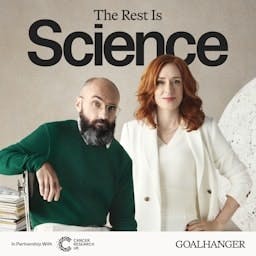
The Rest Is Science
Join mathematician Professor Hannah Fry and science creator Michael Stevens (Vsauce) as they dig into the weird scientific questions that often go unexplored. Welcome to The Rest Is Science, a show that sits in the fascinating space between what we think we know, and what we actually know. Why do we assume we understand things like time, randomness, or even gravity? Once you start questioning these familiar ideas, reality becomes astonishingly strange and completely fragile. Whether you're a lifelong science fan or just naturally curious, The Rest Is Science will change your perception of real...
Bezoek zeker de website van de podcast en steun de maker: www.goalhanger.com
Auteur
Goalhanger
Categorie
Website van de podcast
Nieuwste aflevering
19 nov. 2026
Waar luisteren?
Podcasts in de app Replaio Radio Binnenkort beschikbaarPodcasts komen binnenkort naar de app. Installeer nu en zie als eerste een compleet nieuwe kijk op podcasts
 Gratis installeren
Android 10 mln+ downloads · beoordeling 4,7+
iOS binnenkort
Afleveringen
Mapping Cancer’s Life Story 19.11.2026 33:39
Why can’t eating more stop someone with cancer from wasting away? In The Rest Is Science’s first ever interview, Professor Hannah Fry and Michael Stevens (Vsauce) sit down with Professor Mariam Jamal-Hanjani, lung cancer specialist and Chief Clinician at Cancer Research UK. Cachexia is a wasting syndrome that affects around 80% of people with advanced cancer. Some patients die from it rather than...
What's The Deal With Boomers? 15.11.2026 1:04:52
Boomers were born into a world that bent itself around them. So why do they seem so annoyed by the one they built? Professor Hannah Fry and Michael Stevens (Vsauce) tackle the question the internet can't stop asking: what's the deal with boomers? Was it a baby boom that changed everything, or did everything change because of the babies? Is a "generation" even a real thing, or just a label we all a...
The Secrets Michael Keeps From Himself 12.11.2026 35:50
Is it better to own something amazing, or to actually experience it? Michael has built a collected a whole shelf of things he refuses to look at, smell or open, and he's about to defend every one of them. Professor Hannah Fry and Michael Stevens (Vsauce) are back with Field Notes, a show-and-tell where the star attractions stay firmly sealed. Is a puzzle still a puzzle if the answer is staring you...
Why Does Evolution Keep Inventing Mind Control? 08.11.2026 53:41
What if your thoughts, fears and desires weren't entirely your own? What if something living inside your body could change your behaviour, without you ever knowing? Professor Hannah Fry and Michael Stevens (Vsauce) enter the disturbing world of parasites. From worms that grow inside crickets to viruses that alter animal behaviour, they explore the extraordinary lengths parasites will go to in orde...
Why Sharks Attack The Internet 05.11.2026 49:55
Every week, around three undersea internet cables get damaged badly enough to need urgent repair... and the culprit usually isn’t sabotage. Submarine cables carry more than 99% of the world’s international data, from your video calls to global financial transactions. Yet they lie on the ocean floor, where fishing gear and dragging ship anchors cause huge amounts of the damage. In this episode of T...
Is 100 Better Than 101? 01.11.2026 44:50
Is 100 really such a special number? Or have we spent thousands of years getting excited about something completely arbitrary? To celebrate the 100th episode of The Rest Is Science, Professor Hannah Fry and Michael Stevens (Vsauce) go head-to-head in a mathematical showdown: which is the better number, 100 or 101? It sounds like a simple question, but the answer takes them from the strange history...
Do You Recognise These Creepy Sounds? 29.10.2026 32:16
Some of the creepiest sounds ever recorded aren't from horror films. They're real. From mysterious noises from the deepest parts of the ocean to the eerie voices of people who died more than a century ago, the world is full of sounds stranger than anything we could dream up. But what on Earth is making them? In this Halloween special of The Rest Is Science, Professor Hannah Fry and Michael Stevens...
Earth’s Tilt Makes Time Slippery 25.10.2026 53:20
A sundial can be almost 16 minutes fast in November and 14 minutes slow in February, yet there's nothing wrong with it. So why does the Sun, our oldest timekeeper, disagree with the clock on your wrist? In this episode, Professor Hannah Fry and Michael Stevens (Vsauce) explore the equation of time - the strange relationship between Earth's tilt, its orbit around the Sun and the way we measure our...
A History Of Squatting 21.10.2026 37:34
In many parts of the world, people rest in a deep squat every day. In others, most adults can barely get down there. So what’s going on? Hannah Fry and Michael Stevens dig into the history of squatting and why the ability to squat differs so much between cultures. Plus, your questions: What happens to the air pressure inside a car when it goes round a bend? Why do some burps come out higher than o...
Mathematicians Are The Canary Down The AI Coal Mine 18.10.2026 1:07:24
OpenAI claims a swarm of AI agents has solved the Navier-Stokes problem, one of the hardest unsolved questions in mathematics, with a $1 million prize attached. Then it released more than 700 more mathematical manuscripts, including claims touching the Riemann hypothesis, faster than anyone can check them. Mathematicians are not happy, and the reason goes far beyond the money. In this episode of T...
The Right Way To Open A Shaken Soda Can 14.10.2026 38:28
A can of fizzy drink has been violently shaken. The pressure is building, the bubbles are ready to erupt, and Michael Stevens is about to open it. But Hannah Fry has a trick up her sleeve. Can a few taps really prevent an explosion? This week on The Rest Is Science, Hannah and Michael begin with the surprisingly complicated physics of carbonation before tackling a much bigger question: can we real...
Something Weird Is Going On With Placebos 11.10.2026 49:36
For the past few decades, something strange has been happening in clinical trials. Painkillers aren't getting worse, but the placebos they're tested against appear to be getting better. In one landmark study, the advantage of pain medication over placebo shrank from 27.3% in 1996 to just 8.9% in 2013. Even stranger? This trend was found almost entirely in American trials. In this episode of The Re...
What Was A Mammoth Doing At The Bottom Of The Sea? 07.10.2026 42:13
Hannah surprises Michael with a mammoth bone from Doggerland, the lost Ice Age land that once joined Britain to mainland Europe, and now lies beneath the North Sea. Who lived there, what roamed it, and how did an entire landscape disappear under the waves? Then it's your questions: where did "cool" come from as a word for style, and how did it stick around for so long? What on earth is "skank face...
Why Do We Turn on Innocent People? 04.10.2026 51:08
Why do we turn on innocent people? A convincing story, a suspicious glance and suddenly everyone’s an armchair detective. But what happens when the crowd gets it completely wrong? Hannah Fry and Michael Stevens explore the psychology of false accusations, witch hunts and mob mentality, starting with Richard Jewell, the security guard hailed as a hero after the 1996 Atlanta Olympics bombing before...
Hacking The Kendama With Physics 30.09.2026 40:58
Michael hands Hannah a kendama, the Japanese cup-and-ball toy, and asks her to land a single catch. Then he brings out one built for him by Adam Savage of MythBusters and explains why a heavier kendama is a completely different physics problem. A kendama looks like a children's toy. It is really a pendulum, a lesson in angular momentum and a catching problem borrowed from spacecraft docking. Micha...
Why Do We Like Staring Into Fire? 27.09.2026 59:02
What is fire, and why does watching it hold our attention in a different way from scrolling on your phone? Hannah Fry and Michael Stevens start with the science of a flame: why it glows, what its different colours reveal, and why fire is a series of chemical reactions rather than a single substance. Then they travel back to a time before wildfires could burn on Earth, and ask how early humans lear...
The Fluid Dynamics of Fountain Pens 23.09.2026 1:05:13
The wait is finally over: Hannah Fry introduces Michael Stevens to her beloved fountain pen collection and the beautiful physics behind how fountain pens work. From a £20 Lamy Safari to vintage Waterman and Montblanc pens, Hannah explains how capillary action, surface tension, air pressure and carefully engineered feeds control the flow of fountain pen ink. Michael tests the collection, chooses hi...
Dying In Space, Trapped Water, and What's Hidden In Pi? 20.09.2026 49:23
Almost every human who has ever lived has one thing in common: they were born and died on Earth. Except for three people. Hannah Fry and Michael Stevens uncover the extraordinary story of Soyuz 11, the Soviet cosmonauts who became the only humans ever to die in outer space, and what their deaths meant for the future of human spaceflight. But that raises a bigger question: what exactly is trapped o...
How Codes Were Used To Hack The Telegram Business 16.09.2026 56:59
What if a single strange word could save you a fortune? In this episode Michael opens up a Victorian telegram code book and explores how users compressed long messages into brief coded words to outwit the per word charge of the telegraph system. Coded language turned everyday phrases about everyday events into something that looked like nonsense to outsiders, and why that secrecy was often a...
Why Your Body Needs Gravity 13.09.2026 43:26
Does space travel make astronauts younger? Professor Hannah Fry and Michael Stevens explore Einstein’s twin paradox, time dilation and NASA’s famous Twins Study with astronauts Scott and Mark Kelly. After Scott Kelly spent 340 days aboard the International Space Station, he returned milliseconds younger than his identical twin. But microgravity had also affected his eyesight, bones, blood, gut mic...
What Is Collagen All About? 09.09.2026 41:50
Do collagen pills live up to their promises for skin and joints and healthy ageing? In this episode, Hannah and Michael examine what collagen actually is and how the body makes and uses it, before looking closely at whether collagen supplements survive digestion and reach the skin in any meaningful form. ------------------- For more information about Cancer Research UK, their research, breakt...
The Threshold of Human Sensation 06.09.2026 55:09
What is the smallest thing you can possibly feel? Michael Stevens and Professor Hannah Fry journey through varying levels of perception, from the faintest touch on skin to the faintest trace of flavour and odour, and on to the remarkable question of whether the eye can register a single particle of light. This is an exploration of human senses at their most sensitive, blending physics and...
The Scale of the Universe 02.09.2026 49:01
The scale of the universe stretches from the Planck length, the smallest scale physics can describe, to the observable universe, the largest thing we can see. Travel inward from one and outward from the other by powers of ten and they meet at something astonishingly familiar: the size of a human egg cell. Michael Stevens (VSauce) takes Professor Hannah Fry on a journey through powers of ten, from...
Why Loud Chewing Makes You Angry 30.08.2026 49:35
The mukbang phenomenon is comfort viewing for millions, yet for others the sound of chewing, slurping and everyday mouth noises is enough to trigger instant anger, disgust and distress. Why do the sounds soothe one person and enrage another? In this episode, Professor Hannah Fry and Michael Stevens (Vsauce) explore misophonia, the misunderstood sound sensitivity that can turn everyday mouth sounds...
How Does Language Change What You Smell? 26.08.2026 46:11
In this episode of Field Notes, Professor Hannah Fry and Michael Stevens (Vsauce) begin with a Persian word for a smell Hannah cannot detect on a freshly washed plate. From the Sapir-Whorf hypothesis and Russian words for blue to emotions and identity, Hannah and Michael investigate how language may shape our experience of the world. Then, your questions. How fast would you need to throw a rock fo...
Vergelijkbare podcasts








Luister naar de podcast The Rest Is Science in Replaio
Radio en podcasts in één app - gratis en zonder account. Installeer vandaag nog en mis de lancering niet
Replaio is geen uitgever van podcasts; namen van shows, covers en audio zijn eigendom van hun makers en worden verspreid via openbare RSS-feeds