Goalhanger
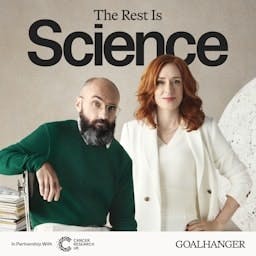
The Rest Is Science
Join mathematician Professor Hannah Fry and science creator Michael Stevens (Vsauce) as they dig into the weird scientific questions that often go unexplored. Welcome to The Rest Is Science, a show that sits in the fascinating space between what we think we know, and what we actually know. Why do we assume we understand things like time, randomness, or even gravity? Once you start questioning these familiar ideas, reality becomes astonishingly strange and completely fragile. Whether you're a lifelong science fan or just naturally curious, The Rest Is Science will change your perception of real...
N'hésitez pas à visiter le site du podcast et à soutenir son créateur : www.goalhanger.com
Où écouter ?
Les podcasts dans l'appli Replaio Radio Bientôt disponibleLes podcasts arrivent très bientôt dans l'appli. Installe-la dès maintenant et découvre en avant-première une toute nouvelle façon de vivre les podcasts
 Installe-la gratuitement
Android près de 10 M de téléchargements · note de 4,8
iOS bientôt
Épisodes
Mathematicians Are The Canary Down The AI Coal Mine 18.10.2026 1:07:24
OpenAI claims a swarm of AI agents has solved the Navier-Stokes problem, one of the hardest unsolved questions in mathematics, with a $1 million prize attached. Then it released more than 700 more mathematical manuscripts, including claims touching the Riemann hypothesis, faster than anyone can check them. Mathematicians are not happy, and the reason goes far beyond the money. In this episode of T...
The Right Way To Open A Shaken Soda Can 14.10.2026 38:28
A can of fizzy drink has been violently shaken. The pressure is building, the bubbles are ready to erupt, and Michael Stevens is about to open it. But Hannah Fry has a trick up her sleeve. Can a few taps really prevent an explosion? This week on The Rest Is Science, Hannah and Michael begin with the surprisingly complicated physics of carbonation before tackling a much bigger question: can we real...
Something Weird Is Going On With Placebos 11.10.2026 49:36
For the past few decades, something strange has been happening in clinical trials. Painkillers aren't getting worse, but the placebos they're tested against appear to be getting better. In one landmark study, the advantage of pain medication over placebo shrank from 27.3% in 1996 to just 8.9% in 2013. Even stranger? This trend was found almost entirely in American trials. In this episode of The Re...
What Was A Mammoth Doing At The Bottom Of The Sea? 07.10.2026 42:13
Hannah surprises Michael with a mammoth bone from Doggerland, the lost Ice Age land that once joined Britain to mainland Europe, and now lies beneath the North Sea. Who lived there, what roamed it, and how did an entire landscape disappear under the waves? Then it's your questions: where did "cool" come from as a word for style, and how did it stick around for so long? What on earth is "skank face...
Why Do We Turn on Innocent People? 04.10.2026 51:08
Why do we turn on innocent people? A convincing story, a suspicious glance and suddenly everyone’s an armchair detective. But what happens when the crowd gets it completely wrong? Hannah Fry and Michael Stevens explore the psychology of false accusations, witch hunts and mob mentality, starting with Richard Jewell, the security guard hailed as a hero after the 1996 Atlanta Olympics bombing before...
Hacking The Kendama With Physics 30.09.2026 40:58
Michael hands Hannah a kendama, the Japanese cup-and-ball toy, and asks her to land a single catch. Then he brings out one built for him by Adam Savage of MythBusters and explains why a heavier kendama is a completely different physics problem. A kendama looks like a children's toy. It is really a pendulum, a lesson in angular momentum and a catching problem borrowed from spacecraft docking. Micha...
Why Do We Like Staring Into Fire? 27.09.2026 59:02
What is fire, and why does watching it hold our attention in a different way from scrolling on your phone? Hannah Fry and Michael Stevens start with the science of a flame: why it glows, what its different colours reveal, and why fire is a series of chemical reactions rather than a single substance. Then they travel back to a time before wildfires could burn on Earth, and ask how early humans lear...
The Fluid Dynamics of Fountain Pens 23.09.2026 1:05:13
The wait is finally over: Hannah Fry introduces Michael Stevens to her beloved fountain pen collection and the beautiful physics behind how fountain pens work. From a £20 Lamy Safari to vintage Waterman and Montblanc pens, Hannah explains how capillary action, surface tension, air pressure and carefully engineered feeds control the flow of fountain pen ink. Michael tests the collection, chooses hi...
Dying In Space, Trapped Water, and What's Hidden In Pi? 20.09.2026 49:23
Almost every human who has ever lived has one thing in common: they were born and died on Earth. Except for three people. Hannah Fry and Michael Stevens uncover the extraordinary story of Soyuz 11, the Soviet cosmonauts who became the only humans ever to die in outer space, and what their deaths meant for the future of human spaceflight. But that raises a bigger question: what exactly is trapped o...
How Codes Were Used To Hack The Telegram Business 16.09.2026 56:59
What if a single strange word could save you a fortune? In this episode Michael opens up a Victorian telegram code book and explores how users compressed long messages into brief coded words to outwit the per word charge of the telegraph system. Coded language turned everyday phrases about everyday events into something that looked like nonsense to outsiders, and why that secrecy was often a...
Why Your Body Needs Gravity 13.09.2026 43:26
Does space travel make astronauts younger? Professor Hannah Fry and Michael Stevens explore Einstein’s twin paradox, time dilation and NASA’s famous Twins Study with astronauts Scott and Mark Kelly. After Scott Kelly spent 340 days aboard the International Space Station, he returned milliseconds younger than his identical twin. But microgravity had also affected his eyesight, bones, blood, gut mic...
What Is Collagen All About? 09.09.2026 41:50
Do collagen pills live up to their promises for skin and joints and healthy ageing? In this episode, Hannah and Michael examine what collagen actually is and how the body makes and uses it, before looking closely at whether collagen supplements survive digestion and reach the skin in any meaningful form. ------------------- For more information about Cancer Research UK, their research, breakt...
The Threshold of Human Sensation 06.09.2026 55:09
What is the smallest thing you can possibly feel? Michael Stevens and Professor Hannah Fry journey through varying levels of perception, from the faintest touch on skin to the faintest trace of flavour and odour, and on to the remarkable question of whether the eye can register a single particle of light. This is an exploration of human senses at their most sensitive, blending physics and...
The Scale of the Universe 02.09.2026 49:01
The scale of the universe stretches from the Planck length, the smallest scale physics can describe, to the observable universe, the largest thing we can see. Travel inward from one and outward from the other by powers of ten and they meet at something astonishingly familiar: the size of a human egg cell. Michael Stevens (VSauce) takes Professor Hannah Fry on a journey through powers of ten, from...
Why Loud Chewing Makes You Angry 30.08.2026 49:35
The mukbang phenomenon is comfort viewing for millions, yet for others the sound of chewing, slurping and everyday mouth noises is enough to trigger instant anger, disgust and distress. Why do the sounds soothe one person and enrage another? In this episode, Professor Hannah Fry and Michael Stevens (Vsauce) explore misophonia, the misunderstood sound sensitivity that can turn everyday mouth sounds...
How Does Language Change What You Smell? 26.08.2026 46:11
In this episode of Field Notes, Professor Hannah Fry and Michael Stevens (Vsauce) begin with a Persian word for a smell Hannah cannot detect on a freshly washed plate. From the Sapir-Whorf hypothesis and Russian words for blue to emotions and identity, Hannah and Michael investigate how language may shape our experience of the world. Then, your questions. How fast would you need to throw a rock fo...
Space Elevators, Skyhooks, and Space Fountains 23.08.2026 1:05:46
What is the fastest, cheapest and possibly worst way to get into space? Could a nuclear explosion launch a manhole cover beyond the Earth’s atmosphere? And could space elevators, skyhooks or launch loops one day replace rockets? In this episode, Professor Hannah Fry and Michael Stevens (VSauce) explore where space really begins, why orbit means falling forever, and how Newton’s cannon explains the...
Bizarre Watches and How They Work 19.08.2026 54:12
Michael Stevens keeps a small museum of unusual timepieces on his desk: a clock that runs backwards, a watch built to be read in complete darkness, and one whose entire face simply says "now." Each is a miniature experiment in the psychology of time, and each reveals something surprising about how our perception of time shapes the way we understand uncertainty and the world around us. The conversa...
Why Your Brain Thinks You're Full (Even When You're Not) 16.08.2026 46:38
How did the Gila monster, a desert lizard that eats just five times a year, help unlock the science behind Ozempic, Wegovy and Mounjaro? In this episode of The Rest Is Science, Professor Hannah Fry and Michael Stevens (Vsauce) trace the strange journey from a molecule found in lizard venom to medicines reshaping diabetes and weight-loss treatment, exploring how GLP-1 helps regulate blood sugar, ap...
The Lake At The North Pole That Stops Europe From Freezing 12.08.2026 47:03
When you picture the North Pole, you probably imagine a vast, frozen expanse of floating sea ice. But hidden deep beneath the surface of the Arctic lies something incredible: a massive, churning reservoir of nearly freshwater, suspended right in the middle of a saltwater ocean. In this episode of The Rest Is Science, Professor Hannah Fry and Michael Stevens (VSauce) explore the hidden hydrodynamic...
The Science of Putting Sunglasses on The Sun 09.08.2026 1:00:02
Why does the cartoon Sun always wear sunglasses? And how big would a real pair need to be? Hannah Fry and Michael Stevens investigate space mirrors, Reflect Orbital and solar eclipses to find out. Starting with a pencil held at arm’s length, they use the Sun’s angular diameter to calculate how big a pair of solar sunglasses would need to be for one eye, two eyes, everyone in London and eventually...
Why Is It A Colour Wheel & Not A Line? 05.08.2026 47:09
Colour wheel or colour line? Light itself runs in a straight line from red to violet, yet every colour theory chart bends that spectrum into a circle and the reason has nothing to do with physics. Professor Hannah Fry and Michael Stevens (VSauce) dig into why human vision refuses to see colour the way light actually behaves, tracing the visible light spectrum from one end to the other and asking w...
Why Lithium Batteries SUCK 02.08.2026 54:29
Can Hannah convince Michael that the lithium-ion battery is one of our most overrated inventions to ever happen? Hannah makes her case using a surprising energy source hidden in your fridge, a bell in Oxford that's been ringing since 1840, and a metal that is useful… but prone to bursting into flame from the inside out. Tracing the battery's strange history, from a twitching dead frog to the execu...
What Happens Inside Earth's Forbidden Zones? 29.07.2026 45:35
What grows in the spaces humans are forced to abandon? Hannah brings Michael an actual piece of barbed wire from the Korean Demilitarised Zone, one of the most heavily fortified and forbidden borders on Earth, and it sends them somewhere unexpected. From deserted no man's land and radioactive exclusion zones to remote islands that most of humankind has quietly agreed to leave well alone, they expl...
The 2012 Maya Apocalypse Myth & Confirmation Bias 26.07.2026 59:35
Did the world really end in 2012? Not with fire, meteors or an ancient Mayan prophecy, but Professor Hannah Fry and Michael Stevens ask whether something just as profound took place instead. Together they unravel how one of the biggest myths in history took hold and why the Maya were unable to accurately predict the apocalypse. But they also delve into why, according to Michael, 2012 was the year...
Podcasts similaires








Écoute le podcast The Rest Is Science sur Replaio
La radio et les podcasts dans une seule appli - gratuite, sans inscription. Installe-la dès aujourd'hui et ne rate pas le lancement
Replaio n'est pas éditeur de podcasts ; les noms des émissions, les visuels et l'audio appartiennent à leurs auteurs et sont diffusés via des flux RSS publics