Al Zambone
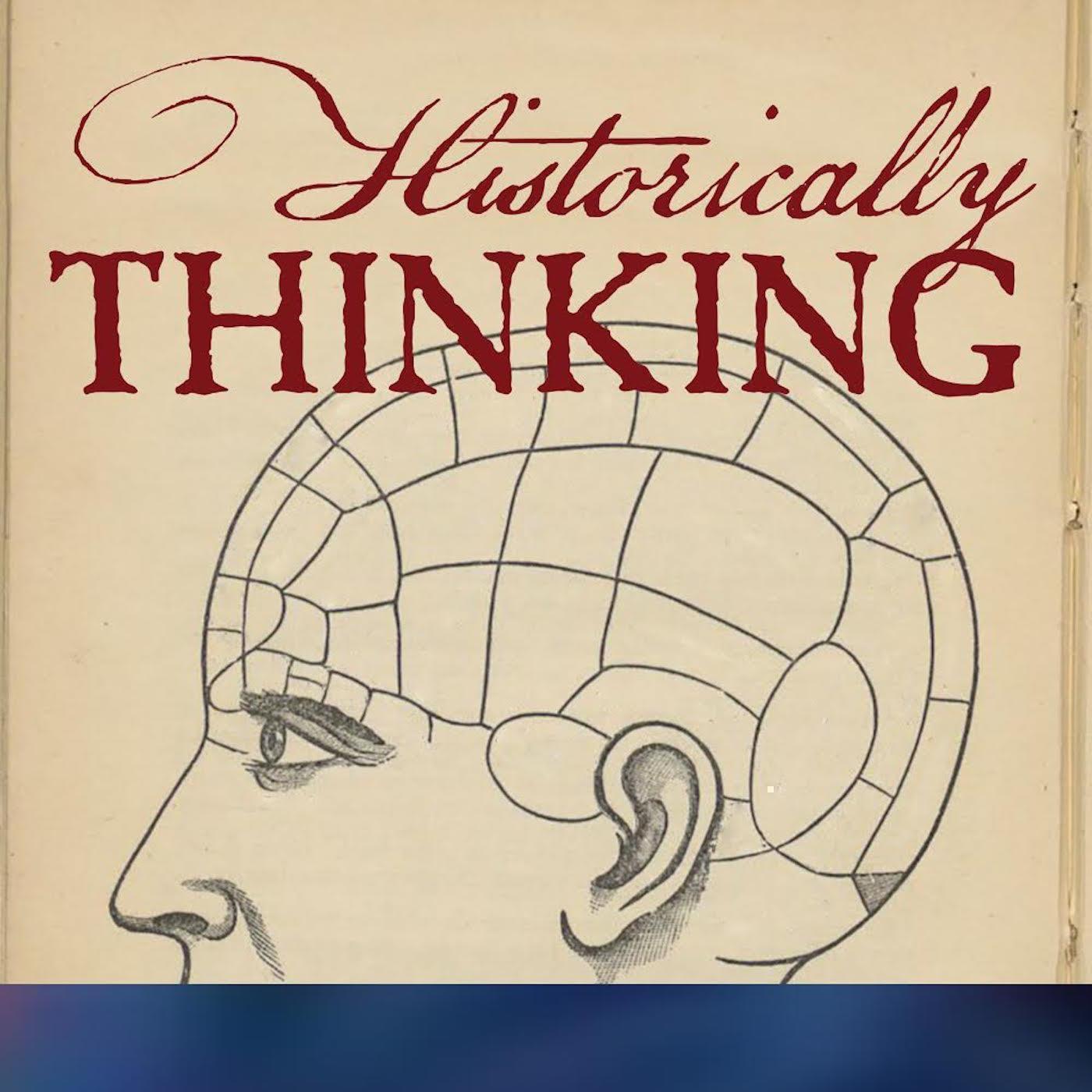
Historically Thinking
We believe that when people think historically, they are engaging in a disciplined way of thinking about the world and its past. We believe it gives thinkers a knack for recognizing nonsense; and that it cultivates not only intellectual curiosity and rigor, but also intellectual humility. Join Al Zambone, author of Daniel Morgan: A Revolutionary Life, as he talks with historians and other professionals who cultivate the craft of historical thinking.
Husk å besøke podkastens nettsted og støtte skaperen: blubrry.com
Hvor kan du lytte?
Podkaster i appen Replaio Radio Kommer snartPodkaster kommer snart til appen. Installer nå, og bli den første som ser en helt ny tilnærming til podkaster
 Installer gratis
Android nesten 10 mill. nedlastinger · 4,8 i vurdering
iOS snart
Installer gratis
Android nesten 10 mill. nedlastinger · 4,8 i vurdering
iOS snart
Episoder
Episode 280: Thinking about Historically Thinking 14.09.2022 1:06:58
Well, this is something new. After 279 podcasts, someone is asking Al Zambone questions about the podcast. Carol Adrienne, recently heard talking on Episode 278 about her book Healing a Divided Nation: How the Civil War Revolutionized Western Medicine insisted that it was a really good idea that she be allowed to record a podcast about this podcast. So she did. It turns out to be a pretty good int...
Episode 279: Count the Dead 08.09.2022 59:45
Stephen Berry begins his new book Count the Dead: Coroners, Quants, and the Birth of Death as We Know It with these two paragraphs: This is a book about death and data or, more specifically, about the dead as data. The dead and the formerly living are not the same. The formerly living built the Parthenon and the Brooklyn Bridge…[they] also made brutal wars and ghastly decisions we are still strug...
Episode 278: Healing a Divided Nation 05.09.2022 58:54
When Confederate cannons fired on Fort Sumter in April 1861, the United States Army was comprised of only 16,000 soldiers. Its medical staff was numbered just 113 doctors. And here’s another fun fact: taking into account all of the doctors then practicing in the United States, possibly as few as 300 doctors in the entire United States had witnessed surgery, or seen a gunshot wound. Over the next...
Episode 277: Saving Freud 29.08.2022 1:03:53
On March 15, 1938, Adolf Hitler addressed 250,000 Austrians in Vienna, announcing the end of the Austrian state. Close by on that same day, Nazis entered the apartment of Dr. Sigmund Freud and his family. They were literally bought off when first his wife Martha offered them cash, and then daughter Anna Freud opened a safe and gave them the equivalent of $840. At this point “the stern figure of Si...
Episode 276: The Secret Syllabus 22.08.2022 1:05:30
New college students usually get lots of advice. “Go to office hours.” “Ask good questions.” “Declare a major as soon as you can.” “Take some time to figure out who you are.” “Get some research experience.” “Get good internships with real-life experience.” “Sit in the front row.” “Avoid procrastination.” Some of this advice is obvious, some of it is contradictory, and some of it is bad.. It almos...
Episode 275: The World the Plague Made 08.08.2022 1:04:50
The pandemic of 1346–the Black Death–in some areas of Europe killed as much as 50% of the population. But this first outbreak, while the worst, was not the last. For three centuries it persisted, with at least 30 further outbreaks. Such numbers indicated that the Black Death resulted in unimaginable suffering and tragedy from which no-one was untouched. But the Black Death also brought about a cu...
Episode 274: Afghan Crucible 01.08.2022 1:09:39
In December 24, 1979, Soviet troops invaded Afghanistan. They entered a country already engaged in a civil war. Figuratively, Afghans had been engaged in a war for nearly 100 years over their identity and direction. Dissension had finally led to political violence in 1978, as Afghans sought to impose upon one another their preferred model of statehood. What happened in Afghanistan, argues Elisabet...
Episode 273: Founder of Modern Poland 25.07.2022 1:50:25
The Dictator and His Daughter (c. 1934) On the morning of November 10, 1918, the overnight train from Berlin arrived in Warsaw station. One of its passengers was Josef Pilsudski. For twenty-six years he had been striving for the liberation of Poland from the Russian Empire, and its re-creation as an independent state and culture. Now, at the end of that train journey, he not only found himself at...
Episode 272: Germans without Borders 18.07.2022 1:03:48
When the Bavarian naturalist Moritz Wagner travelled in the kingdom of Georgia, in 1819, he encountered there thousands of Germans, some of them living in what he described as a “ganz deutscher Bauart”, a German-designed village. They or their parents hhd emigrated there after the Napoleonic Wars. What Wagner found in the Caucusus could also be encountered elsewhere in Russia, as well as in Argent...
Episode 271: The Man at the Center of Two Revolutions 04.07.2022 1:10:49
My guest today is Martin Clagget, author of A Spark of Revolution: William Small, Thomas Jefferson, and James Watt; The Curious Connection Between the American Revolution and the Industrial Revolution. It’s the first biography of William Small ever written. If Small is remembered at all, it’s because he was the tutor of Thomas Jefferson at the College of William and Mary in Williamsburg. But Clagg...
Episode 270: Great Tomatoes of World History 27.06.2022 1:13:17
Colonel Robert Gibbon Johnson of Salem County, New Jersey Joseph T. Buckingham, editor of the Boston Courier in the 1830s, had a way with invective: The mere fungus of an offensive plant which one cannot touch without an immediate application of soap and water with an infusion of eau de cologne, to sweeten the hand…O ye caterers of luxuries, ye gods and godesses of the science of cookery! Deliver...
Episode 269: Free People of Color 20.06.2022 47:03
By 1861, there were 250,000 free people of color living in the American South. They were signs of contradiction amidst a slave society built upon the concept of white supremacy in a racial hierarchy. Laws curtailed and denied their rights seemingly in every conceivable way, from prohibiting their legal testimony against whites to barring them from the ballot box. Whites attempted to control them t...
Episode 268: Feeding Washington’s Army 13.06.2022 1:13:42
In early December, 1777, Joseph Plumb Martin and his comrades in the Continental Army sat down to feast upon a Our Hero: Rhode Island Quaker ironworker turned Major General and logistician Thanksgiving meal, mandated by the Second Continental Congress. “...To add something extraordinary to our present stock of provisions, our country, ever mindful of its suffering army,” wrote Martin decades late...
Episode 267: African Founders 06.06.2022 53:20
In 1609 a free man of African and European ancestry, Juan Rodriguez, left the Dutch ship Jonge Tobias anchored off Manhattan Island with “eighty hatchets and some knives” to set himself up in trading with the local Indians. Ashore in coming years he fought off Dutch rivals, married an Indian woman, and started a family, all the while prospering by trading in bear and beaver pelts. His is one of th...
Episode 266: Happy Dreams of Liberty 30.05.2022 1:02:21
Hello, when Samuel Townsend died in 1856 near Huntsville, Alabama, he was the era’s equivalent of a multimillionaire. He had thousands of acres of cotton-land, and hundreds of enslaved people who planted, harvested, and processed that cotton to make him rich. Like many other parents, he left it all to his five sons, four daughters, and two nieces. But in this case all of them were slaves. And that...
Episode 265: How to Win a Power Struggle 23.05.2022 1:01:51
You might as well admit it; you’ve always wondered how you would do in a vicious struggle for power. Those thoughts might be prompted by an over-long project planning meeting for a new software produce, an angry meeting of a humanities department with an associate dean, or from binge-watching Game of Thrones one too many times. But for high-ranking officials in authoritarian regimes, such thoughts...
Episode 264: The Persian Version 16.05.2022 1:14:10
Some 5,000 years ago nomadic peoples of central Asia settled on the Iranian plateau. Their descendants would be the nucleus of an extraordinary empire that reached north to the lands of their ancestors, eastwards to India and China, and west as far as the Libyan desert and the Aegean Sea. These were the Persians, who not only created the first of the world-empires, but also brought about the first...
Episode 263: The Man Who Understood Democracy (Part Two) 09.05.2022 1:18:20
This is the second and final part of my conversation with Olivier Zunz about his new biography of Alexis de Tocqueville, The Man Who Understood Democracy, just published by Princeton University Press. When last we left Tocqueville, he had just experienced a brilliant success with the publication of the first volume of Democracy in America. In this conversation, we will as promised discuss Tocquevi...
Episode 262: The Man Who Understood Democracy (Part One) 02.05.2022 1:11:42
In 1835 a young French author on the verge of publishing his first book wrote “the best thing that can happen to me is if no one read my book, and I have not yet lost hope that this happiness will be mine.” But Alexis de Tocqueville’s hopes were not fulfilled. Although the first printing was just 500 copies, Tocqueville almost immediately became an intellectual celebrity. When he heard people spea...
Episode 261: The Long Land War 25.04.2022 1:06:36
For most of human history, the wealthy of any given society have been those who owned land. Therefore to change concepts of property ownership has been to change concepts of society itself. In her new book The Long Land War: The Global Struggle for Occupancy Rights, Jo Guldi focus on land and its distribution as an overlooked engine driving politics in the nineteenth and twentieth centuries. Of co...
Episode 260: The Making of History 18.04.2022 1:07:27
Richard Cohen begins his new book Making History: The Storytellers Who Shaped the Past with two particularly appropriate epigrams. First, from the historian E.H. Carr: “Before you study history, study the historian.” Second, the historical novelist Hilary Mantel: “Beneath every history, there is another history—there is, at least, the life of the historian.” The life of historians is the subject ...
Episode 259: In Praise of Good Bookstores 11.04.2022 1:05:12
The sociologist Edward Shils said or wrote somewhere that one of the three principle means of education were bookstores—preferably a used bookstore. Shils, for two generations a student and then faculty member at the University of Chicago, spent a lot of time in bookstores, and particularly in the Seminary Co-operative Bookstore, of which he was the 8,704thmember. Jeff Deutsch is the director of C...
Episode 258: The Pursuit of Perfection 04.04.2022 1:09:21
Britain in the 1840s should have been, observes Simon Heffer, a time of great social improvement. Instead it was a country that was beset by poverty, unrest, assassination attempts on young Queen Victoria and her Prime Minister, and fears of revolution. Yet just forty years later, it was as if none of that had ever happened. It had become a prosperous and progressive nation, transformed by advance...
Episode 257: Inventing a New World Order 28.03.2022 57:54
In 1814, representatives of the grand coalition that had defeated Napoleon gathered in Vienna. There in meetings and balls–interrupted only by Napoleon’s 100 days after his return from exile on Elba–they developed a new order for Europe that connected peace to multilateralism, diplomacy, philanthropy, and rights. These ideas, writes Glenda Sluga, came not only from male aristocrats and diplomats,...
Episode 256: The War That Made the Roman Empire 21.03.2022 54:46
On the coast of Greece there is an ancient monument that no-one pays very much attention to; and yet it marks one of the most consequential battles in the history of Rome, or really all of Europe. It was ordered to be built by Augustus, first Emperor of Rome, to mark his victory at Actium. At that place a fleet loyal to him defeated one commanded by Mark Antony and Cleopatra. The result determined...
Lignende podkaster





Hør på podkasten Historically Thinking i Replaio
Radio og podkaster i én app - gratis og uten registrering. Installer i dag, og ikke gå glipp av lanseringen
Replaio er ikke podkastutgiver; programnavn, omslag og lyd tilhører opphavspersonene og distribueres via offentlige RSS-feeder.