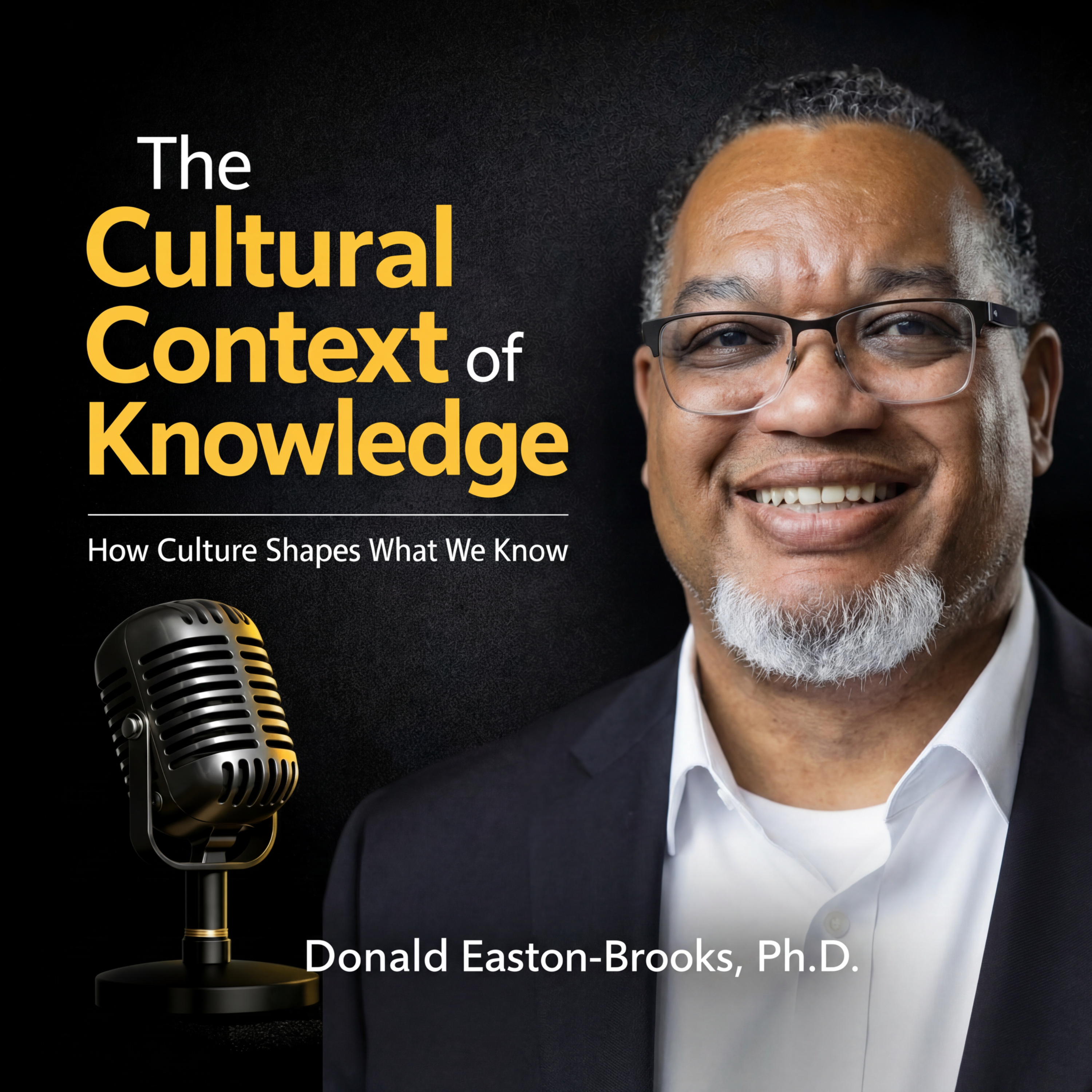
Donald Easton-Brooks Ph.D.
Cultural Context of Knowledge
A podcast about learning and the cultural context that gives knowledge meaning. Donald Easton-Brooks, Ph. D., connects research and educator practice to explore how understanding develops through scaffolding, relationships, and history, and why learning cannot be reduced to information retrieval. Built for teachers and educational leaders seeking deeper, more durable learning. Audience: Educators, teachers, instructional coaches, and school leadersFocus: Learning, learning theory, culture, and knowledge. Host: Donald Easton-Brooks, Ph. D., is an award-winning international scholar recognized
Visita il sito del podcast e sostieni chi lo crea: donaldeastonbrooks.com
Autore
Donald Easton-Brooks Ph.D.
Categoria
Sito del podcast
Ultimo episodio
21 ott 2026
Dove ascoltare?
I podcast nell'app Replaio Radio In arrivoI podcast stanno per arrivare nell'app. Installala ora e scopri per primo un modo tutto nuovo di vivere i podcast
 Installala gratis
Android quasi 10 mln di download · valutazione 4,8
iOS in arrivo
Episodi
The Language in the Room: Who Decides What a Child Learns In (S4 E1) 21.10.2026 14:18
In January 1970, the University of Ife in Nigeria began teaching a group of primary children in Yoruba for all six years of school, with English as a subject. In 2022, Nigeria made home-language instruction national policy for the early grades. In November 2025, the next government cancelled it and restored English, citing exam results. The Nigerian Academy of Education said the evidence showed th...
Season 4 Trailer: Whose Room Is It? 14.10.2026 2:33
Season 4 of The Cultural Context of Knowledge follows one question around the world: who teaches whom, in whose language, and who decided. Eight episodes, with the United States in every one of them as one case among many. The trailer opens in four classrooms at eight in the morning, on the coast of Kenya, in central India, in Barcelona, and in San Francisco in 1970. In each, the language of the l...
What the Communities Already Knew: Research, Method, and the Road Ahead (S3 E11) 12.08.2026 21:16
The season finale looks underneath the whole argument, at the research itself. Dr. Easton-Brooks traces how the evidence for ethnic matching got built, the qualitative scholars who recorded what communities already knew and the quantitative studies that gave it scale, and shows the two did not compete but depended on each other. He carries the season's missing column from the old datasets into the...
Beyond the Schoolhouse Door: Ethnic Matching in Higher Education (S3 E10) 05.08.2026 15:01
For nine episodes this season, ethnic matching stayed inside the PK through 12 classroom. This one steps past the schoolhouse door into higher education, where access is no longer the main barrier and the real work is belonging and cultural responsiveness. Dr. Easton-Brooks returns to the demographic wave he charted in 2009, now arrived: for the first time in United States history, more than half...
From Research to Policy: Pathways That Worked, and Why Most Didn't (S3 E9) 29.07.2026 18:02
The case for ethnic matching was built across three decades. This episode asks the question deferred just as long: what does it actually take to turn that research into policy that lasts? Dr. Easton-Brooks walks through the workforce gap that has not closed, the three structural barriers that keep it open, and the four models that have worked, from Grow Your Own programs and paid residencies to Mi...
Where Is the Data: The Quantitative Wave (S3 E8) 22.07.2026 30:27
A doctoral student sits in the back of a Denver board meeting and watches the whole season come to a point in about nine seconds. Community representatives present the findings of the scholars he has spent years reading. A board member leans forward and asks, where is the data. A presenter answers, this is the data. The board member says, where are the numbers. Then silence. Dr. Easton-Brooks has...
The Research Comes Home: The Qualitative Turn (1980 to 2000) 15.07.2026 22:20
In 1966 the Coleman Report measured six hundred thousand children and, for all its reach, missed the ones it claimed to see. It studied children of color with instruments built by people who had never lived their lives, then wrote its findings in the language of numbers, as if numbers were neutral. A generation of scholars of color read that report and reached a hard conclusion: the data did not f...
The Chair Was Full (S3 E6) 08.07.2026 18:39
They came to measure children like me, and they could not see the one thing that was carrying us. I was born in 1964, and this episode is personal. I grew up in Texas schools where nearly every teacher at the front of my classroom was Black, from my own neighborhood, and knew my family before I said a word. I had the match. For five episodes this season I told you other people's history. This time...
What Winning Cost (S3 E5) 01.07.2026 28:39
A sixteen-year-old girl named Barbara Rose Johns was tired of being taught in a tar-paper shack. In 1951 she led four hundred and fifty of her classmates out on strike, and that walkout became one of the five cases the Supreme Court joined together as Brown v. Board of Education. A child started it. This episode holds two truths at once. First, the long road to Brown, carried at the same time by M...
The Lie in the Lesson (S3 E4) 24.06.2026 33:44
Somewhere around 1930, a child sat in a classroom and learned to be ashamed of her own grandmother. Between 1921 and 1940, the harm of the official school was finally named out loud. The lesson itself had become the weapon: a history book that erased the child, a separate "Americanization" room that called her Spanish a deficit, a federal curriculum built to scrub a Native nation out of...
The Schools Built Against Them: What the Schools Were Protecting Children From (S3 E3 Part 2 of 2) 17.06.2026 12:24
The research did not discover this. It arrived, generations late, at a door the families had been standing behind the whole time. Part two turns from the schools communities built to the harm those schools were built to hold their children against. The official school in this era was designed to take something specific: a Mexican child's Spanish, traded for shame; a Native child's language and kin...
The Schools Built Against Them: What Families Knew, and What They Built (S3 E 3 Part 1 of 2) 17.06.2026 21:00
Part 1 of 2: "The Schools Built Against Them: What Families Knew, and What They Built" They did not need a court ruling to know what the school was for. They already knew. Between 1890 and 1920, Black, Native, Mexican, Chinese, Japanese, and Korean families met a public school system that was built differently for each of them: separate and starved in the Jim Crow South, federal and assimilationis...
The Teacher They Built (S3 E2) 10.06.2026 16:52
Picture four teachers, in the same country, in the same years before the Civil War. They never meet. They speak four different languages. And without knowing it, each one makes the same decision. In St. Louis, a formerly enslaved Black minister teaches children in a church basement, then on a steamboat, because no one else will. In a Southwest parish, a teacher holds a classroom in Spanish for Mex...
The Inheritance Tax Intro: Where Ethnic Matching Became (S3 E1) 04.06.2026 14:57
“Ethnic matching did not begin as a research variable. It began as a lived reality.” Season 3 opens. Dr. Donald Easton-Brooks names the season — The Inheritance Tax: Where Ethnic Matching Became — and walks listeners into the history before the history. Long before the research field had a term for it, Black, Native, Latino, and Asian communities in the U.S. were already practicing what scholars w...
Season 3 Trailer: Ethnic Matching: What Forty Years of Research Already Knows 29.05.2026 3:29
Season 3 of The Cultural Context of Knowledge takes up ethnic matching: the research that asks what happens to students, especially Black, Latino, and Indigenous students, when the teacher in front of them shares aspects of their cultural background. Twelve episodes. One through-line. Forty years of evidence on how matched and unmatched classrooms produce different outcomes, why the teaching workf...
Will Education Pivot With It?: Designing for the World That Already Exists (S2 E10) 27.05.2026 15:39
"The pivot the season has been asking about is not waiting on a new theory. It is waiting on the workforce." We opened this season with a question. The demographic pivot has already happened. Will education pivot with it? After nine episodes describing the architecture (institutions, laws, the hidden curriculum, AI, standards-setting, assessment), the season closes by returning to the cl...
When Assessment Becomes Gatekeeping: An Instrument That Was Never Calibrated Against You (S2 E9) 20.05.2026 18:46
"A number issued by an instrument that was never calibrated against you is not a verdict. It is the instrument telling on itself." Two students take the same standardized reading test. Question fourteen is about a regatta, a sailing race. The first student has been to the harbor every summer of her life. The second has never seen a regatta. They both finish the test. The test reports the...
How State Standards Get Written: Curriculum as Compromise (S2 E8) 13.05.2026 17:51
"A document written in a meeting you have never seen still walks into your child's classroom every morning." Imagine a state standards committee. About twenty people at a long table. Most are educators or administrators, some are content specialists, at least one represents a major textbook publisher. There is rarely a current classroom teacher who isn't also a department chair. There is even more...
AI as the New Gatekeeper: Whose Knowledge the Model Was Built to See (S2 E7) 06.05.2026 17:55
"A model that fills a silence with itself has not answered. It has spoken over you." Two high-school seniors. Same model. Same kind of paper. One asks about jazz. One asks about her grandmother's healing tradition. Both get fluent, structured, authoritative answers. Both get solid grades. But only one of them got a paper grounded in a tradition the world had recorded. The other got a paper quietly...
The Hidden Curriculum: What Schools Teach Without Teaching (S2 E6) 30.04.2026 15:21
"The word violence demands an intervention. The word bias asks for a workshop." This season has been organized around one relationship — knowledge and power. Who decides what counts. Whose voice the institutions treat as the default. This episode names what that relationship looks like when it lands on a six-year-old. Most accounts of the hidden curriculum stop at unfairness. This one names what t...
The Backlash: Anti-CRT Laws and Classroom Censorship (S2 E5) 24.04.2026 10:27
"A history that cannot be told does not disappear. It waits for someone to find the words." When marginalized knowledge finally wins a place in the curriculum, something else happens at the same time. It gets targeted. This episode traces a pattern — dismissal, absorption, restriction — the predictable way dominant knowledge systems respond when histories from the margin enter the classroom. The R...
Teacher Diversity and the Curriculum: Who Gets to Teach It (S2 E4) 20.04.2026 11:15
Integration happened to the students. It did not happen to the teaching profession. This episode revisits the Brown v. Board–era displacement of Black educators rarely included in the standard story, examines what decades of research on ethnic matching reveal about student outcomes, and asks a question the season has been building toward: once institutions decide what counts as knowledge, who do t...
Whose Knowledge Counts: Why Some Knowledge Is Marginalized (Ethnic Studies) (S2 E3) 09.03.2026 13:22
"Marginalized knowledge is rarely attacked when it is ignored. It gets attacked when it starts to move." On November 6, 1968, a coalition of Black, Chicano, Asian American, and Indigenous students walked off campus at San Francisco State College and did not come back for five months ; the longest student-led strike in U.S. history. What they demanded sounded almost unthinkable: that their historie...
From Knowledge to Legitimacy: How Institutions Decide What Counts (S2 E2) 09.03.2026 12:54
How do ideas become legitimate knowledge? In this episode of The Cultural Context of Knowledge , we explore how universities, journals, and academic institutions decide what counts as credible knowledge. Drawing on the work of Foucault, Kuhn, Merton, and Bourdieu, we examine how power, institutions, and emerging technologies shape the knowledge that appears in textbooks, research, and policy. Key...
Knowledge, Power, and the U.S. Demographic Pivot (S2 E1) 21.02.2026 7:55
The classroom has changed. Has education? For the first time in U.S. history, children under 18 are the majority non-white. Meanwhile, women now earn nearly 60% of all bachelor’s degrees, a complete reversal from the 1950s. So here’s the real question: Who decides what counts as knowledge? In this Season 2 premiere, we unpack how demographic shifts collide with outdated knowledge frameworks, and w...
Podcast simili







Ascolta il podcast Cultural Context of Knowledge su Replaio
Radio e podcast in un'unica app - gratis e senza registrazione. Installala oggi e non perderti il lancio
Replaio non è un editore di podcast; i nomi dei programmi, le copertine e l'audio appartengono ai rispettivi autori e vengono distribuiti tramite feed RSS pubblici