Al Zambone
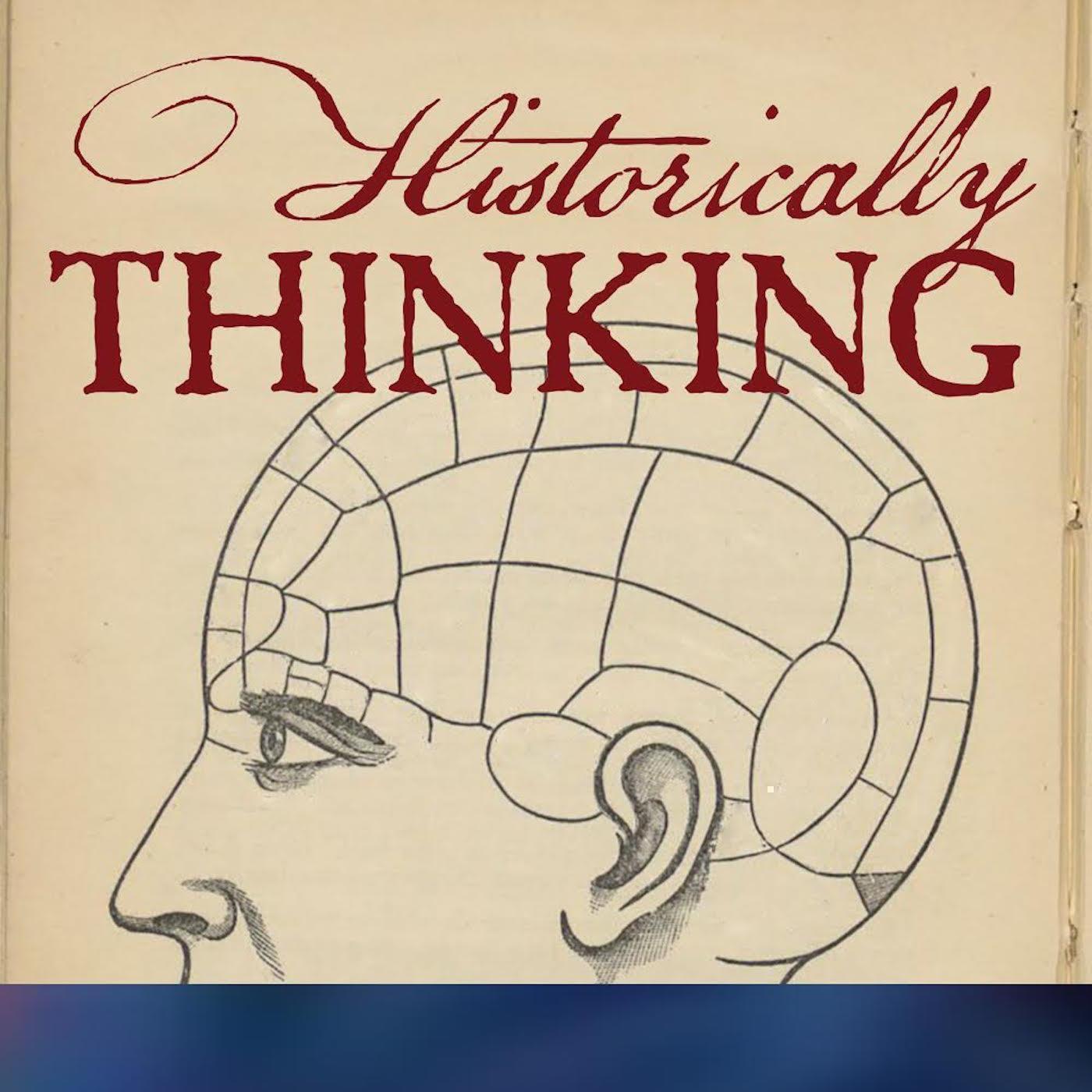
Historically Thinking
We believe that when people think historically, they are engaging in a disciplined way of thinking about the world and its past. We believe it gives thinkers a knack for recognizing nonsense; and that it cultivates not only intellectual curiosity and rigor, but also intellectual humility. Join Al Zambone, author of Daniel Morgan: A Revolutionary Life, as he talks with historians and other professionals who cultivate the craft of historical thinking.
Mindenképp látogasd meg a podcast oldalát, és támogasd a készítőjét: blubrry.com
Hol hallgathatod?
Podcastok az alkalmazásban Replaio Radio HamarosanA podcastok hamarosan megérkeznek az alkalmazásba. Telepítsd most, és láss elsőként egy teljesen új megközelítést a podcastokhoz
 Telepítsd ingyen
Android közel 10 M letöltés · 4,8-as értékelés
iOS hamarosan
Telepítsd ingyen
Android közel 10 M letöltés · 4,8-as értékelés
iOS hamarosan
Epizódok
Episode 400: Talking Cure 17.03.2025 1:04:01
This is the 400th episode of Historically Thinking. And while it’s a podcast that focuses on history, and how historians and everyone else think about the past, I do that each week through conversation. For a long time I have really wanted to believe something that Plato wrote, that “Truth, as human reality, comes about only in conversation.” So it’s fitting, I think, that we devote Episode 400 t...
Episode 399: Replicating History 10.03.2025 1:03:05
This is Episode 399 of Historically Thinking. And whenever the dial turns to 100, my thoughts turn towards what this podcast is about. So it seemed to me a good time to talk with Anton Howes. Anton Howes is official historian at the Royal Society for the Encouragement of Arts, Manufactures, and Commerce, a unique organization the subject his first book Arts and Minds: How the Royal Society of Arts...
Episode 398: The Celts 03.03.2025 1:01:49
During the age of the European Renaissance, a new people was discovered. Not the Aztecs, or the Maya, or the Inca, but a mysterious people with an intriguing language who had once dominated Europe itself. These were the Celts. And their discoverers were not conquistadores or maritime adventurers, but dusty scholars, learning their eighth or fourteenth language, rummaging through dusty manuscripts....
Episode 397: Mutiny on the Black Prince 24.02.2025 1:07:26
In April 1769 a small British vessel sailing along the southern coast of Hispaniola discovered a shipwreck near the current border of Haiti and the Dominican Republic. An investigation found no survivors aboard. But they also found a log which identified that ship as the Black Prince. And there the mystery might have ended. But over the next eight years, “ship’s crew members surfaced in unexpected...
Episode 396: Obscure Important Historian 17.02.2025 55:12
Lists of important Roman historians would certainly include cerebral Polybius (who, to be fair, was also Greek); the friend of Augustus, Titus Livius; the austere Tacitus; and the gossipy Suetonius,. To one extent or another, all of them were participant observers–not simply historians, but actors in the drama of Roman life and politics. Not usually included on this list of great Roman participan...
Episode 395: Summer of Fire and Blood 10.02.2025 1:10:09
It was the greatest popular uprising in western Europe prior to the French Revolution. By spring 1525, across regions of what are now Austria, Germany, Switzerland, and France, armed bands of peasants marched to defeat their lords and to overturn the social and religious hierarchy that had existed for centuries. At least 100,000 people were involved, and likely many more. When it collapsed in the...
Episode 394: Greek Revolution 03.02.2025 1:14:44
If English speakers—or French speakers, or Spanish speakers, or really most any speaker of any language other than Greek…or Turkish—think about the Greek Revolution at all, then that’s amazing. If they do not, then they continue to ignore one of the most consequential collection of events in the 19th century, a series of imperial overlaps, social convulsions, massacres, sieges, expulsions, and som...
Episode 393: Lawless Republic 27.01.2025 1:10:07
Marcus Tullius Cicero lived from 106 BC to his murder in 43 BC. He was a writer, a philosopher, a traveller, a consul of the Roman Republic, and perhaps one of the last people to take the Roman Republic seriously–even when it was long past its shelf date. But most importantly, Cicero was a lawyer—and it was his practice of the law that was at the heart of his philosophy, politics, and devotion to...
Episode 392: Papa von Ranke 13.01.2025 55:22
He was and has been criticized as a “mere burrower into archives”; as a dry man without any ideas; as a painter of miniatures rather than of broad portraits; as a conservative by liberals, and insufficiently dogmatic by conservatives; as motivated by the Lutheran religion of his forebears, but also as a scholar set against teleology and mysticism. This was Leopold von Ranke, born in 1795, dying in...
391: Roman Roads 07.01.2025
Listeners to this podcast are certainly aware of the saying that “all roads lead to Rome”; and, given this audience, you might even be aware that this probably derived from the observation mīlle viae dūcunt hominēs per saecula Rōmam, made by the 12th century theologian and poet Alain de Lille. But what is the history of the Roman roads, or rather, what is the history of how people imagined and rel...
Episode 390: Atlantic Ocean 30.12.2024
“He was a bold man who first ate an oyster,” observed Jonathan Swift; and in fact the first human interaction with the Atlantic Ocean was probably eating shellfish, traces of which can be found along the Western Cape of South Africa dating back 160,000 years ago. When humans began to finally live in numbers along the ocean coast, their culture changed. They took their food from it, and from the sh...
Episode 389: Indian Religions 23.12.2024 1:06:01
“India has 2,000,000 million gods, and worships them all,” wrote Mark Twain, following his 1896 speaking tour of British India. “In religion other countries are paupers; India is the only millionaire.” Twain was exaggerating, but perhaps only a little. Consider that Hinduism, Buddhism, and Jainism all took form some 2,500 years ago in South Asia, that they and their offshoots are now practiced by...
Episode 388: Agent Zo 16.12.2024 1:13:58
In the first months of 1939, before the world changed, Elzbieta Zawacka had an MA degree in Mathematics, and was an enthusiastic instructor in Poland’s “Women’s Military Training” organization, established to prepare women for service in a future war. When that war came, Elzbieta believed from the start that she was a soldier as much as any man. Under Nazi occupation she established espionage netw...
Episode 387: The Study 09.12.2024 1:06:54
In the sixteenth century wealthy men and women began to collect books. With these they began to furnish a new room in the house which they called the studiolo. In the “little study” one could read in happiness and contentment, safe from an external world beset by wars and plague. They could conduct conversations with their contemporaries by letter, and with the dead of past ages through their read...
Episode 386: College Sports 04.12.2024 1:08:37
Many college professors like to remind each other that no other nation on earth has the system of collegiate sports that has developed in the United States, one in which the mishaps of a mediocre football team attract much more attention than what goes on in classrooms, labs, and libraries–and yes, I am thinking of the University of Virginia. These professors love to quote Cornell President Andre...
Episode 385: Golden Years 25.11.2024 55:33
When did old age in America first begin? That is, when did we first begin to conceive ideas about a stage of life in which older people no longer participated in the labor force, but nevertheless had a meaningful place in the world, deserving of respect, security, and dignity. My guest James Chappel argues that this is an idea that became prominent in the American consciousness at a certain poin...
Episode 384: Intent to Destroy 22.11.2024 1:12:58
Many were shocked in February 2022 by the Russian attempt to seize Kyiv and decapitate the Ukranian regime, thereby ending the war begun in 2014. But this was simply the latest in a long series of Russian attempts to “divide and oppress Ukraine.” Since the 19th century, dominating Ukraine has been a cornerstone of Russia’s national identity. To prevent Ukraine from choosing an alternative, Russian...
Episode 383: Quaker Founder 18.11.2024 1:12:06
As today’s guest writes in the introduction of her new book Penman of the Founding: A Biography of John Dickinson, “For more than two hundred years, John Dickinson has suffered from an image problem that no one in his day would have thought possible." In Signers’ Hall at the National Constitution Center in Philadelphia, the statue of John Dickinson stands alone in a corner, hand pensively on chin,...
Episode 382: Women and the Reformations 08.11.2024 1:31:28
A forensic reconstruction of Saint Rose of Lima From the early 16th century, and for over two hundred years after that, a series of convulsions within the Christian church of Western Europe led to its splintering, but also to an incredibly rapid movement of ideas and practices to the four corners of the earth. These convulsions—or reformations—were responsible not only for changes in the practice...
Episode 381: Philosophy to the People 04.11.2024 1:20:40
His lectures at the College de France were so popular that people arrived at the lecture hall at least an hour in advance. When he finally spoke, it was standing room only, with men literally climbing in the windows. During his first visit to New York, his presence on the Columbia University campus caused one of the earliest recorded traffic jams. And when the French government sought to encourage...
Episode 380: Madrid 28.10.2024 1:16:24
For nearly five centuries Madrid has been the capital of Spain, and the focus of frequent contempt by foreign visitors, as well as the scorn and hatred of Spaniards. Prime Minister Manuel Azaña Díaz, born just 31 kilometers from Madrid, would write that in “Madrid there is nothing to do, nowhere to go, nothing to see. Madrid is a town without history. In Madrid, nothing has happened because in two...
Episode 379: Philadelphia 14.10.2024 1:05:04
It is no longer the largest city in America, or the second largest, or even the fifth largest, but there are still those of us who love it. While modern American cities are all racially, ethnically, and religiously diverse, it has always been so, from before it was even a city. Modern American cities, simply because of size, are also stages for a variety of conflicts, and this city has from its be...
Episode 378: Old New World 07.10.2024 1:11:34
For a few hundred years, the New World of the Americas was thought to be genuinely new. But in the course of the nineteenth century, Americans became increasingly uncertain about the ground beneath their feet. Canal building uncovered strange creatures like enormous crabs; seams of coal were determined to be fossilized forests. And while no living mammoths or mastodons were discovered in the lands...
Episode 377: BIG HISTORY (From the Archives) 30.09.2024
This podcast originally dropped on December 17, 2015. If we had the reverb and the talent, we'd introduce this week's podcast like one of those guys touting a monster truck event on "SUNDAY, SUNDAY, SUNDAY." Because this week we're talking about Big History–and calling it Big is actually kind of an understatement. That's because practitioners of Big History, like today's guest Craig Benjamin, beg...
Episode 376: Venerable Bede 24.09.2024 59:13
Generations of college students have probably imagined that his first name was Venerable, and his family name Bede. But Bede–that’s B-E-D-E–was his only name. He was a native of Northumbria, in the north of what we now think of as England. Apparently never going abroad, his life was spent within a few miles of his monastery, and probably just a few miles from where he was born. Yet this seemingly...
Hasonló podcastok






Hallgasd a(z) Historically Thinking podcastot a Replaióban
Rádió és podcastok egy alkalmazásban - ingyen és regisztráció nélkül. Telepítsd még ma, és ne maradj le a premierről
A Replaio nem podcastkiadó; a műsorok nevei, borítóképei és hanganyagai a szerzőiket illetik, és nyilvános RSS-csatornákon keresztül terjednek.