Sarah Rogers
The Art of Space Engineering
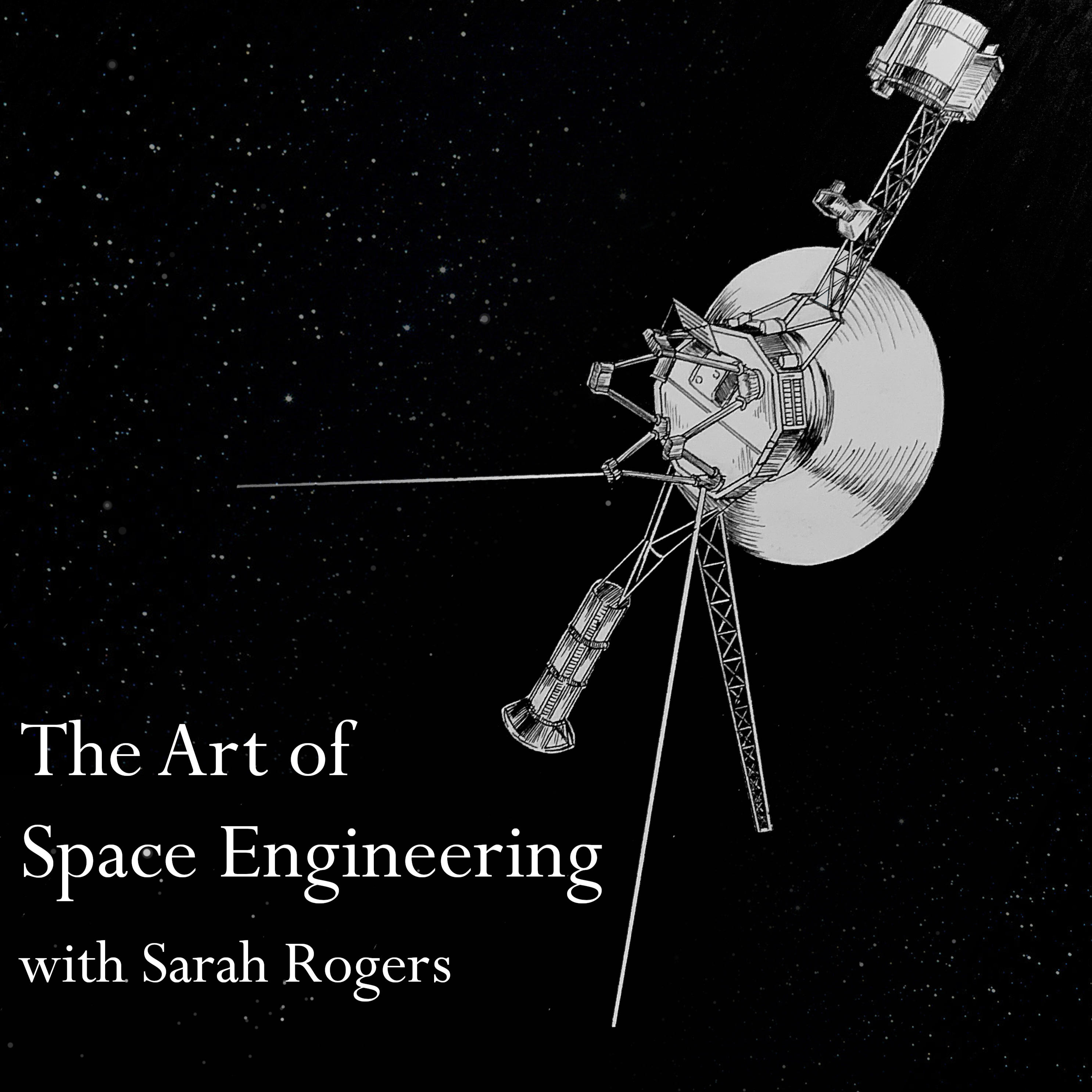
The Art of Space Engineering is a podcast which aims to explore the details behind how spacecraft and various payloads come together before launch, and the lessons learned along the way. Episodes feature discussions between faculty, students, and industry professionals on topics including instruments, CubeSats, and various engineering disciplines, to provide a well-rounded overview of what it takes to prepare space systems for missions both in and beyond Earth's orbit. Hosted by Sarah Rogers Cover art design by Amy LiuFeel free to connect with me! Email: artofspaceeng@gmail.comLinkedIn: https:...
Où écouter ?
Les podcasts dans l'appli Replaio Radio Bientôt disponibleLes podcasts arrivent très bientôt dans l'appli. Installe-la dès maintenant et découvre en avant-première une toute nouvelle façon de vivre les podcasts
 Installe-la gratuitement
Android près de 10 M de téléchargements · note de 4,8
iOS bientôt
Installe-la gratuitement
Android près de 10 M de téléchargements · note de 4,8
iOS bientôt
Épisodes
#30 - Tilebox: End to End Data Processing for Space Missions (Laura Costa Ortega & Laura Todd) 04.03.2025 58:28
Episode Overview This episode features a discussion with Laura Costa Ortega, the co-founder of Tilebox, and Laura Todd, Vice President of Space Exploration Future Programmes at Airbus Defense and Space and mentor at the Creative Destruction Lab. We discuss the challenges of processing data products collected by space missions and new methodologies being developed to improve efficiency of the end t...
#29 - Operating Satellite Constellations at Planet Labs with Deanna Farago 10.03.2024 55:28
Episode Summary This week’s episode features a conversation with Deanna Farago on how Planet Labs manages efficient commissioning and nominal operations for its constellation of over 200 satellites. Planet Labs was founded in 2010 with a goal to collect high resolution imagery of the entire earth every day. Today, Planet’s dataset includes, on average, 1700 images of every place on Earth. Th...
#28 - Developing the AOS Mission Architecture with Dr. Scott A. Braun 30.01.2024 1:10:33
Episode Summary NASA’s Atmospheric Observing System (AOS) is a constellation of 4 smallsats which will help characterize aerosol, cloud, convection, and precipitation processes to give insight into extreme weather events as well as climate change. The spacecraft have been designed to compliment each other with their orbits as well as their instrument suite (which includes radar, lidar, limb sensor...
#27 - Europa Clipper Instrument Science Traceability & Alignment Framework with Dr. Laura Jones-Wilson 26.12.2023 1:58:00
This episode features an interview with Dr. Laura Jones-Wilson on the development of a science traceability and alignment framework (STAF) for NASA’s Europa Clipper mission, which will launch in late 2024. It covers how the science objectives of the Europa Clipper were organized through the STAF and used to derive the top level requirements for its nine different science instruments. This helped e...
#26 - Flight Dynamics of the Dragonfly Rotorcraft with Dr. Jack Langelaan 09.02.2022 1:02:45
Scheduled to launch in 2027, Dragonfly will be the first spacecraft to fly on Saturn’s moon, Titan. Data from Cassini-Huygens revealed evidence of a subsurface ocean, made of water and ammonia, as well as stable bodies of liquid hydrocarbons on the surface. This makes Titan the only other body in our solar system with a stable liquid source on its surface. These features make it an incredibly valu...
#25 - A Conversation on Running Student-Led Projects, with Adi Khuller, Omar Alavi & Joe Mayer 30.12.2021 1:35:57
This episode features a roundtable discussion between myself, Adi Khuller, Joe Mayer, and Omar Alavi about life as engineering students and how we balanced working on projects and coursework at ASU. This diverts from my usual content on space mission engineering, but it is a topic I feel is important to focus on, as this is something that many students struggle with on some level. Given that, if y...
#24 - Pulsed Plasma Thrusters, with Adi Khuller, Omar Alavi & Joe Mayer 30.12.2021 1:41:35
This episode includes a conversation with Adi Khuller, Joe Mayer, and Omar Alavi on the design and implementation of Pulsed Plasma Thrusters (PPTs) and how these can be integrated into CubeSats, specifically. Adi, Omar, and Joe were the core of a group of people who designed and prototyped a state-of-the-art PPT system for CubeSats during their undergrad at ASU. Their PPT was developed entirely by...
#23 - Space Systems Integration LLC & the Art of Space Mission Engineering (with Dr. Tobin Anthony & Chris Costello) 24.12.2021 1:02:05
A mission’s scope, budget, and schedule are all very intertwined, and all are an important part of setting the foundation and feasibility for a project. This makes for a rather complex recipe within space mission development. However, it also means that there is a great deal of knowledge that can be gained from this topic. Episode 23 features a conversation with Dr. Tobin Anthony (CEO) and Chris C...
#22 - Spacecraft Frequency Licensing Explained (Amateur & Experimental Licenses), with Alicia Johnstone 29.09.2021 1:17:08
Frequency licensing is one of the most important logistics when it comes to preparing spacecraft for launch. Spacecraft must have this before they are allowed to transmit or receive on a frequency, and therefore, they must be licensed in order to launch. This episode features a conversation on frequency licensing with Alicia Johnstone, who is the resident expert on licensing at Cal Poly and has he...
#21 - The LunaH-Map CubeSat: Searching for Hydrogen at the Lunar South Pole, with Dr. Craig Hardgrove 24.09.2021 1:35:20
LunaH-Map is a 6U CubeSat, which will map the location and quantity of hydrogen in permanently shadowed regions of the lunar south pole. In doing so, the spacecraft will help scientists and engineers quantify the amount of water available in this region, which can then be used to help humanity live on the moon, sustainably. Measurements will be collected using a neutron spectrometer, which was dev...
#20 - Calling Major Tom: Cloud Based Mission Control, with Tyler Browder 08.09.2021 1:08:58
This episode features a conversation with Tyler Browder, who is the CEO and co-founder of Kubos, whose application, Major Tom, provides a cloud-based solution to operating spacecraft from orbit. Utilizing cloud-based platforms helps reduce development and maintenance resources, as well as allows spacecraft to be operated from anywhere. This discussion dives into how Kubos has been designed to help...
#19 - Unveiling Planetary Mysteries, with Dr. Hugh Kieffer 25.07.2021 1:23:54
Dr. Hugh Kieffer is a renowned geophysicist who studies planetary bodies across the solar system through a combination of numerical modeling and remote sensing. He is the creator of KRC, a planetary thermal model of Mars, which has become the gold standard for predicting temperatures on Mars and other planetary bodies (planets, moons, comets. etc.). He also served as the Project Investigator (PI)...
#18 - Developing the Mission Operations Phase with Ernest Cisneros 25.03.2021 1:28:26
Preparing for the operations phase of a mission is a lot more challenging than it sounds. What information will help me understand the state of the entire spacecraft? What risks might we need to mitigate? What do we need to train people to operate this spacecraft so they can detect anomalies and help resolve them? And how do we organize all of this for a system with a lot of moving parts? This epi...
#17 - Terahertz Electronics for Astrophysics Research (Part 2) with Justin Mathewson & Jonathan Hoh 28.02.2021 1:09:33
THz research! The great basement flood! Betashell! This episode continues the discussion with Justin and Jon on the work done by ASU’s THz lab, and highlights lessons learned, testing LNAs, the great basement flood of 2019, and other words of wisdom for students. Justin and Jon are both part of the THz Lab at Arizona State University, and have contributed to a variety of projects that will benefit...
#16 - Terahertz (THz) Electronics for Astrophysics Research (Part 1) with Justin Mathewson & Jonathan Hoh 28.02.2021 1:23:02
Scientists can gain a great deal of insight into how our universe began and its current state by measuring signals in the THz spectrum, which includes frequencies on the order of 1011 - 1013 Hz. The THz spectrum gives us information on the composition of interstellar gasses, the detection of water on other planetary bodies, and other dynamic processes in planetary atmospheres, such as radiation ba...
#15 - Differences Between CubeSats & Large Spacecraft with Prof. Chuck Boehmer 20.02.2021 1:27:10
CubeSats (small spacecraft ranging from the size of a tissue box to the size of a shoebox) have become widely popular within the universities across the globe as more teams utilize this platform to conduct scientific research, demonstrate new technology, and educate the next generation of engineers. However, student-led CubeSat projects can be very different from industry-level projects, both in t...
#14 - SpaceX Dragon Avionics with Kate Hendrix 29.01.2021 1:31:09
Episode 14 features an interview with Kate Hendrix, who’s career has taken her to SpaceX, Astranis (geostationary satellites), and Luminar Technologies (LiDAR technology). Today’s episode discusses the electrical power avionics systems on the Dragon Spacecraft and what goes into developing them. In addition to avionics, we dive into a bit of SpaceX’s early history, lessons learned over the years,...
#13 - Phoenix Team Structure & What I’d do Differently - PhxSat Q&A Sessions (with the Polytechnic University of Milan, Pt. 2) 22.01.2021 38:18
This episode continues a Q&A conversation with Lyle Campbell and Andrea Sportillo from the Polytechnic University of Milan in Italy, in which we discuss what went into getting the Phoenix CubeSat up and running at ASU. In particular, this episode will cover how we structured the team and general meetings, as well as a few things I would do differently if I were to start a student-led CubeSat proje...
#12 - How the Phoenix CubeSat got Started - PhxSat Q&A Sessions (with the Polytechnic University of Milan, Pt. 1) 22.01.2021 46:27
Episode 12 features a Q&A session with Lyle Campbell and Andrea Sportillo from the Polytechnic University of Milan in Italy, in which we discuss what went into getting the Phoenix CubeSat up and running at ASU. Part 1 of this two-part conversation discusses exactly how the idea for Phoenix got started at ASU, where our funding came from, a bit about our interactions with mentors and with NASA, how...
#11 - Phoenix Comms & Ground Station Development - PhxSat Q&A Sessions (with Rhodes College) 19.01.2021 1:06:30
Today’s episode focuses on the RF side of CubeSat development, both on the spacecraft and the ground station side. I’ll be chatting with Jose Pastrana and Joe McPherson from Rhodes College in Memphis Tennessee about various challenges we faced while working with our UHF transceiver (transmitter/receiver), how we solved these problems while trying to transmit data from the spacecraft to the ground...
#8 - Machine Learning in Remote Sensing with Dr. Hannah Kerner 09.01.2021 58:00
Machine learning has incredible applications for the science community when it comes to processing data once it’s been downlinked and perhaps, even processing data on a spacecraft. Applying machine learning algorithms to these applications allows scientific analysis to become much more efficient and therefore have a greater impact not just in planetary science but also in industries which impact o...
#9 - Spacecraft Electric Propulsion (Part 1) with Dr. Daniel White 09.01.2021 1:06:23
Chemical propellant has enabled spacecraft to explore other planets in ways that people once thought impossible, but, in the grand scheme of exploring our solar system and going beyond it, this can ultimately only get us so far. Enter electric propulsion systems, which propel a spacecraft by using electromagnetic forces to accelerate a gas. This method provides several benefits over traditional pr...
#10 - Spacecraft Electric Propulsion (Part 2) with Dr. Daniel White 09.01.2021 44:51
This episode continues the discussion on spacecraft electric propulsion systems with Dr. White, and focuses on system performance, relevant research in materials science, how propulsion systems are tested, and lessons Dr. White has learned from his experiences.
#6. - Phoenix CubeSat Structures & Integration (Part 2): Flight Integration & Delivery 09.01.2021 50:49
In Part 2 of our discussion on systems integration for the Phoenix CubeSat, Jaime, Vivek, and I recount stories from flight integration, vibe testing, and delivery to the Nanoracks in Houston. This episode also features our infamous story on how Phoenix’s launch date was saved by Kapton tape. So if you’re curious to know what things to look out for in the final phase of the system integration and...
#7 - Thermal Modeling, Control & TVAC Testing with Belinda Shreckengost 09.01.2021 1:26:00
In space, a spacecraft can experience extreme hot and cold temperatures based on its distance from the sun and orbit around a planet. As a result, spacecraft incorporate a control system to maintain hardware within an allowable temperature range so they don’t become damaged. While thermal control systems are essential for spacecraft, modeling and designing these is not an easy or straightforward t...
Podcasts similaires







Écoute le podcast The Art of Space Engineering sur Replaio
La radio et les podcasts dans une seule appli - gratuite, sans inscription. Installe-la dès aujourd'hui et ne rate pas le lancement
Replaio n'est pas éditeur de podcasts ; les noms des émissions, les visuels et l'audio appartiennent à leurs auteurs et sont diffusés via des flux RSS publics