Smile with Daniel
Smile with Daniel
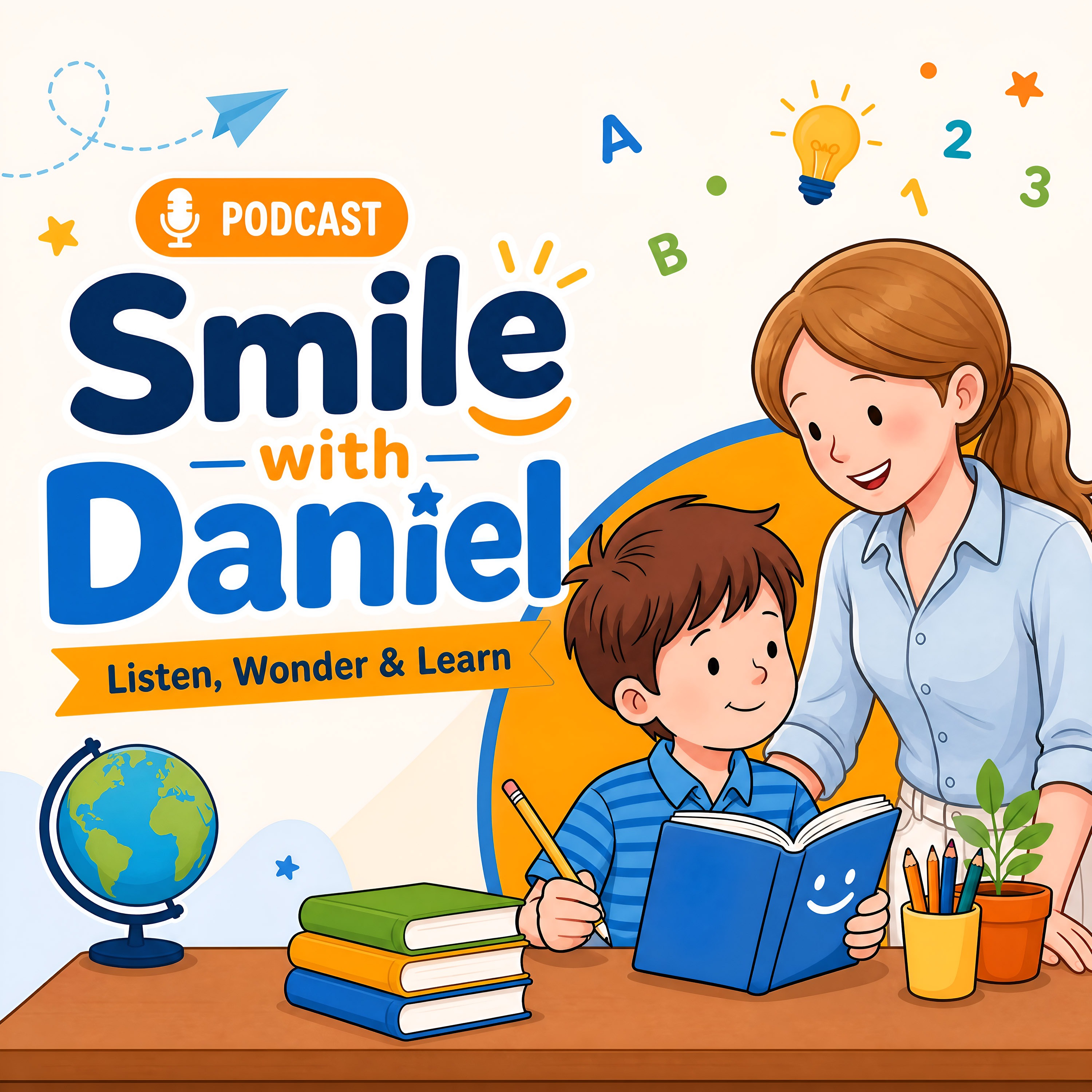
Every night, Daniel asks his mom a question. Why do we call money "bucks"? Why do we get dizzy when we spin? Why do we knock on wood? The answers are always surprising — and a lot more interesting than you'd expect. Smile with Daniel is a short podcast for curious kids and the adults who love them. Real questions. Real answers. No dumbing it down. New episodes every week. Find us @smilewithDaniel everywhere.
N'hésitez pas à visiter le site du podcast et à soutenir son créateur : rss.com
Où écouter ?
Les podcasts dans l'appli Replaio Radio Bientôt disponibleLes podcasts arrivent très bientôt dans l'appli. Installe-la dès maintenant et découvre en avant-première une toute nouvelle façon de vivre les podcasts
 Installe-la gratuitement
Android près de 10 M de téléchargements · note de 4,8
iOS bientôt
Épisodes
Why Is Everyone Racing to Mars? 21.09.2026 9:57
Download the free "Why Is Everyone Racing to Mars?" worksheet for fun questions, listening challenges, and activities inspired by this episode. Mars has rivers. Or it did. Ancient ones, carved into rock that is now bone dry. Scientists believe Mars was once warmer and wetter, possibly with conditions that could have supported life. Now it is a red desert with no breathable air — and the attention...
How Did a Volcano Help Invent the Bicycle? 21.09.2026 9:11
Download the free "How Did a Volcano Help Invent the Bicycle?" worksheet for fun questions, listening challenges, and activities inspired by this episode. In April 1815 a volcano in Indonesia erupted so violently that people heard the explosion two thousand kilometers away. The following summer, it snowed in New England in June. Harvests failed across Europe and North America. Food prices soared....
Why Is Tesla Named After Nikola Tesla? 17.09.2026 9:09
In January 1943 a man died alone in a New York hotel room with almost nothing. At that exact moment, electrical systems built partly on his inventions were powering cities across the world. His name was Nikola Tesla. And his story explains why one of the world's most famous electric car companies carries his name. Tesla did not invent electricity or alternating current. What he did was help solve...
Why Do We Have Different Time Zones? 17.09.2026 8:53
Daniel opens with a joke about time zones and the future looking bright. Then he asks the real question. For most of human history, every town kept its own local time based on when the sun was overhead. If you were traveling by foot or horseback, the gradual difference between towns barely mattered. Trains changed everything. A railway needed a published schedule. But if every town kept its own so...
What Does Social Media Do to a Kid's Brain? 16.09.2026 7:50
Daniel wants to know if social media is actually bad for you — or if that is just something adults say. The answer turns out to be more interesting and more complicated than most headlines suggest. Many social media apps are designed to keep you engaged and coming back. Notifications pull you back. Infinite scroll removes a natural stopping point. And unpredictable social feedback — sometimes a po...
How Do Movies Trick Your Brain? 14.09.2026 7:38
Daniel knows movies are shown on a screen. He wants to know how his brain sees movement when he is really watching still pictures. The answer is stranger than most people realize. A film is a sequence of still photographs, typically around 24 per second for cinema. When they are shown fast enough, the brain does not see individual images flickering. It perceives continuous motion. But the motion i...
Why Are There 12 Months in a Year? 12.09.2026 9:34
Daniel notices something. September, October, November, and December sound like they mean seven, eight, nine, and ten. But they are the ninth, tenth, eleventh, and twelfth months. He wants to know why. The names are a fossil. The Roman year once started in March. September was the seventh month. October the eighth. When the calendar changed, the names stayed. The reason there are twelve months com...
Why Did Everyone Used to Wear a Hat? 10.09.2026 8:24
Daniel is looking at old photographs and notices that everyone is wearing a hat. On the street, at the beach, at baseball games. Everyone. He wants to know when that stopped and why. The hat was doing several jobs at once. It offered protection from the weather. It signaled social position, occupation, and how formally you were dressed. And for a long time it was simply what a respectable person w...
Why Do Crickets Chirp All Night? 07.09.2026 9:06
Daniel is lying awake listening to crickets and wants to know why they never stop. The short answer is that they are trying to find a mate. But the longer answer is more interesting. Crickets do not make their sound by rubbing their legs together. They rub their wings together in a process called stridulation. One wing has a ridged edge called a file. The other has a scraper. Each pass produces a...
Why Are Police Cars Mostly Black and White? 04.09.2026 9:04
Daniel assumes police cars have always been black and white everywhere. They have not. And the origin of the ones that are is murkier than most people expect. Black was common on early American cars because it was an inexpensive factory finish. As police departments grew, the problem became recognition -- a dark patrol car blended in with civilian traffic. Departments began experimenting with cont...
Why Don't All Countries Measure Things the Same Way? 02.09.2026 11:40
Daniel's friend in England measures distance in miles but temperature in Celsius and weight in kilograms. That inconsistency turns out to tell a much bigger story. The metric system was created during the French Revolution to replace a chaotic patchwork of local measurement standards across Europe. Different units with the same name could mean different things in different places. Revolutionary Fr...
Why Are Tires Always Black? 31.08.2026 8:56
Daniel notices that almost every tire he sees is black. Cars. Trucks. Bicycles. Always black. Natural rubber is not black. It is off-white -- milky and pale, the color of latex from a rubber tree. Early car tires in the 1900s were white or light-colored. They also wore out far faster than modern tires. The reason tires are black today is a single additive: carbon black. A fine dark powder made fro...
Why Do Coconuts Have Three Holes? 30.08.2026 7:49
Daniel notices the three dark spots on a coconut. They look like a face. Two eyes and a mouth. They are not just for looking like a face. Those three spots are germination pores -- soft points in the hard inner shell -- and they reveal something about how the coconut fruit was built. Usually only one of the three is functional. That is the pore the developing seedling uses to push through when a c...
Why Do Pirates Wear Eye Patches? 29.08.2026 8:53
Daniel assumes pirates wore eye patches because they lost an eye. That is probably part of the answer. But there is a more interesting theory. When you move from bright light into darkness, your eyes need time to adjust. Full dark adaptation can take up to half an hour. Part of what happens involves rod cells at the back of the eye becoming more sensitive to dim light -- a process that takes time...
Bone vs. Steel: Which Is Actually Stronger? 28.08.2026 8:55
Daniel assumes steel wins easily. It does -- in one measurement. But the question turns out to be more interesting than a simple winner. Steel has a higher tensile strength than bone. But steel is also roughly four times as dense as cortical bone. When you compare by weight rather than volume, bone becomes much more impressive. And there is one thing bone does that steel cannot do at all. Fix itse...
How Do Robotaxis Drive Without a Driver? 26.08.2026 9:35
Daniel sees a video of a Waymo robotaxi driving through San Francisco with nobody in the front seat. He assumes it must be following GPS. It is doing something far more interesting. The car is constantly answering four questions: Where am I? What is around me? What might happen next? What should I do? It answers all four simultaneously, in real time, without a human involved. Before Waymo operates...
Six Bricks. 915 Million Combinations. The LEGO Story 25.08.2026 9:08
Daniel is building with LEGO and starts wondering why it feels so satisfying. The answer turns out to involve extraordinary precision engineering, a Danish carpenter, a fire, and a near-bankruptcy that almost erased one of the most beloved toy brands in history. LEGO started in 1932. Ole Kirk Kristiansen was a carpenter in Billund, Denmark, struggling through an economic crisis. He began making wo...
Electric Cars Are Almost 200 Years Old 24.08.2026 8:51
Daniel asks whether electric cars are going to take over from gasoline cars. Mom asks him a more interesting question. Did he know electric cars were already competing with gasoline cars more than a hundred years ago? He did not. The earliest experimental electric carriages appeared in the 1830s. By around 1900, electric cars were serious competitors to gasoline cars in the United States -- quiete...
Why Do Some Countries Call It Tea and Some Call It Chai? 23.08.2026 7:04
Daniel assumes chai is a different drink from tea -- the spiced version with milk. It isn't. Chai and tea are the same word. They both trace back to a single Chinese character -- 茶 -- that means tea. But Chinese has many varieties of speech, and that same character was pronounced differently in different parts of China. Two of those pronunciations left China by two very different routes -- and th...
Why Are Fire Hydrants Different Colors? 21.08.2026 9:02
Daniel walks past a green fire hydrant and wonders why it isn't red. The colors are not decoration. They can be information. Fire departments and water systems can use color to tell firefighters important things about a hydrant at a glance. Under a system recommended by the National Fire Protection Association, the color on the top and caps of a hydrant can indicate its rated flow capacity -- how...
Why Are They Called Wisdom Teeth? 21.08.2026 8:42
Daniel assumes wisdom teeth make you smarter. They don't. The name has nothing to do with intelligence. Wisdom teeth are called that because of when they arrive -- somewhere between seventeen and twenty-five, an age historically associated with maturity. The Latin name is dens sapientiae. Tooth of wisdom. People have noticed their late arrival for thousands of years -- Aristotle wrote about them m...
Why Do We Call Ships "She"? 20.08.2026 8:30
Daniel notices that ships are always called she -- her hull, her crew, she sailed. He wants to know why. The honest answer is that nobody knows for certain. But the clues that have survived are each interesting in their own way. There is a theory from language. The Latin word for ship -- navis -- was feminine. But the Old English word for ship was actually neuter. So the Latin connection might be...
Why Are Elephants Afraid of Mice? 20.08.2026 9:21
Daniel is confident about this one. Elephants are afraid of mice. Everyone knows that. He is wrong -- and the real story is more interesting than the myth. There is no good scientific evidence that elephants have a special fear of mice. What elephants can do is startle at sudden unexpected movement near their feet -- the kind they cannot clearly see. A mouse, a rabbit, a blowing leaf -- the creatu...
Why "lb" Has Nothing to Do With the Word "Pound"? 19.08.2026 8:08
Daniel notices that the abbreviation for pound is lb. There is no L or B in the word pound. He wants to know why. The answer goes back two thousand years to a Latin phrase that got split in half on its way to English. The word pound came from one part. The abbreviation came from the other. They travelled down different paths through history and never came back together. The Latin word at the cente...
Does Coffee Really Give You Energy? Not Exactly 19.08.2026 8:53
Daniel watches Mom drink her morning coffee and assumes it gives her energy. It doesn't. Not exactly. Coffee doesn't add energy to your system. What it does is block the signal that tells your brain it's tired. Those are two very different things -- and understanding the difference changes how you think about coffee, tiredness, and sleep. The chemical at the center of the story is adenosine -- you...
Podcasts similaires






Écoute le podcast Smile with Daniel sur Replaio
La radio et les podcasts dans une seule appli - gratuite, sans inscription. Installe-la dès aujourd'hui et ne rate pas le lancement
Replaio n'est pas éditeur de podcasts ; les noms des émissions, les visuels et l'audio appartiennent à leurs auteurs et sont diffusés via des flux RSS publics