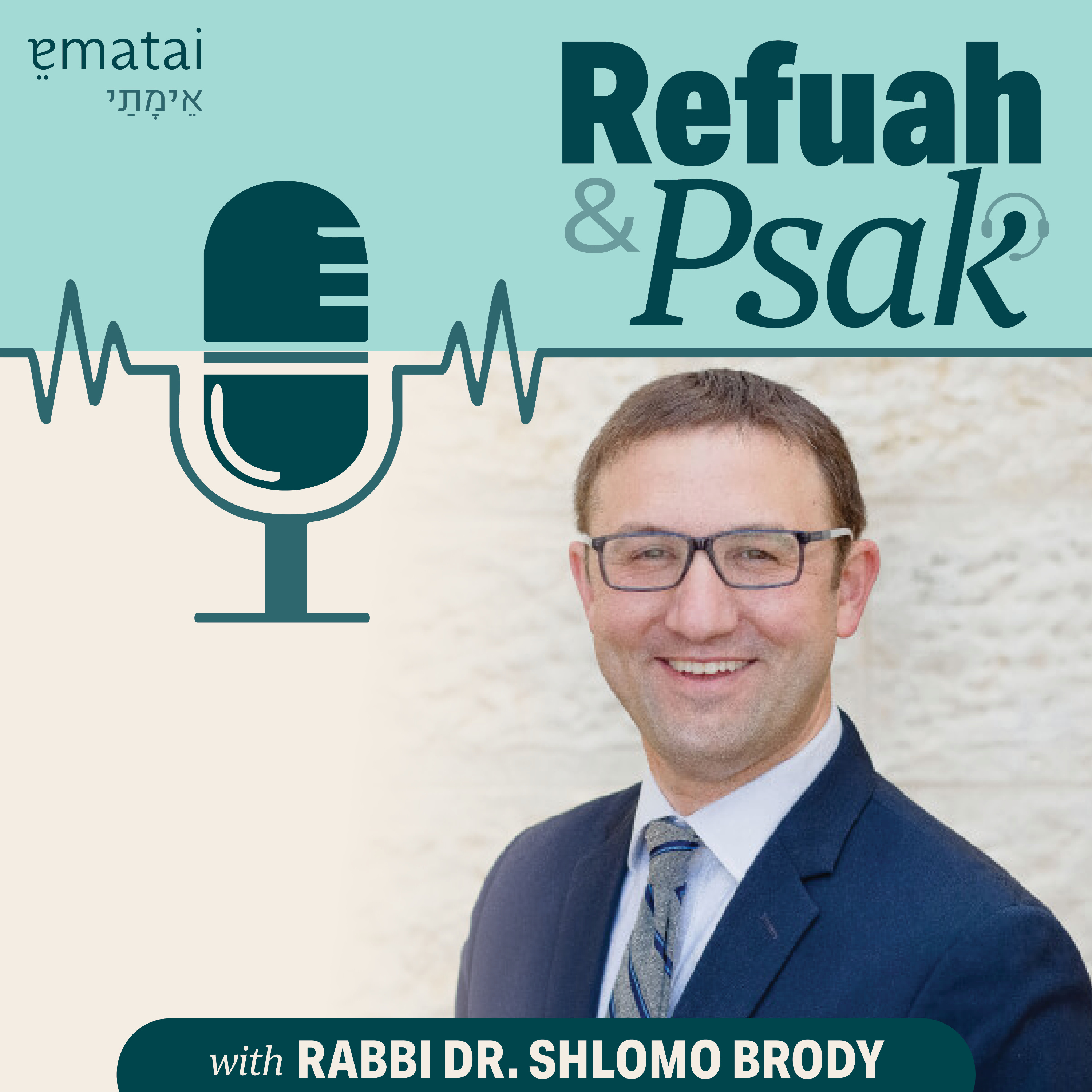
Ematai - Rabbi Dr. Shlomo Brody
Refuah & Psak
Ematai’s podcast for rabbis who support their congregants through life's most sensitive moments. Join Rabbi Dr. Shlomo Brody to deepen your understanding of halachic and medical issues around end-of-life care with real-world halacha, medical realities, and rabbinic care. Each episode brings you practical guidance, expert insight, and thoughtful conversation, so you can be there when it matters most. To submit feedback or ask a question, reach out to office@ematai.orgLearn more about Ematai’s General Principles for End-of-Life Care here. Explore our online resource center here.
Auteur
Ematai - Rabbi Dr. Shlomo Brody
Catégorie
Site du podcast
Dernier épisode
23 févr. 2026
Où écouter ?
Les podcasts dans l'appli Replaio Radio Bientôt disponibleLes podcasts arrivent très bientôt dans l'appli. Installe-la dès maintenant et découvre en avant-première une toute nouvelle façon de vivre les podcasts
 Installe-la gratuitement
Android 5 M+ de téléchargements · note de 4,8
iOS bientôt
Installe-la gratuitement
Android 5 M+ de téléchargements · note de 4,8
iOS bientôt
Épisodes
Episode 10: Understanding Hospice Care 23.02.2026 42:52
In this episode of Refuah & Psak , Rabbi Brody speaks with Chaya Lasson, Director of Jewish Hospice and Palliative Care for Bridging Life in Baltimore, about clarifying misconceptions around hospice and integrating it with Jewish values. Chaya distinguishes hospice from palliative care, outlines the collaborative hospice team model, and dispels myths about hospice. They discuss aligning care...
Episode 9: Understanding Artificial Nutrition &Hydration 09.02.2026 50:55
In this episode of Refuah & Psak , Rabbi Brody speaks with Dr. Beth Popp, a palliative-care physician, about the medical, emotional, and halachic complexities of artificial nutrition and hydration (ANH). They review why ANH may be needed, the methods used, and the risks that may be involved. The conversation highlights how decisions differ at various stages of illness, especially near the end...
Episode 8: Supporting Your Congregants 26.01.2026 42:16
In this episode of Refuah & Psak , Ematai’s associate director and physician assistant Rachel Secunda speaks with Ematai’s director of community outreach, Bassie Taubes, an oncology nurse, health coach, and rebbetzin, about how rabbis and communities can better support those who often feel unseen. They highlight the elderly who quietly withdraw due to physical challenges, caregivers who sacrif...
Episode 7: Understanding Oncology Treatments 12.01.2026 51:28
In this episode of Refuah & Psak , Rabbi Brody speaks with Dr. Moshe Ornstein, a genito-urinary oncologist and author of Cancer in Halakha , about cancer and its treatments. Dr. Ornstein explains what cancer is, clarifies the difference between localized and metastatic disease, and reviews treatment options from surgery and radiation to immunotherapy and targeted therapies. Dr. Ornstein highli...
Episode 6: Understanding Cyclical Treatments 16.12.2025 46:25
In this episode of Refuah & Psak , Rabbi Brody speaks with Dr. Ernest Mandel, member of the Ematai medical advisory board and nephrologist about the halachic and medical nuances of cyclical treatments , with a focus on dialysis and vasopressors. They discuss how treatments that naturally start and stop differ from continuous interventions, and why this distinction matters for both halacha and...
Episode 5: What's the Difference Between Withholding & Withdrawing Treatment? 01.12.2025 48:52
In this episode of Refuah & Psak , Rabbi Brody speaks with Rabbi Dr. Jason Weiner, senior consultant at Ematai as well as the executive director of the Spiritual Care Department at Cedars – Sinai in Los Angeles, about the halachic and ethical distinction between withholding and withdrawing life-sustaining treatments. They explore how Jewish law, secular bioethics, and Israeli law approach thes...
Episode 4 : Understanding DNI 17.11.2025 42:16
In this episode of Refuah & Psak , Rabbi Shlomo Brody speaks with Dr. Jonah (Yonah) Rubin, Ematai medical advisory board member and pulmonary and critical care physician at Mass General Hospital, about the medical and halachic complexities surrounding DNI (“do not intubate”) orders. Dr. Rubin explains the full spectrum of oxygen support, from nasal cannula and high-flow systems to BiPAP and, w...
Episode 3: Pain Medication at the End-of-Life 03.11.2025 32:51
In this episode of Refuah v’Psak , Rabbi Brody is joined by Ematai medical advisory board member and palliative care physician Dr. Moshe Cohen to demystify the halachic and medical concerns around pain management at the end-of-life. From addiction fears to end-of-life sedation, they explore how pain management at the end-of-life is not only possible but may even be halachically mandated.
Episode 2: Understanding DNR 20.10.2025 38:13
In this episode of Refuah & Psak , Rabbi Shlomo Brody speaks with speaks with Dr. Jonah (Yonah) Rubin, Ematai medical advisory board member and pulmonary and critical care physician at Mass General Hospital, about the medical and halachic considerations surrounding DNR (“Do Not Resuscitate”) orders. Dr. Rubin explains what CPR includes and that success should be measured not only by restarting...
Episode 1: Maximizing Rabbi/Physician Communication 20.10.2025 53:41
In this episode of Refuah & Psak , Rabbi Brody speaks with Rabbi Dr. Aaron Glatt, Ematai rabbinic advisory board member and Chairman of Medicine and Chief of Infectious Diseases at Mount Sinai South Nassau, and a medical halacha authority—about how rabbis can most effectively communicate with physicians to guide families through complex medical situations. Rabbi Glatt emphasizes the rabbi’s mu...
Intro Episode: Understanding Medical Terms 01.09.2025 39:13
Welcome to Refuah & Psak, Ematai’s podcast for rabbis who support their congregants through life’s most sensitive moments. In this special introductory episode, Ematai associate director, Rachel Secunda PA-C, takes listeners on an imagined tour of the ICU with Dr. Jonah (Yonah) Rubin, Ematai medical advisory board member and pulmonary and critical care physician at Mass General Hospital. Toget...
Podcasts similaires




Écoute le podcast Refuah & Psak sur Replaio
La radio et les podcasts dans une seule appli - gratuite, sans inscription. Installe-la dès aujourd'hui et ne rate pas le lancement
Replaio n'est pas éditeur de podcasts ; les noms des émissions, les visuels et l'audio appartiennent à leurs auteurs et sont diffusés via des flux RSS publics