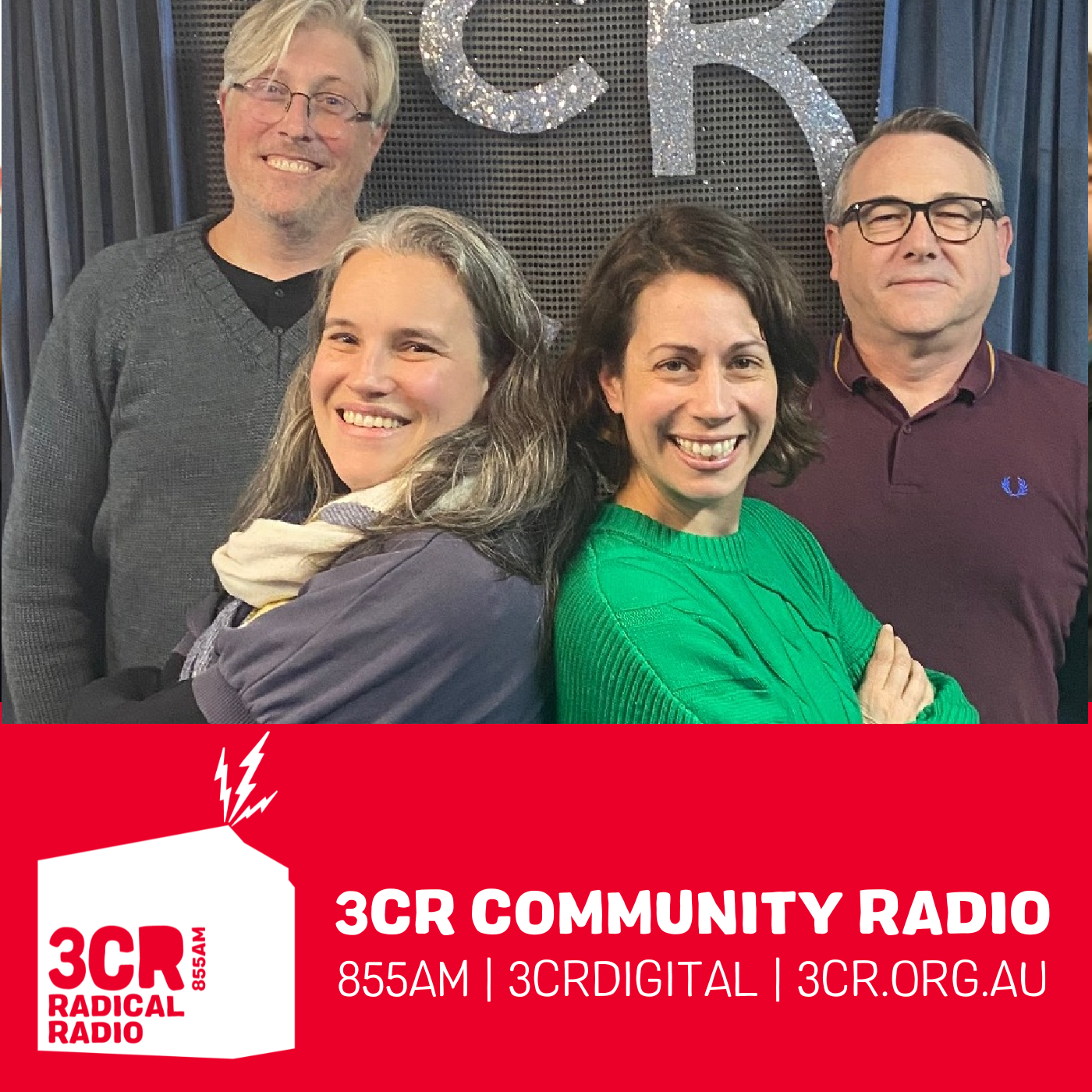
Chris Lassig, Stuart Burns, Claire Farrugia and Linden Ashcroft.
Lost in Science
Lost in Science is your weekly hit of mind-blowing science, strange facts, and big ideas. From cutting-edge discoveries to the science behind everyday life, our curious and passionate hosts make it fun, fast, and fascinating. If it’s weird, wonderful, or just worth knowing - we’re on it.
N'hésitez pas à visiter le site du podcast et à soutenir son créateur : www.3cr.org.au
Auteur
Chris Lassig, Stuart Burns, Claire Farrugia and Linden Ashcroft.
Catégorie
Site du podcast
Dernier épisode
21 oct. 2026
Où écouter ?
Les podcasts dans l'appli Replaio Radio Bientôt disponibleLes podcasts arrivent très bientôt dans l'appli. Installe-la dès maintenant et découvre en avant-première une toute nouvelle façon de vivre les podcasts
 Installe-la gratuitement
Android près de 10 M de téléchargements · note de 4,8
iOS bientôt
Épisodes
Medicine waste and ice age asteroids 30.11.2022
This week, Catriona tells us about research into pharmacological waste or medicines in our waterways, including Prozac (fluoxetine) and oestrogen, and the effect they can have on other species; and Chris examines the Younger Dryas Impact Hypothesis, an asteroid or comet strike some believe to have caused additional cooling at the end of the last ice age, and the status of attempts to prove it by f...
The science of olive oil: Interview with Professor Paolo Inglese 23.11.2022
Stu talks to Professor Paolo Inglese, a world expert on olive oil on what has changed and what hasn't in the long history of olive oil.
Methane is from Mars, Phosphine is from Venus, and doing the rat dance 16.11.2022
Chris talks about the possibility of life on our immediate neighbour planets Mars and Venus based on observations of organic chemicals in their atmospheres, and Stu finds out whether rats really like the nightlife and got to boogie on the disco round...
Covid lab leak speculation & revolutionary click chemistry 09.11.2022
This week, Chris examines some recent reporting on the hypothesis that COVID-19 originated as a leak from a laboratory in Wuhan, China, and finds that it’s based less on science than it is on reading between the lines in questionable translations of online documents; and Stu explains the Nobel Prize in Chemistry 2022, which was awarded for the development of “click” and bioorthogonal chemistry.
Nobel prize for physics and reptilian viruses 02.11.2022
Chris walks us through the 2022 Nobel Prize for physics which unravels quantum entanglement, and Stu talks to Emma Harding about her research into amphibian and reptile viruses and what they can tell us about virus evolution.
Lost in Science Fiction! Space plants, hoverboards & wormholes 26.10.2022
It’s our annual Halloween episode where we get lost in science fiction! Catriona explains how the hoverboards and flying cars in Back to the Future II (1989) could become real; Stu explores the practicalities of moving ecosystems to space as seen in the 1972 movie Silent Running; and Chris goes down the path of wormholes as mentioned in 2022’s Thor: Love and Thunder.
Deflecting asteroids and growing Moon plants 19.10.2022
This week, Catriona tells all about the surprising success of NASA's DART mission, which tested a method of colliding a spacecraft with an asteroid to redirect it before it can threaten Earth; and Stu speaks to Tien Huynh from RMIT University about a plan to grow plants on the Moon as part of the project https://lunaria.one/
Peacock spiders and shark noses 12.10.2022
Two interviews from the archives, Claire talks to Joseph Schubert about Peacock spiders, and to Victoria Camilleri Asch about how sharks can smell in water
Once and future humans: The Nobel prize for physiology and how to get babies to sleep 05.10.2022
The Nobel prize for Physiology and Medicine for 2022 looks at the relationship between ancient homnids and modern humans, Chris talks abotu the research that won the prize. Stu looks at the relationship between the newest humans and their immediate ancestors, as science tackles exactly how to get babies to sleep.
Immune cells and nature walks 28.09.2022
This week, our special guest immunologist and science communicator Catriona Nguyen-Robertson tells us about her PhD research and direct personal experience of how the immune system's T cells can also target fats and oils; and Stu shares a new study using brain scans to find out why spending time in nature can reduce the stress of city life.
The 32nd First Annual Ig Nobel Prizes - The Winners! 21.09.2022
It's that time of year again when science recognises its most improbable research by awarding the 32nd First Annual Ig Nobel Prizes to ten research projects that "make you laugh, then make you think". Find out how researchers use ice cream to save the day (again) and why having your ducks in a row is scientifically a good thing.
T. rex evolution and reverse lasers 14.09.2022
This week, Stu shares new research that may explain why the most famous dinosaur, the T. rex, evolved such big heads, plus maybe why they had tiny arms as well; and Chris talks about reverse or anti lasers, which absorb light rather than emit it, and for that to make that sense he tries to explain how regular lasers work too.
Out-of-season coral spawning and mistaken alpha males 31.08.2022
This week, Claire talks to Dr Cathie Page from the Australian Institute of Marine Science about getting coral to spawn out of season in the laboratory; and Stu explains how the concept of alpha males does not in fact correspond to how wolf packs operate in the wild.
Space junk and world's biggest bacteria 24.08.2022
This week on the show Chris revisits the world of space junk, who is putting it up there, and where it comes down. And Stu informs us of a big discovery that is rocking the microbe world - a giant bacteria that you can see with the naked eye!
Hearing the rise of warm blood and more alleged academic misconduct. 17.08.2022
Claire talks about new research that links hearing with the evolution of warm blooded animals, and Chris fills us in on another possible case of academic misconduct linked to Alzheimers research.
National Science Week 2022 10.08.2022
Stu and Claire give us a run down of events in Melbourne, in Victoria, around the country and online for National Science Week (13-21 August 2022), including the schools program based on the International Year of Glass. And Claire gives a taste of questions for Lost in Science's annual trivia night on Monday 15 August. Find out more about National Science Week at scienceweek.net.au
What is the mental health cost of unpaid domestic work and the Eureka Prizes 2022 07.08.2022
Chris talks to PhD candidate Jennifer Ervine about her review paper of the mental health cost of unpaid domestic labour which is largely borne by women, and Stu checks out the winners of the 2022 Eureka Prizes for science from the Australian Museum.
Covid origins and AI sentience 03.08.2022
This week on the show Stu talks us through the two new research papers on the origins of the spread of the covid-19 virus to humans from the wet market in Wuhan. Also on the show, do you think AI can become sentient? Chris looks into the spurious claims that the laMDA AI chat from google is actually a sentient being.
Interstellar telescope discoveries and life from freeze dried skin 27.07.2022
Chris talks about some of the discoveries the new JW space telescope has possibly discovered since booting up in the last few weeks, and Stu looks at a new technique for bringing dead skins back to life which may hold the key to genetic diversity in endangered animal populations.
Return of the reproducing condors and regenerating frogs 20.07.2022
This week we replay a couple of recent favourites: Claire reveals the surprising observation of parthenogenesis, aka 'virgin birth', in the endangered California condor (Gymnogyps californianus), and explains how this is possible, and why the chicks are male thanks to bird sex chromosomes being different from ours; and Stu tells us how it's possible to get frogs to regrow amputated limbs, raising...
Varroa threat to Australian Honey Bees 13.07.2022
Claire talks to Dr. Jay Iwasaki about the invasive pest of honey bees the Varroa mite which was discovered in hives around Newcastle in NSW for the first time.
SIDS breakthrough and International Year of Glass 06.07.2022
This week on the show Chris dives into the recent research about Sudden Infant Death Syndrome, or SIDS, bringing us closer to understanding a biological cause. Also on the show, did you know it's International Year of Glass? Stu talks about why this humble material is so important in our lives, and for science.
Recycling fabrics, and X and Y diversity 29.06.2022
Recycled cotton and polyester are often seen in clothing shops, but Claire tells us about the challenges to making it work, and how there are other ways to reduce waste; and Stu runs us through recent research showing much more common variations in human sex chromosomes beyond the XX and XY you might have learned at school (see more at https://doi.org/10.1016/j.gim.2022.05.011)
Plastic eating grubs and why twine is so strong 22.06.2022
This week on the show Stu speaks to researcher Chris Rinke about his fascinating research investigating how superworms, the larval stage of some beetles, can eat and digest polystyrene breaking it down into organic components. Also on the show Chris gets experimental again, this time showing how twisting threads creates enough friction to make incredibly strong twine and rope.
What is Monkeypox? And is the Hubble constant accurate? 15.06.2022
A new disease on the block is cause for concern, but how much should we be worried about the erroneously named Monkeypox virus? Claire finds out more on this week's show. And Chris explains what the Hubble constant is, and how it should be able to tell us how fast the universe is expanding, but it may reveal potential flaws in the way we think about physics. Photo by Brett Ritchie on Unsplash
Podcasts similaires








Écoute le podcast Lost in Science sur Replaio
La radio et les podcasts dans une seule appli - gratuite, sans inscription. Installe-la dès aujourd'hui et ne rate pas le lancement
Replaio n'est pas éditeur de podcasts ; les noms des émissions, les visuels et l'audio appartiennent à leurs auteurs et sont diffusés via des flux RSS publics