Josh Rauvola
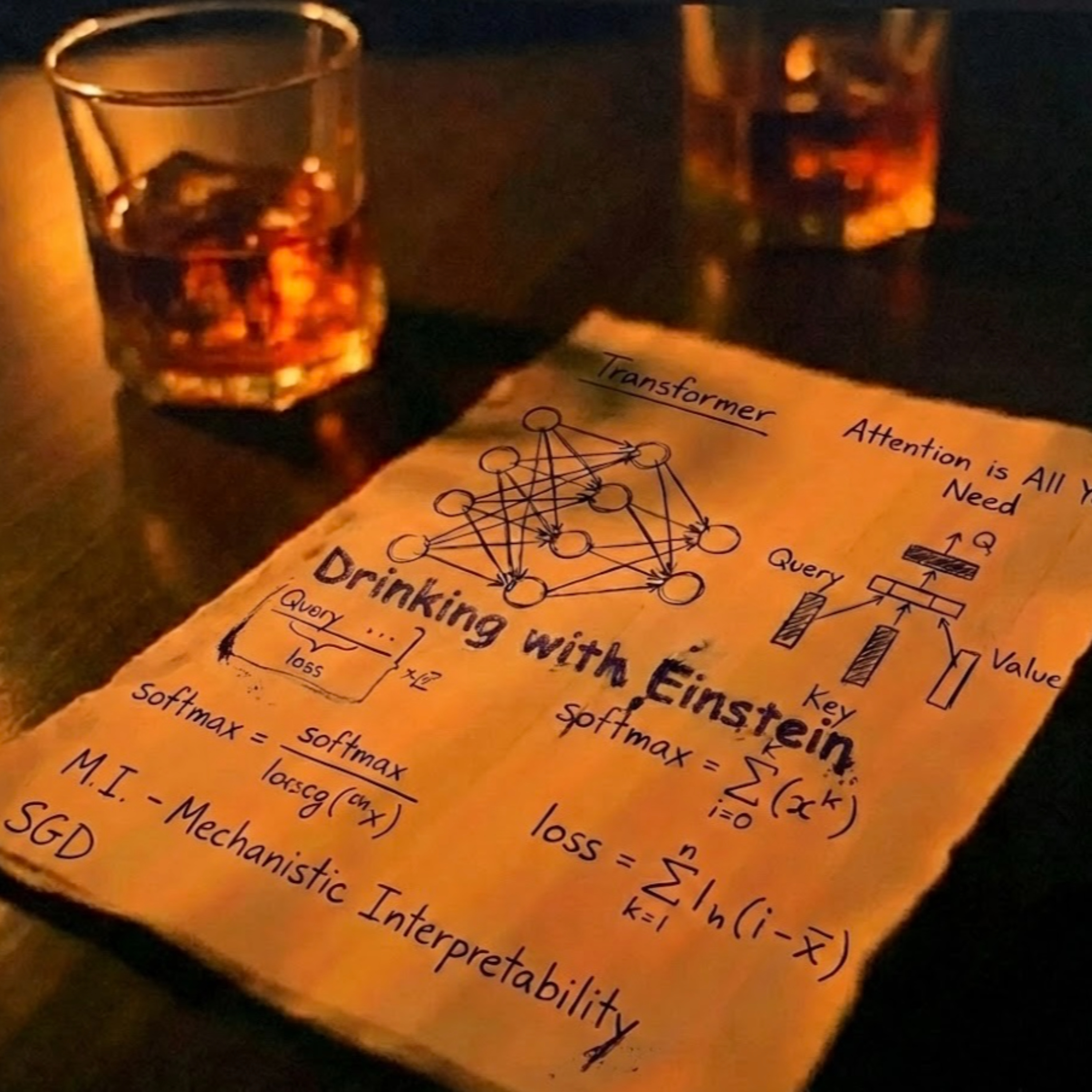
Drinking with Einstein
AI Engineer by day (U.S. Bank), researcher by night (UChicago), Josh Rauvola sits where building AI meets understanding why it works. Each week, he breaks down the field's most complex topics until they actually click: interpretability, safety, reasoning models, agents, and more. No hype. No jargon. Just clarity. This podcast exists because there's too much snake oil on one side and too many PhD-level papers on the other. So grab a drink, and let's make sense of the machines we're building together. New episodes weekly—15 to 20 minutes each.
N'hésitez pas à visiter le site du podcast et à soutenir son créateur : podcasters.spotify.com
Auteur
Josh Rauvola
Catégorie
Site du podcast
Dernier épisode
9 févr. 2026
Où écouter ?
Les podcasts dans l'appli Replaio Radio Bientôt disponibleLes podcasts arrivent très bientôt dans l'appli. Installe-la dès maintenant et découvre en avant-première une toute nouvelle façon de vivre les podcasts
 Installe-la gratuitement
Android près de 10 M de téléchargements · note de 4,8
iOS bientôt
Installe-la gratuitement
Android près de 10 M de téléchargements · note de 4,8
iOS bientôt
Épisodes
From Visualizations to Circuits: The Origins of the Glass Box (The Glass Box Pt. 2) 09.02.2026 23:52
Is AI just a "giant math soup" that happens to work, or is it a machine with parts we can understand? In Part 2 of The Glass Box series, we dig into the origin story of Mechanistic Interpretability. We trace the 7-year arc from the first "camera" that let us see inside a neural network (Zeiler & Fergus, 2013) to the "microscope" of Feature Visualization (Olah et a...
Reading the Mind of the Machine (The Glass Box Pt. 1) 20.01.2026 15:46
We have spent the last decade studying AI like psychologists, observing behavior and guessing at thoughts. It’s time to become neurosurgeons. In this debut episode, AI Engineer Josh Rauvola introduces Mechanistic Interpretability : the emerging science of cracking open neural networks to map the specific circuits inside. We break down how labs like Anthropic, OpenAI, and DeepMind are moving from &...
Podcasts similaires







Écoute le podcast Drinking with Einstein sur Replaio
La radio et les podcasts dans une seule appli - gratuite, sans inscription. Installe-la dès aujourd'hui et ne rate pas le lancement
Replaio n'est pas éditeur de podcasts ; les noms des émissions, les visuels et l'audio appartiennent à leurs auteurs et sont diffusés via des flux RSS publics