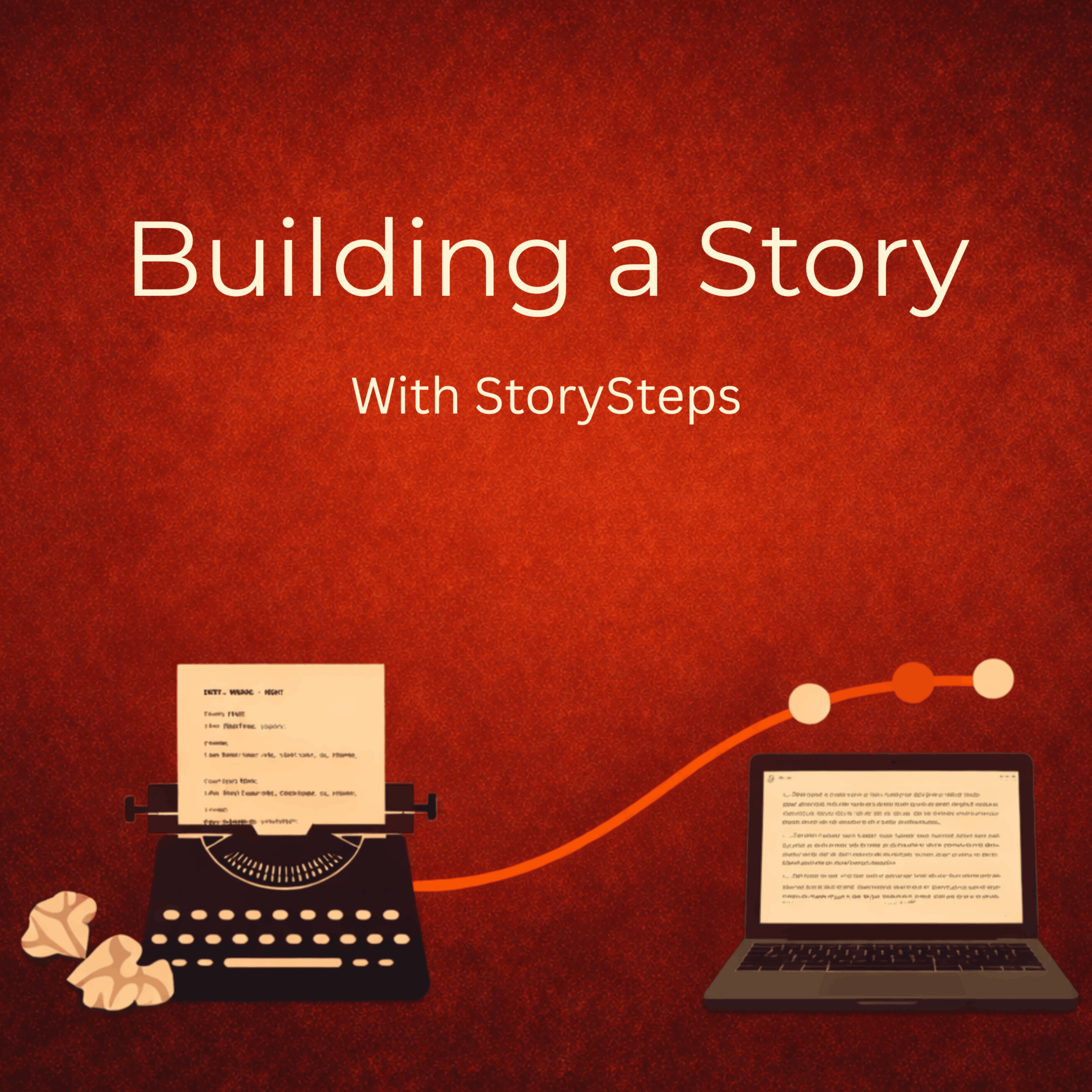
StorySteps
Building a Story
There are thousands of sources of writing advice. This podcast puts it into action. Each episode tackles one key story element or problem, like the hero, antagonist, or opening, and applies it to a case study: a Peter Pan reimagining focused on a lost boy. The full treatment is available for download on storysteps.net in the podcast section. This podcast uses AI-generated voices to present original StorySteps content based on proven storytelling principles.
N'hésitez pas à visiter le site du podcast et à soutenir son créateur : podcasters.spotify.com
Auteur
StorySteps
Catégorie
Site du podcast
Dernier épisode
17 juil. 2026
Où écouter ?
Les podcasts dans l'appli Replaio Radio Bientôt disponibleLes podcasts arrivent très bientôt dans l'appli. Installe-la dès maintenant et découvre en avant-première une toute nouvelle façon de vivre les podcasts
 Installe-la gratuitement
Android près de 10 M de téléchargements · note de 4,8
iOS bientôt
Installe-la gratuitement
Android près de 10 M de téléchargements · note de 4,8
iOS bientôt
Épisodes
Hook your readers without the info dump 17.07.2026 21:03
How do you begin a story without dumping every idea, rule, backstory detail, and piece of worldbuilding onto the audience at once? In this episode, we look at the story setup: the early phase where you show the hero’s normal world before the adventure begins. This is where the audience gets to understand who the hero is, what they want, what they need, what their life looks like, and what happens...
Five steps to a perfect opening image 10.07.2026 12:28
Why do some opening scenes pull us in right away, while others feel flat, vague, or overloaded? In this episode, we look at how to start a story with an opening scene that actually does its job. Before the plot gets big, before the hero changes, and before the audience understands every detail, the opening scene needs to make a promise. To do that, we focus on the opening image: the first clear sn...
Hacking the Storyteller Empathy Handshake 26.05.2026 20:40
Why do we care about some protagonists almost immediately, while others leave us cold? In this episode, we look at what we call the storyteller empathy handshake : the early connection a writer creates between the audience and the protagonist. Before the plot gets big, before the stakes explode, and before the hero transforms, the audience needs a reason to lean in and care. To do that, we explore...
How to Write a Good Villain: The Force That Pushes Your Hero to Change 12.05.2026 17:10
A strong antagonist does not just get in the hero’s way. A strong antagonist attacks the hero’s weakness, pressures their wound, and forces them to become someone stronger by the end of the story. In this episode of Building a Story , we look at how to create an antagonist who is more than just “the bad guy.” A good antagonist has a clear goal, a strong reason for wanting it, and a worldview that...
Plots engineered to destroy your character 05.05.2026 21:58
A strong story does not just give your character something to do. It puts them through the exact situation they are least emotionally prepared to face. In this episode of Building a Story, we look at whether you should start your story with a character or a premise and how to make sure the character and the plot are built to attack the protagonist's emotional wound. If you start with a premise...
Sell your story in one sentence 28.04.2026 21:51
Most stories fall apart before they even begin, and the reason is simple: the writer doesn’t truly know what the story is. In this episode of Building a Story by StorySteps , we break down the logline, the single sentence that defines your entire story. You’ll learn what a logline is, why it matters, how to write a logline, and how it keeps you from writing scenes that go nowhere or constantly sta...
Podcasts similaires







Écoute le podcast Building a Story sur Replaio
La radio et les podcasts dans une seule appli - gratuite, sans inscription. Installe-la dès aujourd'hui et ne rate pas le lancement
Replaio n'est pas éditeur de podcasts ; les noms des émissions, les visuels et l'audio appartiennent à leurs auteurs et sont diffusés via des flux RSS publics