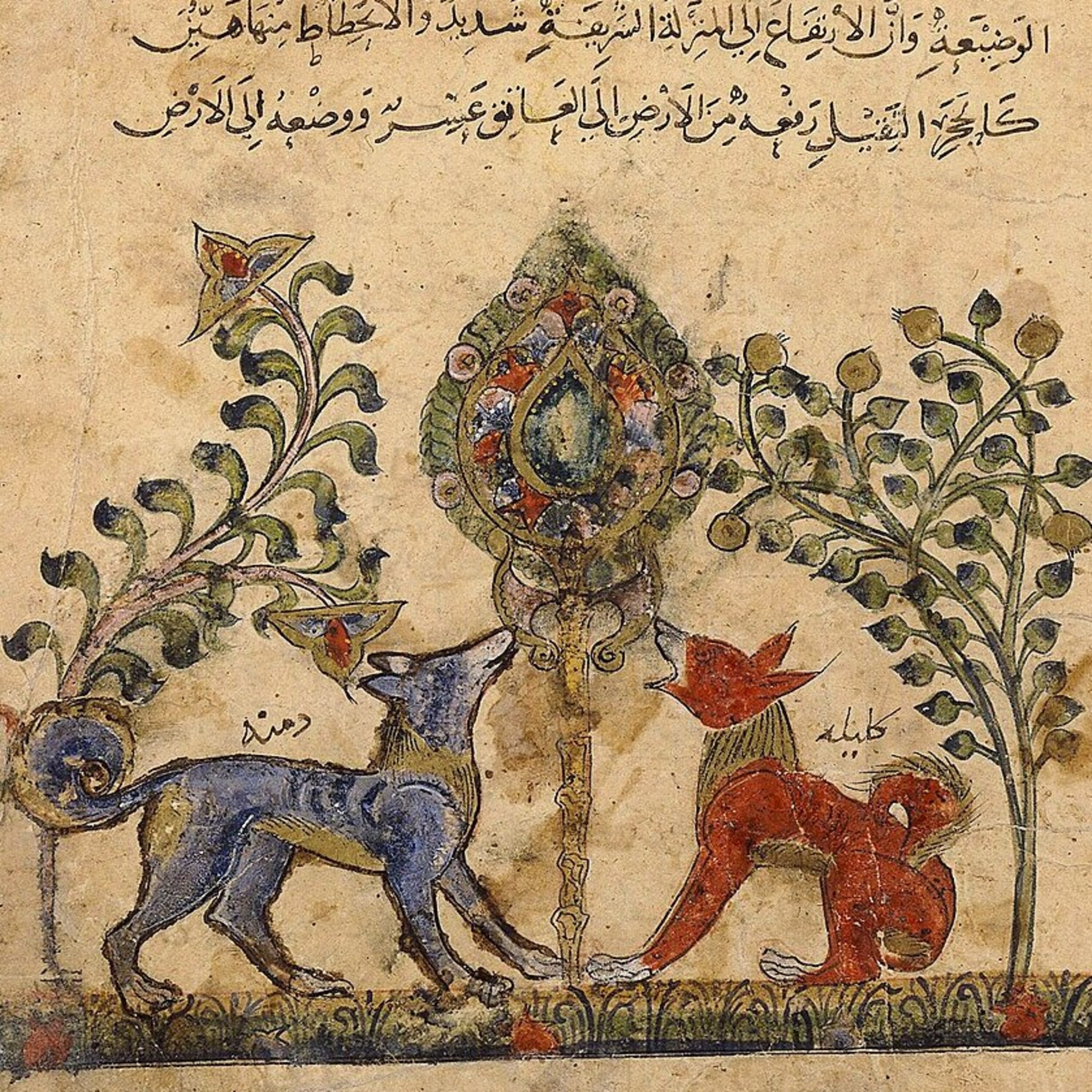
James Montgomery and Lydia Wilson
Classical Arabic Literature Podcast
A podcast exploring classical Arabic literature. Each episode is a conversation on a writer, a book, or a theme between James Montgomery (the Sir Thomas Adams's Professor of Arabic at the University of Cambridge, Fellow of the British Academy, and a founding editor of the Library of Arabic Literature) and Lydia Wilson (a writer and journalist).
Μην παραλείψεις να επισκεφτείς τη σελίδα του podcast και να στηρίξεις τον δημιουργό: rss.com
Πού να ακούσεις;
Podcast στην εφαρμογή Replaio Radio Έρχεται σύντομαΤα podcast έρχονται σύντομα στην εφαρμογή. Εγκατάστησέ την τώρα και δες πρώτος μια εντελώς νέα προσέγγιση στα podcast
 Δωρεάν εγκατάσταση
Android σχεδόν 10 εκατ. λήψεις · βαθμολογία 4,8
iOS σύντομα
Δωρεάν εγκατάσταση
Android σχεδόν 10 εκατ. λήψεις · βαθμολογία 4,8
iOS σύντομα
Επεισόδια
Al-Mutanabbi 02.05.2026 1:08:56
Al-Mutanabbi was born in Kufa in 915 CE, and packed his 50 years of life with politics, religion and poetry. Al-Mutanabbī’s career saw him travel from Kufa to Baghdad, Syria, Egypt and Iran as he sought patronage at the courts of warlords and potentates or service in the retinue of local elites and bureaucrats, and he also spent time in the deserts of Iraq. He died at the hand of bandits in 965 CE...
Kalilah wa Dimnah 02.05.2026 54:52
Kalilah wa Dimnah is a foundational work in Classical Arabic Literature despite the fact it was originally composed in Sanskrit, making its way through Middle Persian and Syriac to be translated into Arabic in the middle of the 8th century CE. At the heart of the book are the discussions between the two jackals of the title, Kalilah and Dimnah, who tell tales within tales with moral and political...
Abu Nuwas 02.05.2026 1:05:40
Abu Nuwas was born around 756 CE and died in 815, after a long and colourful career as a poet, travelling around the Muslim world in search of patronage. His work was as varied as his fortunes, and he has left behind poetry on love and hunting, praise and invective, asceticism and - perhaps most famously - wine.
The Quran 02.05.2026 1:06:55
The Qur’an is the foundational text of Islam. It remains a reference point for the Arabic language, still referred to for questions of grammar. It is a source for law, politics, war and peace. It contains guidance on social norms such as gender roles and social behaviour, and knowledge from mathematics and astronomy to biology. It has been an artistic resource inspiring centuries of reciters and c...
Hayy Ibn Yaqzan 28.01.2026 1:01:37
Al-Andalus of the 12th century was a tumultuous time politically, and a rich time intellectually. One of our major sources for the intellectual currents of the day was Hayy ibn Yaqzan , written by the physician Ibn Tufayl, an allegorical tale which proved enduringly popular through centuries, languages and cultures. It tells the story of a boy growing up in complete solitude on a deserted island,...
The Brethren of Purity 28.01.2026 1:07:08
The Ikhwan as-Safa, or Brethren of Purity, are shadowy figures in history, probably working in the late 10th or early 11th centuries CE, known only by the impressive 52 letters, known as the rasa’il , which present a curriculum of study designed to provide a comprehensive overview of all known subjects of the day. In the subsequent thousand years of scholarship their approach to knowledge and know...
Al-Jahiz 28.01.2026 1:04:31
In 750 CE, a new power swept the Muslim world. This was the Abbasid dynasty. Their rule acted as a catalyst for a burst of intellectual activity, now called the translation movement, when most Greek philosophical, scientific and medical texts were translated into Arabic and stimulated a culture full of debate in books and public spaces. This is the milieu in which the philosopher known as al-Jahiz...
Imru’ al-Qays 28.01.2026 1:05:32
We’re starting our exploration of the rich heritage of Arabic literature by going right back to the beginning: the poetry of pre-Islamic Arabia. This episode looks at one poet from this time: Imruʾ l-Qays (who probably died in 542 CE), though our conversation touches on his peers and the tradition which edited, collected, and prized his work. Reading: Fate the Hunter: Early Arabic Hunting Poems ,...
Παρόμοια podcast






Άκου το podcast Classical Arabic Literature Podcast στο Replaio
Ραδιόφωνο και podcast σε μία εφαρμογή - δωρεάν, χωρίς εγγραφή. Εγκατάστησέ την σήμερα και μη χάσεις την πρεμιέρα
Το Replaio δεν είναι εκδότης podcast - τα ονόματα των εκπομπών, τα εξώφυλλα και ο ήχος ανήκουν στους δημιουργούς τους και διανέμονται μέσω δημόσιων ροών RSS