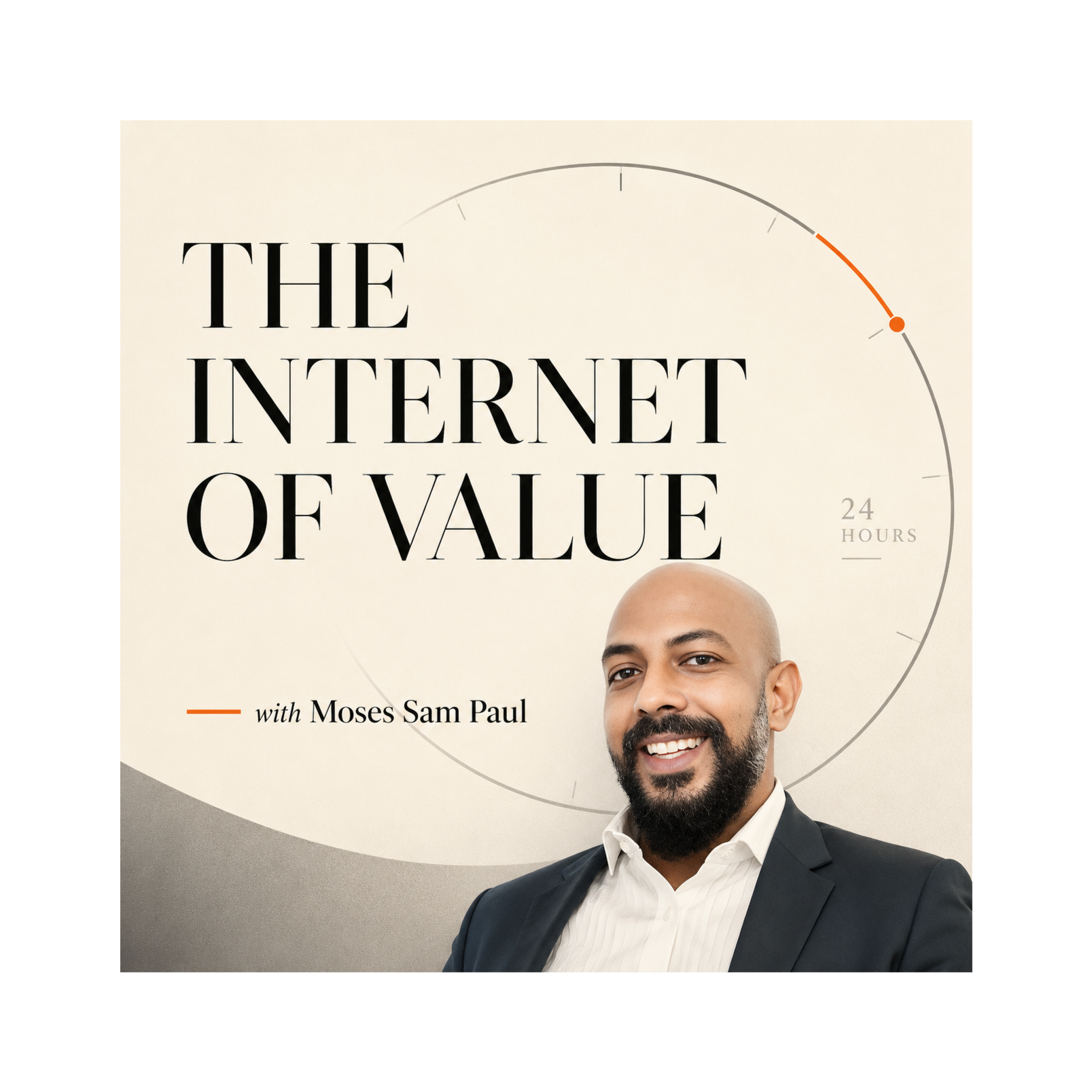
Moses Sam Paul
The Internet of Value
The Internet of Value is a podcast about one question: Can the internet economy actually measure and sustain human wellbeing and wellbecoming? Today, most systems measure value only after life has already been converted into output: GDP, revenue, productivity, engagement, valuation, or price. But before output, there is time. Before performance, there is wellbeing. Before value capture, there is contribution. Hosted by Moses Sam Paul , this podcast explores a new wellbeing-centered economic system built around four core protocol layers: ValueCapture Protocol — how human time, activity, proof,...
Besuch unbedingt die Website des Podcasts und unterstütze die Macher: rss.com
Wo hören?
Podcasts in der App Replaio Radio Bald verfügbarPodcasts kommen bald in die App. Installiere sie jetzt und erlebe als Erster einen ganz neuen Blick auf Podcasts
 Kostenlos installieren
Android 10 Mio.+ Downloads · Bewertung 4,7+
iOS bald
Folgen
What Can a Number Tell You About an Experience? 28.11.2026 22:29
Got something to say to this podcast? Send a voicemail, and you might hear yourself on the next episode! This episode is an AI-generated NotebookLM discussion based on the published article. Corrections to the discussion 9:40 The $96.464 figure was a separate, non-payable performance contribution valuation. It does not measure emotional investment or personal feeling. The presentation recorded zer...
Kerala’s Time Bank: Should an Hour of Care Always Earn the Same Credit? 26.11.2026 15:30
Got something to say to this podcast? Send a voicemail, and you might hear yourself on the next episode! Should an hour spent running an errand earn the same credit as an hour of another eligible service? The hosts debate how equal-hour recognition can coexist with rules for training, safeguarding and matching, and how a programme should account for requests that go unanswered. Curated by Moses Sa...
Kerala’s Time Bank: Can an Hour of Help Come Back? 24.11.2026 12:32
Got something to say to this podcast? Send a voicemail, and you might hear yourself on the next episode! A volunteer helps an older neighbour and earns a credit. Later, he needs help himself. Who sees his request, who can take it, and what happens when nobody is available? The Deep Dive follows Kerala’s software invitation, the reported Elikkulam pilot, and the later feasibility work. It asks how...
The Invisible 24 Hours: Should Governments Measure the Whole Day? 22.11.2026 20:48
Got something to say to this podcast? Send a voicemail, and you might hear yourself on the next episode! One host argues for a time-use indicator alongside GDP. The other defends drawing a clear production boundary and asks how policy would use the extra measure. The conversation follows the same meal across households and markets and asks what time diaries can tell us about unpaid work. Curated b...
The Invisible 24 Hours: Who Gets the Hour? 21.11.2026 18:57
Got something to say to this podcast? Send a voicemail, and you might hear yourself on the next episode! India’s 2019 and 2024 Time Use Surveys offer two snapshots of who reported paid activity and how much time was allocated to unpaid activity. The hosts examine why a population average can include people who logged zero minutes, how simultaneous activities are allocated, and what work the produc...
Redefining Human Worth through Observer Attention and the Architecture of Human Becoming 02.07.2026 21:00
Podcast Description What determines the value of a human life? In this podcast, we explore the groundbreaking research of the Internet of Value Research Foundation , led by author Moses Sam Paul Johnraj . Drawing from the foundational paper "Observer Attention Is All You Need," we dive into a new research architecture designed to measure value creation and human becoming more truthfully. The Power...
The symbolic shift from attention to wellbecoming i.e. # to ~ 01.06.2026 21:57
In this episode, I explore how the hashtag # became one of the defining symbols of the social media age, and why the Internet of Value now needs a new symbol: the tilde ~. The hashtag began as a simple mark used across numbering, telephones, computing, and early internet channels. But in 2007, Chris Messina suggested using # on Twitter to group conversations. By 2009, Twitter made hashtags clickab...
Ähnliche Podcasts








Höre den Podcast The Internet of Value in Replaio
Radio und Podcasts in einer App - kostenlos und ohne Anmeldung. Installiere sie noch heute und verpasse den Start nicht
Replaio ist kein Herausgeber von Podcasts; die Namen der Sendungen, Cover und Audioinhalte gehören ihren Autoren und werden über öffentliche RSS-Feeds verbreitet