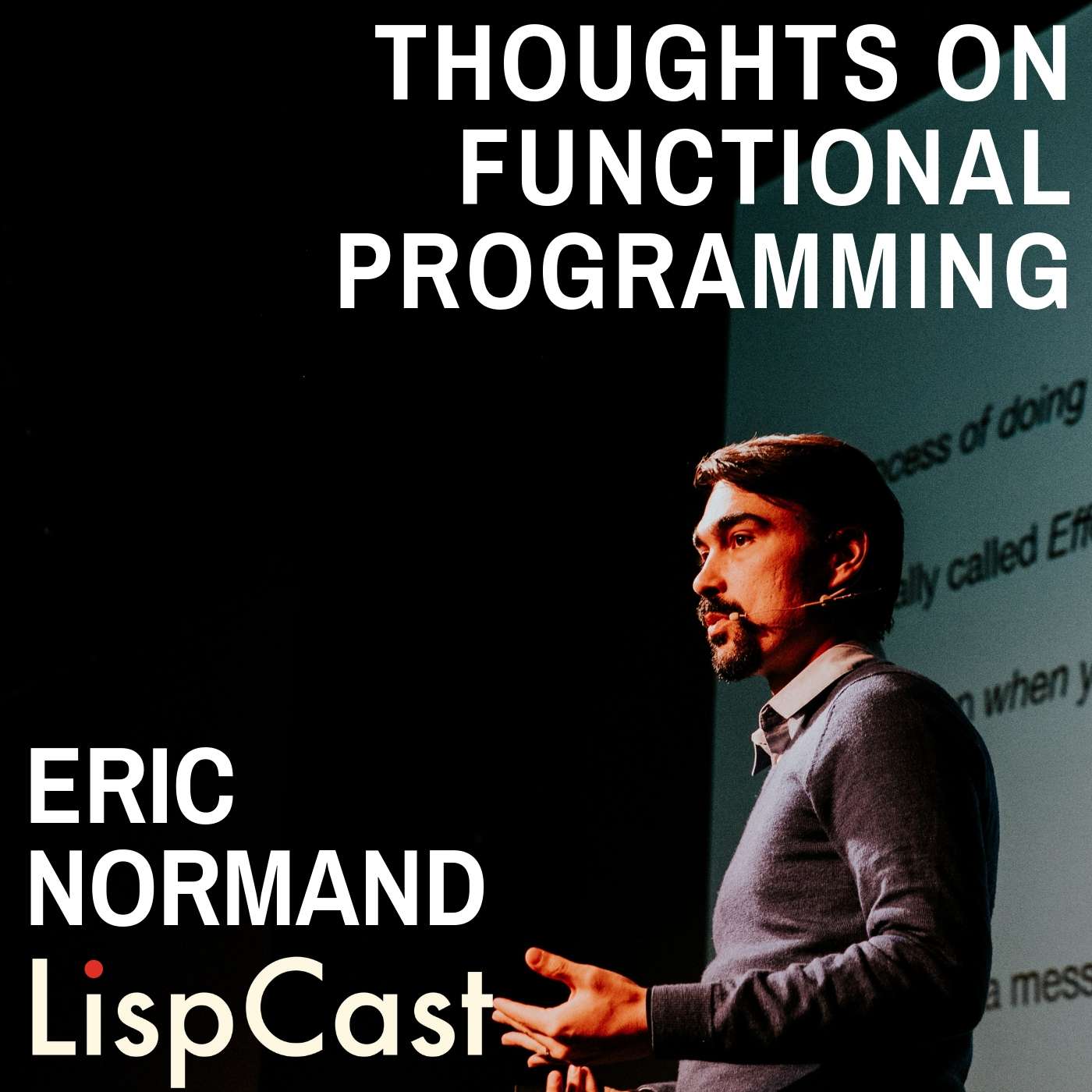
Eric Normand
The Eric Normand Podcast
An off-the-cuff stream of Functional Programming ideas, skills, patterns, and news from Functional Programming expert Eric Normand of LispCast. Formerly known as Thoughts on Functional Programming.
Wo hören?
Podcasts in der App Replaio Radio Bald verfügbarPodcasts kommen bald in die App. Installiere sie jetzt und erlebe als Erster einen ganz neuen Blick auf Podcasts
 Kostenlos installieren
Android fast 10 Mio. Downloads · Bewertung 4,8
iOS bald
Kostenlos installieren
Android fast 10 Mio. Downloads · Bewertung 4,8
iOS bald
Folgen
All about the stratified design lens 25.09.2023 12:24
In this episode, I introduce the stratified design lens, which talks about how and why we split things into layers.
All about the time lens 19.09.2023 10:36
In this episode, I introduce the time lens, and I posit a law about representing time in complex domains.
All about the volatility lens 11.09.2023 18:28
In this episode, I introduce the volatility lens, which seeks to help us write code that deals with a changing world.
All about the architecture lens 31.07.2023 24:20
In this episode, I introduce the architecture lens, its questions, and its goal of modeling architectural domains to manage complexity.
All about the executable specification lens 24.07.2023 15:18
In this episode, I introduce the executable specification lens, its questions, and its goal of getting to runnable, testable code as quickly as possible.
All about the composition lens 10.07.2023 13:44
In this episode, I introduce the composition lens, its questions, and its goal of figuring what's true when you perform multiple operations in a row.
All about the operation lens 03.07.2023 19:40
In this episode, I introduce the operation lens, its questions, and its goal of capturing the use cases of your software.
Data lens 26.06.2023 23:18
In this episode, I introduce the data lens, its questions, and its goals of capturing relationships among data values in data.
All about the domain lens 19.06.2023 19:54
In this episode, I introduce the domain lens, its questions, and its goal.
How does executable specifications compare with other modeling paradigms? 12.06.2023 23:25
In this episode, I compare executable specifications to UML, DDD, and software design.
What is the title of my new book? 05.06.2023 7:26
I've found a better title for my book: Executable Specifications. Listen to find out why it's better.
What are the domain modeling lenses? 29.05.2023 20:58
I'm organizing my new book in terms of lenses. Each lens focuses our attention on one important aspect of software design. In this episode, I briefly introduce each lens.
How is domain modeling evolving these days? 22.05.2023 20:20
I talk about the progress I've made on my book and why I'm throwing it away and starting over.
Why don't I encounter more type errors when programming in Clojure? 15.05.2023 7:17
I give another reason why I don't encounter so many type errors in Clojure.
What is the "reify to an interpreter" refactoring? 08.05.2023 7:13
Watch the creation of a simple refactoring to turn functions into data.
How to teach an essential skill in domain modeling? 24.04.2023 12:05
One important skill in domain modeling is learning to see the semantics of your language, past the habits you've developed. To do that, it helps to see the same example in multiple languages. So how do I show examples in multiple languages without expanding the size of my book?
What is an isomorphism? 17.04.2023 5:12
An isomorphism is a one-to-one mapping from two sets, and encoding your domain model involves finding a mapping between the real world and your code. So does domain modeling involve isomorphism?
Applying domain modeling to an existing data structure 10.04.2023 9:44
Domain modeling also works after you've already got lots of code. How can we apply domain modeling analysis to existing data structures?
What is the commutative property? 20.02.2023 6:21
We discuss the commutative property, why we use it, and three different possible meanings.
Why is the associative property important? 13.02.2023 12:31
We look at several examples where the associative property gives us expressive power.
What is the process for coming up with a good conceptual model? 30.01.2023 14:49
We describe a three-step process for discovering conceptual models.
What is the closure property? 23.01.2023 7:45
I discuss the closure property, which creates operations that can be nested. It's one thing that makes an API feel like a DSL.
All about level three, algebraic modeling 09.01.2023 12:37
What do I mean by algebra? And how do we get from level 0 to level 3?
Why do we need to model time? 26.12.2022 10:59
All sophisticated models need to include time. We discuss two main ways to do that.
How do you make a function total? 19.12.2022 12:06
It is easier to reason about total functions. And you can make any pure function total using three techniques!
Ähnliche Podcasts







Höre den Podcast The Eric Normand Podcast in Replaio
Radio und Podcasts in einer App - kostenlos und ohne Anmeldung. Installiere sie noch heute und verpasse den Start nicht
Replaio ist kein Herausgeber von Podcasts; die Namen der Sendungen, Cover und Audioinhalte gehören ihren Autoren und werden über öffentliche RSS-Feeds verbreitet