NotebookLM - KNS
Study Engineering (MatSci)
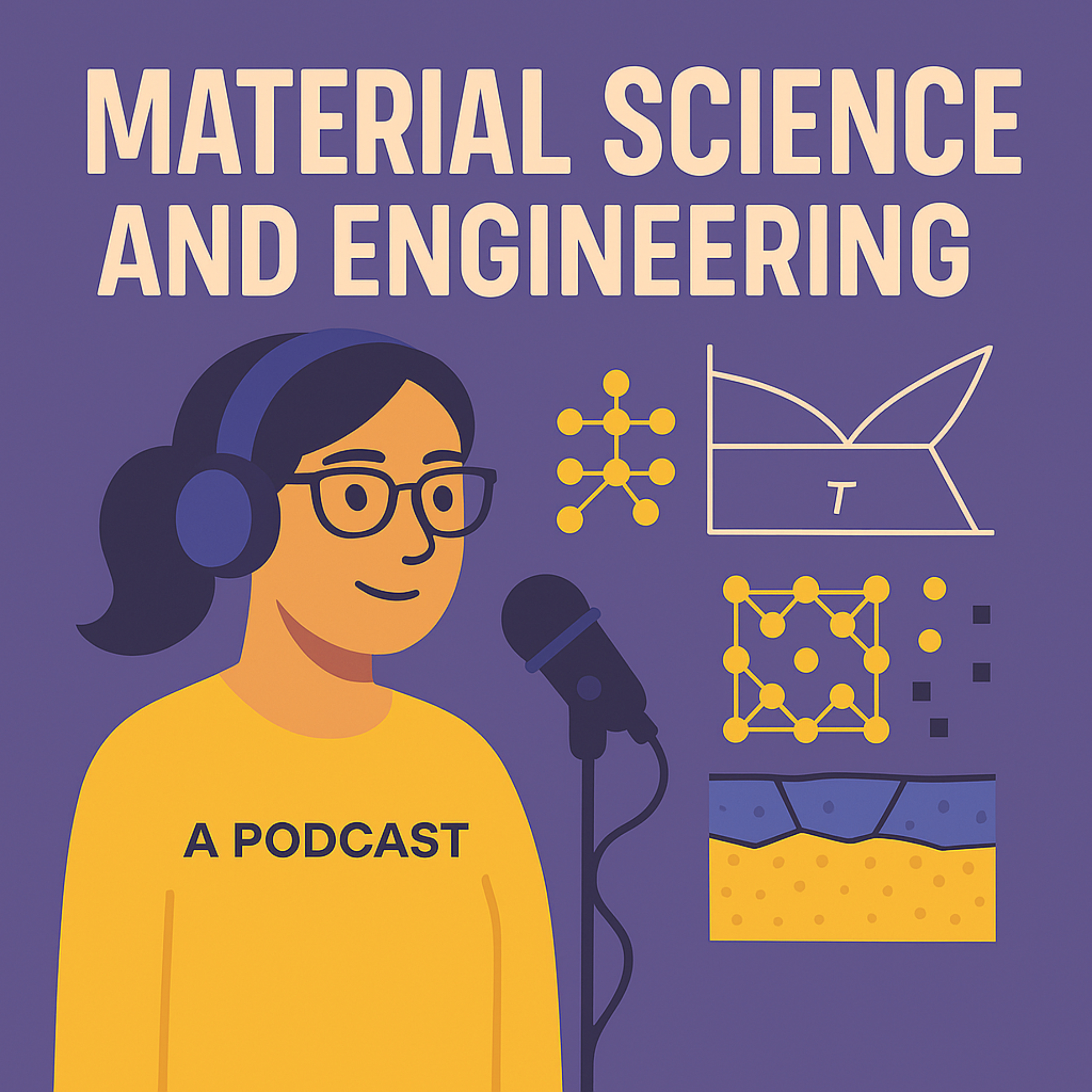
Welcome to Study Engineering (MatSci) — a podcast that simplifies material science and engineering concepts for students who want to learn smarter, not harder. From phase diagrams and solid solutions to microstructures and material compositions, we break complex topics into clear, digestible episodes. Each episode is built using AI tools and structured with the help of NotebookLM, powered by insights from Materials Science and Engineering: An Introduction (10th Edition) by Callister and Rethwisch.
Besuch unbedingt die Website des Podcasts und unterstütze die Macher: podcasters.spotify.com
Autor
NotebookLM - KNS
Kategorie
Podcast-Website
Neueste Folge
20. Mai 2025
Wo hören?
Podcasts in der App Replaio Radio Bald verfügbarPodcasts kommen bald in die App. Installiere sie jetzt und erlebe als Erster einen ganz neuen Blick auf Podcasts
 Kostenlos installieren
Android fast 10 Mio. Downloads · Bewertung 4,7+
iOS bald
Folgen
Corrosion and Degradation of Metals: Mechanisms, Forms, and Prevention (Week 13) 20.05.2025 23:12
This episode explores corrosion as the chemical or electrochemical degradation of metals, emphasizing its economic impact, safety risks, and aesthetic consequences. It explains oxidation-reduction reactions as the core mechanism and introduces tools like the standard emf and galvanic series to evaluate material reactivity. Topics include passivation, environmental factors influencing corrosion, an...
Materials Failure and Fracture Mechanics (Week 12) 20.05.2025 37:50
This episode provides an in-depth exploration of three primary material failure mechanisms: fracture, fatigue, and creep. The discussion begins with static fracture, which occurs under constant or slowly varying stress at relatively low temperatures. Fracture types are distinguished as ductile—characterized by significant plastic deformation and energy absorption—and brittle, which involves minima...
Fabrication and Processing of Metals and Ceramics (Week 11) 20.05.2025 23:44
This episode explores the fabrication and processing of materials, with a focus on metals and ceramics. It covers metal shaping techniques such as extrusion, drawing, casting, welding, and powder metallurgy, emphasizing how these methods influence material properties. Thermal processing and heat treatments are discussed for their role in modifying microstructures and relieving internal stresses. T...
Phase Transformations and Heat Treatment (Week 10) 20.05.2025 20:21
This episode examines phase transformations in materials, emphasizing the role of time in addition to temperature. It introduces isothermal (TTT) and continuous cooling (CCT) diagrams, which map how different cooling paths influence microstructure. Types of transformations—congruent, incongruent, and diffusionless—are explained, along with the Avrami equation that models transformation kinetics. T...
Iron-Iron Carbide Phase Diagram (week 9) 20.05.2025 17:23
This episode explores the Iron-Iron Carbide Phase Diagram, essential for understanding the behavior of steels and cast irons. It highlights key points such as the allotropes of pure iron, carbon solubility limits, and the significance of interstitial spaces in BCC and FCC structures. The formation of pearlite is also introduced as a critical microstructure in steel development.
Phase Diagram Basics (week 6) 18.05.2025 23:14
This episode introduces phase diagrams through the example of water, demonstrating the relationship between temperature, pressure, and states of matter. Fundamental terms such as solute, solvent, solution, and solubility limit are defined using relatable examples. The concepts of phases, microstructure, and phase equilibrium are then explored. The episode concludes with an overview of unary and bi...
Dislocations and Plastic Deformation in Materials (week 5) 18.05.2025 25:19
This episode examines the role of dislocations in plastic deformation and how their movement governs the mechanical behavior of metals. It introduces the concept of dislocation density and explores common sources of dislocations. Key strengthening mechanisms—grain size reduction, solid-solution strengthening, and strain hardening—are detailed, highlighting how each impedes dislocation motion. The...
Mechanical Properties of Metals (week 4) 18.05.2025 20:29
This episode explores how metals respond to stress and strain, focusing on tensile testing methods and the equipment used to measure deformation and fracture. It explains elastic and plastic deformation at the atomic level, distinguishing between reversible and permanent changes. Key concepts such as engineering and true stress-strain are introduced, along with the stress-strain curve as a tool fo...
Diffusion, Microscopy & Imperfections – Week 3 18.05.2025 18:59
This episode explores three foundational topics in material science: diffusion mechanisms, microscopy techniques, and crystal imperfections. Topics include atomic movement in solids, Fick’s laws, vacancy and interstitial diffusion, as well as grain boundaries, dislocations, and point defects. It also covers the principles behind optical microscopy, SEM, and TEM. The content is structured using AI...
Crystalline Solid Materials (week 2) 18.05.2025 16:21
In this episode we examine the fundamental principles governing the structure of crystalline materials, including metals, ceramics, carbon, and polymers. The discussion begins with an overview of unit cells—repeating atomic patterns that form the basis of crystalline structures. Key metallic crystal structures such as Body-Centered Cubic (BCC), Face-Centered Cubic (FCC), and Hexagonal Close-Packed...
Atomic Bonding (Introduction) 18.05.2025 18:57
In this episode, we explore the fundamental world of materials. Using NotebookLM we begin by looking at the atom, the basic building block of all matter, understanding its components and how they lead to different types of atomic bonds. We discuss primary bond types like ionic, covalent, and metallic bonds, which are key to understanding the properties of major material groups such as metals, cera...
Ähnliche Podcasts








Höre den Podcast Study Engineering (MatSci) in Replaio
Radio und Podcasts in einer App - kostenlos und ohne Anmeldung. Installiere sie noch heute und verpasse den Start nicht
Replaio ist kein Herausgeber von Podcasts; die Namen der Sendungen, Cover und Audioinhalte gehören ihren Autoren und werden über öffentliche RSS-Feeds verbreitet