Lee David Evans & Richard Johnson
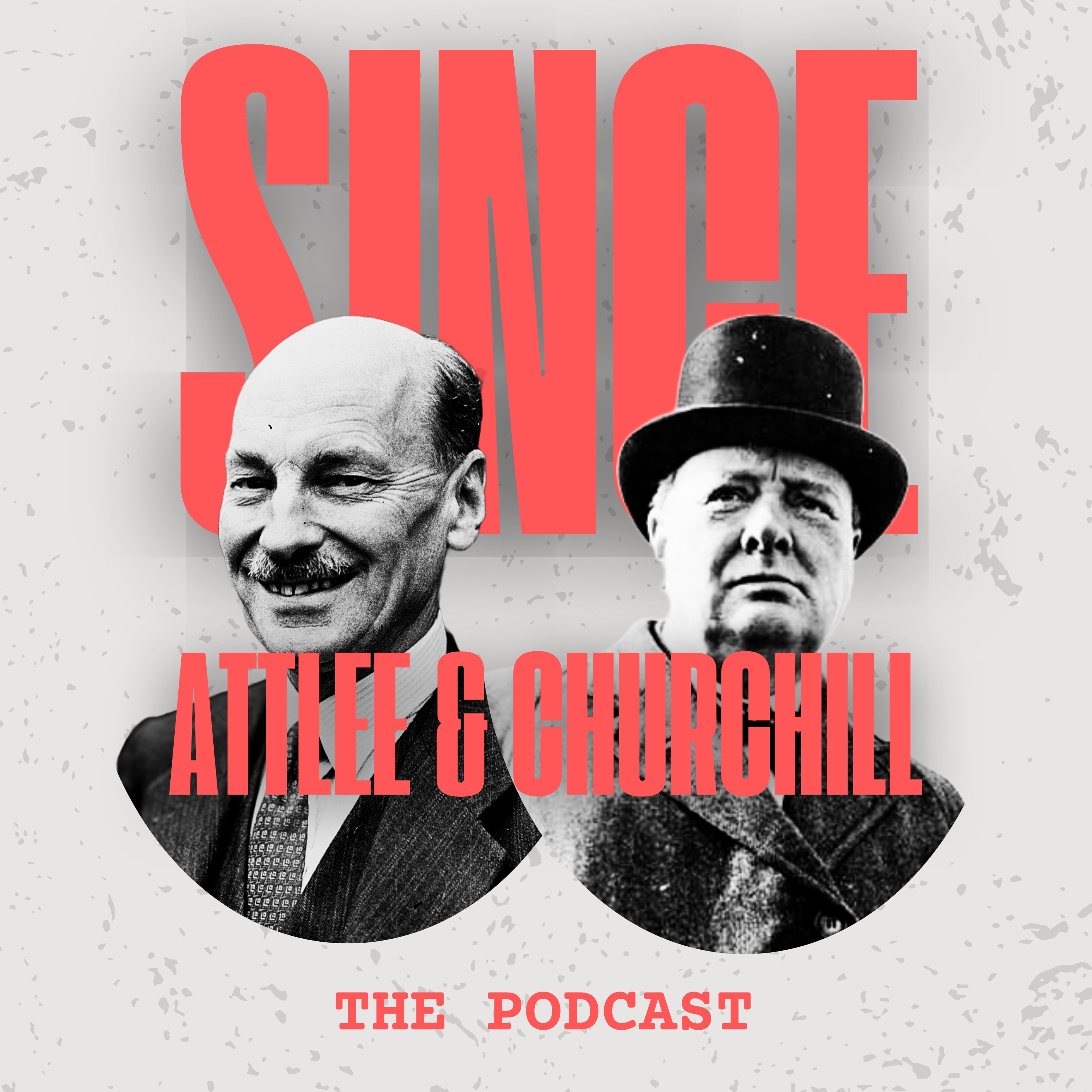
Since Attlee & Churchill
The podcast about post-war British politics - since Attlee & Churchill. Hosted by Lee David Evans, an historian of the Conservative Party, and Richard Johnson, an historian of the Labour Party. Enjoy ad-free listening, bonus episodes and show your support for the podcast by joining the Since Attlee & Churchill Patreon: https://www.patreon.com/c/SinceAttleeAndChurchill If you're a fan of the podcast, we would be very grateful if you could leave us a positive review to help other people find us. Thank you! Since Attlee & Churchill is also available on YouTube. Listen and watch the show at: https...
Besuch unbedingt die Website des Podcasts und unterstütze die Macher: www.patreon.com
Autor
Lee David Evans & Richard Johnson
Kategorie
Podcast-Website
Neueste Folge
19. Nov 2026
Wo hören?
Podcasts in der App Replaio Radio Bald verfügbarPodcasts kommen bald in die App. Installiere sie jetzt und erlebe als Erster einen ganz neuen Blick auf Podcasts
 Kostenlos installieren
Android 10 Mio.+ Downloads · Bewertung 4,7+
iOS bald
Folgen
How did Churchill use Chartwell to change the course of history? 24.08.2025 59:52
For this episode, Lee and Richard are joined by Katherine Carter, the curator of Chartwell, Churchill's country home, and the best-selling author of 'Churchill's Citadel'. Their discussion ranges from Churchill's decision to buy a semi-ruined home in rural Kent to the remarkable cast of characters - from Britain and around the world - that he invited to meet with him there. Throughout Churchill's...
"Alice, who the **** is Alice?" 17.08.2025 55:24
Alice Mahon may not be a well-remembered figure today, but for 18 years she served as MP for Halifax. In this episode, Lee and Richard discuss how this working class Yorkshirewoman entered the House of Commons and how her left-wing politics were received in Tony Blair's Labour Party. In doing so, they reflect on Blair's style of party management - in which left-wingers like Mahon were tolerated -...
Bonus: What was it like working for Ted Heath? 13.08.2025 45:34
In a special bonus episode to mark 25,000 downloads of the Since Attlee & Churchill podcast, Lee and Richard interview Dr Mark Garnett, a renowned historian of the Conservative Party and researcher for Ted Heath on the former prime minister’s memoirs. They discuss Heath’s approach to writing his much-anticipated autobiography; his ideology; how he came to terms with Thatcherism; and why he sta...
Whatever happened to the Young Conservatives? 10.08.2025 1:00:43
In 1949, the Young Conservatives boasted 160,000 members. They were the largest political youth organisation in the free world. Their social events were iconic and thousands of marriages, it was said, had been formed after encounters at Young Conservative committee meetings or balls. But by the mid-1960s, the organisation was declining; by the 1980s, it was in freefall. So what happened to the You...
Was 'Black Wednesday' actually a good day for Britain? 03.08.2025 1:08:55
Black Wednesday, also known as the Sterling Crisis of 1992, is one of the most traumatic events in Britain's post-war economic history. It left Britain looking devalued and powerless compared to the economic powerhouse of Germany, whilst for John Major and his government it was a blow to their economic credibility from which they would never recover. But was it actually a bad day for Britain? And...
The Attlee vs Churchill Elections (Episode 3 of 3): The 1951 General Election 27.07.2025 1:11:42
The third and final instalment of a special mini-series on the Attlee versus Churchill elections turns to the 1951 general election. In some respects, it was a repeat of the contest 20 months earlier - similar candidates, similar ideas, and a similar number of votes for both parties. But due to the workings of the electoral system, it gave the Conservatives and Winston Churchill a small majority i...
The Attlee vs Churchill Elections (Episode 2 of 3): The 1950 General Election 20.07.2025 1:04:49
The 1950 general election, the second contest between Clement Attlee and Winston Churchill, came four and a half years after Labour's landslide victory at the end of the Second World War. In many ways, this election was a referendum on the agenda implemented by Attlee as prime minister, from the NHS to the nationalisation of 20% of the economy. For Winston Churchill, 1950 was an opportunity to try...
The Attlee vs Churchill Elections (Episode 1 of 3): The 1945 General Election 13.07.2025 1:15:20
The 1945 general election is undeniably one of the key turning points in modern British history. It's also the first of three general elections that the namesakes of this podcast - Winston Churchill and Clement Attlee - fought against each other as leaders of their parties. In this first of three special episodes charting the Attlee vs Churchill elections, Lee and Richard look back at the con...
What happened when Tony Blair cut benefits for single mums? 06.07.2025 1:05:43
In 1997, Tony Blair returned Labour to power with a landslide majority. But many people who hoped for radical change were left disappointed when he announced that Labour would continue with the Tory plan to scrap the Lone Parent Premium, a welfare top up for single parents. Lone parents protested; Labour MPs revolted; and Blair had to decide whether to plough on with the measure or surrender to hi...
What were the Kennedys up to in Britain? 29.06.2025 1:04:39
In this special episode, we're joined by Presidential historian Alvin S. Felzenberg to discuss the rich and complex relationship between the Kennedy clan and the United Kingdom. How did this Irish American family, whose patriarch was appointed American Ambassador to Britain, cope with being in England? How did it shape the young Kennedy children? And what relationship would they, including John F....
Why did Stanley Baldwin secretly donate 20% of his wealth to the nation? 22.06.2025 1:04:31
In 1919, a remarkable letter appeared in The Times. The author had estimated the value of his estate and decided to give 20% of it to the government as a 'thank offering' for the sacrifices made in the First World War. The letter was simply signed 'F.S.T.'. It would be several years before people discovered that the letters stood for 'Financial Secretary to the Treasury', the job held by futu...
How did 'Women Against the Common Market' try to keep Britain out of Europe? 15.06.2025 1:05:56
In 1970, an eccentric and passionate Eurosceptic campaign group was founded: Women Against the Common Market. Its founder, Anne Kerr (a former Labour MP) was determined to prevent Britain's entry into the European Economic Community and wanted to persuade women to stand with her. Of course, she failed to keep Britain out - and sadly died before she had the chance to make her arguments in the 1975...
Was Eden right about Suez after all? 08.06.2025 1:09:15
The 1956 Suez Crisis has gone down as one of the most shameful events in modern British history. After Egyptian leader Gamal Abdel Nasser nationalised the Suez Canal, part owned by the United Kingdom, the British government desperately sought to re-assert its authority. A conspiracy developed with France and Israel to intervene and strike a blow against Nasser. Yet the events ended in disaster, wi...
Did Labour choose the wrong Miliband brother? 01.06.2025 1:14:47
After 13 years in government, the 2010 general election saw Labour ejected from office and on the hunt for a new leader. Curiously, two brothers - David and Ed Miliband - stood against each other in a five-way battle to lead the party. This divisive leadership contest led to accusations of fratricide and, when Ed won, many in Labour conclude that the party had chosen the wrong brother to lead it....
How did Viscount Stansgate become Tony Benn MP? 25.05.2025 1:02:47
In 1961 and 1963, two by-elections took place that changed British politics, and the fortunes of Tony Benn, forever. The first came after Benn was removed from the House of Commons following the death of his father. This elevated Benn to the peerage as the second Viscount Stansgate and meant, although Benn won the by-election, he was denied his seat in the Commons. After years of political an...
Does Michael Foot deserve a kinder verdict from historians? 18.05.2025 1:06:04
From 1980-1983, Michael Foot led the Labour Party through a disastrous and divisive period in its history, culminating in the famous landslide defeat of 1983. That result has marred how people think of Foot ever since. But Richard believes that Foot's long and remarkable career - as a journalist and a politician - deserves a more generous appraisal from historians. Is he right? In this episode we...
Do private members clubs still matter in British politics? 11.05.2025 1:02:51
Private members clubs once played a crucial role in British politics, even acting as the organising hubs of the Conservative and Liberal parties. For centuries, politicians of every shade have drunk, dined and gossiped together behind the closed doors of London clubs. But do they still? And do clubs still influence our politics? In this week's episode, Lee and Richard tackle that question and iden...
Which foreign leaders should be invited to address Parliament? 05.05.2025 59:25
Since the end of WWII, an increasing number of foreign leaders have been invited to address MPs and peers - whether in Westminster Hall, the Royal Gallery or elsewhere in Parliament. In 2017 and again today, a debate raged about whether Donald Trump should be among them. Lee and Richard look back on the history of foreign leaders addressing Parliament and consider whether it would be reasonable fo...
Are prime ministerial resignation honours an embarrassment? 27.04.2025 1:03:55
Prime ministerial resignation honours - first used in 1895 and regularly issued since - have been a perennial embarrassment for outgoing prime ministers. In this episode, Richard and Lee look back on the post-war lists, from Churchill to Sunak, Attlee to Brown, and consider who they chose to honour, why, and whether it harmed their reputation and legacy. In this episode, the following books are me...
Could 'English Socialism' save the Labour Party? 20.04.2025 56:43
The ideas underpinning English socialism go back to before the Norman Conquest, but they have been strangely absent from the Labour Party in recent years. In this week's episode, Lee and Richard discuss the concept of English socialism - what it is, where it comes from, how its distinct (but compatible) with British socialism, and why its values could be a recipe for the rejuvenation of the Labour...
Ernest Marples MP - a visionary, a scoundrel, or both? 13.04.2025 52:10
Few people today can recall the man who launched premium bonds, gave us the motorway network, or invited Dr Beeching to swing his axe on the United Kingdom's railway network. It was Ernest Marples, a post-war Conservative MP and ally of Harold Macmillan. Marples has a claim to be one of the most consequential ministers of the 1951-64 Conservative governments, but his personal immorality and financ...
What is the socialist case for monarchy? 06.04.2025 58:48
For the past century, many of the most prominent left-wing politicians in Britain, especially Labour leaders, have judged that the institution of monarchy is compatible with their vision of a more equal Britain. Why? In this episode, Richard and Lee discuss the socialist case for monarchy, from the earliest days of the Labour Party right up to the present day. Richard, a socialist himself, makes t...
Was this the most explosive Tory conference ever? 30.03.2025 1:01:45
In 1963, Harold Macmillan resigned as prime minister and triggered one of the most dramatic fights for the Tory leadership in modern history. Four men jockeyed for position at the party's annual conference in Blackpool, with an unassuming fourteenth earl eventually coming out on top. Why did Macmillan resign? Who should have succeeded him? And did the 1964 general election, which brought Harold Wi...
What lessons can be learned from a political maverick? 23.03.2025 56:36
For almost 40 years, Austin Mitchell was a staple of the House of Commons. At the beginning of his career, he was an up-and-coming star with a successful media career. Yet for the vast majority of his time as an MP, he was overlooked by successive leaders and confined to the backbenches. In this episode, Richard and Lee look back on Mitchell's career and consider what lessons can be learned from t...
Did Edward Heath deserve the name 'The Incredible Sulk'? 16.03.2025 57:15
Edward Heath spent more time in the House of Commons after he was Conservative leader (1975-2001) than beforehand. This long period, in which he was a frequent thorn-in-the-side of Margaret Thatcher and critic of her legacy, has become known as 'The Incredible Sulk.' But is that title fair? Why did Heath stick around for so long? What did he hope to achieve? And was he successful? That's the topic...
Ähnliche Podcasts








Höre den Podcast Since Attlee & Churchill in Replaio
Radio und Podcasts in einer App - kostenlos und ohne Anmeldung. Installiere sie noch heute und verpasse den Start nicht
Replaio ist kein Herausgeber von Podcasts; die Namen der Sendungen, Cover und Audioinhalte gehören ihren Autoren und werden über öffentliche RSS-Feeds verbreitet