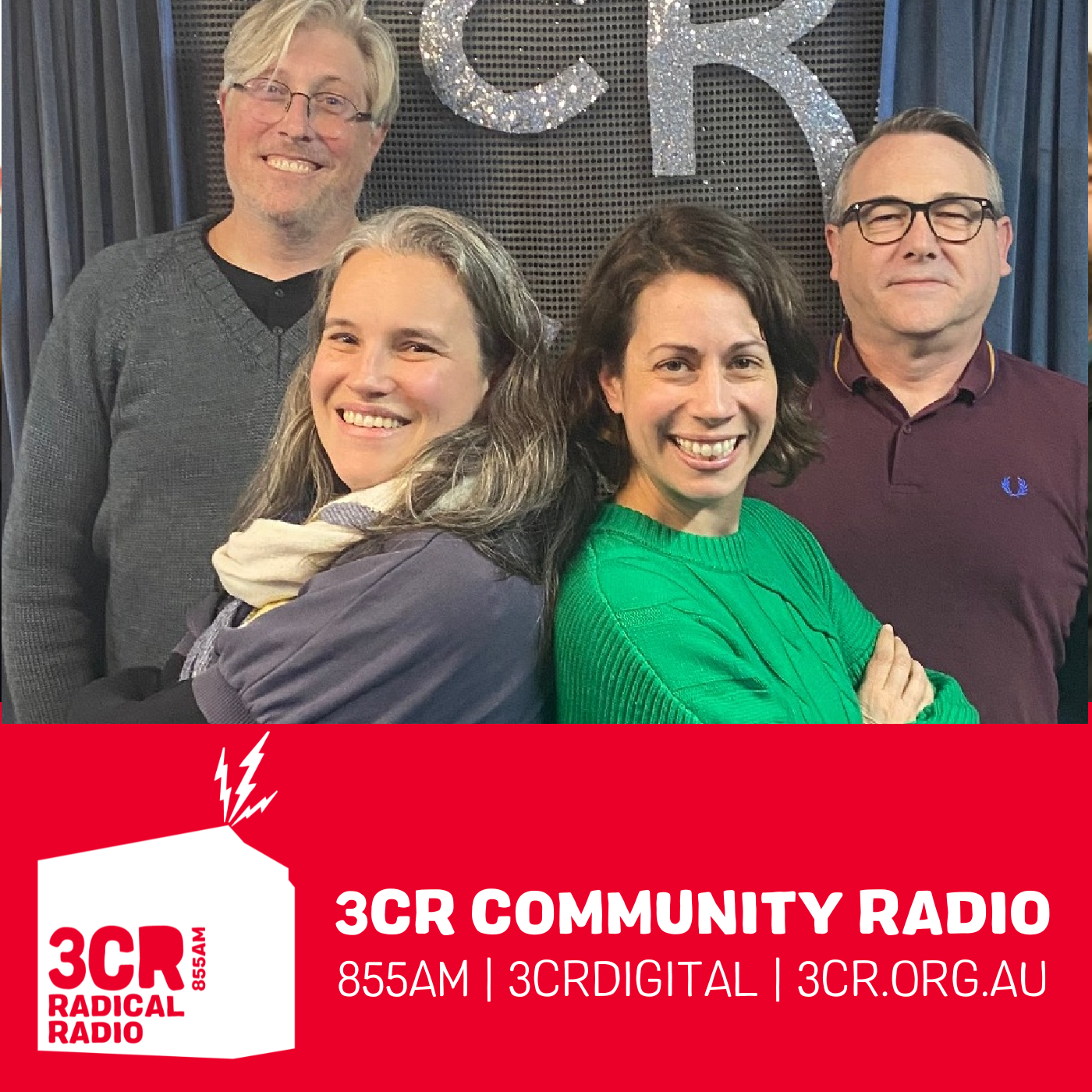
Chris Lassig, Stuart Burns, Claire Farrugia and Linden Ashcroft.
Lost in Science
Lost in Science is your weekly hit of mind-blowing science, strange facts, and big ideas. From cutting-edge discoveries to the science behind everyday life, our curious and passionate hosts make it fun, fast, and fascinating. If it’s weird, wonderful, or just worth knowing - we’re on it.
Besuch unbedingt die Website des Podcasts und unterstütze die Macher: www.3cr.org.au
Autor
Chris Lassig, Stuart Burns, Claire Farrugia and Linden Ashcroft.
Kategorie
Podcast-Website
Neueste Folge
21. Okt 2026
Wo hören?
Podcasts in der App Replaio Radio Bald verfügbarPodcasts kommen bald in die App. Installiere sie jetzt und erlebe als Erster einen ganz neuen Blick auf Podcasts
 Kostenlos installieren
Android fast 10 Mio. Downloads · Bewertung 4,8
iOS bald
Folgen
Lost in Science Fiction Flashback 05.11.2025
Revisiting some past stories from episodes of Lost in Science Fiction, we look at the science contained in (and the science inspired by) Star Wars, 2001: a Space Odyssey, and Ad Astra
Lost in Science Fiction! Halloween Special 29.10.2025
This week the team explore the science behind some science fiction classics. How strong would a tornado have to be to suck up the shark from Jaws? Would murderous robots in the future really be human-like? And what is the best science fiction movie, according to quantum physicists?
Predicting eureka & rule-breaking ants 22.10.2025
This week, Linden reveals a new study into predicting the tipping points when mathematicians have a sudden “ah-ha!” moment when working on a blackboard; and Claire stuns us all with research that found a single ant was able to lay eggs for two different species. S. Tabatabaeian, A. O’bi, D. Landy, & T. Marghetis, An information-theoretic foreshadowing of mathematicians’ sudden insights, Proc. Natl...
2025 Nobel Prizes in science 15.10.2025
This week we pay tribute to the science winners at this year's Nobel prizes, though possibly not as much fun as the Ignobels from last week, they will definitely get people thinking (and solving problems) if not laughing as much about the research.
Laugh, Think, and Maybe Drink: The Ig Nobel Prizes 08.10.2025
This week on Lost in Science, we dive into the delightfully weird world of the Ig Nobel Prizes — awards that celebrate research which first makes you laugh, then makes you think. From testing whether babies prefer garlicky milk, to exploring the science of perfect pasta, and discovering if a few drinks can improve your foreign language skills, we’re unwrapping the year’s most curious and clever di...
Scicomm student takeover 2: genes and Anthropocenes 01.10.2025
In this week's episode we welcome two more students from the University of Melbourne's Science Communication program. Carola explores her own family history through the story of Mendel's peas, while Lucy spills the tea on how the world's scientists rejected the idea of the Anthropocene as a geological era.
Scicomm student takeover: elephants and ravens 24.09.2025
A recent study suggests elephants have nicknames for each other. Find out more with Jessica on this week's episode. Photo by Nam Anh on Unsplash In this week's episode we welcome two students from the University of Melbourne's Science Communication program. Jessica and Niqi discuss the amazing communication styles of elephants, and try to quash bad news stories about ravens from around the world.
Ted Vanderfeen, space and mechatronics 24.09.2025
Stu talks to Ted Vanderfeen, a Palawa man from Peerapper lands in Northern Tasmania who has shifted his sights to space exploration. He tells us about his work in the US at the NASA jet propulsion laboratory through the Australian National Indigenous Space Academy and his current work on mechatronics with CSIRO.
Science Under Siege interview 10.09.2025
This week, Chris speaks to climate scientist Michael E. Mann and vaccinologist Peter Hotez about how their common challenges with denialism and anti-science influences led to writing their new book, Science Under Siege: How to fight the five most powerful forces that threaten our world.
Clancy the Bee Man and scanning for signs of life 03.09.2025
This week Linden talks to Clancy "The Bee Man" about native pollinators and how to look after them, while Stu finds out about how we can "Scan for life signs" in the 21st century without having to actually see any living things directly.
Plains-Wanderers Expanding & Reviving Thylacines 27.08.2025
This week on Lost in Science, Claire speaks with researcher Saskia Gerhardy about her fascinating new work revealing that the critically endangered plains-wanderer has a much wider habitat than previously thought – including the discovery of a new population in South Australia. And from the archives, Chris revisits a conversation with animal reproductive biologist Jarrod McKenna, exploring the bol...
Year of Quantum and Kelp Carbon Capture 20.08.2025
This week on the show we continue our Quantum for Dummies series, celebrating the International Year of Quantum. Claire takes the “dummy” seat once again, putting Chris, our resident quantum physicist, to the test with questions about the mysterious principle of uncertainty. Plus, we head into the archives to revisit Stu's interview with Dr Ellie Paine who researchers the role kelp could play in c...
Science voices and static electricity 13.08.2025
In this National Science Week episode, Linden unmasks some famous performers who also have a science background; and Chris shares some new research into how static electricity works, which is still unsolved after thousands of years. Sobarzo, J.C., Pertl, F., Balazs, D.M. et al. Spontaneous ordering of identical materials into a triboelectric series. Nature 638, 664–669 (2025). https://doi.org/10.1...
Evolution Show; Ancient Burials & Animal Doubles 06.08.2025
This week on Lost in Science, Linden explores fascinating new evidence that Homo naledi may have buried their dead 250,000 years ago—over three times earlier than we thought humans developed such rituals. What does this mean for our understanding of cultural evolution? Meanwhile, Chris dives into the curious world of convergent evolution—why do so many creatures evolve similar traits, like ant-eat...
Stressed Bird Leaders and pre feather feathers 30.07.2025
Claire looks to the animal kingdom for leadership strategies, and Stu explores ancient creatures who developed their own version of something almost completely unlike feathers millions of years before feathers appeared
Matter vs antimatter, and clouds vs climate 23.07.2025
This week, Chris breaks down the latest experimental results from the Large Hadron Collider, which confirmed an asymmetry between matter and antimatter, but not enough to explain the imbalance seen in the universe; and Linden explains the power of clouds, and new research showing that how they respond to climate change can make it worse. LHCb Collaboration. Observation of charge–parity symmetry b...
Underground eyeless invertebrates and interstellar interlopers 16.07.2025
Claire talks to Dr. Jess Marsh abotu eyeless invertebrates under the Nullarbor, and Chris looks into the dark sky for a new interstellar visitor to our solar system
Year of Quantum and Blood type changes 09.07.2025
This week to celebrate International Year of Quantum, Claire gets all her most basic quantum questions answered by Chris - what is Quantum, why should we be celebrating, and when will quantum technology teleport pizza to my door? Also on the show we head back into the archives and a story from Claire on new research using gut bacteria to switch blood A and B blood types to 'universal'.
Does AI change your brain? Young Indigenous Womens' STEM Academy 02.07.2025
Linden talks about a recent study into the effect of generative AI use on cognitive function and Stu talks to Kim Dyball, Executive Manager of the Young Indigenous Womens' STEM Academy and how a Churchill fellowship is going to help improve outcomes for young indigenous women in STEM in Australia
New viruses in bats & weight-loss drugs in the brain 25.06.2025
This week, Claire reveals new research that discovered 20 unknown viruses in the kidneys of bats in China; and Stu digs into recent studies of how weight-loss drugs like Ozempic work in the brain, and what this tells us about how our appetites function.
Galaxy Collisions and Cannonball Fungi 18.06.2025
This week on Lost in Science: Did you know the Andromeda galaxy is heading straight for us? Chris unpacks new research that pushes the expected Milky Way-Andromeda collision a few billion years further into the future. Meanwhile, Stu investigates cannonball fungi—tiny but mighty organisms that launch their spores over six metres! Find out how these fungal sharpshooters can stain your house and fru...
Possum rediscovery and sleep apnoea vs taping 11.06.2025
This week, Claire shares the great news that the critically endangered Leadbeater's possum, which is Victoria's faunal emblem, has been found living in NSW; and Chris explains the risks of sleep apnoea, and how the social media trend of mouth taping probably doesn't help.
Ice baths & cave diving for fossils 04.06.2025
This week on Lost in Science, Stu plunges into the cold truth about ice baths and athletic performance, while Claire revisits an interview with cave-diving palaeontologist Meg Walker, who searches underwater caves for fossils of Australia’s extinct megafauna – including giant wombats, marsupial lions and one-toed kangaroos.
Radio telescopy, and lifeless life 28.05.2025
Linden talks to radio astronomer Natasha Hurley-Walker about all things radio telescopy, and Stu brings a story about a new potential species that may not actually be alive.
Sitting vs exercise, and searching for Planet 9 21.05.2025
This week, Linden talks to researcher Michael Wheeler about the dangers of too much sitting, whether it really is the new smoking, and how to aim for more exercise; and Chris updates us on the search for a ninth planet in our Solar System (not counting) Pluto, why some astrophysicists believe it exists, and a dot seen in old telescope data that may be the missing planet.
Ähnliche Podcasts








Höre den Podcast Lost in Science in Replaio
Radio und Podcasts in einer App - kostenlos und ohne Anmeldung. Installiere sie noch heute und verpasse den Start nicht
Replaio ist kein Herausgeber von Podcasts; die Namen der Sendungen, Cover und Audioinhalte gehören ihren Autoren und werden über öffentliche RSS-Feeds verbreitet