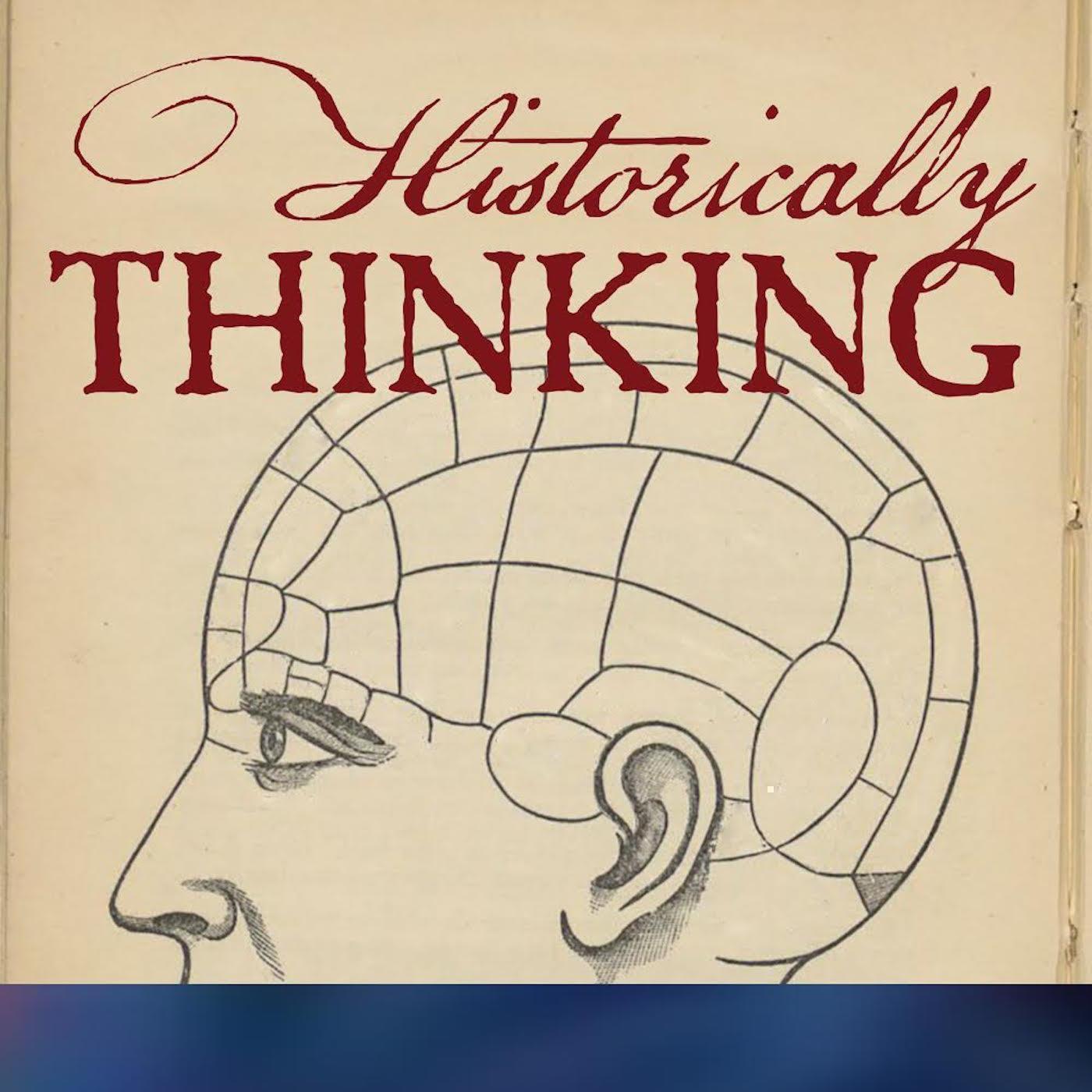
Al Zambone
Historically Thinking
We believe that when people think historically, they are engaging in a disciplined way of thinking about the world and its past. We believe it gives thinkers a knack for recognizing nonsense; and that it cultivates not only intellectual curiosity and rigor, but also intellectual humility. Join Al Zambone, author of Daniel Morgan: A Revolutionary Life, as he talks with historians and other professionals who cultivate the craft of historical thinking.
Besuch unbedingt die Website des Podcasts und unterstütze die Macher: blubrry.com
Wo hören?
Podcasts in der App Replaio Radio Bald verfügbarPodcasts kommen bald in die App. Installiere sie jetzt und erlebe als Erster einen ganz neuen Blick auf Podcasts
 Kostenlos installieren
Android fast 10 Mio. Downloads · Bewertung 4,8
iOS bald
Kostenlos installieren
Android fast 10 Mio. Downloads · Bewertung 4,8
iOS bald
Folgen
Episode 375: Bible History 16.09.2024
It is the most influential book in the history of the world, a book that in many ways set the standard for what books would become, but it is also the book at the heart of a world spanning religion. It has never purported to be the words of God, but the result of a complex partnership between God and his creation, the result being a “divine words written by human hands.” This book is of course the...
Episode 374: Serpent in Eden 04.09.2024 1:12:37
In his long short story or very short novella entitled “The Man Without a Country,” Edward Everett Hale describes his protagonist Philip Nolan as a young man from the Mississippi Valley who “had grown up in the West of those days, in the midst of ‘Spanish plot’, ‘Orleans plot’, and all the rest. He had been educated on a plantation where the finest company was a Spanish officer or a French merchan...
Episode 373: Spycrafte 30.08.2024 1:06:23
In Early Modern Europe, spying was not really a profession but it certainly was a verb. At times it would seem, from the dark suspicious years at the end of Henry VII’s life, to Cromwell’s protectorate and the restoration of the Stuart monarchy, that it was a game that everyone was playing. And in an era in which anyone with a modicum of political power was, figuratively speaking, always looking o...
Episode 372: Glorious Lessons 26.08.2024 1:03:05
Colonel John Trumbull, Artist John Trumbull must be one of the only artists in the history of American art to insist upon being addressed by his military rank; he was Colonel Trumbull until he died. But it was not John Trumbull’s feats in battle or in managing administrative correspondence that won him fame among his contemporaries, but what he painted on canvas. Hanging in the rotunda of the US C...
Episode 370: Enemies of All 19.08.2024 1:19:34
Maritime plundering, or piracy, has happened in nearly all regions of the world, in most ages of human history. Yet the image that we have of "a pirate" in our collective imagination comes from one period in the late seventeenth and early eighteenth centuries. So "why has that one relatively short moment come to stand for all sea raiding across time and space?" That is the question with which Ric...
Episode 371: Forming National Character 12.08.2024 1:13:39
How can a new nation establish itself amidst the networks and intrigues of a very old part of the world, while at the same time trying to be different from everyone else? Are these inherently contradictory aims? And how can either–or none–of these objectives be achieved by civil servants who are engaging in, at best, on the job training? These are some of the questions that are prompted by studyi...
Episode 369: Horse 29.07.2024
More than any other creature, it has proven itself over millennia to be man’s best and most useful friend. At first it was just another prey animal, but eventually it became such a close companion and coworker that it seems impossible for many of us to imagine ever eating one–although probably a billion people around the world do so on a regular basis. For thousands of years it remade cultures an...
Episode 368: Mosquito 22.07.2024 1:03:32
It is without question the most lethal predator in the history of the planet. It has killed more humans than any other single cause of death—something around 52 billion over the course of 200,000 years of human history. In 2022 alone, it probably killed 680,000 people—a number much reduced from the carnage it has caused in past centuries. This super-predator is the mosquito, which has since the t...
Episode 367: Bloody Tuesday 15.07.2024 1:08:51
Just before 10 AM on Tuesday, June 9th, 1964, in Tuscaloosa, Alabama, hundreds of people were gathered in First African Baptist, prepared to march to the new Tuscaloosa County Courthouse where they planned to drink from water fountains and use restroom facilities that were supposed to be only used by whites. Around the church were gathered hundreds of police, members of the Ku Klux Klan, and other...
Episode 366: Longing for Connection 08.07.2024 1:04:33
Does knowing a lot of facts about the historical past – say, of early America – make us feel closer to it? Or is something else required? How can we–as my guest puts it, “appreciate a bit better what it felt like to be alive then. Naturally,” he continues “we can’t teach emotions to any who weren’t alive to experience them how Pearl Harbor felt in real time – let alone Fort Sumter or Lincoln‘s as...
Episode 365: Chesapeake Bay Sea Monster 01.07.2024 1:11:52
In 1978, along the shoreline of the Potomac River in Westmoreland County, Virginia, people began to see…something…out in the water. Whatever it was, it seemed snakelike. But then all such sightings ended–until, over a period of years in the early 1980s, sightings proliferated around Kent Island, situated in the very middle of the Chesapeake, the eastern end of the Chesapeake Bay Bridge. The “monst...
Episode 363: Flying Saucers 17.06.2024 54:28
On June 24th, 1947, a private pilot and fire suppression equipment manufacturer named Kenneth Arnold was flying south of Mount Rainier, bound for Yakima, Washington. At about 3 PM he saw a flash of light in the air to the north of the mountain, and subsequently he saw a long chain of flying objects passing in front of the mountain. He described them as having convex shapes, and this was soon chang...
Episode 362: Out of One, Many 03.06.2024 1:04:33
Sometime around two and half millennia ago, a cluster of cities and states around the northeastern Mediterranean began to do amazing things. For some reason they began to spread out, establishing towns and outposts around the fringe of both the Mediterranean and the Black Seas. And as they sailed and traded in the outer world, they also began to explore with ever-increasing rigor their inner world...
Episode 361: Book Makers 27.05.2024 57:30
Books have been made for over 530 years. That is, they have been created from raw materials– sometimes lovingly, sometimes not–printed, bound, and sold, only then to be read. When we think only of what is written in books, we ignore much of the history of the book. So ubiquitous is the book, so commonplace is the book, that we often neglect it both as a brilliant technology; the product of multipl...
Intellectual Humility and Historical Thinking: Joseph Manning 20.05.2024 24:38
This is another of our series of conversations on intellectual humility and historical thinking. With me today is Joseph Manning. He is the William K. and Marilyn Milton Simpson Professor of Classics and History, Professor in the Yale School of the Environment, and Senior Research Scholar in Law. Manning has a specialized historical focus on Hellenistic history, with particular focus on the lega...
Episode 360: City of Light, City of Darkness 13.05.2024 1:13:26
The Paris of the Belle Époque was a city divided by new and old conflicts–the tensions of modernity, and the schisms which had divided France since 1789. Modernity, which the city both exemplified and advanced, could be both celebrated and the source of anxiety–sometimes by the same person at more or less the same time, certainly by the same person at different times. “The glories of the Belle Ep...
Episode 359: Damascus Events 06.05.2024 1:10:22
At 2 PM on July 9, 1860, a mob attacked the Christian quarter of Damascus. For over a week, shops, churches, houses, and monasteries were attacked, looted, and burned. Men were killed, women raped and abducted, children taken from their families. Some 5000 Christians were ultimately killed, about half of them refugees who had fled to the city from Mount Lebanon during an earlier outbreak of violen...
Episode 358: Narrative 29.04.2024 1:11:30
As you might have noticed, the world is awash in narratives. You hear people talk about “establishing the narrative”, or noting that “in the last 24 hours the narrative has changed.” We don’t talk about facts any more, we talk about narratives. And more than that. Narratives are, many have decided, cause conflict. They enable genocide, and wars. They are also embedded into our biology–”hardwired”,...
Episode 357: Empire of Climate 22.04.2024 1:01:07
"..Since ancient times, the idea that the climate exerts a determining influence on minds and bodies, health and well-being, customs and character, war and wealth has attracted a long line of committed followers.” Alarm over climate change brought about by anthropogenic global warming has renewed—or perhaps simply enhanced—an idea with a very long history. It was after all in 1748 when Montesquieu...
Episode 356: First Dark Ages? 15.04.2024 1:07:13
In 1177 BC a series of very unfortunate events culminated in the collapse of numerous kingdoms centered upon the western Mediterranean. The nature of those events, and how one played upon the other, was the topic of our conversation with Eric Cline way back in Episode 62, when we talked about his book 1177 BC: The Year Civilization Collapsed. Now Eric Cline is back on the podcast to answer one of...
Episode 355: Steam Powered 08.04.2024
At a pivotal moment in Chapter 17 of Nathanael Hawthorne’s House of the Seven Gables, two of his protagonists escape from haunted Salem, Massachusetts, and are whirled away from its power by the even greater power of steam: “…Looking from the window, they could see the world racing past them. At one moment, they were rattling through a solitude; the next, a village had grown up around them; a few...
Episode 354: Collisions 01.04.2024 1:09:15
In late July 2013, Vladimir Putin visited Kiev. There he celebrated the 1,025th anniversary of Christianity coming to the Kievan Rus. There he and Ukrainian President Victor Yanukovych stood shoulder to shoulder and celebrated the unity of Russia and Ukraine. At that moment–my guest Michael Kimmage writes– Putin and Yanukovych, Russia and Ukraine, seemed to be “twin protagonists of the same story....
Episode 353: Devils’ Rise 25.03.2024 1:06:58
On June 24, 1894, President of France Sadi Carnot was stabbed by an anarchist; on September 10, 1898, Empress Elisabeth of Austria was stabbed by an anarchist; on July 29, 1900, King Umberto I of Italy was shot by an anarchist; on September 6, 1901, President of the United States William McKinley was shot by an anarchist. If you have ever wondered why people in the 1900s right up to the Great War,...
Intellectual Humility and Historical Thinking: Mark Carnes 14.03.2024 51:43
Today’s guest is Mark Carnes, Professor of History at Barnard College. His academic speciality is modern American history and pedagogy. Among his many books are an edited volume, Meanings for Manhood: Constructions of Masculinity in Victorian America (University of Chicago Press, 1992), and Secret Ritual and Manhood in Victorian America (Yale University Press, 1989). An interest in how history app...
351: Pox Romana 11.03.2024 1:09:10
By the reign of Marcus Arelius, Rome seems to be unquestioned in its reach of its power, its wealth, and its cultural and intellectual sophistication. The Pax Romana stretched from Britain and Portugal to Syria and Egypt. Yet at the moment of its seemingly greatest achievements, Rome was struck by a disease that annihilated its legions and ravaged its cities. This was the Antonine plague, perhaps...
Ähnliche Podcasts






Höre den Podcast Historically Thinking in Replaio
Radio und Podcasts in einer App - kostenlos und ohne Anmeldung. Installiere sie noch heute und verpasse den Start nicht
Replaio ist kein Herausgeber von Podcasts; die Namen der Sendungen, Cover und Audioinhalte gehören ihren Autoren und werden über öffentliche RSS-Feeds verbreitet