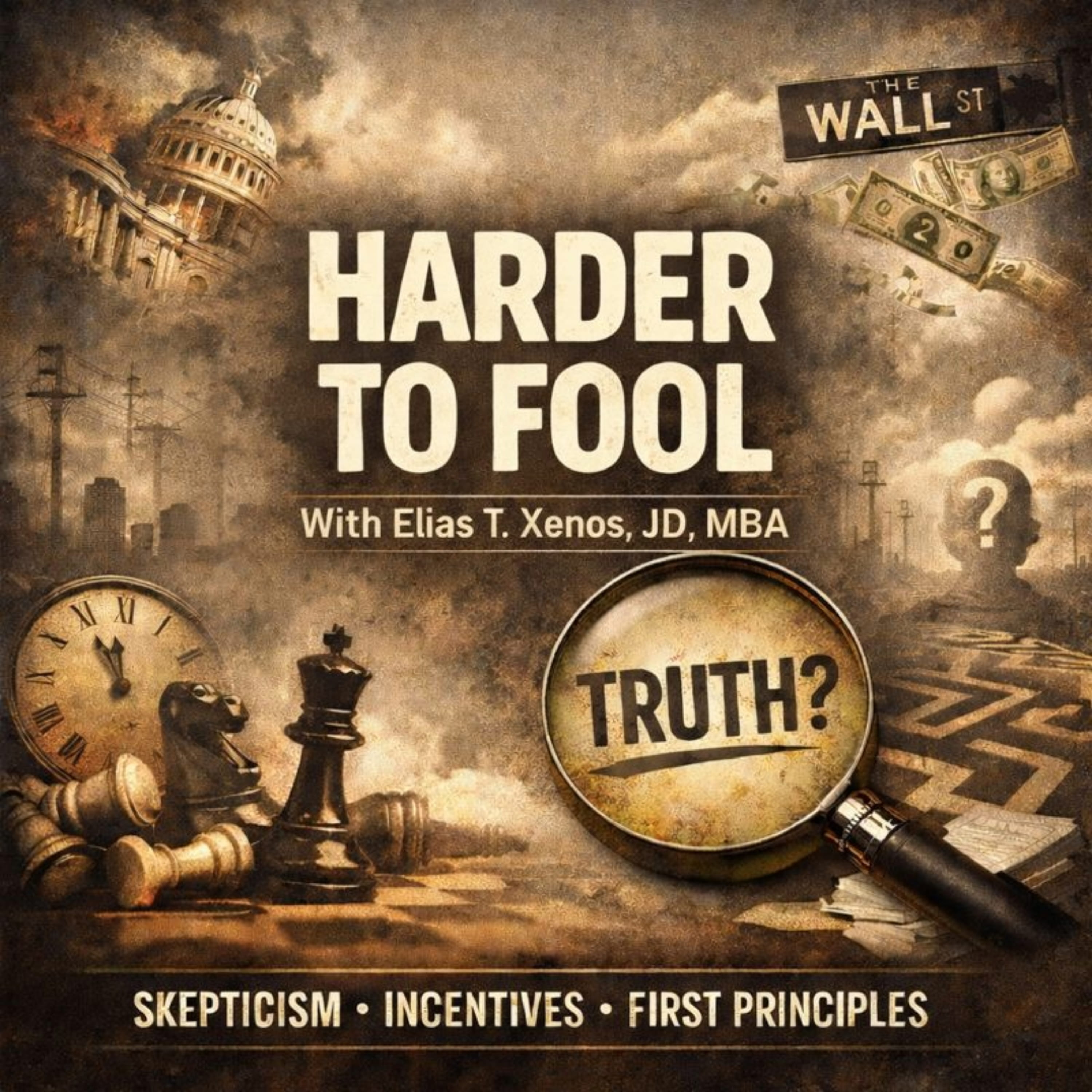
Elias T. Xenos, JD, MBA
Harder to Fool
This podcast isn’t a manifesto, and it doesn’t offer a single grand theory to explain modern life. It’s closer to an almanac: a collection of observations, warnings, and hard-earned patterns—many of them unfashionable—meant to be consulted, not blindly accepted. Modern American life is saturated with advice but starved of wisdom. Institutions that once filtered nonsense now produce it at scale. Narratives are sold as facts, incentives are disguised as morality, and skepticism is increasingly treated as a character flaw. This podcast is an attempt to clear some of that fog. Episodes range acros...
Wo hören?
Podcasts in der App Replaio Radio Bald verfügbarPodcasts kommen bald in die App. Installiere sie jetzt und erlebe als Erster einen ganz neuen Blick auf Podcasts
 Kostenlos installieren
Android 5 Mio.+ Downloads · Bewertung 4,8
iOS bald
Kostenlos installieren
Android 5 Mio.+ Downloads · Bewertung 4,8
iOS bald
Folgen
The Quiet Criminalization of Ordinary Life 15.02.2026 9:37
Why do more aspects of everyday life seem to be drifting toward criminalization? In this episode, we challenge the comforting myth that the past was simply more tolerant. Instead, we explore a harder truth: law often expands not because morality changes, but because enforcement technology advances. When surveillance becomes cheap, automated, and continuous, the question shifts from “Should this be...
Higher Education and the Cost of Easy Money 25.01.2026 7:35
College tuition didn’t spiral out of control by accident. This episode examines how unlimited access to subsidized money, non-dischargeable student loans, and administrative bloat turned higher education into one of the most profitable—and least disciplined—industries in America. From the Bennett Hypothesis to the explosion of bureaucracy and low-value degrees, the discussion argues that the crisi...
The Business of Illness 25.01.2026 7:18
Healthcare in America isn’t broken—it’s perfectly aligned with the incentives that govern it. This episode examines how scale, insurance design, and cultural expectations have transformed medicine into a system where costs rise invisibly, accountability dissolves, and intermediaries thrive. From Medicare’s role as a dominant buyer to the psychological separation between patients and prices, the co...
Before You Invest, Ask Why You're Being Invited 25.01.2026 6:09
Most investors ask the wrong first question. Instead of “How much can I make?” this episode asks something far more revealing: “Why is this opportunity being offered to me at all?” This conversation explores what access really signals in investing—how scarcity, liquidity, and incentives shape both public and private markets. From private deals to publicly traded stocks, the episode unpacks why bro...
Decide on Your Relationship With Money Early 22.01.2026 7:38
Most people never consciously decide what role money will play in their lives—they drift into it. In this episode, we examine why that quiet drift is so costly, and why your relationship with money should be chosen early and deliberately. We explore two coherent paths that actually work—intentional frugality and aggressive ambition—and why the unfocused middle ground produces stress rather than se...
Own the Relationship 20.01.2026 8:25
Every industry divides into two roles: those who do the work and those who control access to money. This episode examines why technicians—often the most skilled and indispensable people in the system—are routinely out-earned by relationship owners who sit closest to the transaction. From law and medicine to music, film, and corporate leadership, we unpack the structural reasons effort and difficul...
Why Responsibility Rarely Determines Pay 20.01.2026 7:46
Why does someone entrusted with thousands of lives earn less than someone brokering expensive deals with little personal risk? Because pay is rarely about responsibility, difficulty, or social value. This episode breaks down how modern compensation actually works: income flows to those positioned near large pools of money, not those bearing the greatest consequences. We explore deal-size thinking,...
The Myth of the "Well=Rounded" Applicant 20.01.2026 6:11
Colleges insist they want well-rounded students. In reality, they want something very different: a carefully engineered, well-rounded class . This episode unpacks the quiet distinction between individual breadth and institutional design, and why genuine intellectual range—formed through curiosity and free choice—often works against modern admissions incentives. We examine how the language of “well...
Home Ownership: The Costs That Shape Your Life 20.01.2026 8:01
Home ownership is treated as a moral good in American life—question it and you risk sounding heretical. But beneath the spreadsheets, tax deductions, and rent-vs-buy calculators lies a deeper set of costs few are willing to confront. This episode examines home ownership not as a financial decision, but as an existential one: how it shapes mobility, opportunity, influence, and exposure to the state...
Be a Service Capitalist 20.01.2026 7:07
Brick-and-mortar businesses are often celebrated as the backbone of the economy—but structurally, they are some of the most exposed. This episode examines why enterprises tied to physical locations and fixed assets become easy targets for taxation, regulation, and political extraction, especially as economic activity grows more mobile and digital. We contrast capital-intensive businesses with serv...
Wealth is Not Financial Independence 20.01.2026 8:25
Wealth and financial independence are often treated as the same thing—but they aren’t. This episode examines the difference between having assets on paper and having a life that can withstand disruption. We look at how dependence hides inside jobs, markets, debt, and “passive” income, and why high net worth can still mean fragility. Financial independence, properly understood, isn’t about maximizi...
Hold Cash to Preserve Your Liberty and Dignity 20.01.2026 7:59
Harder to Fool examines how modern systems quietly trade liberty for convenience—and why that trade is rarely as benign as advertised. In this episode, we take a hard look at the push toward a cashless economy, not as a technological upgrade, but as a structural shift in power. When money becomes fully digital, choice erodes, enforcement becomes automatic, and compliance replaces consent. This is...
Ähnliche Podcasts





Höre den Podcast Harder to Fool in Replaio
Radio und Podcasts in einer App - kostenlos und ohne Anmeldung. Installiere sie noch heute und verpasse den Start nicht
Replaio ist kein Herausgeber von Podcasts; die Namen der Sendungen, Cover und Audioinhalte gehören ihren Autoren und werden über öffentliche RSS-Feeds verbreitet