Dr. Jason Edwards
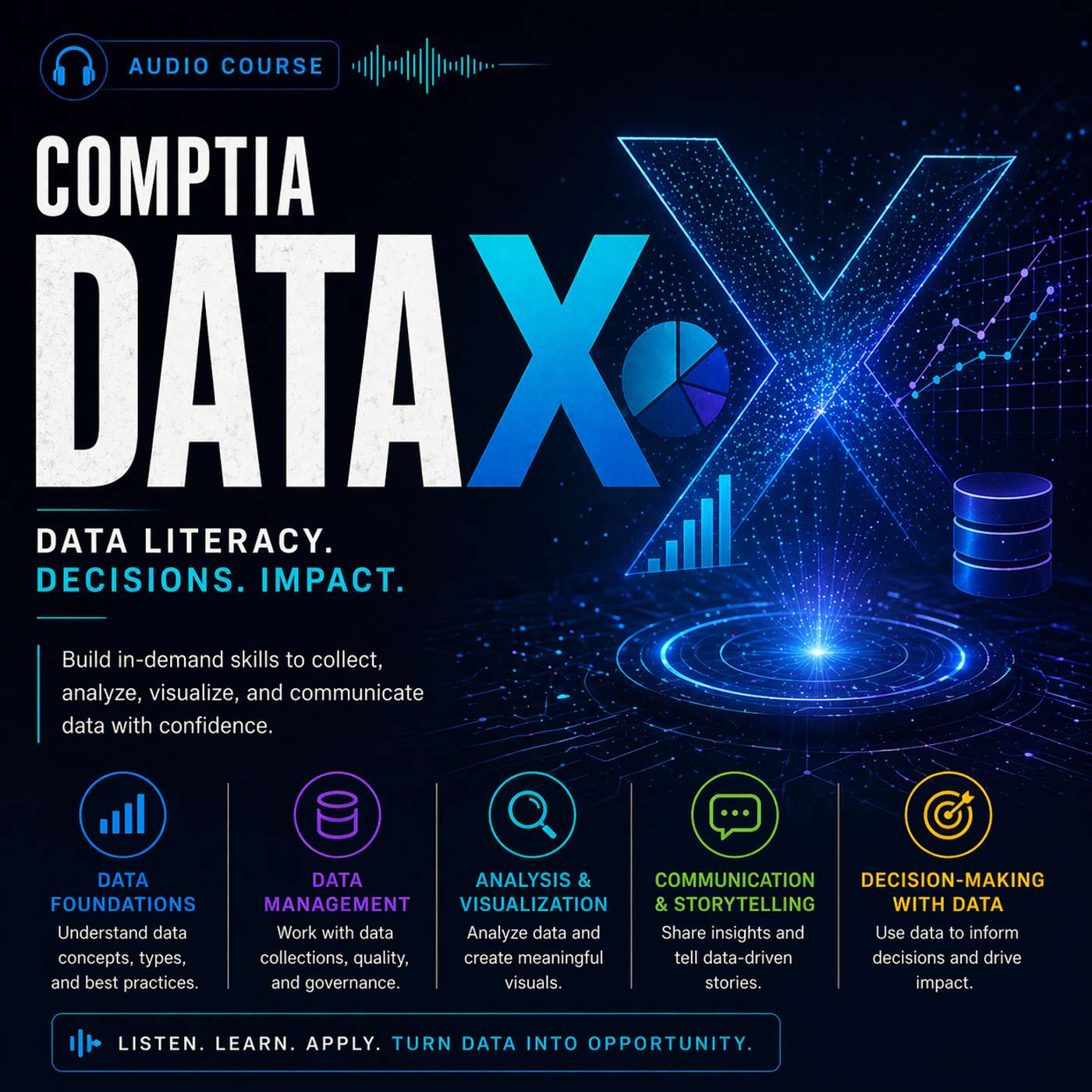
Certified: The CompTIA DataX Audio Course
This DataX DY0-001 PrepCast is an exam-focused, audio-first course designed to train analytical judgment rather than rote memorization, guiding you through the full scope of the CompTIA DataX exam exactly the way the test expects you to think. The course builds from statistical and mathematical foundations into exploratory analysis, feature design, modeling, machine learning, and business integration, with each episode reinforcing how to interpret scenarios, recognize constraints, select defensible methods, and avoid common traps such as leakage, metric misuse, and misaligned objectives. Conce...
Wo hören?
Podcasts in der App Replaio Radio Bald verfügbarPodcasts kommen bald in die App. Installiere sie jetzt und erlebe als Erster einen ganz neuen Blick auf Podcasts
 Kostenlos installieren
Android 5 Mio.+ Downloads · Bewertung 4,8
iOS bald
Kostenlos installieren
Android 5 Mio.+ Downloads · Bewertung 4,8
iOS bald
Folgen
Episode 95 — Naive Bayes: When Simple Probabilistic Models Shine 24.01.2026 17:38
This episode explains Naive Bayes as a fast, practical probabilistic classifier that can perform surprisingly well when its conditional independence assumption is “wrong but useful,” which is a nuance DataX scenarios may probe. You will define Naive Bayes as computing class probabilities using Bayes’ rule while assuming features are conditionally independent given the class, which simplifies estim...
Episode 94 — LDA vs QDA: Choosing Discriminant Methods by Data Shape 24.01.2026 16:38
This episode teaches linear and quadratic discriminant analysis as probabilistic classification methods whose suitability depends on data shape assumptions, because DataX scenarios may test whether you can choose between LDA and QDA based on covariance structure and sample size. You will learn the conceptual foundation: both methods model class-conditional distributions, typically as Gaussian, and...
Episode 93 — Logit vs Probit: Recognizing Differences Without Overcomplicating It 24.01.2026 16:33
This episode explains logit versus probit as two closely related approaches for binary outcome modeling, focusing on what differences matter for DataX exam recognition without overcomplicating the math. You will learn that both models map a linear predictor into a probability between zero and one, but they use different link functions: logit uses the logistic function while probit uses the normal...
Episode 92 — Logistic Regression: Probabilities, Log-Odds, and Threshold Strategy 24.01.2026 17:09
This episode teaches logistic regression as a probability model for classification, emphasizing how it represents outcomes through log-odds and why threshold strategy is a decision layer on top of the model, because DataX scenarios often test these distinctions. You will define logistic regression as modeling the probability of a class using a linear combination of features passed through a sigmoi...
Episode 91 — Weighted Least Squares: Handling Non-Constant Variance in Regression 24.01.2026 17:04
This episode explains weighted least squares as a targeted response to heteroskedasticity, because DataX scenarios may describe regression errors that grow or shrink across ranges and ask what method addresses non-constant variance without abandoning the regression framework. You will learn the core idea: when observations have different error variance, treating them equally can overemphasize nois...
Episode 90 — OLS Assumptions: What Violations Look Like in Real Problems 24.01.2026 17:28
This episode teaches ordinary least squares assumptions as diagnostic signals rather than as a memorization list, because DataX scenarios often describe symptoms—unstable coefficients, misleading significance, patterned residuals—and ask what assumption is violated and what you should do. You will learn the core OLS assumptions in applied terms: linearity in parameters, errors with zero mean, inde...
Episode 89 — Regression Families: When Linear Regression Is Appropriate 24.01.2026 14:34
This episode reviews regression families with a focus on when linear regression is appropriate, because DataX scenarios often test whether you can defend linear regression as a strong baseline when assumptions are reasonable and interpretability is required, while also recognizing when it will fail. You will define linear regression as modeling the expected value of a continuous target as an addit...
Episode 88 — Explainability: Global vs Local and Interpretable vs Post-Hoc 24.01.2026 17:26
This episode teaches explainability as a spectrum of needs and methods, because DataX scenarios often include constraints like regulatory review, operational trust, or stakeholder understanding that require you to choose between inherently interpretable models and post-hoc explanations. You will define global explainability as understanding the overall model behavior across the population and loca...
Episode 87 — Drift Types: Data Drift vs Concept Drift and Expected Warning Signs 24.01.2026 16:45
This episode distinguishes data drift from concept drift as two different reasons performance decays after deployment, because DataX scenarios often ask you to identify which drift is occurring and what monitoring or remediation strategy matches it. You will define data drift as changes in the distribution of inputs or feature values, such as new ranges, new category frequencies, or shifting corre...
Episode 86 — Data Leakage: “Too Good to Be True” Results and How to Catch Them 24.01.2026 17:10
This episode teaches data leakage as the most common reason models look perfect in evaluation and then collapse in production, which is why DataX scenarios repeatedly test whether you can recognize “too good to be true” patterns and identify the leak source. You will define leakage as any pathway where information unavailable at prediction time influences training or validation, including direct t...
Episode 85 — Generalization: In-Sample vs Out-of-Sample and Interpolation vs Extrapolation 24.01.2026 14:55
This episode teaches generalization as the central promise and risk of machine learning, because DataX scenarios often ask whether a model will hold up beyond the data it was trained on and what limitations should be stated or mitigated. You will define in-sample performance as how well the model fits the training data and out-of-sample performance as how well it performs on new, unseen data, emph...
Episode 84 — SMOTE and Resampling: When Synthetic Examples Help or Harm 24.01.2026 18:12
This episode explains SMOTE and resampling as imbalance mitigation tools, focusing on when synthetic examples improve learning versus when they create false structure, leakage-like artifacts, or miscalibrated probabilities, which is exactly the nuance DataX may test. You will learn the core idea of SMOTE: generating synthetic minority examples by interpolating between existing minority points, whi...
Episode 83 — Class Imbalance: Why It Breaks Metrics and How to Fix Decisions 24.01.2026 16:28
This episode addresses class imbalance as a decision and evaluation problem, because DataX scenarios frequently involve rare events where accuracy and naive thresholds produce misleading comfort while the model fails on the cases that matter. You will define class imbalance as a large difference in prevalence between classes, such as rare fraud, rare failures, or rare security incidents, and conne...
Episode 82 — Hyperparameter Tuning: Grid vs Random vs Practical Constraints 24.01.2026 17:44
This episode explains hyperparameter tuning as a constrained search problem, because DataX scenarios often test whether you can choose a tuning strategy that balances performance gains with time, compute, and reproducibility limits. You will define hyperparameters as configuration settings chosen before training, such as regularization strength, tree depth, learning rate, or number of neighbors, a...
Episode 81 — Cross-Validation: k-Fold Logic and Common Misinterpretations 24.01.2026 16:57
This episode teaches cross-validation as an estimation method for generalization performance, focusing on k-fold logic and the misinterpretations that DataX scenarios often target. You will define k-fold cross-validation as splitting data into k parts, training on k-1 parts and validating on the remaining part, then repeating so each part serves as validation once, producing a distribution of perf...
Episode 80 — Regularization: Ridge, LASSO, Elastic Net as Control Knobs 24.01.2026 19:46
This episode explains regularization as a stability and generalization control knob, because DataX scenarios frequently test whether you understand how Ridge, LASSO, and Elastic Net change model behavior under multicollinearity, high dimensionality, and limited signal. You will define regularization as adding a penalty to discourage overly complex parameter settings, which reduces variance and hel...
Episode 79 — Bias-Variance Tradeoff: Diagnosing Overfitting and Underfitting by Symptoms 24.01.2026 19:32
This episode teaches the bias-variance tradeoff as a diagnostic tool, because DataX scenarios often describe symptoms—train/validation gaps, unstable performance, or persistent systematic errors—and ask what is happening and what you should do next. You will define bias as error from overly simple assumptions that cause underfitting and variance as sensitivity to noise that causes overfitting, the...
Episode 78 — ML Core Concepts: Learning, Loss, and What “Optimization” Really Means 24.01.2026 18:41
This episode defines the core machine learning loop in exam-ready terms: learning is the process of adjusting a model so its predictions improve on a defined objective, loss is the quantitative measure of how wrong the model is, and optimization is the method used to reduce that loss under constraints. You will learn to treat “learning” as a mapping problem from inputs to outputs, where the model...
Episode 77 — Domain 2 Mixed Review: EDA, Features, and Modeling Outcomes Drills 24.01.2026 18:05
This episode is a mixed review designed to turn Domain 2 concepts into fast scenario decisions, because the DataX exam often asks for the best next step when data quality, feature design, and modeling outcomes interact in messy real-world conditions. You will practice identifying the primary bottleneck in a prompt—quality defects, weak signal, wrong feature type handling, nonlinearity, drift, or v...
Episode 76 — Documentation Essentials: Data Dictionary, Metadata, and Change Tracking 24.01.2026 18:17
This episode covers documentation as a reliability and governance requirement, because DataX scenarios often involve teams inheriting models, auditing outcomes, or troubleshooting drift, and documentation is what makes those tasks feasible. You will learn the purpose of a data dictionary: precise definitions for fields, units, valid ranges, and business meaning, which prevents silent misinterpreta...
Episode 75 — Communicating Results: Clear Narratives, Honest Limitations, and Accessibility 24.01.2026 18:16
This episode teaches communication as a technical skill, because DataX scenarios often test whether you can translate model results into a clear narrative, state limitations honestly, and make outputs usable for decision-makers without overstating certainty. You will learn to structure communication around the decision: the objective, the approach, the evidence, and what action is recommended, the...
Episode 74 — Validation Hygiene: Data Splits, Leakage Prevention, and Reproducibility 24.01.2026 16:40
This episode covers validation hygiene as the backbone of trustworthy performance claims, because DataX scenarios often include “too good to be true” results and ask what went wrong or what you should do next. You will learn the purpose of data splits: separating training, validation, and test roles so you can tune without overfitting and estimate generalization honestly, then connect split choice...
Episode 73 — Residual Thinking: Diagnosing What Your Model Still Can’t Explain 24.01.2026 18:19
This episode teaches residual thinking as a diagnostic discipline, because DataX scenarios frequently test whether you can interpret what remains unexplained after modeling and turn that insight into the next best improvement step. You will define a residual as the difference between what the model predicted and what actually happened, then connect residual analysis to identifying missing structur...
Episode 72 — Training Cost vs Inference Cost: Choosing Models for the Real World 24.01.2026 18:38
This episode teaches cost thinking as a deployment constraint, because DataX scenarios often test whether you can choose models that fit operational realities, not just offline performance, by balancing training cost against inference cost. You will define training cost as the compute, time, and engineering complexity needed to build and update a model, and inference cost as the resources and late...
Episode 71 — Metric Selection by Goal: Aligning Measures With Business Outcomes 24.01.2026 17:06
This episode teaches metric selection as a goal alignment exercise rather than a default choice, because DataX scenarios often hinge on whether you can connect business outcomes and risk tolerance to the right evaluation measures. You will learn to start by defining what “success” means operationally, such as reducing false negatives, minimizing costly false positives, lowering average error in cr...
Ähnliche Podcasts







Höre den Podcast Certified: The CompTIA DataX Audio Course in Replaio
Radio und Podcasts in einer App - kostenlos und ohne Anmeldung. Installiere sie noch heute und verpasse den Start nicht
Replaio ist kein Herausgeber von Podcasts; die Namen der Sendungen, Cover und Audioinhalte gehören ihren Autoren und werden über öffentliche RSS-Feeds verbreitet