Roey Granot
Agents 101: From Chatbots to Autonomous Systems
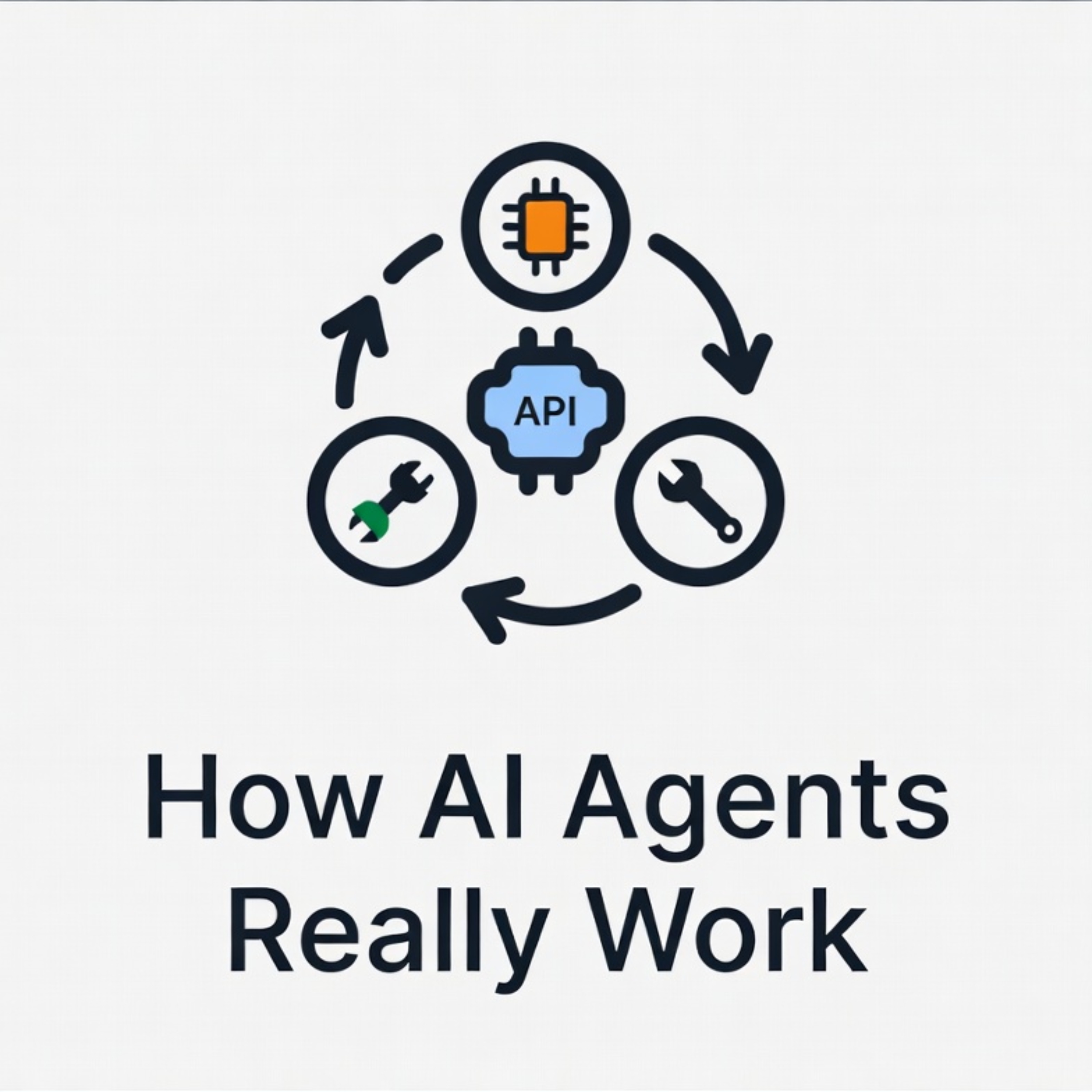
AI agents are everywhere. But most people still don’t understand how they actually work. This show breaks it down simply. No hype. No buzzwords. No magic. Each episode explains one core building block:What an agent really is. How tools and APIs connect. How memory works. How agents plan, decide, and act. Why they fail. And when you shouldn’t use them at all. If you want to design, build, or manage real AI systems, this is the practical foundation you need. Understand the mechanics first. Then build smarter.
Autor
Roey Granot
Kategorie
Podcast-Website
Neueste Folge
7. Jun 2026
Wo hören?
Podcasts in der App Replaio Radio Bald verfügbarPodcasts kommen bald in die App. Installiere sie jetzt und erlebe als Erster einen ganz neuen Blick auf Podcasts
 Kostenlos installieren
Android 5 Mio.+ Downloads · Bewertung 4,8
iOS bald
Kostenlos installieren
Android 5 Mio.+ Downloads · Bewertung 4,8
iOS bald
Folgen
Episode 6- How to Control Autonomous AI Agents 07.06.2026 23:43
A truly autonomous agent can create huge value — or make the same mistake perfectly, ten thousand times in a row. In this episode, we move from how agents work to how you actually run one safely. We break down the control layer: human-in-the-loop approvals, permission tiers (read-only vs. write access), circuit breakers, and retry limits. You'll learn the failure modes that matter — error prop...
Episode 5- Planning and multi-step reasoning in agents 13.02.2026 38:00
Most AI systems don’t actually “plan.” They respond. There’s a difference. In this episode, we break down what planning and multi-step reasoning in AI agents really mean. You’ll learn how agents take a high-level goal and turn it into structured, ordered actions instead of a single answer. We explain how goals are decomposed, how decisions are made step by step, and how feedback loops help agents...
Episode 4- Memory in AI agents (short-term vs long-term) 13.02.2026 19:08
Most AI systems don’t actually “remember” anything. Unless memory is deliberately engineered, every interaction starts from zero. In this episode, we break down memory in AI agents, specifically the difference between short-term memory inside a model’s context window and long-term memory stored externally in databases or vector stores. You’ll understand what each type does and why both are necessa...
Episode 3- What “tools” and API calling mean in agent systems 13.02.2026 30:56
Text isn’t enough to get real work done. In this episode, we explain what “tools” and API calling actually mean inside AI agent systems, and why they’re the difference between a model that talks and a system that acts. You’ll learn how agents connect to external software like CRMs, databases, email, payments, and internal systems, how APIs let them send and receive structured data, and how this tu...
Episode 2- How large language models (LLMs) actually work (at a high level) 13.02.2026 39:58
LLMs feel intelligent. But under the hood, they’re not thinking. They’re predicting. In this episode, we explain in plain English how large language models like ChatGPT actually work. What they’re trained on, what a “token” really is, how probabilities drive every word they generate, and why they sometimes sound confident but still get things wrong. We break down the core mechanics step by step: t...
Episode 1- What is an AI agent vs a chatbot? 13.02.2026 25:01
Everyone says they’re building “AI agents.” Most are still just chatbots. In this episode, we break down the real difference between chatbots, large language models (LLMs), and true AI agents that can plan, use tools, and execute multi-step tasks across systems. You’ll learn how agents actually work under the hood, where they fail, and when you should use a simple chatbot instead. We cover real bu...
Ähnliche Podcasts







Höre den Podcast Agents 101: From Chatbots to Autonomous Systems in Replaio
Radio und Podcasts in einer App - kostenlos und ohne Anmeldung. Installiere sie noch heute und verpasse den Start nicht
Replaio ist kein Herausgeber von Podcasts; die Namen der Sendungen, Cover und Audioinhalte gehören ihren Autoren und werden über öffentliche RSS-Feeds verbreitet