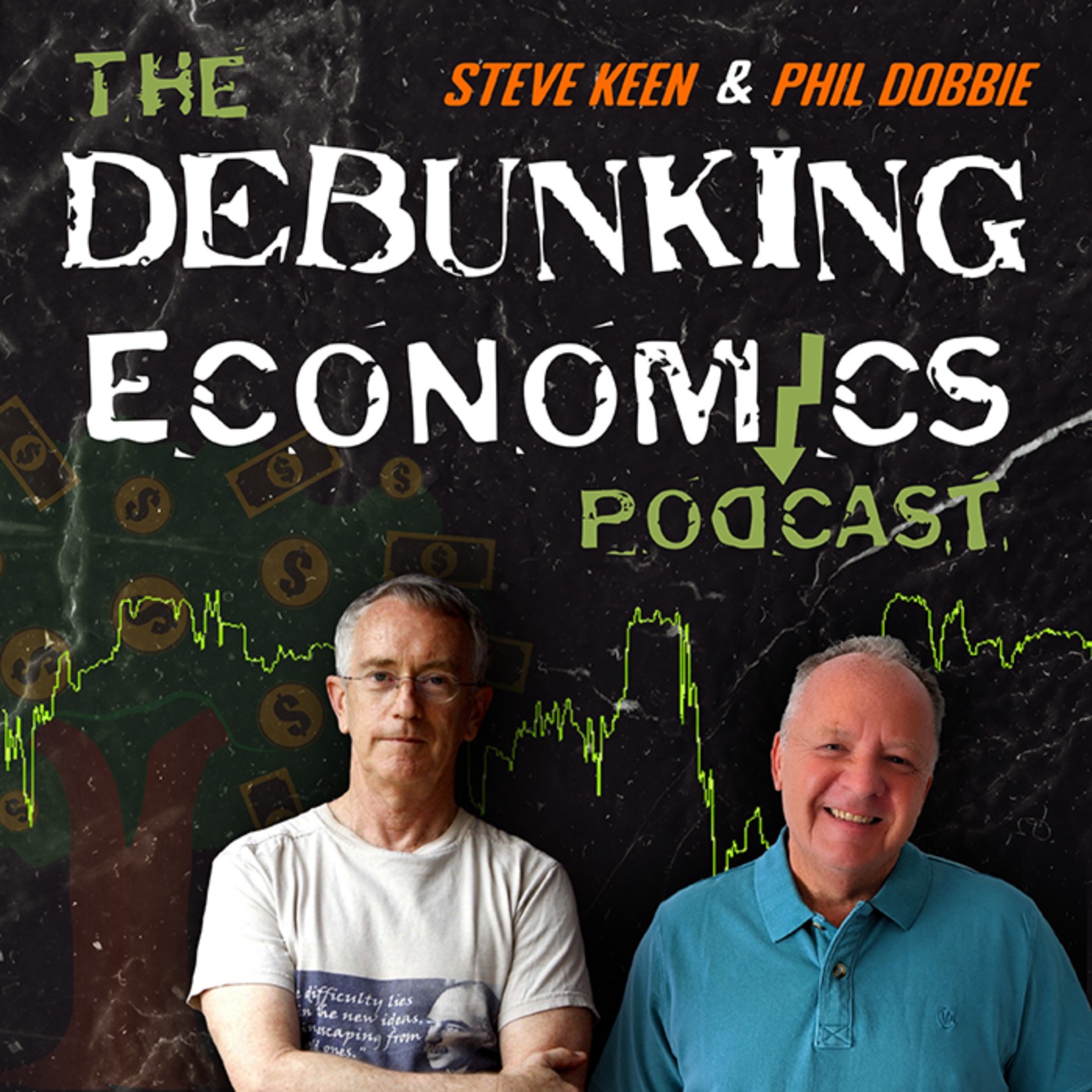
Steve Keen & Phil Dobbie
Debunking Economics - the podcast
Economist Steve Keen talks to Phil Dobbie about the failings of the neoclassical economics and how it reflects on society. Hosted on Acast. See acast.com/privacy for more information.
Husk at besøge podcastens hjemmeside og støtte skaberen: debunkingeconomics.com
Forfatter
Steve Keen & Phil Dobbie
Kategori
Podcastens hjemmeside
Seneste episode
7. okt. 2026
Hvor kan du lytte?
Podcasts i appen Replaio Radio Kommer snartPodcasts kommer snart til appen. Installer nu, og vær den første til at se en helt ny tilgang til podcasts
 Installer gratis
Android næsten 10 mio. downloads · 4,8 i bedømmelse
iOS snart
Episoder
The inequality of fear and greed 07.10.2026 39:50
Fear and greed don’t affect everyone equally. In this episode, Phil Dobbie and Steve Keen explore how debt, financial bubbles, and economic policy can reward those at the top while leaving workers, renters, and households to carry more of the risk. From market crashes and speculative booms to the growing role of private debt, they unpack why inequality persists—and why fear has become an everyday...
Should Britain rejoin the EU? 30.09.2026 37:53
Phil and Steve unpack the case for a renewed relationship with Europe, from trade and supply chains to freedom of movement and political sovereignty. They debate whether the euro still makes sense in an era of low-cost digital payments, why a shared currency can leave national economies exposed, and what European cooperation should actually look like. Along the way, they explore the legacy of Brex...
Are bond vigilantes in charge? 23.09.2026 32:43
Bond yields are not “warning” governments to behave—they’re exposing a system where central banks and treasuries can backstop the entire market whenever they choose. Steve says the panic around government debt is mostly an economic fairy tale, and the real danger is what happens when policymakers let that fiction dictate spending. Phil presses him on the recent surge in 10-year and 30-year yields,...
The always moving equilibrium 16.09.2026 36:32
Equilibrium is a fantasy—and this conversation explains why. Phil and teve explore how the belief that markets naturally self-correct has shaped economic policy, contributed to the failure to anticipate the Global Financial Crisis, and continues to distort debates about bond yields, government intervention, debt, and inflation. From Irving Fisher’s original models to today’s financial markets, AI...
What did Keating do for Australia? 09.09.2026 42:31
Paul Keating is often sold as the man who modernized Australia - but what if the reforms that made him legendary also helped create the financialized, boom-and-bust economy we live with today? Steve argues the real story is far more unsettling. From the "recession we had to have" to the housing bubble, tariff cuts, bank deregulation, and the superannuation system, he breaks down how Keating's poli...
The risks of hedging 02.09.2026 28:33
In this episode, Prof Steve Keen and host Phil explore the complexities of hedging, its applications, pitfalls, and its impact on markets and the economy. Hedging, rife in the financial and commercial world, is designed to protect our investments. If prices of our investments go down, or the cost of our business inputs go up, hedging is the insurance that stops things getting too bad. But do...
Burnham on Buying British 25.08.2026 40:29
The UK Prime Minister Andy Burnham has said he wants government departments to focus on buying British, The UK state spends roughly £300bn to £400bn a year on public procurement—and currently treats it merely as a bureaucratic exercise to secure the absolute cheapest upfront contract, rather than using it as an economic driver. Steve says it’s a step in the right direction, but Phl asks what is it...
Ways to foster innovation 18.08.2026 39:48
Unless you are one of the tech bros, it is difficult for anyone to push on with innovative ideas, probably why the world seems reliant on the US for the next big thing. If you not running a Megacap getting money for a new idea is virtually impossible, particularly in the early stages. Even government schemes are focused on reducing risk, to the pint that they offer little more than is availab...
Do we actually need bonds? 13.08.2026 40:08
There’s only one reason a government issues bonds. It’s so their account with the central bank is not overdrawn. It’s only regulation that stops the central bank from saying a rapidly expanding deficit is fine. After all, it’s an indicator of how much government money has gone into supporting the private sector. But economists and finances see that as monetising finanacing, and it’s a no no. Inste...
A reality check on bonds and government spending 04.08.2026 53:10
A listener (Doug) left a comment on YouTube saying I assume Phil intends to play "devil's advocate" when he speaks as though taxes are necessary for money issuance by governments with sovereign currencies. He’s worried that it might confuse new listeners to the podcast. So this week, Phil and Steve get stuck into the more contentious side of MMT – how government spending creates money, and bond is...
AI, inequality and basic income 29.07.2026 44:20
Phil happened upon a book to Australian economist Joshua Gans (and Andrew Leigh) called Innovation & Inequality – how to create a future that is more Star Trek than Terminator. He discusses some of the concepts with Steve, including whether companies responsible for the creative destruction of other industries should be made to pay. As Phil puts it, if I burnt down a shop, I would possibly go...
The Burnham Factor 21.07.2026 45:17
Andy Burnham is now the British Prime Minister but, Phil asks, aside from convening cabinet meetings in the north, will he do anything different to his predecessor. No, he will follow the same neoclassical economics approach as all Prime Ministers, with an obsession for balancing the books, rather than developing creative outcomes to distribute wealth and grow the economy. In short, it’s a slightl...
The unrelenting progress of winner takes all economics 17.07.2026 41:52
This week Phil and Steve talk about the staggering accumulation of capital, which has ratcheted up since the pandemic. In the US the top 0.1 percent of companies hold 88 percent of all corporate assets. In 2017, the top 10 S&P companies accounted for 20% of the market cap of all 500 companies, now they account for 37%. And its not because these companies are good. It’s because the nature of pr...
Too slow for zero? 07.07.2026 42:51
This week Phil and Steve confront the mathematical and environmental reality of a "zero growth" future, sparked by a debate over the deflationary traps of finite currency systems like Bitcoin. Steve thoroughly dismantles standard neoclassical theories of "decoupling"—the fantasy that global economies can indefinitely expand their wealth while reducing energy consumption—exposing how mainstream eco...
Challenges for the reserve currency 02.07.2026 39:09
How much longer can the United States rely on the US dollar to dominate the global financial system, and what happens when the cracks finally start to show? In this week's Debunking Economics podcast, Phil Dobbie and Professor Steve Keen travel back to the 1944 Bretton Woods conference to revisit John Maynard Keynes's ultimate lost argument. Steve details how Keynes's visionary proposal for a glob...
The world’s anti-migration shift to the right 23.06.2026 48:11
Phil and Steve confront the global surge in anti-immigration rhetoric and right-wing political momentum, tracing its roots to the structural failures of neoliberalism rather than the actions of migrants themselves. Steve dissects how decades of fiscal paranoia, deregulation, and slashed public spending on health, welfare, and education systematically eroded working-class security, turning migrants...
GDP is hopelesss as a relative measure 17.06.2026 45:30
Steve and Phil critique our systemic over-reliance on Gross Domestic Product (GDP) as the definitive baseline for comparing global economies and measuring societal well-being. The discussion underscores a fundamental flaw in neoclassical modeling: while GDP measures raw industrial output, it completely fails to reflect actual public welfare due to stark differences in income distribution, unpriced...
Is Labour right to cut tax incentives for housing speculators? 10.06.2026 44:46
This week Phil and Steve dig into the storm of controversy over Australia's new budget rules targeting property speculators. The Labor government has scaled back negative gearing and abolished the 50% capital gains tax discount for established dwellings—major tax shelters that have historically rewarded people for gambling on rising asset prices rather than working productive jobs. Steve demonstra...
Hedging an Uncertain Future 20.05.2026 38:14
This week Phil challenges Steve on how the futures market handles terminal risk, pointing out that oil prices slope downward over time simply because traders blindly assume the Strait of Hormuz will reopen. Steve agrees and tears into the financial sector, explaining that modern pricing models dangerously mistake unquantifiable "uncertainty" for manageable "risk" by using flawed Gaussian distribut...
Conditioned to borrow, not save 13.05.2026 45:43
This week Phil and Steve dismantle the structural shift of the global economy toward a permanent state of debt dependence. Following a critique of Steve’s recent debate on the Piers Morgan show and a revisit to last week’s discussion on th link between energy and productivity, they look at how policy since the 1980s aggressively incentivizes borrowing over saving. Steve argues that the banking sec...
Improving Productivity 06.05.2026 32:35
In this episode of Debunking Economics , Steve Keen dismantles the mainstream economic obsession with "Total Factor Productivity" (TFP), labeling it a mythical construct that ignores the laws of physics. He argues that economists historically "fudged" data to credit an abstract idea of technology for growth, while in reality, productivity gains are almost entirely a function of increasing the ener...
Beating inflation? 30.04.2026 38:31
Phil and Steve analyze the 2026 return of double-digit inflation, characterizing it as a structural cost-push crisis rather than the result of excess consumer demand. Keen argues that with Brent crude hitting $100 a barrel due to the Strait of Hormuz blockade, energy costs have become a fundamental driver of prices that central bank interest rate hikes are fundamentally powerless to resolve. He de...
More Central Bank Independence? 22.04.2026 40:01
In this episode, Phil Dobbie and Steve Keen dissect Bank of England Governor Andrew Bailey’s push for greater central bank independence, a move Bailey claims is necessary to shield price stability from politically motivated meddling. Steve Keen, however, isn't buying the mainstream narrative, arguing that central banks are operating on a "fantasy" model that ignores the actual mechanics of money c...
Energy - the AI Achille's Heel 14.04.2026 39:38
In this episode of the Debunking Economics podcast, Phil Dobbie and Professor Steve Keen explore the precarious intersection of the ongoing global energy crisis and the massive resource demands of the AI revolution. The conversation traverses a landscape of geopolitical instability—from Iranian influence in the Strait of Hormuz to the vulnerabilities of Western microchip manufacturing—while questi...
The looming diesel disaster 07.04.2026 36:37
Phil and Steve discuss the escalating global energy crisis and Australia’s precarious response. They critique the government’s move to lower fuel prices by cutting excise taxes and GST, arguing that while it offers short-term relief to the working class, it fails to address the critical issue of supply and consumption. The conversation highlights a significant vulnerability: Australia maintains on...
Lignende podcasts







Lyt til podcasten Debunking Economics - the podcast i Replaio
Radio og podcasts i én app - gratis og uden tilmelding. Installer i dag, og gå ikke glip af lanceringen
Replaio er ikke podcastudgiver; programmernes navne, coverbilleder og lyd tilhører deres ophavsmænd og distribueres via offentlige RSS-feeds.