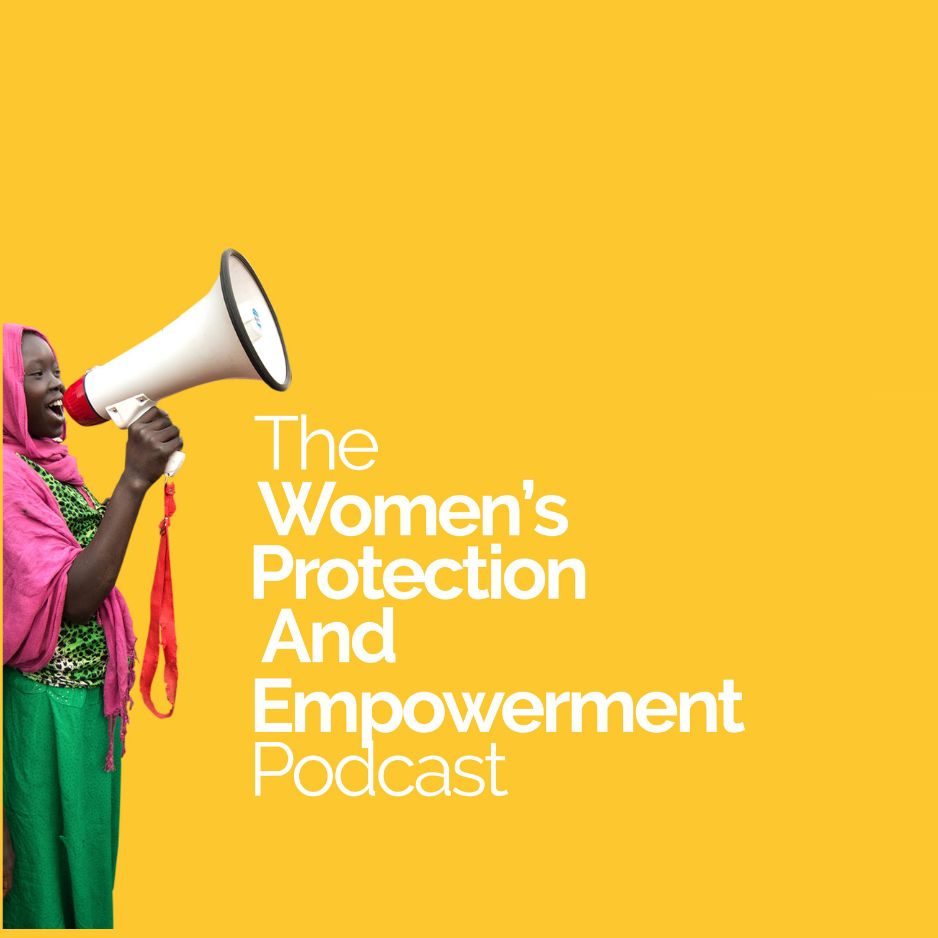
Women's Protection and Empowerment
Women's Protection and Empowerment
Podcast by Women's Protection and Empowerment
Author
Women's Protection and Empowerment
Category
Podcast website
Latest episode
Apr 26, 2024
Where to listen?
Podcasts in the app Replaio Radio Coming soonPodcasts are coming to the app soon. Install now and be the first to see a whole new take on podcasts
 Install for free
Android 5M+ downloads · 4.8 rating
iOS soon
Install for free
Android 5M+ downloads · 4.8 rating
iOS soon
Episodes
Why Not Local? GBV, women’s rights organisations, and the missed opportunity of COVID-19 04.03.2022 26:27
In this episode, we talk about a report recently released by the IRC, called “Why Not Local? Gender-based violence, women’s rights organisations, and the missed opportunity of COVID-19”. The report looks at how the pandemic continues to impact women and girls in Cameroon, South Sudan, and Yemen. It also provides a snapshot of GBV funding trends to across the three countries. It asks the question “...
Can M&E be more than just reporting? 09.02.2022 30:38
This episode, requested by a listener, asks the question, “How do we move beyond reporting when it comes to M&E?” Guests Bann Tabbara and Betsy Laird discuss how programs can use monitoring data to go beyond compliance and reporting, and instead look at quality and program improvement.
What does a holistic approach to GBV case and information management look like? 24.08.2021 20:32
In this episode, Kristy Crabtree (IRC) and Virginia Zuco (UNICEF) discuss the newly available resource, the GBVIMS+ GBV Case Management Companion Guide. This new, holistic guidance complements the GBVIMS+ and explicitly links GBV case management and information management as it builds upon the Inter-Agency GBV Case Management Guidelines. Designed to accompany the GBVIMS+ User Guide, this resource...
The Women Rise Psychosocial Support Framework and Toolkit 27.07.2021 27:18
In this episode we talk with Sadia Dahir, Maimuna Mohammed, and Rose Poni about the recently released Women Rise Psychosocial Support Framework and Toolkit. Funded by USAID’s Bureau of Humanitarian Affairs, the Women Rise Toolkit seeks to address a critical gap in technical guidance for GBV service providers implementing MHPSS programming. This toolkit provides thorough guidance on group psychosoc...
How can we remake the world with data? Data Feminism in Humanitarian Contexts 02.02.2021 39:51
Meet the Author! In this episode, we speak with one of the authors of Data Feminism, Professor Catherine D'Ignazio, Director of the Data + Feminism lab at MIT. We talk about the difficulty of "converting life experience into data," about putting the humanity and emotion back into data, and "how we can use data to remake the world." This episode is cross-posted on the GBVIMS podcast. Thanks to Mega...
Twenty Years of Service: What do two lifelong GBV activists think is the future of this work? 27.01.2021 40:32
Esther Karnley and Marian Rogers have dedicated their lives to activism for women's rights, protection, empowerment, and the prevention of violence. They both got their start in Liberia, but have held a myriad of positions in their combined 43 years of experience in this field. Listen to them talk about the beginnings of this movement in the humanitarian space, their lessons, their advice, and the...
What Happened? How the Humanitarian Response to COVID-19 Failed to Protect Women and Girls 26.10.2020 25:19
In this episode, we talk about a report issued by International Rescue Committee that looks at the humanitarian response to COVID-19 and its effect on women and girls. We're joined by three contributors to the report, Caroline Mwanki, Ilaria Michelis, and Nancy Abwola who discuss how the pandemic has affected the safety women and girls in emergencies in their day to day lives and the need for incr...
Staff Spotlight: Tizita Tekletsadik 13.10.2020 23:50
This is the fourth in our series called Staff Spotlight. In this episode, we're highlighting the work of Tizita Tekletsadik, Child Protection and GBV Survivor Specialist in International Rescue Committee's Violence Prevention and Response unit. In her career, she's been a lawyer, and author, a project manager, among other titles. Listen to hear about her career trajectory, what challenges she see...
Climate Change 101: How it impacts women and girls 15.09.2020 30:50
This episode we talk Climate Change - the current state of things, the impact on humanitarian contexts and on women and girls, and climate action we can take. Tara Clerkin, Senior Agriculture Coordination in Climate and Partnerships, and Charlotte Collins, a climate change researcher and intern at IRC, tell us all about the right vocabulary and the role of women and girls as change agents.
How to think like a comms person 18.08.2020 19:07
Communication should be purposeful in its delivery of information that brings awareness to a topic, betters our understanding, and incites action. But communicating about violence against women and girls comes with unique challenges. How we are communicating about new trends in this field, projects we’re piloting, and the impacts of our programs? And how do we do that in the right way that gets th...
COVID Adaptation: How can we create a productive learning atmosphere online? 09.06.2020 28:48
With COVID-19 travel and working restrictions, many IRC country programs are shifting to digital modalities for remote staff training. In this episode, Kristy Crabtree shifts roles from host to interviewee in order to provide practical guidance on how to adapt training from in-person to remote settings. Learn how to identify and overcome barriers, engage participants, design a training that makes...
Getting the response right: safety, services and solidarity for women in girls during COVID 23.04.2020 29:44
In this episode, we're dedicating space to talk about the realities for women and girls and GBV programs when it comes to Covid-19. Everywhere where IRC operates from Lesvos, Greece, to Al Hol, Syria, to Turkana, Kenya, to Mae Sot, Thailand, to NY, USA has been affected. We a global round table, we talked about risks to women and adolescent girls, how are program are adapting, what resources are a...
COVID Adaptation: How can we include women and girls through remote engagement? 08.04.2020 14:53
We are reposting this episode from 2018 at at time that could not be more relevant. With the covid-driven programmatic adaptations happening everywhere and many shifting towards the use of digital technology because of social distancing and mobility constraints, it's more important than ever that we are acknowledging the massive digital gender gap, not making assumptions about access, and planning...
Is a feminist approach to monitoring, evaluation, and learning really possible? 02.04.2020 23:38
What we measure and the way we measure it has significant impacts on our programming. In this episode, Kelsey Simmons and Michelle Wong, both M&E specialists at IRC, walk us through the meaning of a feminist approach to monitoring, evaluation and learning. They discuss how does that work practically in humanitarian settings and through the project cycle. Resources referenced in the podcast (and a...
Spotlight on Lebanon: How do we design programs with girls? 25.03.2020 20:02
Programs evolve over time, especially in our work with specific populations. In this episode, we walk through that process with Farah Salhab, the manager of the adolescent girl's program in Lebanon, to see how their program evolved from a stand-alone initiative to a core part of IRC's Women's Protection and Empowerment programming model, and all with girls' voices driving the process.
Can we have an intersectional approach to humanitarian work? 10.03.2020 43:17
Our response in humanitarian settings, the services we provide and the access or barriers to them affect people differently. Part of the reason for this are our interconnected social categorizations (gender, race, class, sexual orientation, disability). These overlapping identities contribute to systems of oppression, discrimination or disadvantage. So, how can we adopt and incorporate an intersec...
Empowered Aid 26.11.2019 35:41
Since its magnitude first came to light in 2002, the aid community’s focus on addressing sexual exploitation and abuse (SEA) has primarily rested on establishing reporting mechanisms and only recently shifted toward proactive measures to mitigate risk and prevent such abuses from occurring. In this episode, Alina Potts of the Global Women's Institute, Harriet Kolli of the International Rescue Comm...
Unrelated Book Review - The Artist's Way 12.11.2019 34:20
This is the first in a new series on the podcast called Unrelated Book Reviews where we discuss books that are seemingly unrelated to our field, but actually have a lot of potential for application. Stick with us. There is a lot outside this field that can have really practical benefits when applied to this work. For the first one in this series, we read Julia Cameron’s bestseller, The Artist’s Wa...
Creating Safe Spaces for Women and Girls in Humanitarian Settings 21.08.2019 11:55
How can we create safe spaces for women and girls in humanitarian settings? In this episode, we talked with Melanie Megevand of International Rescue Committee about the Global Women and Girls Safe Space Toolkit, which offers a blueprint to support the transformational shift in use of power GBV practitioners seek to achieve in partnership with women, adolescent girls and local women’s organizations...
Staff Spotlight - Betelhem (Ethiopia) 14.08.2019 14:31
This is the third in our series called Staff Spotlight. In this episode, we're highlighting the work of Betelhem, Community Wellbeing Initiative Coordinator in International Rescue Committee's Women's Protection and Empowerment program in Ethiopia.
What does psychosocial support to women and girls look like? 07.08.2019 21:06
Psychosocial support is a crucial part of the recovery process for women and girls, yet guidance on providing this service has been lacking. IRC is currently developing the Women Rise Psychosocial Support Toolkit for IRC, including specific curriculum, M&E tools, and supervision tools to cover this gap. This project is led by Gretchen Emick, GBV Psychosocial Support Specialist for the IRC. The Wom...
Staff Spotlight - Zahra (Pakistan) 29.07.2019 11:06
This is the second in our series called Staff Spotlight, where we highlight the impact of staff who have dedicated their careers to working with women and girls in humanitarian settings. This episode spotlights Zahra, the Senior Women's Protection and Empowerment Manager in Pakistan.
Ask Me Anything: Alina Potts 31.05.2019 44:54
This is the second in our new series of Ask of Anything, a collaboration with the GBV Area of Responsibility's community of practice. In this episode, Sarah Martin interviews Alina Potts of the George Washington University Global Women's Institute to talk about her work, her career pathway and advice she has for others. Read Alina's blog here: https://missinginthemission.com/
How can we measure outcomes for women and girls engaged in GBV case management? 07.05.2019 19:21
Often the measurement of GBV response looks at outputs – number of women and girls receiving services, incidents of GBV, distributions – and overlooks the core question: are women and girls recovering from GBV with the support of GBV response services? In this episode, we talk about a new tool, the GBV Case Management Outcome Monitoring Toolkit, that aims to change how we measure outcomes. The too...
How to provide psychological first aid in emergencies 16.04.2019 25:09
Psychological First Aid is a practice that “involves humane, supportive and practical help to fellow human beings suffering serious crisis events.” In this episode we talk with Sonia Rastogi and Jessica Izquierdo of the GBV Guidelines Implementation Support Team about psychological first aid, the need, the practice, related self-care practices, and where to learn more. Check out these resources re...
Similar podcasts

Listen to the Women's Protection and Empowerment podcast in Replaio
Radio and podcasts in one app - free, with no sign-up. Install today and do not miss the launch
Replaio is not a podcast publisher; show names, artwork and audio belong to their authors and are distributed through public RSS feeds.