Kelly Therese Pollock
Unsung History
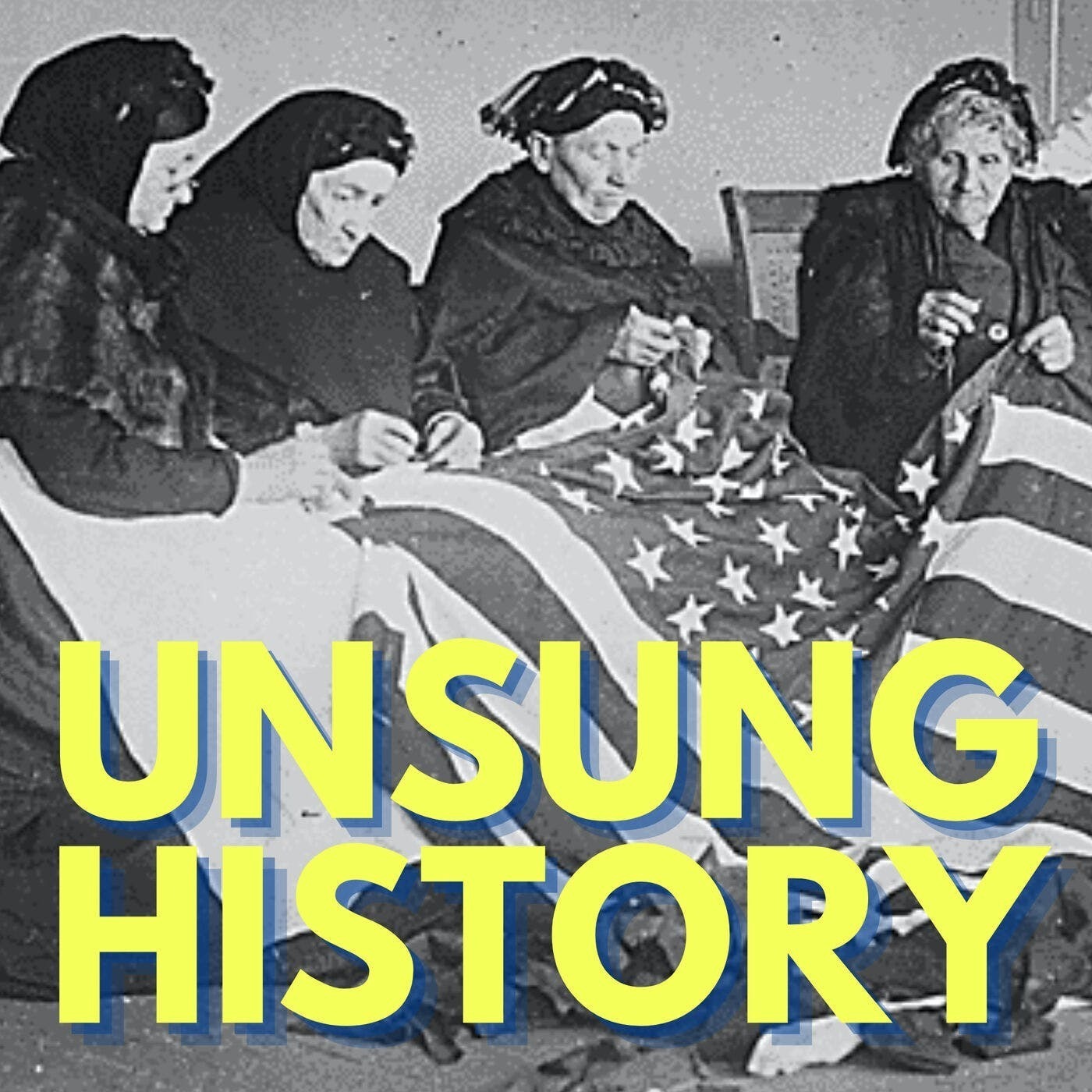
A podcast about people and events in American history you may not know much about. Yet.
Be sure to visit the podcast's website and support the creator: redcircle.com
Author
Kelly Therese Pollock
Category
Podcast website
Latest episode
Aug 10, 2026
Where to listen?
Podcasts in the app Replaio Radio Coming soonPodcasts are coming to the app soon. Install now and be the first to see a whole new take on podcasts
 Install for free
Android almost 10M downloads · 4.8 rating
iOS soon
Install for free
Android almost 10M downloads · 4.8 rating
iOS soon
Episodes
The Long History of the Chicago Portage 20.11.2023 47:08
When Europeans arrived in the Great Lakes region, they learned from the Indigenous people living there of a route from Canada to the Gulf of Mexico, made possible by a portage connecting the Chicago River and the Des Plaines River. That portage, sometimes called Mud Lake, provided both opportunity and challenge to European powers who struggled to use European naval technology in a region better su...
The Haudenosaunee Confederacy 13.11.2023 54:39
Before Europeans landed in North America, five Indigenous nations around what would become New York State came together to form the Haudenosaunee Confederacy. When the Europeans arrived, the French called them the Iroquois Confederacy, and the English called them the League of Five Nations. Those Five Nations were the Mohawks, Oneidas, Onondagas, Cayugas, and Senecas; the Tuscaroras joined the Con...
Gun Capitalism & Gun Control in the U.S. after World War II 06.11.2023 53:04
In 1945, the population of the United States was around 140 million people, and those Americans owned an estimated 45 million guns, or about one gun for every three people. By 2023, the population of the United States stood at just over 330 million people, and according to historical data from the US Bureau of Alcohol, Tobacco, Firearms and Explosives, the number of guns produced and imported for...
The History of the Nutrition Facts Label 30.10.2023 44:49
If you go to a grocery store in the United States and pick up a box of cereal, you expect to find a white box on the back of the package with information in Helvetica Black about the food’s macronutrients (things like fat and protein) and micronutrients (vitamins and minerals). The Nutrition Facts label is so ubiquitous that you may not even notice it. But how did it get there and why does it look...
The History & the Present of the Northern Cheyenne Tribe 23.10.2023 40:13
During the 19th Century, the Northern Cheyenne people made a number of treaties with the United States government, but the U.S. repeatedly failed to honor its end of the treaties. In November 1876, the U.S. Army, still fuming over their crushing defeat by the Lakota and Northern Cheyenne at the Battle of Little Bighorn, attacked a village of Northern Cheyenne, destroying 200 lodges and driving the...
The Borinqueneers of the Korean War 16.10.2023 38:26
In 1950, President Harry Truman ordered US troops to the Korean peninsula to help the South Koreans repel the invading North Korean People’s Army, which was supported by the communist regimes of the Soviet Union and China. One of the regiments shipped overseas to fight was the 65th Infantry Regiment, the Borinqueneers, made up of soldiers from Puerto Rico. In Korea, the Borinqueneers served heroic...
The Student Right in the late 1960s 09.10.2023 44:02
In the late 1960s, as college campuses became hotbeds of liberal protest, conservative college groups, like the Intercollegiate Society of Individualists (ISI), the Young Americans for Freedom (YAF), and College Republicans, backed by powerful conservative elders and their deep pockets, fought back, staging counter protests, publishing conservative newspapers, taking over student governments, and...
The History of the National Organization for Women (NOW) 02.10.2023 47:08
At the Third National Conference of Commissions on the Status of Women, a group of women, led by writer Betty Friedan and organizer and attorney Pauli Murray, decided that to make progress they needed to form an independent national civil rights organization for women. Within months, the National Organization for Women had 300 founding members, a slate of officers, and a statement of purpose. By 1...
The Murder of Maria Cornell 25.09.2023 45:54
When farmer John Durfee found the body of a local factory girl hanging from a fence post on his property on the morning of December 21, 1832, he and the rest of the townspeople assumed she had died by suicide. But a cryptic note she had left among her possessions pointed the investigation in a different direction, and the ensuing murder trial captured the public imagination. Joining me to discuss...
The Great New York City Fire of 1776 18.09.2023 45:02
Just days after British troops captured New York City from General Washington and his army in September 1776, fire broke out, destroying a fifth of the city. The British blamed rebels who had remained hidden in Manhattan, but Washington, who had been ordered by Congress to leave the city standing on his retreat, never claimed responsibility, though he complained that the blaze hadn’t caused more d...
The History of Drag in New York City 11.09.2023 44:39
RuPaul’s Drag Race first aired on TV in 2009, but the New York City drag scene that launched RuPaul started over a century earlier. From drag balls to Wigstock, New York has long been considered the capital of drag culture. Joining me in this episode to discuss New York City’s rich history of drag is writer Elyssa Maxx Goodman , author of Glitter and Concrete: A Cultural History of Drag in New Y...
Thomas Smallwood and the Underground Railroad 04.09.2023 55:16
Over the course of just one year in the early 1840s, Thomas Smallwood, a recently emancipated Black man, with the assistance of the New England educated white abolitionist Charles Torrey, arranged for around 400 enslaved people to escape the Baltimore and DC area for freedom in Canada. While the abolition movement was still debating the best path forward, Smallwood and Torrey put their beliefs int...
Phillis Wheatley 28.08.2023 49:50
One of the best known poets of Revolutionary New England was an enslaved Black girl named Phillis Wheatley, who was only emancipated after she published a book of 39 of her poems in London. Wheatley, who met with Benjamin Franklin and corresponded with George Washington, was the first person of African descent to publish a book in English. Wheatley achieved literary success and helped drive the ab...
Gladys Bentley 21.08.2023 38:20
One of the biggest stars in Prohibition Age New York was blues singer Gladys Bentley, who caused a stir in Harlem, wearing a top hat and tails, flirting with women in the audience, and singing raunchy lyrics. Despite Bentley’s phenomenal talent, the repeal of Prohibition and the end of the jazz age led to waning interest in the type of bawdy performance for which she was known. Despite attempts to...
Anna May Wong 14.08.2023 51:07
As a child in Los Angeles, Wong Liu Tsong knew she wanted to be an actress. Adopting the screen name Anna May Wong and dropping out of school to pursue her passion, Wong landed her first lead role at age 17. Despite Hollywood racism that would limit the types of roles she would receive, Wong’s impressive career spanned over 60 films, in addition to stage and television work, and she was the first...
Anna Rosenberg 07.08.2023 38:37
When Anna Rosenberg Hoffman died in 1983, the New York Times called her “one of the most influential women in the country's public affairs for a quarter of a century.” A skilled labor mediator and advisor to four U.S. presidents, Rosenberg, a Jewish immigrant from Hungary, stood up to Senator Joe McCarthy and was confirmed by the Senate as Assistant Secretary of Defense in 1950, making her the...
Pullman Porters & the History of the Black Working Class 31.07.2023 42:03
In the early 20th century, career options for Black workers were limited, and the jobs often came with low pay and poor conditions. Ironically, because they were concentrated in certain jobs, Black workers sometimes monopolized those jobs and had collective power to demand better conditions and higher pay. The Pullman Company, founded in 1862, hired only Black men to serve as porters on Pullman ca...
The History of Black Women & Physical Fitness in the United States 24.07.2023 45:54
In 1894, Mary P. Evans, wrote in the Woman’s Era , a Black women’s magazine, that exercise: “enables you to keep in the best condition for work with the hands or with the brain… It prepares you to meet disappointment, sorrow, ill treatment, and great suffering as the strong, courageous and splendid woman meets them. It is a great aid to clear, quick, and right thinking.” She wasn’t the only Black...
Enslaved Women who Murdered their Enslavers 17.07.2023 39:56
In the American colonies and then in the antebellum United States, the legal system reinforced the power and authority of slaveholders by allowing them to physically abuse the people they enslaved while severely punishing enslaved people for even minor offenses. Some enslaved women, who could find no justice in the courts, sought their own justice through lethal resistance, murdering their enslave...
Jean-Baptiste Pointe DuSable, the Founder of Chicago 10.07.2023 50:42
Sometime in the mid-1780s, Jean-Baptiste Pointe DuSable, a Black man from Saint-Domingue, and his Potawatomi wife, Kitihawa, settled with their family on a swampy site near Lake Michigan called Eschecagou, “land of the wild onions.” The homestead and trading post they built on the mouth of the Chicago River, with a comfortably appointed cabin, workshop, bake house, stable, smokehouse, and more, wa...
"What, to the American slave, is your 4th of July?" 03.07.2023 47:57
When Thomas Jefferson wrote in the Declaration of Independence that all men were endowed with the rights of “Life, Liberty and the pursuit of Happiness,” he did not have in mind the rights of the hundreds of human beings he enslaved. But the enslaved population of the United States, and the abolitionists who supported them, like Frederick Douglass and John Brown, adopted the American symbols of re...
1970 Hijackings by the Popular Front for the Liberation of Palestine 26.06.2023 42:14
In September 1970, commandos from the Popular Front for the Liberation of Palestine (PFLP) hijacked five planes, landing three of them near Zarqua, Jordan, at a remote desert airstrip called Dawson’s Field, which the commandos renamed Revolution Airport. While they held hundreds of passengers and flight crew hostage in the desert, the PFLP issued their demands for release of Palestinian militants...
W. E. B. Du Bois & African American Contributions to World War I 19.06.2023 38:34
Over 350,000 African American men joined the United States military during World War I, serving valiantly despite discrimination and slander. Historian and civil rights activist W. E. B. Du Bois had hoped that their patriotism would help them gain respect and equality, but after the war it was quickly evident that would not be the case. Du Bois spent the next several decades attempting to tell the...
The Internment of Japanese Americans during World War II & the Role of Attorneys at the Relocation Centers 12.06.2023 46:50
During World War II, over 120,000 Japanese Americans, most of whom were US citizens, were forcibly removed from their homes in California, Washington, and Oregon, and imprisoned in relocation centers, small towns surrounded by barbed wire and armed guards. The War Relocation Authority, the government agency created by FDR that oversaw the mass relocation and internment, appointed a project attorne...
Racial Conflict in the U.S. Army During the Vietnam War Era 05.06.2023 43:05
In September 1969, African American journalist Wallace Terry reported on “another war being fought in Vietnam — between black and white Americans.” After the 1948 integration of the military, the U.S. Army had tried to be color blind, seeing not Black or white but just olive drab, but by 1970, the Deputy Chief of Staff for Personnel, Gen. Walter T. Kerwin, noted: “In the past year racial discord h...
Similar podcasts




Listen to the Unsung History podcast in Replaio
Radio and podcasts in one app - free, with no sign-up. Install today and do not miss the launch
Replaio is not a podcast publisher; show names, artwork and audio belong to their authors and are distributed through public RSS feeds.