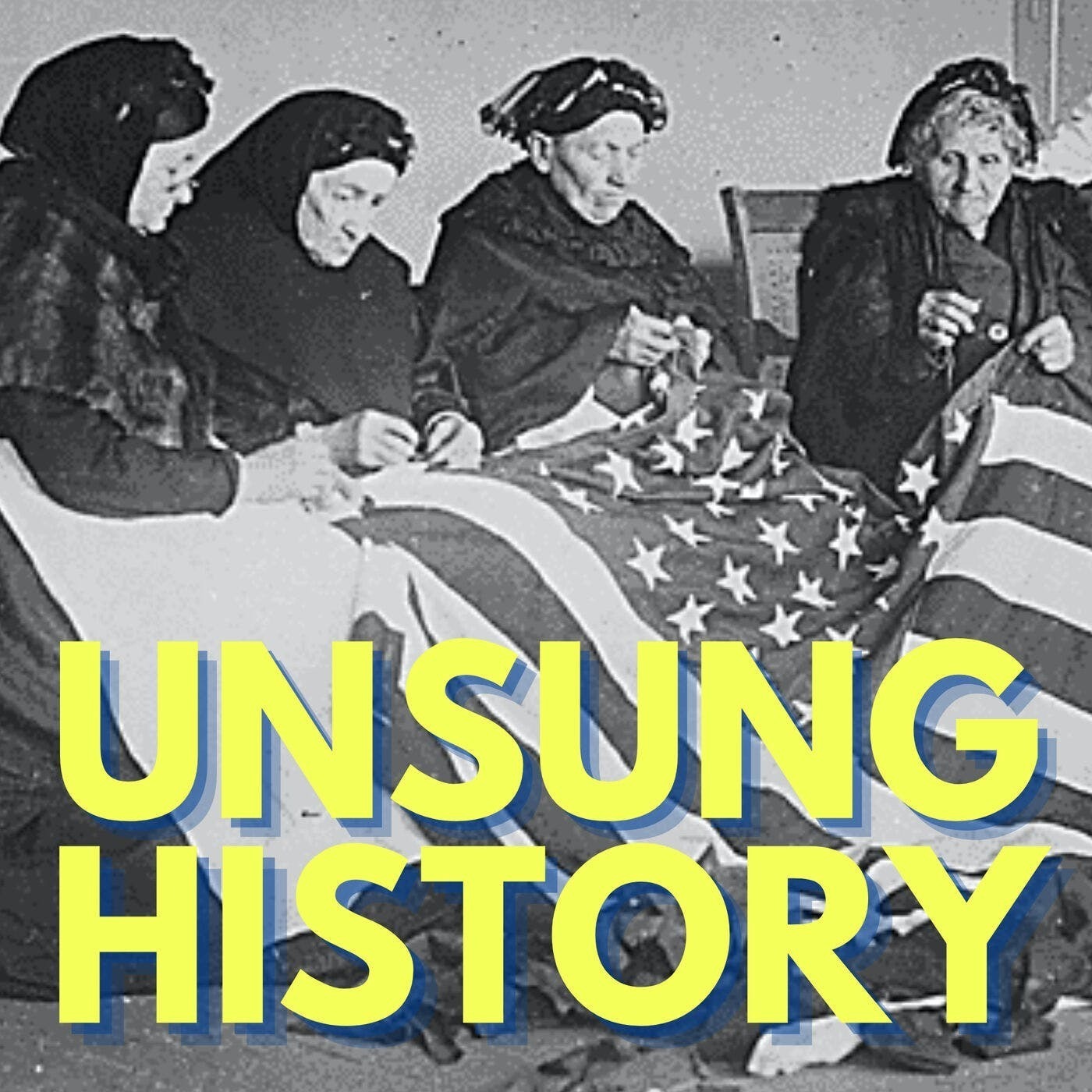
Kelly Therese Pollock
Unsung History
A podcast about people and events in American history you may not know much about. Yet.
Be sure to visit the podcast's website and support the creator: redcircle.com
Author
Kelly Therese Pollock
Category
Podcast website
Latest episode
Aug 10, 2026
Where to listen?
Podcasts in the app Replaio Radio Coming soonPodcasts are coming to the app soon. Install now and be the first to see a whole new take on podcasts
 Install for free
Android almost 10M downloads · 4.8 rating
iOS soon
Install for free
Android almost 10M downloads · 4.8 rating
iOS soon
Episodes
The History of the Electoral College 04.11.2024 41:43
At the end of August 1787, after three long months of debate and deliberation, the Constitutional Convention had neared the end of its work. They were poised at that time to write into the Constitution that the President of the United States would be elected by the legislature, but at the last minute they referred the matter to the Committee on Unfinished Parts to resolve. It was that committee, g...
Baseball & the Chinese Educational Mission of the 1870s 28.10.2024 44:08
In the 1870s, 120 Chinese boys came to New England as part of the Chinese Educational Mission. The boys studied at prep schools and colleges, and while they continued their lessons in Chinese language and culture, they also learned about the culture of their adopted homeland, including the local sports, like baseball. By the mid-1870s, some of the Chinese students had formed a semi-pro baseball te...
Ryan White & the CARE Act of 1990 21.10.2024 51:12
Shortly after he was born in 1971, Ryan White was diagnosed with severe hemophilia. Ryan was able to reduce his hospitalizations from the disease through the use of in-home injections of Factor VIII concentrate, something he and other people with hemophilia saw as a lifeline. The downside of this lifeline was that it pooled blood and plasma from thousands of donors, increasing the user’s risk of e...
The Sanders Family of Philadelphia 14.10.2024 40:05
When she was just fifteen years old, in 1830, Sarah Martha Sanders was sold to Richard Walpole Cogdell of Charleston, South Carolina. Within a year she was pregnant with his child, and just after she turned 17, Sarah Martha gave birth to Robert Sanders, the first of nine children she would bear to then 45-year-old Richard Cogdell. Because the legal status of the children followed that of the mothe...
Education & Reconstruction in the Washington DC Region 07.10.2024 50:40
At the dedication for a school for African American students in Manassas, Virginia, in 1894, Frederick Douglass said: “no greater benefit can be bestowed upon a long benighted people, than giving to them, as we are here earnestly this day endeavoring to do, the means of an education.” In the Reconstruction Era, throughout the South, and especially in the Washington, DC, region, formerly enslaved p...
A History of Postpartum Depression in the United States 30.09.2024 42:21
In his bestselling childcare manual American pediatrician Dr. Benjamin Spock advised new moms:“If you begin to feel at all depressed, go to a movie, or to the beauty parlor, or to get yourself a new hat or dress.” Although puerperal insanity had been a recognized diagnosis at the end of the 19th Century, doctors in the early 20th century dismissed the postpartum onset of psychiatric symptoms as “p...
Segregation Scholarships 23.09.2024 48:43
Between 1921 and 1948, every Southern and border state, except Delaware, set up scholarship programs to send Black students out of state for graduate study rather than admit them to historically white public colleges or build graduate programs in the public HBCUs. While the individual Black students often benefited from graduate education at top-tier universities, the segregation scholarships crea...
Doug Williams, Vince Evans & the History of Black Quarterbacks in the NFL 16.09.2024 43:20
In 1946, the National Football League began the process of reintegration after a “gentleman’s agreement” had stopped teams from hiring Black players for over a decade. Even as the NFL began to re-integrate, though, racist stereotypes kept teams from drafting Black players into so-called “thinking” positions like quarterback. Black players who started at quarterback in college would be drafted into...
Jewish Patriots in the American Revolution 09.09.2024 44:27
In the Continental Army, one company of patriots in Charleston, South Carolina, was a majority Jewish, and at least fifteen Jewish soldiers in the Army achieved the rank of officer during the American Revolution, something unheard of in European armies at the time. Though their numbers were small (in proportion with their population in the colonies), Jewish patriots participated in the war, and in...
Abigail Adams 02.09.2024 53:27
Abigail Smith Adams, wife to the second U.S. president and mother of the sixth U.S. president, may be best known for exhorting her husband to “remember the ladies” as he worked with his colleagues to form a new government, but that was just one of her many strongly-held political views. Adams, who lacked formed education and whose legal status was subsumed under that of her husband, never stopped...
Hair and the American Presidency 26.08.2024 36:24
In March 1778, while he was camped at Valley Forge, Commander in Chief George Washington sent a lock of his hair to the daughter of the New Jersey Governor. It wasn’t a romantic gift; rather, Washington was responding to a common request made to celebrities of his time, similar to the autographed photo one might request today. Because hair is so long-lasting, people of the 18th and 19th centuries...
Margaret Chase Smith 19.08.2024 51:36
At the Republican National Convention in July 1964, Maine Senator Margaret Chase Smith’s name was placed in nomination for the presidency, and she received votes from 27 delegates, the first time a woman was placed in nomination at a major party’s presidential convention in the United States. It was only one of many firsts Smith would achieve in her remarkable decades-long career that included spe...
The 1968 Democratic National Convention in Chicago 12.08.2024 52:07
Even before Democrats met in Chicago in August to choose their presidential nominee, the year 1968 had been a turbulent, and often violent, time in the United States. In Chicago, the tumult of an open convention inside the International Amphitheatre was matched by the huge anti-war protests downtown. While the Democrats inside the convention hall voted down a peace plank and nominated the incumben...
Sigrid Schultz 05.08.2024 42:55
In 1926, American Sigrid Schultz became one of the first women to head a foreign bureau for a US newspaper when she was named the chief correspondent for the Berlin bureau of the Chicago Tribune. In her 26 years with the Tribune, Schultz, using her command of German and French, her knowledge of German politics and history, and her wide range of contacts, reported on the rise of Nazism and warned A...
The History of Synchronized Swimming 29.07.2024 44:20
When the 1934 World’s Fair in Chicago was looking for an aquatic act to complement their new underwater lights, organizers turned to physical educator Katherine Curtis, who put together a wildly popular show called the Modern Mermaids. No one could quite figure out what to call it, trying out water ballet and figure swimming until a radio announcer landed on “synchronized swimming.” Soon synchroni...
The FTA & Antiwar Protests in 1971 22.07.2024 46:03
In 1971, a group of performers calling themselves the Free Theatre Associates (FTA), including Jane Fonda and Donald Sutherland, began putting on popular antiwar shows for audiences of active-duty GIs. Over 10 months they performed near military bases all over the United States and in the Pacific Rim. The Pacific Rim tour led to a documentary, which was released briefly in July 1972 and then quick...
The Incorruptibles & Organized Jewish Crime in New York City in the Early 20th Century 15.07.2024 45:25
In 1912, a group of wealthy and influential German Jews in uptown New York funded an effort to root out organized crime on the lower East Side, then the most densely populated neighborhood on Earth, home to half a million people, many of them recent Jewish Russian immigrants. As a result, a Jewish investigator and a Jewish lawyer joined the NYPD and pulled together a group of cops who refused to b...
Dr. Claudia Hampton & the History of Affirmative Action in California 08.07.2024 46:28
In 1974, Republican governor Ronald Reagan appointed educator Dr. Claudia Hampton, a Democrat active in her local NAACP, as the first Black woman trustee to the board of California State University. For the next twenty years Hampton would be known as the affirmative action trustee as she advocated for policies and budgets that would help support and diversify the CSU faculty, staff, and students....
Josephine McCarty: Mother, Lobbyist, Spy & Abortionist 01.07.2024 58:00
Josephine McCarty, née Fagan, aka Mrs. Virginia S. Seymour, dba Emma Burleigh. M.D., was many things: mother, teacher, saleswoman, spy, lobbyist, and abortionist. And in 1872 she was also an accused murderer, after eyewitnesses saw her fire a pistol on a public streetcar in Utica, New York, killing one man and wounding another. Historian R.E. Fulton , author of The Abortionist of Howard Street: Me...
The Auburn Prison System & the Case of William Freeman 24.06.2024 54:09
In 1817, the second state prison in New York opened in Auburn, situated on a fast-flowing river so waterpower could be used to run machinery in the factories that would be housed in the prison. In a new practice of incarceration that would come to be known as the Auburn System, the prisoners labored in silence during the day for the profit of the prison, stayed in solitary confinement every night,...
Quilting & the New Deal 17.06.2024 41:51
As part of the Works Progress Administration (WPA), so-called “unskilled” women were put to work in over 10,000 sewing rooms across the country, producing both garments and home goods for people in need. Those home goods included quilts, sometimes quickly-made utilitarian bedcoverings, but also artistic quilts worthy of exhibition. Quilts were featured in other New Deal Projects, too, like the WPA...
The Federal Theatre Project 10.06.2024 45:43
Between 1935 and 1939, the Federal Theatre Project, part of the Works Progress Administration (WPA), employed over 12,000 actors and put on over 1200 productions in 29 states. Led by Hallie Flanagan, the FTP, using only a small fraction of the total WPA budget, employed theater professionals; entertained audiences, some two-third of whom had never attended theater before the FTP; and helped launch...
The Red Summer of 1919 & Black Resistance 03.06.2024 44:28
In 1919, racial tensions in the US, exacerbated by changes brought about by the first wave of the Great Migration and by the return of Black soldiers who demanded equal citizenship from the country they’d fought for, boiled over into a summer of violence. In Washington, DC, 39 people died after days of fighting between white mobs and Black citizens who stood their ground and fought back. The event...
The Reconstruction Era & its Aftermath 27.05.2024 50:25
As the Civil War was drawing to a close, President Lincoln was preparing for what came after, with plans for reunification of the country, and he began to advocate for limited suffrage for Black Americans. John Wilkes Booth’s bullet cut short those plans, and Southerner Andrew Johnson, who was much more sympathetic to the former Confederacy, succeeded Lincoln. It wasn’t until Congress passed the R...
The Southern Plantation System 20.05.2024 46:56
Fictional depictions of Southern plantations often present romanticized visions of genteel country life, but for the people enslaved on plantations the reality was that of a forced labor camp. At the same time the plantation was also their home. And although they had no choice in where or how they lived, enslaved people did work to make their residences home, for instance by sweeping their yards,...
Similar podcasts





Listen to the Unsung History podcast in Replaio
Radio and podcasts in one app - free, with no sign-up. Install today and do not miss the launch
Replaio is not a podcast publisher; show names, artwork and audio belong to their authors and are distributed through public RSS feeds.