Albert D. Grauer
Travelers In The Night
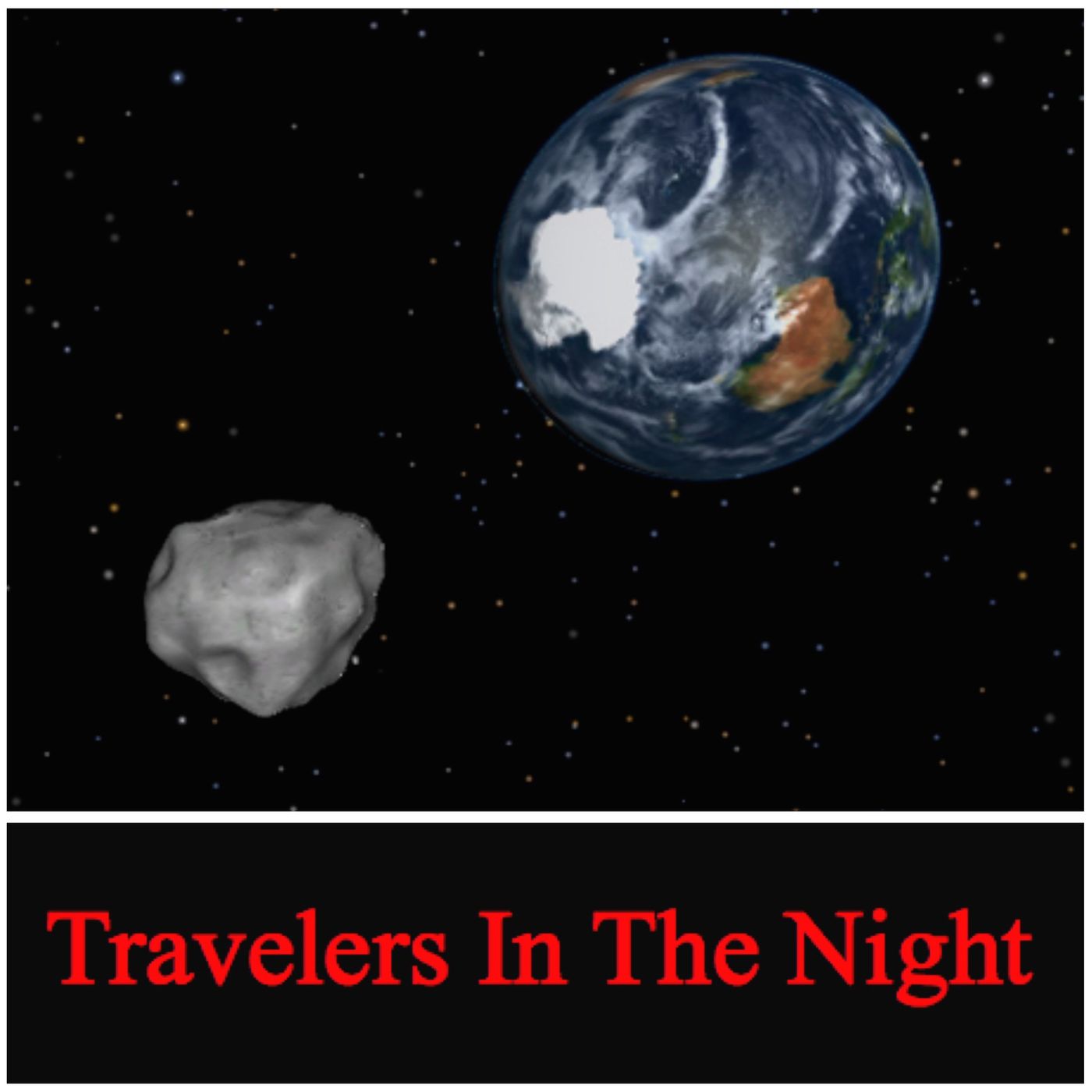
A real "Science Snack" for anyone who is interested in the extraterrestrial. Dr. Al Grauer is a member of the Catalina Sky Survey which has led the world in near Earth asteroid discoveries for 17 of the past 19 years. The music is "Eternity" by John Lyell. Astronomy Asteroids Space NASA Comets Earth Impact Aliens
Be sure to visit the podcast's website and support the creator: travelersinthenight.org
Author
Albert D. Grauer
Category
Podcast website
Latest episode
Oct 9, 2026
Where to listen?
Podcasts in the app Replaio Radio Coming soonPodcasts are coming to the app soon. Install now and be the first to see a whole new take on podcasts
 Install for free
Android almost 10M downloads · 4.8 rating
iOS soon
Install for free
Android almost 10M downloads · 4.8 rating
iOS soon
Episodes
334E-353-Backwards 29.04.2025 2:01
Using the University of Arizona's Large Binocular Telescope atop Mt. Graham in southern Arizona, Dr. Paul Wiegert of Western University in Canada, led a team of astronomers who have determined that a 2 mile diameter object bucks the solar system traffic by traveling in a direction backwards to all of the planets. In their March 30, 2017 article in the journal Nature, these astronomers confirm that...
846-Bright Nights 25.04.2025 2:01
One little known and infrequently observed phenomenon in the natural night sky are “bright nights” during which observers have reported being able to read a book when both the Sun and Moon are both well below the horizon.
333E-352-Worth Tracking 22.04.2025 2:01
My Catalina Sky Survey teammate Greg Leonard was observing with our team's 60 inch telescope on Mt. Lemmon in Arizona when he discovered a relatively large space rock, 2017 FD157, which can theoretically come closer to the Earth's surface than the communications satellites. We don't have enough data to predict when it will make a very close approach to us. What we do know is that 2017 FD157's orbi...
845-Mighty Schmidt 18.04.2025 2:01
On a single February night my Catalina Sky Survey teammate Jacqui Fazekas reported the discovery of 5 Earth approaching objects using our small but mighty Schmidt telescope on Mt. Bigelow, Arizona. Rest assured that on any given night there are asteroid hunters on the look out for seriously dangerous space rocks.
332E-351-Another Close One 15.04.2025 2:01
Asteroid hunters have become aware of the many small space rocks which come near Earth because of improvements made to telescopes, cameras, and computer analysis software. Recently, my Catalina Sky Survey teammate Rose Matheny used her skills and a new camera to discover the second small space rock in 32 days which came between the communications satellites and the Earth's surface. Rose spotted he...
844-Global Meteor Network 11.04.2025 2:01
As the Earth travels in its orbit around the Sun it collides with objects called meteoroids traveling through space. These tiny members of the solar system range in size from dust grains to objects a meter in diameter. By becoming part of the GMN’s network , your data will help to discover and document meteor showers, aid in identifying the parent cometary objects, and in some cases help to ident...
331E-350-Asteroid Defense 08.04.2025 2:01
In 2013 a 56 foot diameter space rock exploded over Chelyabinsk, Russia releasing the energy of 450 kt of TNT and filled local hospitals with some of the 1,500 people who were injured. Fortunately no one died. In 1908 a 200 ft diameter meteor exploded over a largely unpopulated region at Tunguska, Siberia knocking down trees over a 750 square mile area. If it had hit over a populated area it could...
843-Possible Impactor 04.04.2025 2:01
On 27 December 2024 the Atlas group in Chile discovered an object now known as 2024 YR4 which appeared to have a significant chance of impacting Earth 22 December of 2032. The most recent data indicates the chance that 2024 YR4 impact Earth is about 1 in 25,000. These data indicate our moon has about a 1 in 700 chance to be impacted by this space rock. Even so astronomers are preparing for 2028 w...
330E-349-Big and Fast 01.04.2025 2:01
I was observing with the Catalina Sky Survey 60 inch telescope on Mt Lemmon, Arizona when a fast moving object appeared on a set of four images of the same area of the night sky. After I sent the discovery observations to the Minor Planet Center this new object was observed by telescopes in Arizona, Germany , South Bohemia in the Czech Republic , Chile, Pennsylvania , Italy, Hungary, and France. 2...
842-Tesla Recovered 28.03.2025 2:01
My Catalina Sky Survey teammate Greg Leonard was asteroid hunting in the constellation of Hydra with our Schmidt telescope on Mt. Bigelow, Arizona when a fast moving unknown point of light passed through a set of his images. After Greg reported his observations to the Minor Planet Center for the next 10 days it was tracked by observatories in Arizona, Italy, Hawaii, Australia, and Argentina. Citi...
329E-348-16 25.03.2025 2:01
A clear night with excellent pinpoint star images allowed me to discover 16 near Earth approaching asteroid candidates with the Catalina Sky Survey 60 inch telescope on Mt Lemmon, Arizona. This 9 hr period of time provides us with a snap shot of the kinds of objects which constantly zip past our home planet. Thirteen of the candidates turned out to fit the definition of an Earth approaching object...
841-Moon Fragment 21.03.2025 2:01
Astronomers have yet to discover any long lasting natural object, beside our Moon, which orbits the Earth, however, occasionally, a small space rock enters into a temporary dance with our home planet.
328E-347-Your Space Rock 18.03.2025 2:01
If you are luckier than a hundred million dollar power ball winner you will see your space rock as a meteor streaking across the sky, fall to the ground, and land in a place where can you walk over and pick it up. On the other hand, with more persistence than luck you can find a space rock where it has been waiting for you on the surface of planet Earth . First you need a place to look. Dry lake b...
840-Lunar South Pole Living 14.03.2025 2:01
NASA has decided to make the lunar south pole the focus for human space exploration. It is a rough area consisting of high mountains, valleys, and craters. One serious problem is that the highest possible elevation of the Sun in the target landing areas is 7° making it akin to driving your car into the west at sunset. Such lighting conditions provide serious challenges to piloting landers, oper...
327E-346-Arctic Ice 11.03.2025 2:01
Eliminating NASA's climate research programs is a bit like someone who has a CT scan which reveals a health problem demanding that the CT scan machine be destroyed instead of looking for a cure for themselves. On March 7, 2017 the Arctic Sea ice reached a record low wintertime maximum extent. The maximum Arctic ice cover in 2017 was about a half million square miles smaller than the average for 19...
839-Dodged A Meteor 07.03.2025 2:01
Recently , for the first time, the sight and sound of a meteor impact was recorded by a doorbell camera on Prince Edward Island, Canada. Fortunately the event occurred a few minutes after Joe Velaidum the home’s owner had been standing at the impact point on the way out to walk his dogs. Joe himself considers it to be a near death experience.
326E-345-364days 04.03.2025 2:01
My Catalina Sky Survey teammate Greg Leonard was using the University of Arizona's 60 inch telescope atop Mt. Lemmon when he discovered a 50 foot diameter asteroid with an orbital period around the Sun of 364.4 days. After the discovery observations were posted this small asteroid was observed by telescopes in Arizona, Illinois, Ohio, England, New Mexico, New Zealand, Japan, France, and Australia....
838-Webb-Asteroid-Discoveries 28.02.2025 2:01
Using high powered graphics processing units, a team of 21 astronomers led by Dr. Artem Y. Burdanov of MIT used 93 hours of data from the James Webb Space Telescope or JWST for short to serendipitously search for asteroids which happened to be present in images taken in the of study planets circling distant stars. JWST and the new Vera C. Rubin Observatory will help to fill in asteroid hunters cur...
325E-344-Gnats 25.02.2025 2:01
Near Earth Asteroids or NEAs which are accessible are those objects whose orbits bring them close to Earth at speeds which are reachable by our rockets. They are potential space mission targets for science as well as for asteroid mining to obtain the raw materials necessary for humans to colonize space.
837-Weird Extraterrestrial Life 21.02.2025 2:01
We will continue to search for life as we know it by studying the chemistry of the atmospheres of extraterrestrial planets and trying to detect signals from alien civilizations while being aware that alien life could be so weird that it is unrecognizable
836-Jacqui's Comet 14.02.2025 2:01
My Catalina Sky Survey teammate Jacqueline Fazekas was asteroid hunting with our 60 inch telescope on Mt. Lemmon, Arizona when she spotted a glowing patch of light moving through the constellation of Cancer. By discovering her first comet Jacqui became the 483 person to discover a comet since 1758 when Charles Messier created a catalogue of diffuse objects to help fellow comet enthusiasts not be f...
323E-342-That's Close 11.02.2025 2:01
My Catalina Sky Survey teammate Greg Leonard discovered an asteroid, 2017 EA, which is so tiny that it could pass under a basketball hoop. It missed exploding in our atmosphere by only about 9,000 miles as it streaked between the communications satellites and the surface of our planet high above the eastern pacific ocean. After Greg discovered it, this small celestial visitor was tracked by telesc...
835-Bok Impactor 07.02.2025 2:01
My Catalina Sky Survey teammate Vivian Carvajal was asteroid hunting in the constellation of Aries with the Steward Observatory 90 inch Bok telescope on Kitt Peak, Arizona when she spotted a fast moving point of light in a set of her images. Nearly 10 hours later it entered the Earth’s atmosphere over Eastern Siberia north of Olekminsk
322E-341-Ballooning to Space 04.02.2025 2:01
To travel to the edge of space you can strap yourself into a capsule and ride atop of a carefully controlled explosion or you can enter a crew capsule and be gently lifted by a balloon into the stratosphere. Unlike a suborbital rocket flight lasting for a few minutes a ride under a balloon can give you several hours to enjoy the wonders of the Earth and its curvature against the back drop of space...
834-Dark Comets 31.01.2025 2:01
From our vantage point on planet Earth asteroids appear as moving points of light which strictly follow the law of gravity as they orbit the Sun. On the other hand comets appear as gas clouds which sometimes deviate from their gravitational orbits when they burp bursts of gases as they are warmed by the Sun. Dark comets appear as points of light like asteroids but move through space as though they...
Similar podcasts








Listen to the Travelers In The Night podcast in Replaio
Radio and podcasts in one app - free, with no sign-up. Install today and do not miss the launch
Replaio is not a podcast publisher; show names, artwork and audio belong to their authors and are distributed through public RSS feeds.