Albert D. Grauer
Travelers In The Night
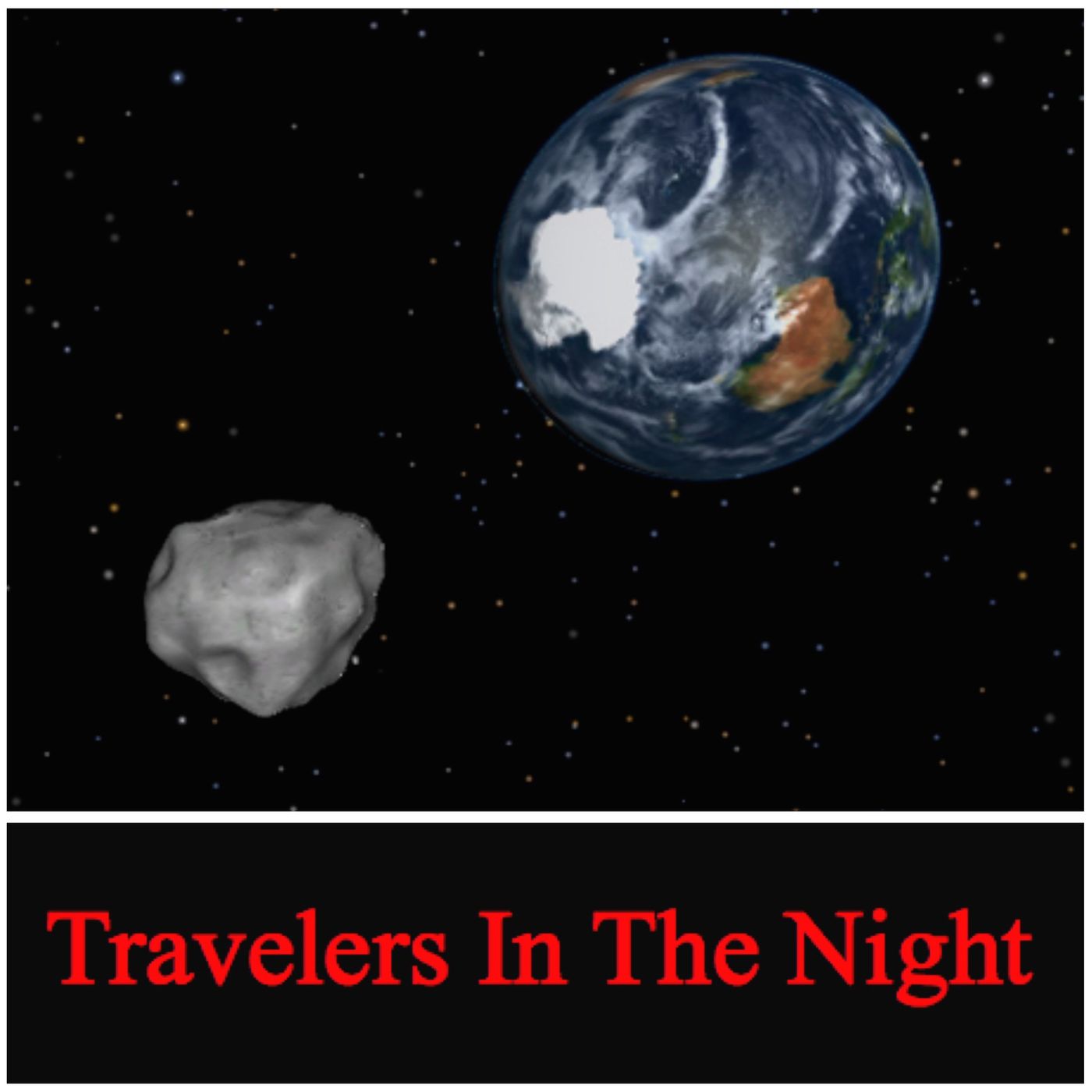
A real "Science Snack" for anyone who is interested in the extraterrestrial. Dr. Al Grauer is a member of the Catalina Sky Survey which has led the world in near Earth asteroid discoveries for 17 of the past 19 years. The music is "Eternity" by John Lyell. Astronomy Asteroids Space NASA Comets Earth Impact Aliens
Author
Albert D. Grauer
Category
Podcast website
Latest episode
Jul 10, 2026
Where to listen?
Podcasts in the app Replaio Radio Coming soonPodcasts are coming to the app soon. Install now and be the first to see a whole new take on podcasts
 Install for free
Android 5M+ downloads · 4.8 rating
iOS soon
Install for free
Android 5M+ downloads · 4.8 rating
iOS soon
Episodes
58E-70-NASA Mars Spacecraft Prepare For A Close Flyby 07.01.2020 2:01
Robert McNaught discovered a comet as it was traveling northward from under the plane of the Earth's orbit. He was observing at the Siding Spring Observatory in New South Wales Australia. This object was tracked by telescopes all around the world and named Comet C/2013 A1 (Siding Spring). It attracted attention as soon as it was realized that it would pass very close to the planet Mars in October...
569-Fossil Ice 03.01.2020 2:01
Recent findings, published in the Journal of Geophysical Research suggests that there is more water locked in the minerals of nearby asteroids, which are easier to reach than the Moon, than could be found in ice deposits near the lunar poles. This asteroidal water combined with solar energy could provide space colonists with water to drink, air to breathe, and hydrogen and oxygen to fuel their roc...
57E-69-Fly Out Of Spaceport America 31.12.2019 2:01
SpaceShipTwo will carry 6 passengers and two pilots and be launched from the 18,000 acre SpacePort America in New Mexico
568-Tough Space Rock 27.12.2019 2:01
At its closest point, a small space rock comes to only 1/3 of Mercury's average distance from the solar surface and receives 9 times the amount of solar energy which heats the planet Mercury to 800F. If it has the chemical composition of a stony meteorite it could contain a sizable amount of iron and in the future could be of interest to space colonists as a valuable source raw materials.
56E-68-Hubble Finds Three Surprising Dry Exoplanets 24.12.2019 2:01
Water is essential to life on our planet. Recently, NASA's Hubble Space Telescope was used to study 3 planets orbiting stars similar to our Sun. Astronomers divided the infrared light from these planets into its component colors to see which are present and which are missing. These data provide direct evidence of the amount of water which is present on each planet.
567-Close Space Rock 20.12.2019 2:01
Nine hours after it was discovered a tiny, 4 foot in diameter, space rock streaked less than 4,000 miles above southern Africa as it passed through the cloud of communications satellites which surround our planet. If you are fortunate to witness such an event you would be treated to a spectacular light show and perhaps of a new sense of appreciation for Earth's atmosphere as it protects us from th...
55E-67-NASA Deep Space Network Turns 50 17.12.2019 2:01
NASA's Deep Space Network is celebrating its 50th birthday. Australia, Spain, and California host its three sites. These facilities are spaced nearly evenly around the world to provide continuous communication with any spacecraft.
566-October Fest 13.12.2019 2:01
October of 2019 was a record breaking month for my team the Catalina Sky Survey during which we discovered 240 Earth approaching asteroids. This diverse collection of space rocks ranged in size from one that would fit into the bed of a small pickup truck to one which is more than 1/2 mile in diameter. Three of them can come closer to us than the communication satellites.
54E-66-Opportunity Celebrates 10 years on Mars 10.12.2019 2:01
The Opportunity Rover has been joined by, a car sized robot, named Curiosity. So far it has found that ancient Mars could have supported living microbes. You can follow its journey on the NASA Curiosity website. What will it find next?
565-Ancient Crater 06.12.2019 2:01
In ancient times, Aboriginal people in southwestern Australia quarried fine grained rock on an ancient hill called Barlangi Rock to make very sharp tools. Dr. Timmons Erickson, a NASA scientist at the Johnson Space Flight Center, led a team which discovered that the rocks the Aborigines used to make tools were formed by the impact which produced the 46 mile diameter Yarrabubba Crater. Over the cou...
53E-65-Your Shield 03.12.2019 2:01
The NEOShield project is an international group of scientists and engineers from space faring nations. They are doing the detailed analysis and planning required to provide an effective means of dealing with an asteroid which is on a collision course with planet Earth. They are also studying the ways to protect us from falling man made space debris since it is a greater danger than asteroids.
564-Heavy Traffic 29.11.2019 2:01
In the space of less than 13 hours four small space rocks zipped through the Earth-Moon neighborhood. All of them were discovered by my team, the NASA funded, Catalina Sky Survey, before they made close approaches to our home planet.
52E-64-Asteroid Brings Life's Ingredients to Earth 26.11.2019 2:01
A unique opportunity occurred in January of 2000, when a large meteoroid exploded and rained down pieces onto the frozen surface of Tagish Lake in British Columbia. Dr. Christopher Herd of the University of Alberta said that the first Tagish Lake samples were quickly collected from the frozen surface. They are the best preserved meteorite in the world. Dr. Michael Callahan of NASA's Goddard Space...
563-Pre-Autumnal Harvest 22.11.2019 2:01
On a clear but windy night, near the fall equinox, my Catalina Sky Survey teammate Greg Leonard was able to discover and verify 23 new Earth approaching objects as they passed through our celestial neighborhood.
51E-63-Rocks From Space Bearing Vitamin B3 19.11.2019 2:01
Research indicates that Vitamin B3 can form on ice crystals in deep space. From there asteroids and comets can bring it to Earth. How rocks from space play into life as we know it remains a mystery for us to ponder.
562-Monster Space Rock 15.11.2019 2:01
An object the size of this huge space rock enters the Earth's atmosphere every 180,000 years with an energy of 5,800 megatons of TNT. The only place to survive would be in an underground bunker.
50E-62-From Big Dark Asteroid to Beautiful Bright Comet 12.11.2019 2:01
About 26 weeks after its discovery, astronomers in Australia were the first to notice that an asteroid was beginning to have a fuzzy appearance. Six weeks later, Damian Peach, in England, took a stunning image showing this object is a beautiful comet with a coma and a long tail. This type of frog to prince transformation shows that the distinction between an asteroid and a comet may change dependi...
561-Hannes Is Back 08.11.2019 2:01
During the monsoon rainy season, my Catalina Sky Survey teammate, Hannes Groeller took a vacation in his native Austria. Returning to begin the fall season of observing with our Schmidt Telescope on Mt. Bigelow, Arizona, Hannes discovered 7 new Earth approaching asteroids in a single night.
49E-61-There Are Still Big Ones Out There 05.11.2019 2:01
Asteroid Hunters have discovered almost 900 Earth Approaching Asteroids whose impact could trigger global climate change. Fortunately none of them are on a collision course with planet Earth. Statistically we expect that there about another 100 out there. There are many more smaller ones whose impact would cause a hurricane sized area of devastation.
560-Wet Nights 01.11.2019 2:01
One of the most frustrating situations for an asteroid hunter is a night when the stars are shining bright above the mountain but the humidity is so high that it is impossible to open the telescope's dome without damaging sensitive optics and electronics.
48E-60-A Close Visit With A Message 29.10.2019 2:01
Eric Christensen was observing with the NASA funded Catalina Sky Survey Telescope on Mt. Lemmon, Arizona when he discovered a bright fast moving object in the night sky. During the next 25 hours it was observed by telescopes in Arizona and France and given the name 2014 MH6. It orbits the Sun in a bit over 16 months on a path which goes from closer than Venus to out past Mars.2014 MH6 is slightly...
559-Farming Mars 25.10.2019 2:01
On Earth plants provide us with medicines, food to eat, and oxygen to breathe. In the future, in addition to providing treats like strawberries it turns out that tending to the needs vegetables and watching them grow can help space travelers cope with the psychological stresses produced by the confinement experienced on long space missions.
47E-59-Spotting Travelers In The Night 22.10.2019 2:01
Travelers In The Night from outer space are closer than you may imagine. If you were to go straight up more than 4 miles you would need supplementary oxygen to stay conscious. At 50 - 70 miles, the realm of meteors, humans require a full space suit to survive. During the year, there are a dozen major meteor showers. Check out the American Meteor Society website for a complete listing.
558-Exploring The Lunar South Pole 18.10.2019 2:01
The race to explore the Moon by robots and eventually human lunar colonists is on. Near the lunar south pole human space colonists could use solar energy to power equipment and keep warm, manufacture needed items, and most importantly have water to drink as well as to use a raw material.
46E-58-NASA Hunts For A Special Asteroid 15.10.2019 2:01
Several years ago the NASA funded Lincoln Near Earth Asteroid Research Program discovered an SUV sized asteroid which comes closer to Earth than about 1/6 of the distance to the Moon. It was2011 MD's mass and size make it a good candidate for NASA's plans to use a robotic space craft to intercept and redirect a small asteroid into an orbit around our Moon.named 2011 MD. It remained a minor curiosi...
Similar podcasts







Listen to the Travelers In The Night podcast in Replaio
Radio and podcasts in one app - free, with no sign-up. Install today and do not miss the launch
Replaio is not a podcast publisher; show names, artwork and audio belong to their authors and are distributed through public RSS feeds.