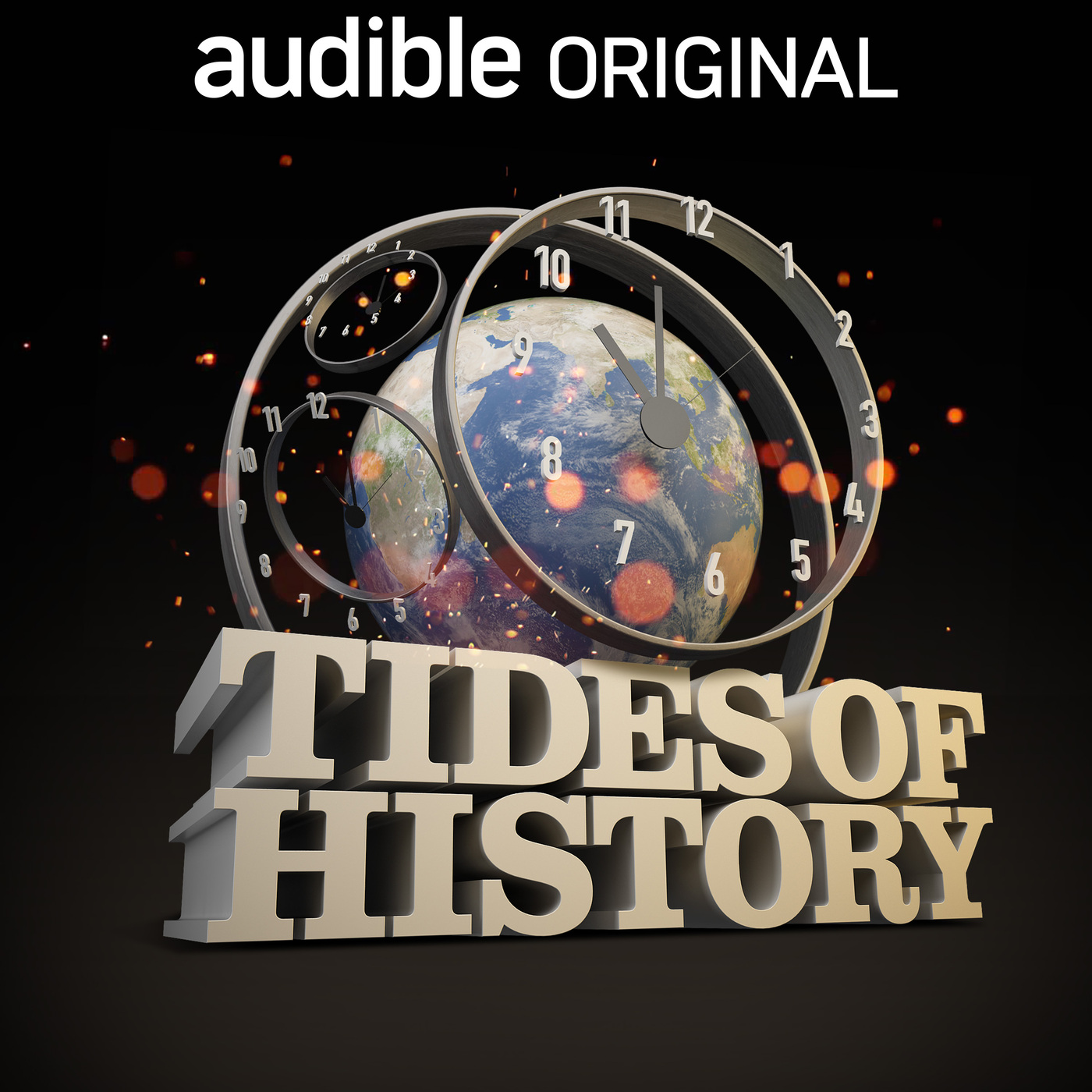
Audible / Patrick Wyman
Tides of History
Everywhere around us are echoes of the past. Those echoes define the boundaries of states and countries, how we pray and how we fight. They determine what money we spend and how we earn it at work, what language we speak and how we raise our children. From Wondery, host Patrick Wyman, PhD (“Fall Of Rome”) helps us understand our world and how it got to be the way it is. Audible subscribers can listen to all episodes of Tides of History ad-free right now. Join Audible today by downloading the Audible app.
Author
Audible / Patrick Wyman
Category
Podcast website
Latest episode
Apr 30, 2026
Where to listen?
Podcasts in the app Replaio Radio Coming soonPodcasts are coming to the app soon. Install now and be the first to see a whole new take on podcasts
 Install for free
Android 5M+ downloads · 4.8 rating
iOS soon
Install for free
Android 5M+ downloads · 4.8 rating
iOS soon
Episodes
Daily Life and Common People in Egypt's New Kingdom 18.08.2022 43:24
When we think about ancient Egypt, the vast majority of our attention goes to its elite: pharaohs, queens, priests, and nobles. But the elite made up only the tiniest portion of the population. What about the people who built the pyramids, royal tombs, great temples, and palaces? What can we know about them? A great deal, as it turns out. Patrick's book is now available! Get The Verge: Reformation...
Why Did the Bronze Age World Collapse? Interview with Professor Eric Cline 11.08.2022 1:00:51
If we know one thing about the Bronze Age world, we know that it collapsed. But what made it a world? And why did it fall apart? There's nobody better to ask than Professor Eric Cline, who literally wrote the book - 1177 BC - on the end of the Bronze Age. Patrick's book is now available! Get The Verge: Reformation, Renaissance, and Forty Years that Shook the World in hardcopy, ebook, or audiobook...
Kings, Images, and Violence in Ancient Egypt: Interview with Professor Laurel Bestock 04.08.2022 50:34
Kings are one of the constants of ancient Egypt's long history. But what, exactly, were kings supposed to do, and how did ancient Egyptians understand the role of their king? Professor Laurel Bestock is one of the world's leading experts on the institution of kingship in ancient Egypt, as well as an experienced archaeologist, and she brings several fascinating viewpoints to help us understand the...
Egypt's New Kingdom: Empire, Religious Change, and the Tomb of Tutankhamun 28.07.2022 42:57
Egypt's New Kingdom lasted for more than 400 years. In that time, Egypt changed dramatically, weathering ups, downs, and turmoil of all kinds. Much of that turmoil centered around a religious visionary who also happened to be pharaoh: Akhenaten, father of the famous Tutankhamun, whose incredible tomb and less-than-impressive reign was a reflection of those unsettled times. Please support us by sup...
The Rise of Egypt's New Kingdom 21.07.2022 40:09
Most of what we think we know about ancient Egypt is actually things we know about the New Kingdom, the last of Egypt's three classical golden ages: an empire stretching into the Near East and Nubia, warrior kings leading armies of chariots, the lavish tombs of the Valley of the Kings, and the well-preserved faces of royal mummies. Patrick's book is now available! Get The Verge: Reformation, Renai...
Lost Landscapes of the Ancient Pacific: Interview with Professor Mike Carson 14.07.2022 57:08
Sea levels rise, hills erode, and rivers change course over decades and centuries, dramatically affecting how people choose to live in their landscapes. Professor Mike Carson is an expert in the study of archaeological landscapes in the ancient Pacific, and his work has provided incredible insights into how the ancient speakers of the Austronesian languages saw and lived in their world.  ...
Encore: Chivalry and Knighthood in Medieval Europe 07.07.2022 52:24
When we think of the Middle Ages, the first thing that comes to mind is usually knights in shining armor. Chivalry - the ideal of behavior that guided knights - was a major force in medieval life. Honor and piety, bravery and reputation: these were core values for the secular elite. We explore what they actually meant to medieval people. Patrick's book is now available! Get The Verge: Reformation,...
The Coolest Archaeological Site in the World: Interview with Professor Chantal Conneller on Star Carr and the Mesolithic 30.06.2022 42:36
Star Carr, located in the Yorkshire region of northern England, is one of the world's richest archaeological sites, a waterlogged window onto the European Mesolithic more than 11,000 years ago. Professor Chantal Conneller spent more than a decade excavating at Star Carr, and she joins me to talk about this enigmatic and little-known but incredibly fascinating period of human history. Patrick's boo...
The Polynesians and the Pacific: Interview with Professor Patrick Vinton Kirch 23.06.2022 46:40
Of all the Austronesian-speaking peoples, none have gone further than the Polynesians. Professor Patrick Vinton Kirch of the University of Hawaii is one of the world's leading experts on the Polynesian voyages and colonization of the Pacific, and we discuss how, why, and with what impact the Polynesians spread out over half of the planet. Patrick's book is now available! Get The Verge: Reformation...
The Austronesian Expansion, Part 2 16.06.2022 43:20
The first wave of migration out of Taiwan brought speakers of Austronesian to the northern reaches of the Philippines, the homeland of the Malayo-Polynesians. From there, they spread out over a vast swathe of Southeast Asia and Oceania, eventually moving to the distant reaches of Indonesia and the previously uninhabited spaces of Remote Oceania. Patrick's book is now available! Get The Verge: Refo...
The Austronesian Expansion, Part 1 09.06.2022 37:38
More than 4,000 years ago, a remarkable migration - one of the great journeys in human history - began in Taiwan. Within just a thousand years, people speaking the Austronesian languages spread out everywhere from the Philippines to Borneo to the previously uninhabited islands of Vanuatu and Fiji in Remote Oceania. Patrick's book is now available! Get The Verge: Reformation, Renaissance, and Forty...
How Did Civilizations in the Andes Deal with Environmental Upheaval? Interview with Professor Jason Nesbitt 02.06.2022 43:51
The harsh, unforgiving conditions of the Andes and the nearby Pacific coastline make it one of the best places in the world to study the relationship between people and their environment. Professor Jason Nesbitt is an expert on the archaeology of the Andes and has extensively worked on how ancient people in the region organized themselves to deal with El Nino events and other climatic disasters. P...
Human Sacrifice, Oracle Bones, and Shang China: Interview with Professor Rod Campbell 26.05.2022 51:05
China's Shang Dynasty is something of an enigma. It produced the earliest written evidence in China, in the form of inscribed oracle bones, and decades of archaeology have shed light on its capital city and society. Yet much about it is still unclear, including precisely how the Shang understood themselves and their world. Professor Rod Campbell is one of the world's leading experts on the Shang,...
The Beginnings of Civilization in the Andes: The Mounds of Norte Chico 19.05.2022 39:17
The arid shoreline between the Andes Mountains and the Pacific seems like an unlikely place to host one of the world's earliest complex societies. But more than 5,000 years ago, the people of the Norte Chico Culture built cities, temples, and monuments that laid the foundation for thousands of years of Andean civilization. Patrick's book is now available! Get The Verge: Reformation, Renaissance, a...
The Rise of the Olmecs 12.05.2022 42:56
Mesoamerica is one of only a few places in the world where "civilization" - states, writing, cities, monumental building, and so on - emerged independently. The first society to do all this were the enigmatic Olmecs more than 3,000 years ago. Today the Olmecs are known mostly for their colossal carved stone heads, but they were the pioneers of a distinctively Mesoamerican form of civilization that...
Migration, Ancient DNA, and European Prehistory: Interview with Kristian Kristiansen 05.05.2022 40:51
Over the past several decades, ancient DNA and other archaeological sciences have transformed our understanding of Europe in prehistory. Professor Kristian Kristiansen has worked with these new methods since the very beginning, and combines them with a deep grounding in both traditional archaeology and big-picture thinking about what it all means. Patrick's book is now available! Get The Verge: Re...
The Steppes of Central Asia in the Bronze Age: Interview with Professor Michael Frachetti 28.04.2022 55:38
The Eurasian steppe is central to grasping the past 5,000 years of human history, and in the past couple of decades, new tools of analysis have transformed our understanding of the place and its importance. Professor Michael Frachetti has developed and applied a whole series of innovative approaches to understanding the people of the Bronze Age steppe and much more, ranging from ancient DNA to iso...
Indo-Aryans, the Rigveda, and a World on the Move 21.04.2022 45:13
Four thousand years ago, the sprawling cities of the Indus Valley Civilization dominated much of South Asia; a millennium after that, however, the cities were in ruins, and new migrants ultimately deriving their ancestry from the Eurasian steppe had established themselves throughout much of the region. These new arrivals have become known as Indo-Aryans, and they left behind some of the earliest w...
The World of the Indo-Iranians 14.04.2022 47:23
More than a billion people around the world speak a language of the Indo-Iranian family today. These languages all trace their origin to a group of innovative people living on the steppes of southern Russia more than 4000 years ago, people who inhabited a surprisingly far-flung, complex, and mutable world. Patrick's book is now available! Get The Verge: Reformation, Renaissance, and Forty Years th...
What was the Indus Valley Civilization? Interview with Dr. Adam Green 07.04.2022 49:48
The Indus Valley Civilization doesn’t get much attention compared to Mesopotamia or Egypt, but it covered an area of a million square kilometers, was home to hundreds of thousands or millions of people and a unified culture, and lasted for the better part of a millennium. More than that, the Indus Civilization doesn’t seem to fit the models we have for how early states functioned. Dr. Adam Green o...
Languages of the World in 1200 BC 31.03.2022 40:58
Language is fundamental to how people experience the world, but how can we know what languages people spoke in the distant past? By 1200 BC, the linguistic outlines of the world were becoming a bit clearer, thanks to an explosion in written texts. Follow along as we go on a historical linguistic tour of the globe around 1200 BC, from the first Bantu-speakers of western Africa to the Indo-Iranians...
Kathryn de Luna on Africa, Bantu, and Historical Linguistics 24.03.2022 51:39
About one in every five people alive on the planet today speaks a language belonging to the Bantu family, and Bantu-speaking peoples have shaped the history of Africa in profound ways. But how did they expand from their original homeland, and how can we tell? Professor Kathryn de Luna joins me to talk about historical linguistics, archaeology, and how they can shed light on one of the most importa...
What is the State? 17.03.2022 40:59
The state - a centralized administration that exerts control over a territory and can coerce the people living there - is one of the driving forces of the last several thousand years of history. But when and where did states appear, and why? And can we really call all of the various forms of political control that emerged around the world “states?” We can’t understand the world today without under...
Mary Prendergast on Ancient Africa 10.03.2022 44:27
Ancient DNA and new archaeological work have changed our understanding of many different parts of the global past, but nowhere more so than Africa. Professor Mary Prendergast sits on the very cutting edge of both fields, having worked on both the largest-scale studies of ancient DNA in Africa and some of the most fascinating and innovative work being done on the continent. Patrick's book is now av...
The Green Sahara and African Neolithics 03.03.2022 44:32
The most striking environmental shift on the planet in the Holocene epoch was the greening of the Sahara. For thousands of years, the now-deserts of northern Africa were a mosaic of savannahs, river valleys, and shallow lakes. This unique environment produced the ways of life that eventually brought pastoralism and food production, as well as a variety of language families and populations, to the...
Similar podcasts





Listen to the Tides of History podcast in Replaio
Radio and podcasts in one app - free, with no sign-up. Install today and do not miss the launch
Replaio is not a podcast publisher; show names, artwork and audio belong to their authors and are distributed through public RSS feeds.