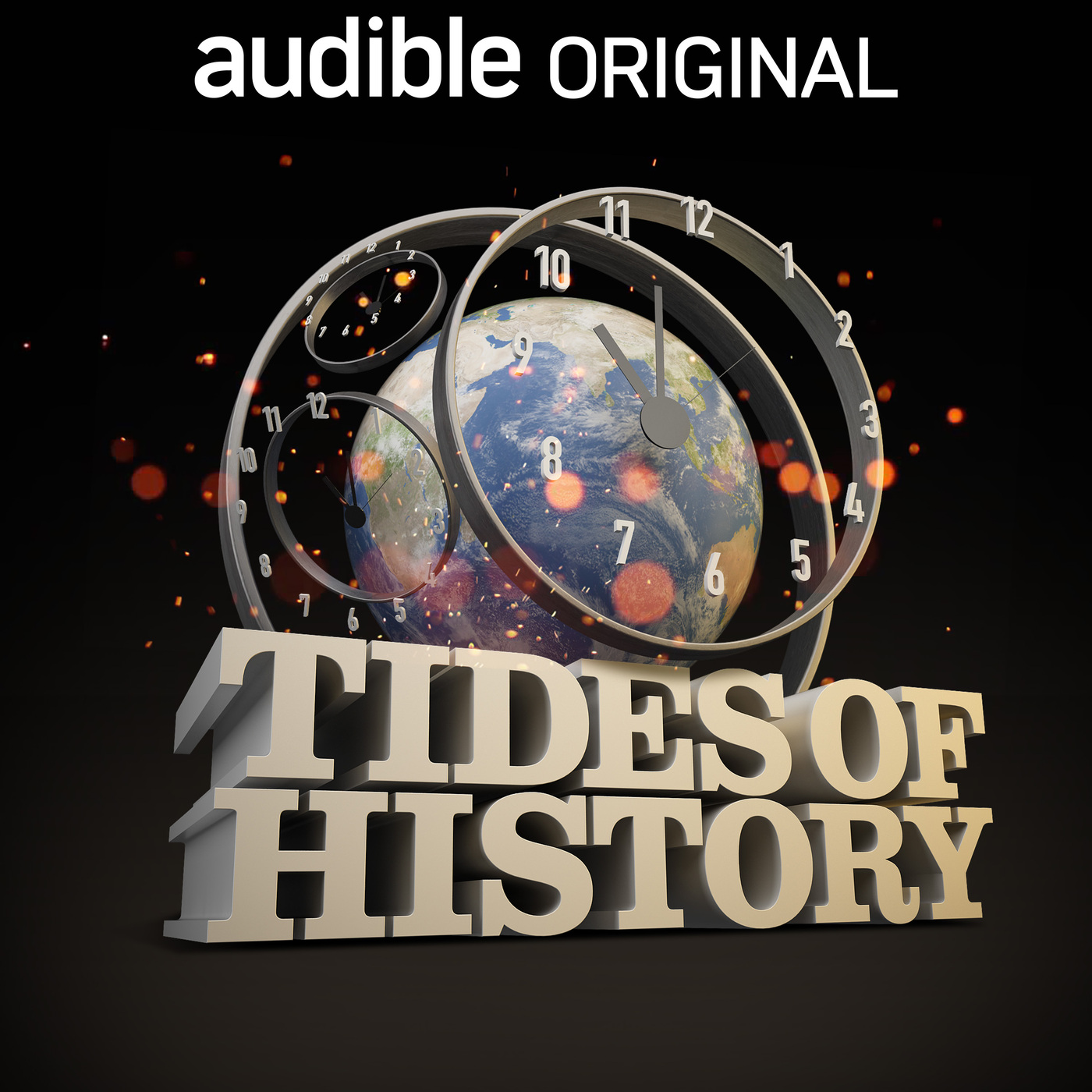
Audible / Patrick Wyman
Tides of History
Everywhere around us are echoes of the past. Those echoes define the boundaries of states and countries, how we pray and how we fight. They determine what money we spend and how we earn it at work, what language we speak and how we raise our children. From Wondery, host Patrick Wyman, PhD (“Fall Of Rome”) helps us understand our world and how it got to be the way it is. Audible subscribers can listen to all episodes of Tides of History ad-free right now. Join Audible today by downloading the Audible app.
Author
Audible / Patrick Wyman
Category
Podcast website
Latest episode
Apr 30, 2026
Where to listen?
Podcasts in the app Replaio Radio Coming soonPodcasts are coming to the app soon. Install now and be the first to see a whole new take on podcasts
 Install for free
Android 5M+ downloads · 4.8 rating
iOS soon
Install for free
Android 5M+ downloads · 4.8 rating
iOS soon
Episodes
The Neolithic Revolution: Europe's First Farmers 01.10.2020 45:47
Farming came into existence in the Fertile Crescent, but it didn't stay there. By 5000 BC, agriculture had spread east and west, reaching both Central Asia and the Atlantic Ocean. But how did this happen? Did indigenous hunter-gatherers adopt farming, or did the farmers themselves move and bring their way of life with them? If you'd like to see some visuals of the things we talk about in this epis...
How Did People Domesticate Animals? An Interview with Professor Greger Larson 17.09.2020 58:01
The domestication of animals has transformed the way that people eat, clothe themselves, and live over the past 10,000 or so years, but what in the world does "domestication" even mean? How did this happen, and why did people start doing this? I talk with Professor Greger Larson of Oxford University about the genetics of animal domestication and how cutting-edge science is helping us answer these...
The First Farmers 10.09.2020 46:45
The domestication of plants and animals has remade the way that people feed themselves, organize their societies, and interact with the landscapes around them. But for most of the human past, this isn't how people subsisted. When, where, and how did people start farming? And most importantly, why? If you'd like to see some visuals of the things we talk about in this episode, check out the accompan...
After the Ice: The Younger Dryas, the Mesolithic, and the Birth of a New World 03.09.2020 47:41
For most of Homo sapiens ' time out of Africa, we lived in a world defined by ice. But by around 20,000 years ago, the ice had begun to melt, the glaciers retreating back toward the poles and mountain ranges. This left behind a new world, a whole different series of environments, opportunities, and perils for the people who had made it through the Ice Age. Support us by supporting our sponsors! Se...
How Should We Understand the Deep Human Past? Interview with Professor John Hawks 27.08.2020 54:52
Professor John Hawks of the University of Wisconsin-Madison, one of the world's best communicators on the deep human past and paleoanthropology, joins me to talk about archaic humans, genomics, and whether the concept of different human species even makes sense these days. Check out his blog , which is an amazing resource, and follow him on Twitter . Support us by supporting our sponsors! See Priv...
New Insights on the First Americans: Interview with Professor Jennifer Raff 13.08.2020 50:28
Our understanding of the past is constantly in flux, and there's no field where that's clearer than with the early settlement of the Americas. I'm joined by Professor Jennifer Raff of the University of Kansas, an anthropological geneticist, to discuss the game-changing (or not?) recent work pushing back the date of first settlement to 30,000 years ago or more. Support us by supporting our sponsors...
Who Were the First Americans? 06.08.2020 47:16
The Americas were the last continents Homo sapiens reached. Why did it take so long for people to enter this vast and promising expanse of land? Who were they, and where had they come from? In today's episode, we explore the latest - just days old! - science of the First Americans, and discover the descendants they've left behind even today. Support us by supporting our sponsors! See Privacy Polic...
Trapped in Ice: The Paleolithic World 30.07.2020 45:52
Twenty thousand years ago, the world was locked in ice. The glaciers advanced from the poles and mountain ranges, swallowing huge portions of the planet's surface and making the rest colder and drier, a more difficult place to live. Yet people nevertheless thrived, spreading out across the continents and creating some of the most incredible art in human history. See Privacy Policy at https://art19...
Ancient DNA and the Human Story: Interview with Geneticist Eske Willerslev 16.07.2020 41:40
Ancient DNA is the key that's unlocking the deep history of humanity, allowing us to answer questions about our collective past that we never dreamed of addressing even 20 years ago. Eske Willerslev is a pioneer in the field of extracting, sequencing, and analyzing the preserved DNA of people who lived thousands upon thousands of years ago; on top of that, he's a fascinating person with unique per...
The Ghosts of Archaic Humans 09.07.2020 46:06
Until very recently, Homo sapiens - our species - was only one of several varieties of humans on this planet. As our ancestors spread outward from Africa in their great migration, they encountered those other species. The results of those encounters left us a genetic legacy that is still with us today. If you'd like to see some visuals of the things in this episode, check out this post...
Bone, Stone, and Genome: Understanding Humanity's Deep Past 02.07.2020 45:01
Welcome to a new season of Tides of History! Over the next year, we'll be traveling from the very origins of our species through the peopling of the planet, the Ice Age, and then to the beginnings of agriculture, cities, metalworking, and states. Today, we cover our deepest past, from the divergence from our closest ape relatives to the first appearance of anatomically modern humans. To see visual...
Did I End My Early Modern Series in the Right Place? Interview with Keith Pluymers 18.06.2020 56:17
How do we tell when one period ends and another begins? What are the fundamental characteristics of the early modern period? My dear friend (and friend of the show!) Keith Pluymers, assistant professor of history at Illinois State University, returns to chat with me about periodization, the Great Divergence, and riots in the early modern period. Support us by supporting our sponsors! See Privacy P...
The Globalization of the Year 1000: Interview with Professor Valerie Hansen 11.06.2020 35:25
Around the year 1000, merchants, explorers, and missionaries linked the world together from Newfoundland to China. Trade goods, people, and above all ideas flowed across a rich assortment of routes, connecting previously distant places into a single unit. This was the first instance of what we can call globalization, according to Professor Valerie Hansen of Yale, who wrote a compelling new book on...
Alaric, the Goths, and the Sack of Rome: Interview with Professor Douglas Boin 04.06.2020 43:41
Alaric was one of the most famous barbarians of antiquity, and yet we know little about him - or at least, we knew very little, until Douglas Boin's excellent new book came out. It's entitled Alaric the Goth: An Outsider's History of the Fall of Rome. In today's episode, I chat with Professor Boin about the book, the Goths, and how we should understand this period of Roman - and Gothic - history....
John Maynard Keynes and His Legacies: Interview with Author and Journalist Zach Carter 28.05.2020 46:09
John Maynard Keynes was one of the most important figures of the 20th century, creating the economic structures and ideas that defined the Second World War and its aftermath. I spoke with Zach Carter, author of the wonderful new Keynes biography The Price of Peace: Money, Democracy, and the Life of John Maynard Keynes , about Keynes's wild life and enduring legacies. Get Zach's book here . Listen...
Malta, Lepanto, and the End of an Era 14.05.2020 49:29
We reach the epic conclusion of our series on the early modern period with the Great Siege of Malta and the Battle of Lepanto. Listen ad-free on Wondery+ here Support us by supporting our sponsors! See Privacy Policy at https://art19.com/privacy and California Privacy Notice at https://art19.com/privacy#do-not-sell-my-info .
The Battle for the Mediterranean 07.05.2020 48:10
For much of the 16th century, the Habsburgs of Spain and the Ottoman Empire waged an epic conflict for control over the Mediterranean. Follow along with two composite characters, a Barbary corsair and a Hospitaller knight, as they raid, pillage, and fight a holy war for decades on end. Listen ad-free on Wondery+ here Support us by supporting our sponsors! See Privacy Policy at https://art19.com/pr...
Charles V and the Failure of Empire 30.04.2020 53:41
Charles V controlled more of Europe than any ruler in centuries, with resources other monarchs could only dream of. But that was never enough to give the Holy Roman Emperor more than a momentary victory; there was always a new enemy, some unforeseen calamity, waiting around the corner. See Privacy Policy at https://art19.com/privacy and California Privacy Notice at https://art19.com/privacy#do-not...
Mike Duncan on Pandemics, Revolutions, and COVID-19 23.04.2020 1:16:51
DISCLAIMER: If you do not think that this pandemic is a big deal; if you do not want to hear our personal political views; if you don’t care about present-day politics; if you think that this will somehow offend you; then please don't listen to this episode. Author and history podcaster extraordinaire Mike Duncan joins me to talk about pandemics, social instability, and present-day politics. See P...
The Rise of Charles V 16.04.2020 52:29
Charles V was the most powerful European ruler since Charlemagne: king of Spain and Naples, Holy Roman Emperor, and ruler of a whole bunch else besides. How did all of these vast territories, and the central political role that went along with them, come into his possession? The answer wasn't ability or merit; it was inheritance. Support us by supporting our sponsors! See Privacy Policy at https:/...
Pandemics in History 09.04.2020 44:59
All of us are dealing with the ongoing pandemic in different ways, and I decided to wedge myself into my closet to record an informal talk with you all about pandemics throughout history and what, if anything, they might help us understand about what we're dealing with today. Economic effects, political upheavals, and disease all play together, so let's try to figure out the connections. Support u...
Genetics and the Transformation of Prehistory: Interview with Spencer Wells and Razib Khan 02.04.2020 40:14
Genetics has radically transformed our understanding of prehistory over the past two decades, revealing everything from the existence of brand-new, unknown species to interbreeding between Neanderthals and our human ancestors. I talked to geneticists Spencer Wells and Razib Khan, two of the world's most knowledgable communicators on genetics and prehistory, to get a sense for how things have chang...
Classic Tides: Plague, Climate, and the End of the Roman World 26.03.2020 43:27
In light of current events, we are re-posting one of my favorite episodes (from December, 2017) on natural disasters and the fall of the Roman Empire. Justinian was the last great Roman emperor, but his reign was plagued by disasters beyond his control: volcanic eruptions, a changing climate, and a plague of epic proportions. Those disasters created a turning point that we can, with good reason, c...
American Nations, American Union: Interview with Colin Woodard 19.03.2020 46:59
Few books have influenced my view of American history and politics more than Colin Woodard's American Nations: A History of the Eleven Rival Regional Cultures of North America . We've been divided since the beginning, Woodard argues, and this has influenced every aspect of American history, not to mention its future. He has a new book coming out in May, Union , which expands this thesis further. G...
Classic Tides: The Black Death Revisited 17.03.2020 52:36
In light of current events, we are re-posting one of my favorite episodes (from June, 2018) on the Black Death. Between 1346 and 1351, the Black Death killed tens of millions of people - at least half the population - in Europe and the Middle East. This great mortality, one of the worst disasters of any era, fundamentally reshaped European society and set the stage for the world that followed. See...
Similar podcasts







Listen to the Tides of History podcast in Replaio
Radio and podcasts in one app - free, with no sign-up. Install today and do not miss the launch
Replaio is not a podcast publisher; show names, artwork and audio belong to their authors and are distributed through public RSS feeds.