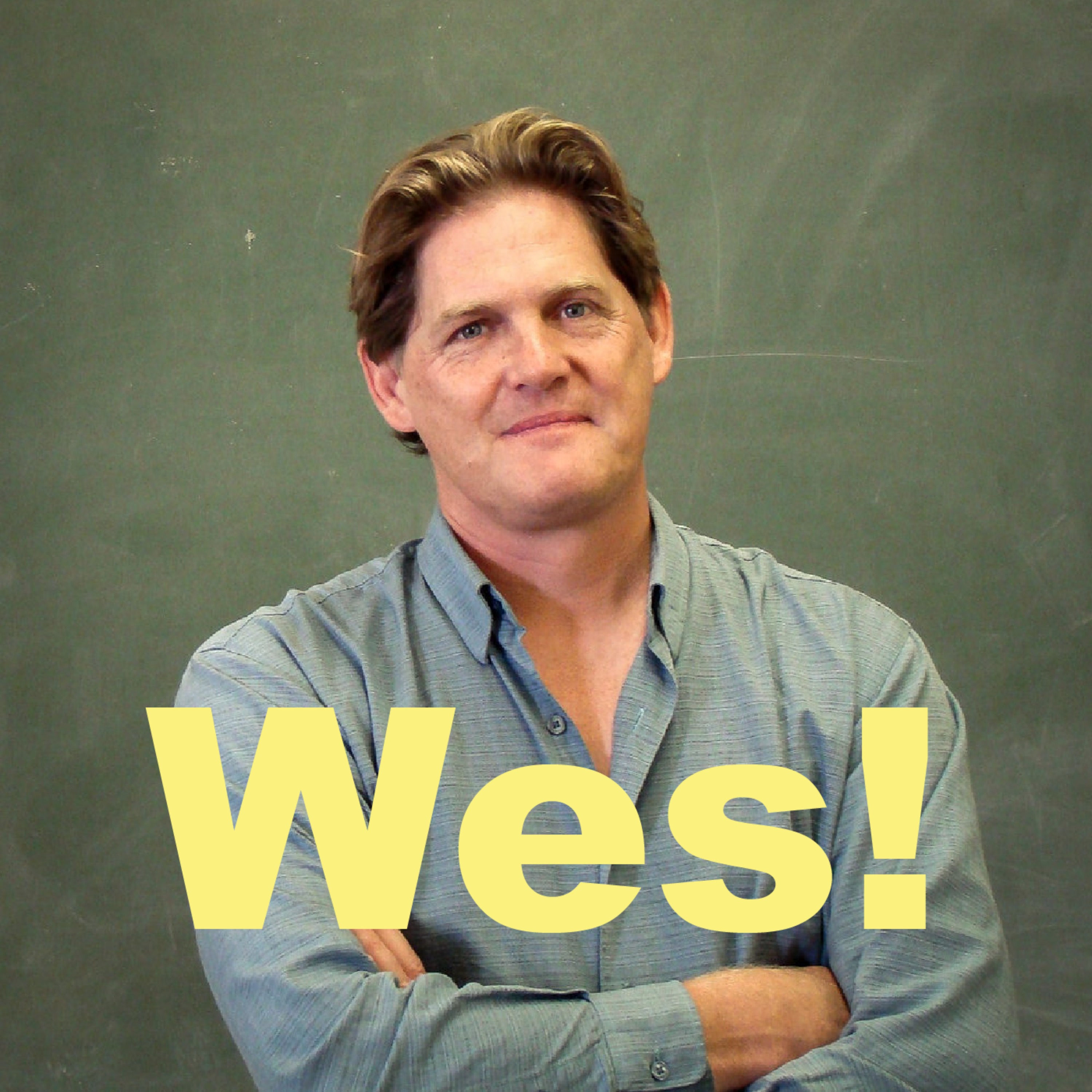
Wes Cecil
The Wes Cecil Podcast
My lectures are dedicated to making Philosophy in particular and the world of ideas in general available to everyone. My exploration of topics and thinkers is designed to provide a foundation for listeners to engage in further reading and thought and develop their own conceptions of the topics I introduce. I have PhD in Literature and Philosophy and was a college professor for over 20 years. I am working to remove the barriers that prevent many from experiencing and understanding the lives and thoughts of some of the world's greatest thinkers. Hosted on Acast. See acast.com/privacy for more in...
Where to listen?
Podcasts in the app Replaio Radio Coming soonPodcasts are coming to the app soon. Install now and be the first to see a whole new take on podcasts
 Install for free
Android 5M+ downloads · 4.8 rating
iOS soon
Install for free
Android 5M+ downloads · 4.8 rating
iOS soon
Episodes
The History of Philosophy in 16 Questions - Q16: Nihilism? 19.11.2025 45:00
The History of Philosophy in 16 Questions - Q16: Nihilism? Nihilism is the belief that all values are baseless and that nothing can be known or communicated. It is often associated with extreme pessimism and a radical skepticism that condemns existence. A true nihilist would believe in nothing, have no loyalties, and no purpose other than, perhaps, an impulse to destroy. Structur...
Late Capitalism: A Survival Guide - Ep. 1 17.11.2025 1:07:11
The revolution has happened, and we are its victims. If you feel a bit hopeless and disoriented by the world today, this is not just you or some random happenstance. You are being disoriented, and your sense of hope is being systematically undermined by a global economic logic—Late Capitalism—that has come to dominate almost every aspect of our lives. This series is not meant to be anti-commerce o...
Reading vs. TV 14.11.2025 26:33
A reflection on the relative nature of Reading vs TV and the peculiarities of both mediums. Indeed, given how much time we spend engaged in watching various kinds of media, I think it is a bit shocking how little time we spend reflecting on the nature of the media and how it impacts us. Sign-up for Wes’s PATREON to get your questions answered by Wes! Plus, gain access to course material...
The History of Philosophy in 16 Questions - Q15: Truth? 12.11.2025 42:35
The History of Philosophy in 16 Questions - Q15: Truth? Principia Mathematica The aim of the book is to set a limit to thought, or rather — not to thought, but to the expression of thoughts: for in order to be able to set a limit to thought, we should have to find both sides of the limit thinkable (i.e. we should have to be able to think what cannot be thought). It will therefore only be in langu...
Primates In Space: Primates Are Stressed (Conclusion) - Ep. 12 10.11.2025 43:14
The accumulated gap between our environment and our needs as primates have grown increasingly large over the last 100 years. As a result virtually every measure of health and well being have become shockingly negative. Yet we have little sense of why or what is happening because the systemic issues we face are difficult to identify in the sea of changes we experience in the world since the industr...
Narrativium 07.11.2025 20:16
We continually tell ourselves stories about every aspect of our lives. Taking a little time to reflect on the stories we tell ourselves is often quite revelatory about how our thinking is directed and limited. Likely it is impossible for humans to live without a rich life filled with stories, but the stories are often under our control to a remarkable degree. Image attribution: https://creativecom...
The History of Philosophy in 16 Questions - Q14: What is this science thing? 06.11.2025 53:00
The History of Philosophy in 16 Questions - Q14: What is this science thing? Now my method, though hard to practice, is easy to explain; and it is this. I propose to establish progressive stages of certainty. The evidence of the sense, helped and guarded by a certain process of correction, I retain. But the mental operation which follows the act of sense I for the most part reject; and instead of...
Primates In Space: Primates Go Wild - Ep. 11 03.11.2025 45:49
While the industrial revolution is widely recognized as a turning point in human history, less well appreciated is why it has been so influential. Each of the developments were undoubtedly important, however I argue it has been the rate of change that has had a greater impact than any particular change. As primates we are simply incapable of adapting as quickly as we have been presented with chang...
Andre Gide and Marcel Proust 31.10.2025 31:27
Two famous works that critiqued the Moral structure of turn of the century French society did so in entirely different ways. While Gide is more known for his critique, I argue Proust’s critique is far, far more important and powerful. Both authors are worth reading, however, it is Proust who forces us to join him in his reconsideration of whether we are aware of the fact or not. Image attributions...
The History of Philosophy in 16 Questions - Q13: Enlightened? 29.10.2025 47:31
The History of Philosophy in 16 Questions - Q13: Enlightened? We can see from this that the sovereign power, absolute, sacred and inviolable as it is, does not and cannot exceed the limits of general conventions, and that every man may dispose at will of such goods and liberty as these conventions leave him; so that the Sovereign never has a right to lay more charges on one subject than on another...
Primates In Space: Primates Take Over - Ep. 10 28.10.2025 39:32
The combination of new crops, new outlooks, new technologies but, most importantly, the expansion of the primate intellectual and imaginative capacities led to the explosive growth in human population that created the world we live in today. Sign-up for Wes’s PATREON to get your questions answered by Wes! Plus, gain access to course materials, reading lists, peer discussions, bonus lect...
The History of Philosophy in 16 Questions - Q12: What was reborn? 22.10.2025 46:35
The History of Philosophy in 16 Questions - Q12: What was reborn? 1374 death of Petrarch 1413 Brunelleschi systematizes perspective 1439 Movable Press 1492 Columbus 1514 More's Utopia and Machiavelli's The Prince 1528 Castiglionie's The Courtier 1543 Copernicus The Revolution of the Heavens No one, it seems to me, can hope to equal Augustine. Who, nowadays, could hope to e...
Primates In Space: Primates Discover The Printing Press- Ep. 9 20.10.2025 50:58
Despite the general acknowledgement of the importance of the printing press, I argue that why the press had such an impact is largely misunderstood. The printing press was the technology that most powerfully transitioned us from a face to face very personal experience of the world to one in which abstraction, distance, time and imagination slowly came to dominate our experience of the world. Sign-...
America As Seen From France - A Follow Up On Consumerism 18.10.2025 19:43
A follow up to my lecture on America seen from France that explores in more detail some of the data behind American consumerism and how this translates into lived experience. In sum, while consumerism is a real issue everywhere, the comparisons between Europe and the US mask how utterly dedicated the US is to consumerism as a way of life. Image Attribution: Lionel Allorge, CC BY-SA 3.0 < https:...
Baudrillard, the Simulacra and You 17.10.2025 59:03
Following a question from a Patreon member, here is a reflection on Baudrillard and his theory of the Simulacra and how it relates to us and our condition today. Spoiler alert, I’m pretty sure he was really accurate in his analysis of the problem. Seemingly much less helpful, however, in what we can do about the position we find ourselves today. Image Attribution: http://en.wikipedia.org/wiki/User...
The History of Philosophy in 16 Questions - Q11: Why Golden? 15.10.2025 56:00
The History of Philosophy in 16 Questions - Q11: Why Golden? 800 ad Abbasid Capital is established in Baghdad displacing the Umayids 801-873 Al Kindi and the Translation Movement 980-1037 Avicenna Medicine, Philosophy Bukhara 1126-1200 Averroes and the Al-Andalus 1258 Mongols sack Baghdad and destroy most libraries and books Muḥammad ibn Mūsā al-Khwārizmī played a significant role in the developme...
Primates In Space: Primates Discover Iron - Ep. 8 13.10.2025 34:15
Wow, Iron is a huge, huge deal. Both the impact of the Iron itself and the cultural infrastructure necessary to harness the potential of Iron contributed to a revolution in civilization and a noticeable increase in both the global population and the rate of population increase. In some ways, Iron is likely as significant a contributor to civilization's growth as agriculture. Sign-up for Wes’s...
America As Seen From France 10.10.2025 35:12
A reflection on some of the differences I have experienced between France and the US. I start with some, at least to me, startling statistics about French working lives and economic situation and then expand to a more subjective sense of what I have ‘felt’ living in France that is quite distinct from the US. Delivered in lieu of my cancelled lecture. Image Attribution: Lionel Allorge, CC BY-SA 3.0...
The History of Philosophy in 16 Questions - Q10: So, About God...? 08.10.2025 42:18
The History of Philosophy in 16 Questions - Q10: So, About God? Timeline of Catholicism 313 Legalization of Christianity under Constantine 325-800 Beginning with the Council of Nicaea a series of councils attempt to deal with various controversies and Heresies. 900-1200 Catholic Church consolidates Papal primacy and civil power and begins to systematize church hierarchy. 1200-1520 Beginning of the...
Primates In Space: Primates Discover God - Ep. 7 06.10.2025 34:50
The Anthropological and Archaeological records strongly suggest we love, love, love creating gods. Whether via animism or anthropomorphic super-beings, humans seem to love placing ourselves within the context of a world filled with supernatural beings different from, yet fundamentally similar to humans. Sign-up for Wes’s PATREON to get your questions answered by Wes! Plus, gain ac...
Ishiguro and McEwan 03.10.2025 13:22
Two well regarded authors to the impact of AI robots and their impacts on humans as their subjects for novels. The results are a fascinating contrast in tone, style, and emphasis that highlights the many different reasons, and ways, we read. Image credit: https://easy-peasy.ai Sign-up for Wes’s PATREON to get your questions answered by Wes! Plus, gain access to course materials, reading...
The History of Philosophy in 16 Questions - Q9: The New World? 01.10.2025 48:24
The History of Philosophy in 16 Questions - Q9: The New World? Mayan Civilization 2,000-750 B.C. earliest developments 750 B.C. to 250 A.D. Cities, construction of monumental architecture 250- 900 A.D. Long Count Calendar and spread of city states. Height of Mayan Civilization 900-1500 Post classical period, shift in power centers, fragmentation. 1500-1600 Contact and conquest by the Spanish...
Primates In Space: Primates Discover Writing - Ep. 6 29.09.2025 45:35
Perhaps THE breakthrough that makes the major components of civilization possible, writing transformed our capacity to understand both the world and ourselves. Nonetheless, literacy was historically exceedingly rare and even today is not universally considered an important capacity. Sign-up for Wes’s PATREON to get your questions answered by Wes! Plus, gain access to course materials, r...
Investment is not the Pope 26.09.2025 20:12
Our powerful belief in the economic narrative of investment and growth blinds us to the actual nature of the world we experience and the problems we face. Much like Luther’s critique of the Catholic church, re-thinking this concept would be so disruptive as to cause a complete rethink of our approach to economic challenges - something we are so far unwilling to do. Sign-up for Wes’s PATREON &...
The History of Philosophy in 16 Questions - Q8: Why is life so hard? 24.09.2025 42:01
The History of Philosophy in 16 Questions - Q8: Why is life so hard? 1 All existence is dukkha. The word dukkha has been variously translated as ‘suffering’, ‘anguish’, ‘pain’, or ‘unsatisfactoriness’. The Buddha’s insight was that our lives are a struggle, and we do not find ultimate happiness or satisfaction in anything we experience. This is the problem of existence....
Similar podcasts







Listen to the The Wes Cecil Podcast podcast in Replaio
Radio and podcasts in one app - free, with no sign-up. Install today and do not miss the launch
Replaio is not a podcast publisher; show names, artwork and audio belong to their authors and are distributed through public RSS feeds.