Synthetic Universe
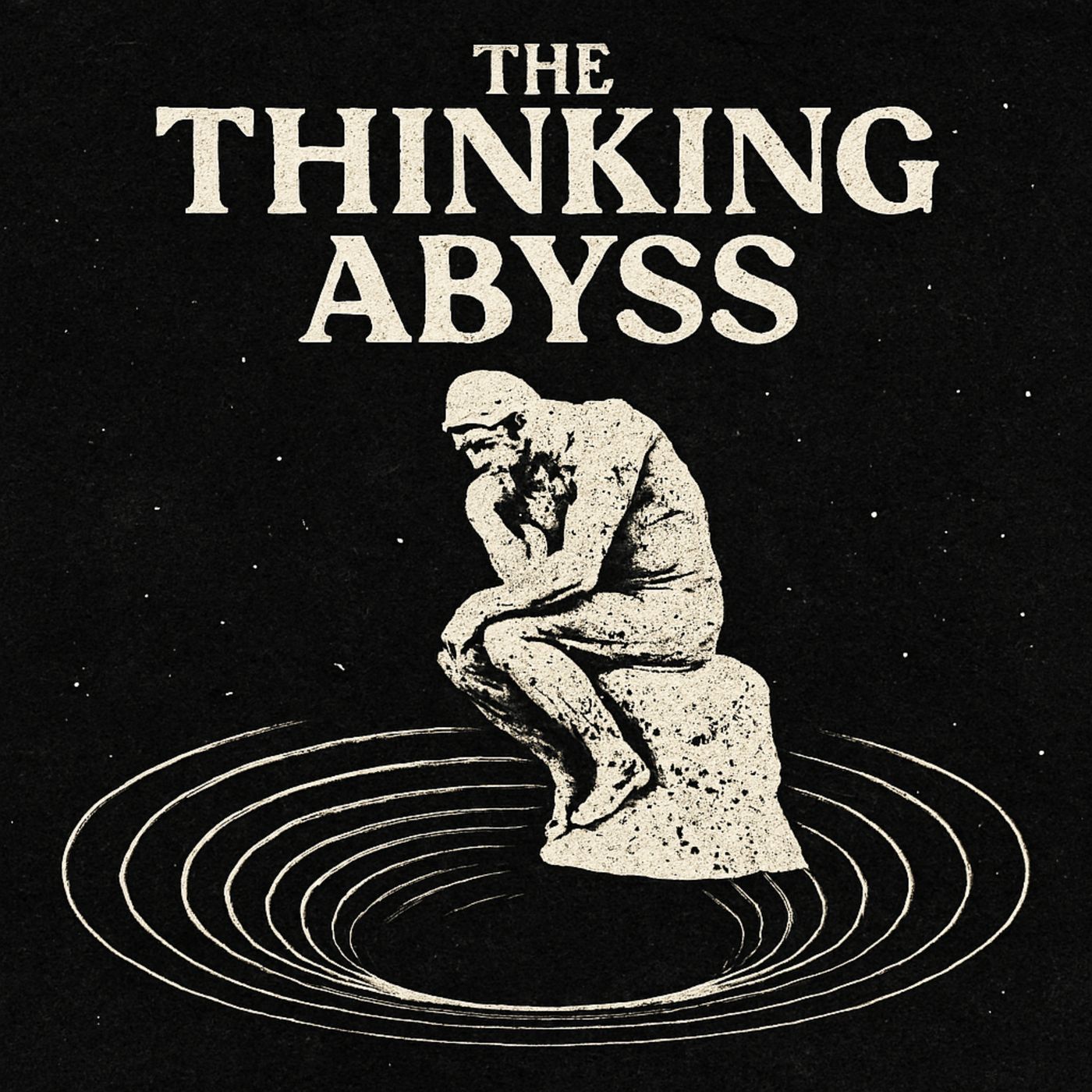
The Thinking Abyss: Philosophy and Science
The Thinking Abyss explores profound questions at the intersection of philosophy, science, and human experience. From consciousness to quantum mechanics, free will to artificial intelligence, we dive deep into ideas that challenge our assumptions about reality and what it means to be human. Thoughtful conversations for curious minds. AI-narrated, human-researched. The tech just lets us focus on what matters: bringing you mind-expanding content.
Be sure to visit the podcast's website and support the creator: www.spreaker.com
Author
Synthetic Universe
Category
Podcast website
Latest episode
Nov 19, 2026
Where to listen?
Podcasts in the app Replaio Radio Coming soonPodcasts are coming to the app soon. Install now and be the first to see a whole new take on podcasts
 Install for free
Android 10M+ downloads · 4.7+ rating
iOS soon
Episodes
What If the Self Is Only a Cognitive Illusion? 27.08.2026 50:00
What if the self is not a fixed entity but a cognitive illusion created by the brain? Drawing on neuroscience, philosophy, and psychology, this episode explores evidence that personal identity may emerge from countless interacting processes rather than a single, enduring “I.” From neurological disorders and decision-making experiments to meditation and artificial intelligence, the discussion chall...
The Hidden Human Need for Purpose, Identity, and Symbolism 24.08.2026 36:57
Human beings have always created gods, ideologies, and symbolic systems to give meaning to existence and protect themselves from the chaos of an indifferent universe. Ancient religions helped explain suffering, strengthen morality, and unite civilizations, while modern societies increasingly turn to nationalism, politics, technology, and consumer culture for the same psychological purpose. The dis...
Why Modern Technology Rewards Distraction Over Thought 20.08.2026 44:47
Human attention is becoming one of the most contested resources of the digital age. This episode explores how algorithms, social media, and AI-driven platforms are reshaping cognition by turning focus into a commodity optimized for engagement. As constant stimulation fragments concentration and weakens deep reflection, researchers warn that creativity, critical thinking, and even democratic stabil...
Why LLMs Are Reopening the Biggest Questions in Philosophy 17.08.2026 39:35
Artificial intelligence is forcing philosophers to rethink what language and understanding really are. This episode explores whether modern LLMs genuinely reveal hidden truths about human communication — or merely imitate meaning through massive pattern prediction. Drawing on the ideas of Ludwig Wittgenstein and John Searle, we examine how AI hallucinations, symbolic reasoning, and the absence of...
Why Gen Z Is Obsessed With Soft ‘Gummy’ Textures 13.08.2026 47:01
The “Gummy Everything” trend has become a major cultural phenomenon, driven by Gen Z’s fascination with soft, stretchy, and tactile textures inspired by gummy candy. Expanding into fashion, home decor, cosmetics, and product design, the movement reflects a growing desire for physical comfort and emotional self-regulation in an increasingly digital world. Neuroscience suggests these materials can t...
The Quiet Magic Hidden in Everyday Life 10.08.2026 37:21
This episode explores the idea of “quiet magic” — the hidden value of people, experiences, and everyday comforts that humans often fail to appreciate until they disappear. Through psychology, habit, and the phenomenon of hedonic adaptation, the discussion reveals how routine can numb awareness and make even life’s most meaningful aspects feel ordinary. The episode examines how loss reshapes percep...
Why AI May Master Logic but Never Wisdom 06.08.2026 44:24
As Artificial Intelligence becomes increasingly capable of performing complex philosophical analysis, some researchers believe machines may soon surpass humans in logic, synthesis, and conceptual reasoning. Yet while AI can process ideas at superhuman scale and identify contradictions across centuries of philosophy, it still lacks consciousness, emotion, mortality, and lived experience — the very...
The Architect of Sleep: How Dreams Shape Human Reality 03.08.2026 39:53
This episode explores how dreams influence human perception, creativity, and behavior. Blending neuroscience, psychology, and philosophy, it examines dreaming as a mental space where memory, emotion, and imagination reshape the way humans experience reality itself. This episode includes AI-generated content.
The Neuroscience of Creativity 30.07.2026 50:10
This episode explores how modern Neuroscience explains creativity as the interaction between imagination, memory, emotion, and executive control. Rather than appearing from nowhere, creative ideas emerge through the brain’s ability to recombine existing knowledge into new mental structures shaped by attention, dopamine, and spontaneous thought. This episode includes AI-generated content.
The Philosophy of Collective Loneliness 27.07.2026 27:05
This episode explores collective loneliness as a structural condition of modern life. In an age of constant connectivity, fragile and transactional relationships increasingly replace stable forms of belonging, revealing how digital visibility and endless communication do not necessarily create genuine This episode includes AI-generated content.
The Architecture of Repetition and Daily Rituals 23.07.2026 40:12
This episode explores how repetition shapes identity, memory, and perception. Moving beyond simple habits, it examines how rituals transform ordinary actions into structures of meaning, while asking whether human life depends on balancing predictable routines with novelty and change. This episode includes AI-generated content.
The Philosophy of Noise and Silence 20.07.2026 36:46
This episode explores noise and silence not as opposites, but as interconnected forces that shape perception, meaning, and attention. From philosophy and art to technology and power, it examines how disorder and absence influence the way humans interpret reality and structure experience. This episode includes AI-generated content.
Smell Over Sight: Rethinking Perception 16.07.2026 37:54
This episode explores a shift from vision to smell as the dominant mode of perception, arguing that olfaction offers a more relational and integrated understanding of reality. Drawing on ideas from Ann-Sophie Barwich, it examines how odors function as dynamic processes rather than fixed objects, blurring boundaries between self and environment. By framing reality as permeable and context-dependent...
Do AI Systems Deserve Rights? 13.07.2026 56:11
This episode explores whether advanced artificial intelligence could warrant moral consideration. It contrasts functionalism—focused on information processing—with biological naturalism, which ties consciousness to organic substrates. The debate weighs the precautionary principle against the risk of anthropomorphizing statistical systems, while examining proposed scientific criteria for detecting...
Memory Is Not a Record — It’s a Reconstruction 09.07.2026 45:46
Human memory is not an archive but a reconstructive process, constantly reshaping the past to fit the present. Rather than preserving exact facts, it stabilizes identity through narrative coherence—favoring a consistent story over historical precision. Each act of remembering becomes a form of authorship, where fragments are reorganized into a usable model of experience. In this view, the past is...
From Isolated Minds to Networked Intelligence 06.07.2026 37:50
The classical idea of the autonomous mind is giving way to a model of distributed cognition, where thinking extends beyond the brain into digital networks and algorithmic systems. Human intelligence now operates as part of a larger infrastructure, turning individuals into processing nodes within interconnected systems of knowledge production. This shift challenges traditional notions of identity a...
Everything Is Flow: The Hidden Motion Behind Stability 02.07.2026 44:40
What if nothing in reality is truly stable? This episode explores a radical shift in perspective—from seeing the world as a collection of fixed objects to understanding it as a network of continuous processes. Rocks, bodies, and even identity itself appear stable, but are actually temporary equilibria, sustained by constant internal motion and energy exchange. What we perceive as permanence is sha...
The Evolution of Error: Why Imperfection Drives Complexity 29.06.2026 42:42
What if error isn’t a flaw—but the engine of complexity? This episode explores how evolution doesn’t eliminate mistakes—it selects the right ones. Absolute precision leads to rigidity, while controlled imperfection allows systems to adapt, explore, and survive. From genetic mutations to cognitive biases, both biology and intelligence rely on mechanisms that generate deviation. These “failures” are...
Are You Living Authentically—or Playing a Role? 25.06.2026 47:02
This episode unpacks Jean-Paul Sartre’s concept of bad faith—the subtle form of self-deception we use to avoid the weight of absolute freedom. Through classic examples, it shows how people adopt rigid roles, pretending to be fixed identities to escape the anxiety of choice. At the core is a tension between facticity (our given circumstances) and transcendence (our capacity to redefine ourselves). ...
Altered States and the Nature of the Self 22.06.2026 36:42
This episode explores the philosophical and scientific debate around psychedelic substances—do they generate genuine knowledge or merely reflect brain chemistry? We examine three core views: psychedelics as windows into hidden realities, as tools for ego dissolution and psychological insight, and as nothing more than neural hallucinations. Drawing from neuroscience and phenomenology, the discussio...
Is Morality Real or Just Evolution at Work? 18.06.2026 47:45
This episode explores the clash between moral realism—the idea that universal ethical truths exist—and the view that morality is an evolutionary survival strategy shaped to enhance cooperation. Through classic dilemmas like the trolley problem and debates around abortion, the discussion tests whether our sense of right and wrong reflects something objective or biologically constructed. At its core...
The Architecture of Dreams and the Code of Existence 15.06.2026 43:18
This episode reframes dreaming as more than illusion—presenting it as a form of “alternate physics” where the mind constructs fully functional realities with their own rules of time, space, and causality. In contrast to the fixed laws of waking life, dreams operate as modular environments, shaped by internal narrative logic rather than external constraints. This perspective suggests that our unive...
The Architecture of Abundance: Navigating a Post-Scarcity Future 11.06.2026 22:01
This episode explores a potential post-scarcity world, where advances in AI, robotics, and clean energy make essential goods nearly free, reshaping the foundations of the economy. Inspired by thinkers like John Maynard Keynes and Karl Marx, the discussion examines how automation could eliminate poverty while raising deeper questions about motivation, meaning, and human purpose. As traditional work...
Universal Basic Income: Solution or Risk for the Future of Work? 08.06.2026 49:48
This episode examines Universal Basic Income (UBI)—regular, unconditional payments to all citizens—and its role in a world shaped by automation and AI. Tracing its historical roots and analyzing results from global pilot programs, we explore impacts on mental health, financial stability, and work behavior. While advocates see UBI as a tool to reduce poverty and inequality, critics question its cos...
The Architecture of Emotional Intelligence 04.06.2026 32:13
What if emotions aren’t the enemy of reason—but its foundation? This episode explores the idea that feelings act as high-level evaluative systems, assigning value and priority where pure logic cannot. Far from being irrational, emotions function as efficient heuristics, enabling fast, meaningful decisions in complex and uncertain situations. Without them, reasoning alone can lead to indecision and...
Similar podcasts







Listen to the The Thinking Abyss: Philosophy and Science podcast in Replaio
Radio and podcasts in one app - free, with no sign-up. Install today and do not miss the launch
Replaio is not a podcast publisher; show names, artwork and audio belong to their authors and are distributed through public RSS feeds.