Sam Labun and Jordan Strauss
The Philosophers Stoned
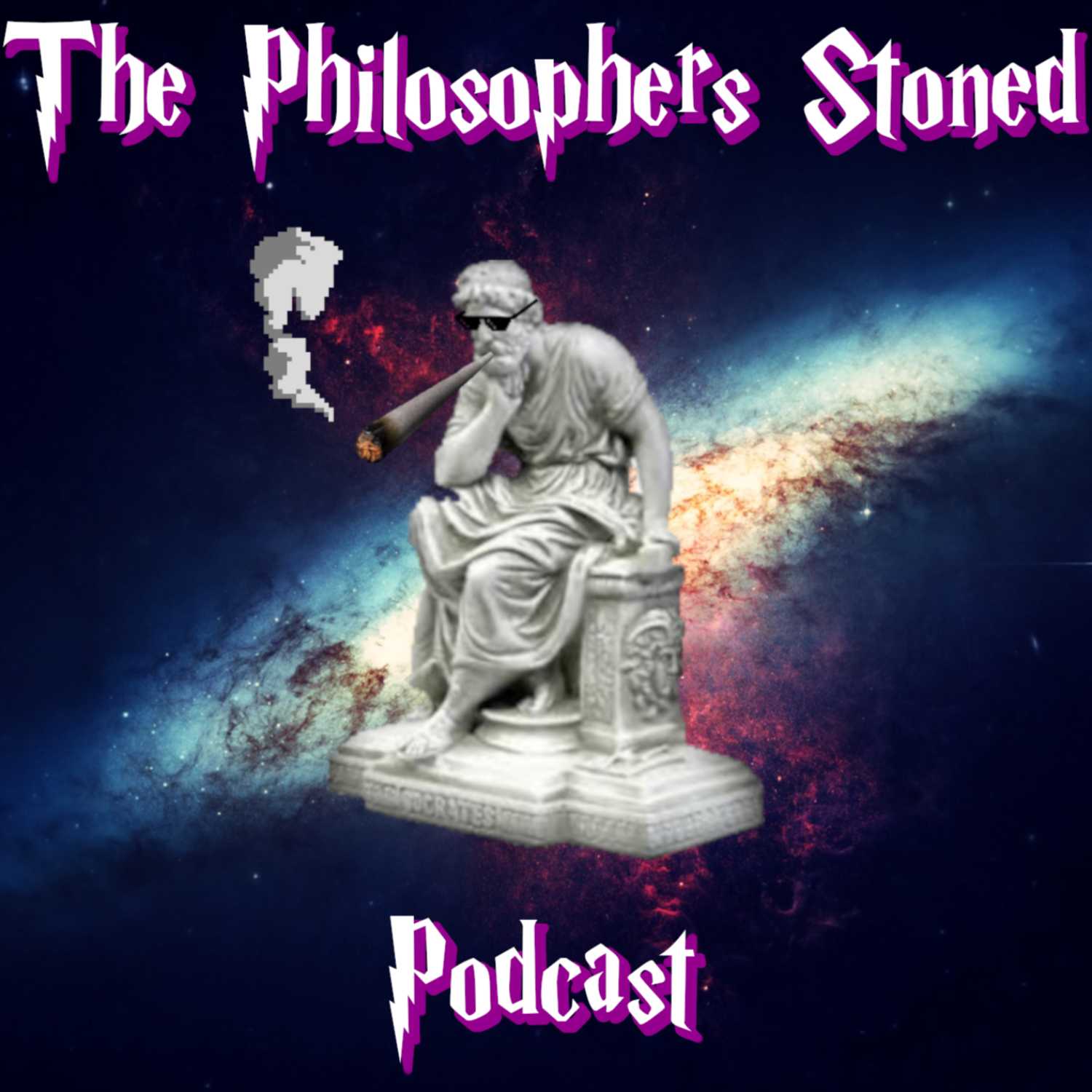
A comedy podcast about philosophy with Sam Labun (B.A. and M.A. in philosophy) and comedian Jordan Strauss. Email us with questions or proposed topics at TPSpodcast420@gmail.com.
Where to listen?
Podcasts in the app Replaio Radio Coming soonPodcasts are coming to the app soon. Install now and be the first to see a whole new take on podcasts
 Install for free
Android 5M+ downloads · 4.8 rating
iOS soon
Install for free
Android 5M+ downloads · 4.8 rating
iOS soon
Episodes
Sorry not sorry 25.01.2023 58:22
In this episode, Sam and Jordan discuss the Trial of Socrates. Circa 399 BCE, Socrates was put on trial for atheism and corrupting the youth of Athens. Socrates delivered one of the greatest non-apologies of all time, and was promptly sentenced to death.
EP 1: The Return 19.01.2023 54:34
We're back! In the long awaited return of the philosopher-kings, Sam and Jordan recount what happened in their long abscence, and share their predictions for 2023. Tune in next week for Part One of the Trial of Socrates.
Philosophy of War 09.03.2022 59:01
In this episode, we discuss the philosophy of war. Is war ever justified, and if so, under what conditions?
War and Beauty 04.03.2022 1:01:00
In this episode, we take some time to discuss Russia's invasion of Ukraine. Then, we look at Beauty, a controversial subject in philosophy. Is Beauty subjective or objective? Is "Edge of Tommorow" a better film than "Crouching Tiger Hidden Dragon?" Find out! Email all queries/comments to TPSpod420@gmail.com.
A Discussion About Social Justice...Part 1? 23.02.2022 1:05:50
In this episode, we are joined by our second guest ever. He wishes to remain anonymous. We discuss the dilemma of social media and freedom of speech within the context of democracy and social justice. As always, please send your feedback to TPSpod420@gmail.com
Philosophy and Protests 16.02.2022 59:35
In this epsiode, we revisit the philosophy of protests and how it applies to the recent "Freedom Convoy" protests in Canada, as well as historical "occupation" style protests.
Episode 9: Imagination ft Joel Strauss 02.02.2022 1:01:02
In this episode we are joined by our first guest. Joel Strauss is a musician based out of Fredericton, New Brunswick (and happens to be Jordan's older brother). We discuss the recent Neil Young/Joe Rogan drama, the protest in Ottawa, and take a philosophical view of Imagination. source: https://plato.stanford.edu/entries/imagination/ , by Shen-yi Liao and Tamar Gendler
Mental Imagery 17.01.2022 58:10
In this episode, we discuss how modern fMRI technology has revealed startling facts about mental imagery. We discuss how the visual cortex activates in response to mental images, the differences between aphantastics and hyperphantastics, and how involuntary mental imagery plays a role in racial biases. Please send your emails to TPSpod420@gmail.com source: Source: Stanford Encyclopedia of Philosop...
The Apocalypse Draft 12.01.2022 58:40
Scenario: Earth is faced with a crisis: the planet will soon be destroyed, and the only survivors will be those who can board the Ark ships to journey to Alpha Centauri to settle a brave new world.. The Ark ships can hold 10 million people, but the Earth's population is 8 billion. Many will be left behind. Suppose you are in charge of choosing who gets a spot on the Ark ships. Who will you draft f...
The Molyneux Problem 24.12.2021 59:13
Suppose someone is born blind, and they are taught to distinguish a sphere and a cube by touch. Then, suppose this person's sight is restored, and they are shown a sphere and a cube. Could the person, using sight alone, distinguish the sphere from the cube? That is Molyneux's Problem.
Walden 2 17.12.2021 59:02
Utopia. Not Fruitopia. BF Skinner imagined a Utopian community called "Walden 2," where people are raised in carefully controlled environments. Walden 2's Planners and Managers would use "behavioural engineering" to eliminate human flaws like greed and violence, allowing human nature to flourish. We discuss his brilliant but flawed Utopian project.
The Imitation Game 09.12.2021 1:02:43
Can computers think or are they just unintelligent mechanisms that do whatever we tell them to? British mathematician Alan Turing, writing in the 1950s, proposed a game, or test, that he claimed would determine whether or not a computer could be considered intelligent. We discuss the Imitation Game and the many objections against it.
Game Theory 01.12.2021 58:35
In this episode, we discuss Game Theory. Game Theory is a mathematical way of studying how self-interested, rational agents make decisions. In philosophy, Game Theory has been used to solve an old problem: is it ever in our best interests to act immorally or unjustly?
"Dune" and Post-humanism 18.11.2021 57:05
In this episode, there will be spoilers for "Dune" (2021). Posthumanism is an intellectual movement that argues many of humanity's challenges can be overcome by changing our minds and bodies with technology. The 2021 film "Dune" explores the uncertainty of a posthuman future populated by individuals who are barely recognizeable as human.
Episode 1: Jordan Peterson 09.11.2021 57:17
In this episode, we discuss He Who Shall Not Be Named (Jordan Peterson). Dr. Jordan Peterson is a professor of psychology and one of the most famous public intellectuals in the world. He is most famous for his opposition to Bill C-16, which made gender identity and expression protected grounds from discrimination. We discuss why the bill has failed to end Western Civilization.
Episode 52: Karl Marx 20.10.2021 1:00:35
This is the final episode of Season One of the Philosophers Stoned. Stay tuned for Season Two! In this episode, we discuss the beliefs of one of the most notorious thinkers in history, Karl Marx. In some ways similar to Hegel and Nietzsche, Marx believed that history was dialectical, or a struggle of opposing sides working towards an ultimate outcome. However, unlike Hegel and Nietzsche, Marx pred...
Episode 51: The Utilitarians 06.10.2021 56:28
In the fourth episode on the intellectual climate that preceded the two World Wars, we discuss Utilitarianism. Jeremy Bentham (1748-1832) is widely regarded as the founder of Utilitarianism as a social and philosophical program. Bentham was the defacto leader of a group of British intellectuals called the Philosophical Radicals. The Radicals believed that British society needed to be drastically r...
Episode 50: Friedrich Nietzsche 20.09.2021 56:47
In this episode, we discuss the philosophical and theological views of Friedrich Nietzsche. Nietzsche, today recognized as one of the most influential thinkers in history, never achieved fame while he was alive. His books, polemical attacks on Christianity and "slave morality," did not sell. Nietzsche suffered from chronic ill-health, and was an invalid most of his life. In 1889, he went insane an...
Episode 49: Jean Jacques Rousseau 10.09.2021 52:56
We continue our series on the philosophical and intellectual climate that preceded the two World Wars. In this episode, we discusss Jean Jacques Rousseau. Rousseau is known as the father of 18th century Romanticism. The Romantics sought to liberate human beings from the constraints of conventional morality. Rousseau believed that Science and the Arts had done more harm than good to humanity. He id...
Episode 48: Hegel 03.09.2021 53:11
In this episode, we begin our series on the philosophical climate that preceded the two World Wars. Today, we discuss the life and work of the German philosopher Georg Wilhelm Friedrich Hegel (1770-1831). Hegel argued that human history progresses according to a process called The Dialectic. At each stage in The Dialectic, one nation is responsible for pushing the world into the next stage of hist...
Causation Part 3: The Kant Awakens 26.08.2021 50:06
Immanuel Kant is notorious for being almost impossible to understand, which is the hallmark of a truly great philosopher. Send your comments to TPSpodcast420@gmail.com.
Causation Part 2: The Hume Strikes Back 18.08.2021 51:06
Isaac Newton's revolutionary theory of physics upended Aristotle's purpose-driven view of causation, and offered a new hope that we could finally obtain genuine scientific knowledge of the universe. But in a cruel twist of fate, a mysterious intellectual named David Hume emerged from the darkness of Scotland and struck at the heart of Newton's rebellion. Hume's arguments seemed to prove that human...
Causation Part One: The Phantom Aristotle 09.08.2021 52:13
This is the first episode in a three-part series on the philosophy of causation. In this episode, we discuss Aristotle's views on causation. Aristotle was one of the most influential philosophers of all time, and even served as Royal Tutor to the young Alexander the Great. Aristotle understood causation as a question about why things change. Why does a block of iron become a knife? Why do lions al...
Episode 44: Arguments 02.08.2021 57:47
In the parlance of our times, an argument means a disagreement, and disagreements are often nothing more than people contradicting each other over and over again, and rarely lead to truth. But in philosophy, an argument means a series of premises that justify a conclusion. For example, Aristotle, who lived over 2000 years ago, invented a deductively valid argument known as a syllogism, which we st...
Episode 43: George Berkeley 27.07.2021 55:55
If a tree falls in a forest, and no one is around to hear it, does it make a sound? George Berkeley would say that if a tree falls in a forest, and no one perceives the tree, then the tree didn't even exist in the first place. Berkeley is often known as the father of Idealism. Berkeley believed that there is no such thing as physical matter. All that exists, according to Berkely, are ideas. In thi...
Similar podcasts







Listen to the The Philosophers Stoned podcast in Replaio
Radio and podcasts in one app - free, with no sign-up. Install today and do not miss the launch
Replaio is not a podcast publisher; show names, artwork and audio belong to their authors and are distributed through public RSS feeds.