Maria
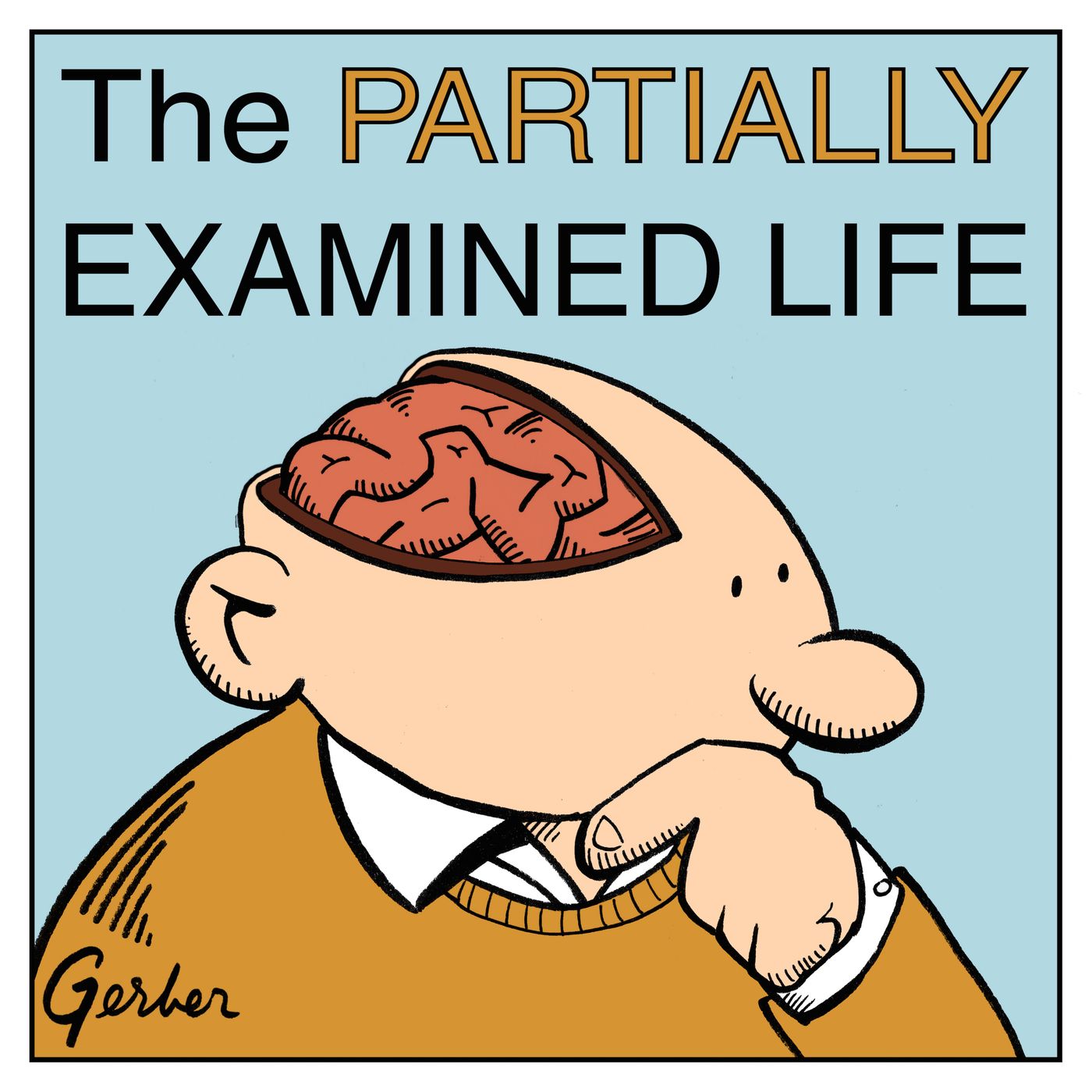
The Partially Examined Life Philosophy Podcast
The Partially Examined Life is a podcast by some guys who were at one point set on doing philosophy for a living but then thought better of it. Each episode, we pick a short text and chat about it with some balance between insight and flippancy. You don't have to know any philosophy, or even to have read the text we're talking about to (mostly) follow and (hopefully) enjoy the discussion. For links to the texts we discuss and other info, check out www.partiallyexaminedlife.com. We also feature episodes from other podcasts by our hosts to round out your partially examined life, including Pretty...
Where to listen?
Podcasts in the app Replaio Radio Coming soonPodcasts are coming to the app soon. Install now and be the first to see a whole new take on podcasts
 Install for free
Android 5M+ downloads · 4.8 rating
iOS soon
Install for free
Android 5M+ downloads · 4.8 rating
iOS soon
Episodes
PREMIUM-PEL Ep 79: Heraclitus on Understanding the World 15.07.2013 30:59
Eva Brann discusses her book The Logos of Heraclitus (2011). What is the world like, and how can we understand it? Heraclitus thinks that the answer to both questions is found in "the logos." Looking for the full Citizen version?
PREMIUM-Episode 78: Ayn Rand on Living Rationally 01.07.2013 31:41
On Rand's Introduction to Objectivist Epistemology (1967) and "The Objectivist Ethics" (1961). First Rand grounds everyday human knowledge, largely by dismissing the concerns of other philosophers (even those whom she unknowingly parrots) as absurd. Then she uses this certainty to argue for her semi-Nietzschean vision of Great Men who master their emotions and rely only on themselves. Looking for...
PREMIUM-Episode 77: Santayana on the Appreciation of Beauty 09.06.2013 30:55
On George Santayana's The Sense of Beauty (1896). What are we saying when we call something "beautiful?" Are we pointing out an objective quality that other people (anyone?) can ferret out, or just essentially saying "yay!" without any logic necessarily behind our exclamation? The poet and philosopher Santayana thought that while aesthetic appreciation is an immediate experience--we don't "infer"...
PREMIUM-Episode 76: Deleuze on What Philosophy Is 14.05.2013 32:55
On Gilles Deleuze and Félix Guattari's What Is Philosophy? (1991). How is philosophy different from science and art? What's the relationship between different philosophies? Is better pursued solo, or in a group? Deleuze described philosophy as the creation of new concepts, whereas science is about functions that map observed regularities and art is about creating percepts and affects. With guest D...
PREMIUM-Episode 75: Lacan & Derrida Criticize Poe's "The Purloined Letter" 19.04.2013 33:17
On Jacques Lacan's "Seminar on 'The Purloined Letter'" (1956), Jacques Derrida's "The Purveyor of Truth" (1975), and other essays in the collection The Purloined Poe: Lacan, Derrida, and Psychoanalytic Reading. How should philosophers approach literature? Lacan read Edgar Allen Poe's story about a sleuth who outthinks a devious Minister as an illustration of his model of the psyche, and why we per...
PREMIUM-Episode 74: Jacques Lacan's Psychology 04.04.2013 29:31
On Bruce Fink's The Lacanian Subject (1996) and Lacan's "The Mirror Stage as Formative of the Function of the I as Revealed in Psychoanalytic Experience" (1949). What is the self? Is that the same as the experiencing subject? Lacan says no: while the self (the ego) is an imaginative creation, cemented by language, the subject is something else, something split (at least initially) between consciou...
PREMIUM-Episode 73: Why Do Philosophy? (And What Is It?) 23.03.2013 32:05
Mark, Seth, Wes, and Dylan share what drove them into philosophy and keeps them there. How is philosophy different than (or similar to) science? Than religion? Art? The consensus seems that philosophy, to us, is inevitable for the curious. It's just inquiry, unbounded (in principle at least) by any fixed assumptions. We did no formal reading for this discussion, but did tell each other to keep in...
PREMIUM-Episode 72: Terrorism with Jonathan R. White 09.03.2013 32:38
We're joined by an international terrorism expert to discuss how to define terrorism and whether it can ever be ethical. With readings by Donald Black, J. Angelo Corlett, Igor Primoratz, Karl Heinzen, Bhagat Singh, and Carl von Clausewitz. Looking for the full Citizen version?
PREMIUM-Episode 71: Martin Buber's "I and Thou" 15.02.2013 33:06
On Buber's 1923 book about the fundamental human position: As children, and historically, we start fully absorbed in relation with another person (like mom). Before that, we have no self-consciousness, no "self" at all. It's only by having these consuming "encounters" that we gradually distinguish ourselves from other people, and can then engage in what we'd normally consider "experience," which B...
PREMIUM-Episode 70: Marx on the Human Condition 30.01.2013 31:49
On Karl Marx's The German Ideology, Part I, an early, unpublished work from 1846. What is human nature? What drives history? How can we improve our situation? Marx thought that fundamentally, you are what you do: you are your job, your means of subsistence. All the rest, this culture, this religion, this philosophy, is just a thin layer over our basic situation. Ideas are not primarily what change...
Partially Examined Life Not School Digest Jan 2013 23.01.2013 51:00
Excerpts of discussions about Deleuze & Guattari's A Thousand Plateaus, an article on emergence called "More Is Different" by Nobel Prize Winning physicist P.W. Anderson, John Searle's Mind: A Brief Introduction, and Italo Calvino's trippy science fantasy novel Cosmicomics.
PREMIUM-Episode 69: Plato on Rhetoric vs. Philosophy 13.01.2013 32:58
On Plato's Dialogue, "Gorgias" (380 BCE or so). Why philosophize? Isn't it better to know how to persuade people in practical matters, like a successful lawyer or business leader? Plato (via Socrates) thinks that the "art" of rhetoric isn't an art at all, in the sense of requiring an understanding of one's subject matter, but merely a talent for saying what people want to hear. Looking for the ful...
Not Episode 69: PEL Players Full Cast Audiobook of Plato's "Gorgias" (part 1) 12.01.2013 1:24:40
Three podcasters and two listeners join to read Plato's fabulous dialogue.
PREMIUM-Episode 68: David Chalmers Interview on the Scrutability of the World 22.12.2012 31:12
On David Chalmers's book Constructing the World (2012). How are all the various truths about the world related to each other? David Chalmers, famous for advocating a scientifically respectable form of brain-consciousness dualism, advocates a framework of scrutability: if one knew some set of base truths, then the rest would be knowable from them. Get the full discussion at partiallyexaminedlife.co...
Not School Digest Nov-Dec 2012: A Bonus Quasisode 16.12.2012 31:30
Excerpts of discussions about David Chalmers's The Conscious Mind: In Search of a Fundamental Theory, Thomas Nagel's Mind and Cosmos, and Paul Auster's City of Glass.
PREMIUM-Episode 67: Carnap on Logic and Science 07.12.2012 33:01
On Rudolph Carnap's The Logical Structure of the World (1928). What can we know? Carnap thinks that all the various spheres of knowledge are logically interrelated, that you can translate sentences about any of these into sentences about sets of basic, momentary experiences. This book, aka the Aufbau, is his attempt to sketch out how this system of linguistic reduction can work (it doesn't). With...
PREMIUM-Episode 66: Quine on Linguistic Meaning and Science 21.11.2012 31:07
On W.V.O. Quine's "On What There Is" (1948) and "Two Dogmas of Empiricism" (1951). What kind of metaphysics is compatible with science? Quine sees science and philosophy as one and the same enterprise, and he objects to ontologies that include types of entities that science can't, even in principle, study. Also, troubles with the concept of synonymy, i.e. "same meaning." With guest Matt Teichman....
Celebrating Two Million Downloads: A Highlights Minisode 08.11.2012 7:56
Our highlight reel in thanks to all you listeners who have brought us to the milestone of approximately two million downloads.
PREMIUM-Episode 65: The Federalist Papers 27.10.2012 32:37
On Alexander Hamilton/James Madison's Federalist Papers (1, 10-12, 14-17, 39, 47-51), published as newspaper editorials 1787-8, plus Letters III and IV from Brutus, an Anti-Federalist. What constitutes good government? These founding fathers argued that the proposed Constitution, with its newly centralized (yet also separated-by-branch) powers would be a significant improvement on the Articles of...
PREMIUM-Episode 64: Celebrity, with guest Lucy Lawless 07.10.2012 35:49
On Fame: What the Classics Tell Us About Our Cult of Celebrity by Tom Payne (2010). What's the deal with our f'ed up relationship with celebrities? Payne says that celebrities serve a social need that's equal parts religion and and aggression. TV's Lucy Lawless (Xena, Spartacus, Battlestar Galactica) joins us to discuss the accuracy of this thesis. Looking for the full Citizen version?
PREMIUM-Episode 63: Existentialist Heroes in Cormac McCarthy's "No Country for Old Men" 21.09.2012 32:16
On philosophical issues in McCarthy's 2005 novel about guys running around with drug money and shooting each other, and about fiction as a form for exploring philosophical ideas. What can morality mean for people who have witnessed the "death of God," i.e. a loss in faith in light of the horrors of war? Who knows what McCarthy himself thinks? With guest Eric Petrie. Get the full discussion at part...
PREMIUM-Episode 62: Voltaire's Novel "Candide" 05.09.2012 36:29
On Candide: or, Optimism, the novel by Voltaire (1759). Is life good? Popular Enlightenment philosopher Leibniz argued that it's good by definition. God is perfectly good and all-powerful, so whatever he created must have been as good as it can be; we live in the best of all possible worlds. Voltaire loads this satirical adventure story up with horrific violence to demonstrate that Leibniz's posit...
PREMIUM-Episode 61: Nietzsche on Truth and Skepticism 15.08.2012 31:48
On Friedrich Nietzsche's "On Truth and Lies in a Nonmoral Sense" (1873). What is truth? This essay, written early in Nietzsche's career, is taken by many to make the extreme claim that there is no truth, that all of the "truths" we tell each other are just agreements by social convention. WIth guest Jessica Berry, who argues that that Nietzsche is a skeptic: our "truths" don't correspond with the...
PREMIUM-Episode 60: Aristotle: What's the Best Form of Government? 23.07.2012 33:12
On Aristotle's Politics (350 BCE), books 1 (ch 1-2), 3, 4 (ch 1-3), 5 (ch 1-2), 6 (ch 1-6), and 7 (ch. 1-3, 13-15). Aristotle provides both a taxonomy of the types of government, based on observations of numerous constitutions of the states of his time, and prescriptions on how to best order a state. Get the full discussion at partiallyexaminedlife.com.
PREMIUM-Episode 59: Alasdair MacIntyre on Moral Justifications 05.07.2012 31:29
On Alasdair MacIntyre's After Virtue: A Study in Moral Theory (1981), mostly ch. 3-7 and 14-17. What justifies ethical claims? MacIntyre claims that no modern attempt to ground ethics has worked, and that's because we've abandoned Aristotle. We see facts and values as fundamentally different: the things science discovers vs. these weird things that have nothing to do with science. In Aristotle's t...
Similar podcasts




Listen to the The Partially Examined Life Philosophy Podcast podcast in Replaio
Radio and podcasts in one app - free, with no sign-up. Install today and do not miss the launch
Replaio is not a podcast publisher; show names, artwork and audio belong to their authors and are distributed through public RSS feeds.