Maria
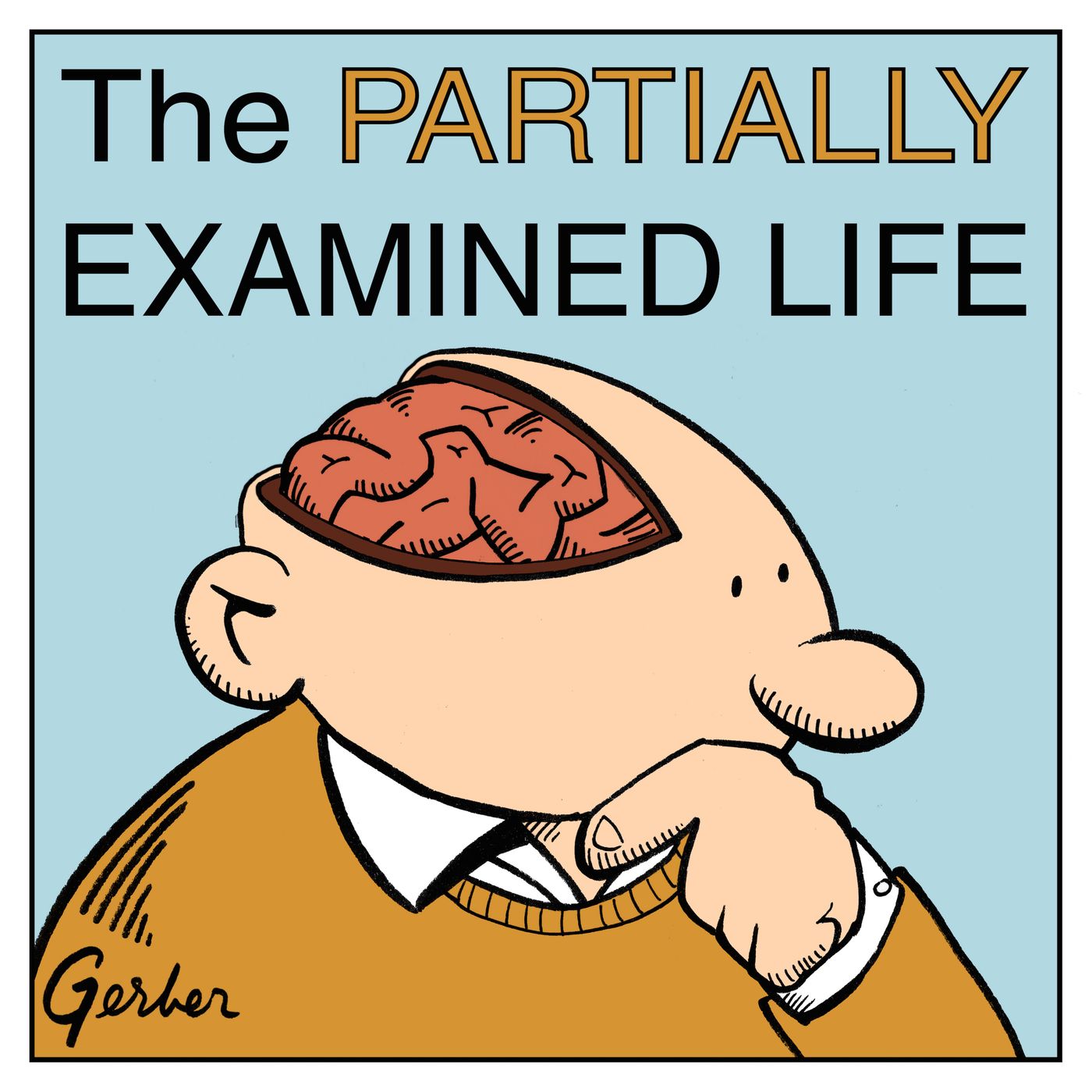
The Partially Examined Life Philosophy Podcast
The Partially Examined Life is a podcast by some guys who were at one point set on doing philosophy for a living but then thought better of it. Each episode, we pick a short text and chat about it with some balance between insight and flippancy. You don't have to know any philosophy, or even to have read the text we're talking about to (mostly) follow and (hopefully) enjoy the discussion. For links to the texts we discuss and other info, check out www.partiallyexaminedlife.com. We also feature episodes from other podcasts by our hosts to round out your partially examined life, including Pretty...
Where to listen?
Podcasts in the app Replaio Radio Coming soonPodcasts are coming to the app soon. Install now and be the first to see a whole new take on podcasts
 Install for free
Android 5M+ downloads · 4.8 rating
iOS soon
Install for free
Android 5M+ downloads · 4.8 rating
iOS soon
Episodes
Episode 161: White Privilege (Peggy McIntosh, Charles Mills, et al) (Part One) 27.03.2017 51:49
Is the rhetoric of "White Privilege" just the modern way of acknowledging historical and systemic truths of racism, or does it point to a novel way for acknowledging injustice, or does it on the contrary obscure these insights by involving confused claims about group responsibility and guilt? Readings include articles by Peggy McIntosh, Charles W. Mills, George Yancy, Tim Wise, Lewis R. Gordon, La...
Episode 160: Orwell on Totalitarianism and Language (Part Two) 20.03.2017 1:12:55
Continuing with 1984. How does the book relate to real-world politics? Is this something that we should actually be afraid our society will turn into? Was he predicting history, or was it satire, or what? We discuss the the realms of intimacy vs. surveillance, how a state might "contain" a mind that it controls, and "doublethink." Listen to part 1 first, or get the ad-free Citizen Edition . End...
Episode 160: Orwell on Totalitarianism and Language (Part One) 13.03.2017 51:37
On the novel 1984 (1949) and the essays "Politics and the English Language" (1946) and "Notes on Nationalism" (1945). What's the relation between language and totalitarianism? Orwell shows us a society where the rulers have mastered the art of retaining power, and one element of this involves "Newspeak," where vocabulary is limited to prevent subversive speech, and ultimately thoughts. Do our ling...
Episode 159: Confucius on Virtuous Conduct (Part Two) 06.03.2017 1:16:50
Continuing on the Analects without our guest. We cover passages on glibness, using names properly, filial conduct, remonstrance, love of learning, places where he sounds like Socrates, and more! Listen to part 1 first or just get the full, ad-free Citizen Edition . End song: "Please Allow Me to Look at You Again," from The Edge of Heaven (2013) by Gary Lucas, as interviewed on Nakedly Examined...
Episode 159: Confucius on Virtuous Conduct (Part One) 27.02.2017 53:05
On the Analects, compiled after 479 BCE. How should we act? What's the relation between ethics and politics? Can a bunch of aphorisms written in the distant past for an unapologetically hierarchical culture emphasizing traditional rituals actually give us relevant, welcome advice on these matters? Are we even in a position to determine the meaning of these sayings? With guest Tzuchien Tho. Please...
Episode 158: Boethius: The Consolation of Philosophy (Part Two) 20.02.2017 1:11:16
Continuing on the Consolation, chiefly books 3 and 4, on virtue ethics (we all naturally aim at the good but can be mistaken about it or too weak to follow it), theodicy (even the apparent bad is actually good from God's perspective), and the weird way in which those interact (fame, pleasure, wealth are really all the same thing, i.e., happiness, i.e., God). Listen to part 1 first, or get the un...
Episode 158: Boethius: The Consolation of Philosophy (Part One) 13.02.2017 56:09
On the Consolation, written as he awaited execution in 524 CE. Do bad things really happen to good people? Boethius, surprisingly, says no, for Stoic (anything that can be taken away can't be of central importance; you can't lose your virtue in this way), Aristotelian (all things tend toward the good, and the best thing for a person is achieving his or her innate potential, which is to be virtuous...
Episode 157: Richard Rorty on Politics for the Left (Part Two) 06.02.2017 1:04:24
Continuing on Achieving Our Country: Leftist Thought in 20th Century America (1998). We talk more about Rorty's description of the conflict between the "reformist left" and the "cultural left." Do political-comedy shows serve a a positive political purpose? Can an enlightened political viewpoint really be a mass movement at all? Is it better to pursue specific political campaigns or be part of a "...
Episode 157: Richard Rorty on Politics for the Left (Part One) 30.01.2017 55:21
On Achieving Our Country: Leftist Thought in 20th Century America (1998). What makes for efficacious progressivism? Rorty argues that reformism went out of fashion in the '60s in favor of a "cultural left" that merely critiques and spectates, leaving a void that a right-wing demagogue could exploit to sweep in, claiming to be a champion of regular working people. Sound familiar? Please support PEL...
Episode 156: Philosophy and Politics Free-Form Discussion (Part Two) 23.01.2017 1:02:29
Continuing our liberal bubble-bursting exercise, the core foursome address more directly the question of how philosophy is supposed to shape one's political views and actions. On a non-partisan "public good" and rhetorical strategies in the face of an apathetic and/or ignorant public. Listen to part 1 first or get the ad-free, unbroken Citizen Edition . Please support PEL! End song: "Better Da...
Episode 156: Philosophy and Politics Free-Form Discussion (Part One) 16.01.2017 52:24
How does studying philosophy help you to make sense of the political landscape? Wes, Mark, Dylan, and Seth play pundit and reflect on political rhetoric, elitism, and much more. There is no text for this episode! Freedom! Please support PEL!
Episode 155: Richard Rorty Against Epistemology 02.01.2017 1:54:01
On Philosophy and the Mirror of Nature (1979), Part II: "Mirroring." Is a "theory of knowledge" possible? Rorty thinks that any such account will be a fruitless search for foundations. Knowledge is really just a matter of social agreement, and beliefs must be justified from other beliefs, not from any alleged relationship to reality. End song: "The Ghosts Are Alright" from The Bye-Bye Blackbirds (...
Episode 154: Wilfrid Sellars on the Myth of the Given 19.12.2016 1:43:43
On "Empiricism and the Philosophy of Mind" (1956). Is knowledge based on a "foundation," as Descartes, Locke, et al. thought? Sellars says no: The allegedly basic elements upon which knowledge would be built either have to be propositions, in which case they involve a lot of prior knowledge involved in language use and so aren't really basic, or they're "raw feels," in which case they can't actual...
Episode 153: Richard Rorty: There Is No Mind-Body Problem 05.12.2016 1:53:33
On Philosophy and the Mirror of Nature (1979), Part I: "Our Glassy Essence." "The mind" seems to be an unavoidable part of our basic conceptual vocabulary, but Rorty thinks not, and he wants to use the history of philosophy as a kind of therapy to show that many of our seemingly insoluble problems like the relation between mind and body are a result philosophical mistakes by Descartes, Locke, and...
Episode 152: Alexis de Tocqueville on Democracy in America (PEL Live!) 21.11.2016 1:28:20
Democracy is in peril! So said Tocqueville in 1835 and 1840 when Democracy is America was published, and it's still true now. Democracy is always just one demagogue away from stripping us of our liberties, though certain structural and cultural features can make that more or less likely. He liked our volunteerism and innovation, but not so much our tendencies toward materialism and isolation and o...
Episode 151: Edmund Burke's Conservatism 07.11.2016 1:57:01
On Reflections on the Revolution in France (1790). What relevance do the concerns of a monarchy-defending aristocrat have for us today? Surprisingly, a lot! The full foursome discuss possible conflicts between freedom, rights, and well-being. What is political freedom without public wisdom? The tyranny of the mob! End song: "Hard Times of Old England" from Peter Knight's Gigspanner (from Layers of...
PEL Special: Bill Bruford on Nakedly Examined Music #25 06.11.2016 1:20:17
NEM now features jazz, hip-hop, classical, folk, and more. Check out all the episodes at nakedlyexaminedmusic.com , where you can subscribe and follow on Facebook . Bill was the original drummer for Yes, a default member of King Crimson, and briefly played with Genesis and the late '70s supergroup U.K., but most of his output has been with his own jazz-inflected Earthworks and Bruford, as rock pro...
Episode 150: Guest Peter Singer on Famine, Affluence, and Morality 24.10.2016 2:07:49
Mark and Wes interview perhaps the world's most influential living philosopher, then the full foursome discusses. We discuss his ongoing work rooted in his 1971 essay "Famine, Affluence, and Morality," about the warped priorities of our consumerist society: We spend money on luxuries while innocent children overseas die from inexpensively preventable causes. For more about Peter, see www.petersing...
Episode 149: Plato's "Crito": A Performance and Discussion 17.10.2016 1:21:21
Broadway stars Walter Bobbie and Bill Youmans perform Plato's dialogue in which Socrates awaits his execution. Should Socrates defy the verdict and try to escape the city? Socrates says no; that would be ungrateful to the city whose benefits he's enjoyed. Bill joins the full PEL foursome for a lively discussion. End song: "Fall Away" by Mark Lint and the Fake from the album So Whaddaya Think? (200...
Episode 148: Aristotle on Friendship and Happiness 03.10.2016 2:02:19
On the final books 8–10 of Aristotle's Nichomachean Ethics. What does friendship have to do with ethics? With guest Ana Sandoiu. Get this and every episode ad-free by becoming a PEL supporter at partiallyexaminedlife.com/support .
Episode 147: Aristotle on Wisdom and Incontinence 19.09.2016 2:00:49
On the Nichomachean Ethics (ca. 350 BCE), books 6–7. Is intelligence just one thing? Aristotle picks out a number of distinct faculties, some of which are relevant to ethics, and he uses these to explain Plato's puzzle of how someone can clearly see what the good for him is, and yet fail to pursue it due to weakness of the will. This episode continues our discussion from way back in ep. 5 . End so...
Episode 146: Emmanuel Levinas on Overcoming Solitude 05.09.2016 2:20:32
More Levinas, working this time through Time and the Other (1948). What is it for a person to exist? What individuates one person from another, making us into selves instead of just part of the causal net of events? Why would someone possibly think that these are real, non-obvious questions that need to be addressed? End song: "Call on You" by Mark Lint from from the 1993 Mark Lint album Spanish A...
Episode 145: Emmanuel Levinas: Why Be Ethical? 22.08.2016 2:03:37
On "Ethics as First Philosophy" (1984). More existentialist ethics, with a Jewish twist this time! Seth returns to join Mark and Wes in figuring out how to best leave off all this aggressive "knowing" and other forms of individual self-assertion to grasp the more primordial appearance of the Other in all his or her vulnerability, which Levinas thinks makes us wholly responsible for others right of...
Episode 144: Guest Martha Nussbaum on Anger 01.08.2016 2:25:26
On Anger and Forgiveness: Resentment, Generosity, Justice (2016). What role should we allow anger to play in our public life? Should systems of punishment be utilitarian, or should they be retributive? Nussbaum thinks that anger necessarily involves the desire for payback, which is unhelpful. We should instead use anger to prevent future harm. Mark, Wes, and Dylan interview Martha and then discuss...
Phi Fic #3 Frankenstein (PEL Crossover Special) 25.07.2016 1:58:08
Guest Wes Alwan joins regulars Nathan Hanks, Mary Claire, Daniel St. Pierre, Laura Davis, and Cezary Baraniecki to discuss Mary Shelley's classic novel in this special cross-post from the newest member of the Partially Examined Life podcast network. More Phi Fic .
Similar podcasts




Listen to the The Partially Examined Life Philosophy Podcast podcast in Replaio
Radio and podcasts in one app - free, with no sign-up. Install today and do not miss the launch
Replaio is not a podcast publisher; show names, artwork and audio belong to their authors and are distributed through public RSS feeds.