Maria
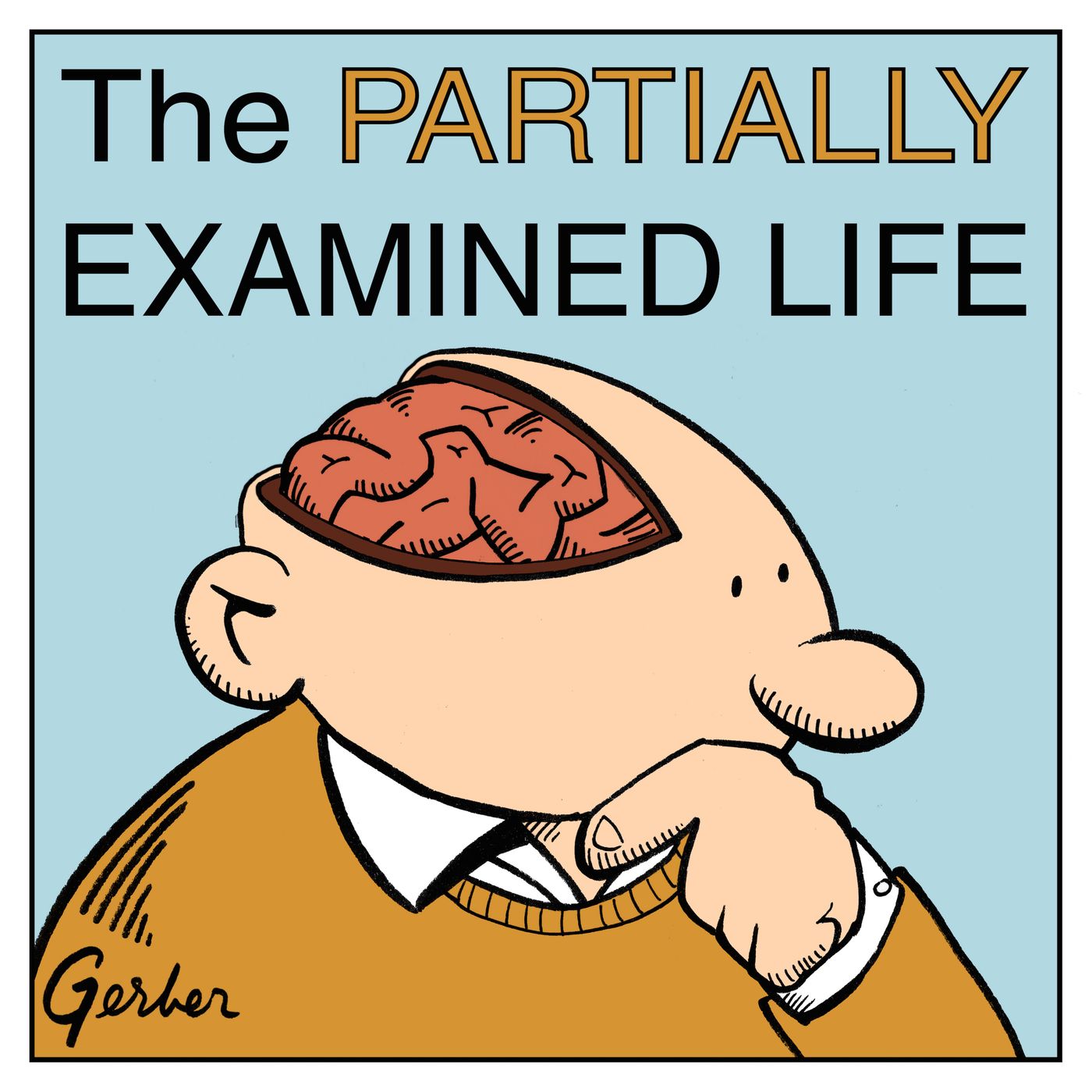
The Partially Examined Life Philosophy Podcast
The Partially Examined Life is a podcast by some guys who were at one point set on doing philosophy for a living but then thought better of it. Each episode, we pick a short text and chat about it with some balance between insight and flippancy. You don't have to know any philosophy, or even to have read the text we're talking about to (mostly) follow and (hopefully) enjoy the discussion. For links to the texts we discuss and other info, check out www.partiallyexaminedlife.com. We also feature episodes from other podcasts by our hosts to round out your partially examined life, including Pretty...
Where to listen?
Podcasts in the app Replaio Radio Coming soonPodcasts are coming to the app soon. Install now and be the first to see a whole new take on podcasts
 Install for free
Android 5M+ downloads · 4.8 rating
iOS soon
Install for free
Android 5M+ downloads · 4.8 rating
iOS soon
Episodes
Ep. 225: Simone Weil on War and Oppression (Part One) 09.09.2019 48:06
On Simone Weil's essays "The Iliad, or the Poem of Force" (1939) and "Analysis of Oppression" (1934). How do circumstances oppress and dehumanize us? Weil describes the mechanisms that keep people at war and maintain oppression even through revolutions as inherent to the logic of power. With guest Corey Mohler . Please support PEL!
Ep. 224: Kierkegaard Critiques The Present Age (Part Two) 02.09.2019 1:05:36
Continuing on "The Present Age" (1846), plus Hubert Dreyfus's "Nihilism on the Information Highway: Anonymity vs. Commitment in the Present Age" (2004) with guest John Ganz . Does K's critique actually apply to our present age? We address K's view of humor, romance, authenticity, actual community vs. "the public," the leveling that occurs without anyone specific actually doing it, and the virtue o...
PEL Presents PMP#8: Spider-Man: Far From Home (and Elsewhere) 27.08.2019 50:14
Mark, Erica, and Brian discuss the function of super-hero films and how this new one fits in. Do we need "realism" in such stories? When does a premise like this get too old to keep recycling? For more, visit prettymuchpop.com . Hear bonus content for this episode, and more episodes in advance, at patreon.com/prettymuchpop . This podcast is part of the Partially Examined Life podcast network and...
Ep. 224: Kierkegaard Critiques The Present Age (Part One) 26.08.2019 48:38
On Soren Kierkegaard's essay "The Present Age" (1846) and Hubert Dreyfus's "Nihilism on the Information Highway: Anonymity vs. Commitment in the Present Age" (2004). What's wrong with our society? Kierkegaard saw the advent of the press and gossip culture as engendering a systematic passivity and shallowness in his fellows, and Dreyfus thinks this is an even more apt description of the Internet Ag...
Ep. 223: Guest Ned Block on Consciousness (Part Two) 19.08.2019 55:52
We talk with Ned about a second Blockheads (2019) article, Michael Tyle's "Homunculi Heads and Silicon Chips: The Importance of History to Phenomenology," which provides a variation off of the David Chalmers fading qualia argument, and then Mark, Seth, Dylan, and Wes continue exploring the details uncovered by our interview after Ned leaves. Please support PEL! End song: "Your So Dark Sleep/Goodby...
Ep. 223: Guest Ned Block on Consciousness (Part One) 12.08.2019 51:29
The climax and denouement of our summer philosophy of mind series: Ned Block visits to fill in the gaps about functionalism and attributing consciousness to machines and discuss essays from Blockheads (2019), focusing here on Brian McLaughlin's "Could an Android be Sentient?" Please support PEL!
Ep. 222: Debating Functionalism (Block, Chalmers) (Part Two) 05.08.2019 53:02
Continuing on Ned Block's "Troubles with Functionalism" (1978) and David Chalmers's "Absent Qualia, Fading Qualia, Dancing Qualia" (1995). What would it be like to be halfway between person and machine? If you think the machine can't have consciousness, then Chalmers thinks that there's no sensible way to describe such an experience, ergo the machine (if functionally equivalent to the person) must...
Ep. 222: Debating Functionalism (Block, Chalmers) (Part One) 29.07.2019 49:55
On Ned Block's "Troubles with Functionalism" (1978) and David Chalmers's "Absent Qualia, Fading Qualia, Dancing Qualia" (1995). If mental states are functional states, there couldn't be zombies. Yet Block claims that there could be zombies: for example, a functional duplicate of you whose components are actually citizens of China obeying algorithmic rules. Even if the resulting system acts like yo...
PEL Presents PMP#3: CONFORM w/ Yakov Smirnoff 23.07.2019 1:14:46
Is media trying to brainwash us into being ALL THE SAME? Are the excesses of the mob scaring us into conformity? Mark, Erica, and Brian muse on cultural homogenization and are joined by comedian Dr. Yakov Smirnoff to talk about growing up in a repressive society and the shadow of political correctness over comedy. For more about this podcast, see prettymuchpop.com . Hear bonus content for this ep...
Ep. 221: Functionalist Theories of Mind (Putnam, Armstrong) (Part Two) 22.07.2019 1:10:52
Continuing on functionalism with David M. Armstrong's "The Causal Theory of the Mind" (1981). Your four hosts start afresh the day after Part One on Putnam to discuss this version of functionalism that is supposed to clear the way for the scientific identification of mental states with brain states. Mental states are defined by their causal relations with other states and with behavior, and the co...
Ep. 221: Functionalist Theories of Mind (Putnam, Armstrong) (Part One) 15.07.2019 50:46
On Hilary Putnam's "The Nature of Mental States" (1973). What is the mind? Functionalist theories identify the mental with not with the brain exactly, but with something the brain does. So some other creature without a brain (maybe a computer) might be able to do that same thing if it could duplicate the structure of what our brains do. Is this a satisfying account of the mind? Please support PEL!
PEL Presents PMP#1: Pop Culture vs. High Culture 09.07.2019 44:32
What is pop culture? Does it make sense to distinguish it from high culture, or can something be both? Welcome to this new pop culture podcast hosted by Mark Linsenmayer, Erica Spyres, and Brian Hirt. This episode also features Tyler Hislop, our editor. For more, see prettymuchpop.com . Get involved from the start at patreon.com/prettymuchpop . We'll solicit your input for our episodes, release th...
Ep. 220: 10-Year Retrospective of The Partially Examined Life 05.07.2019 1:03:03
Mark, Seth, Dylan, and Wes reflect on the changing state of podcasting and public philosophy over the last decade, how our goals and interests have changed since we started we started. Why don't colleges pay their faculty to educate the public through regular, broadcasted conversations like ours? If you think we're snarky, take a look at actual philosophy faculty! Should we continue to do more lit...
Ep. 219: The Harder Problem of Consciousness (Block & Papineau) 01.07.2019 1:23:53
On Ned Block's "The Harder Problem of Consciousness" (2002) and David Papineau's "Could There Be a Science of Consciousness?" (2003). What would give us sufficient reason to believe that a non-human was conscious? Block thinks this is a harder problem that we might suspect. We can't know for sure exactly what consciousness in us is, so we can't know for sure what such a being might require (a brai...
Ep. 218: The Hard Problem of Consciousness (Chalmers et al) (Part Two) 24.06.2019 50:50
Continuing on "Consciousness and Its Place in Nature" by David Chalmers (2003). We finish Chalmers's account of the types of physicialism, then move on to dualism (including epiphenomenalism), and finally dally with panpsychism, the specialty of our guest, Gregory Miller from the Panpsycast . Listen to part 1 first or listen to the unbroken, ad-free Citizen Edition . Please support PEL! End song:...
Ep. 218: The Hard Problem of Consciousness (Chalmers et al) (Part One) 17.06.2019 56:24
On "Consciousness and Its Place in Nature" by David Chalmers (2003), with special guest Gregory Miller from the Panpsycast Philosophy Podcast . Can we explain human experience using the terms of brain physiology? Chalmers thinks not, and lays out the arguments against this and the range of positions philosophers have taken in response to these objections. Please support PEL!
(sub)Text #1: Shakespeare's "The Tempest": Poesis as Revenge Forsaken 08.06.2019 1:10:20
At last, the full, public release of this discussion between Wes Alwan and Bill Youmans covering Shakespeare's 1611 play about revenge, forgiveness, and authorship. Or maybe it's about exploitation, or how we react to changes in status, or perhaps how a liberal education can give you magical powers! Listen and decide for yourself!
Episode 217: Discussing Calderón's "Life Is a Dream" 03.06.2019 1:44:44
On the 1636 comedy by Pedro Calderón de la Barca, considering destiny (Christian vs. Ancient Greek), skepticism, meta-theater, and the ethic of honor. Listen to our performance first . With guests Bill Youmans and Erica Spyres. End song: "Pulling Apart" by Jonathan Segel . Hear him on Nakedly Examined Music #38 .
Glimpse: Machiavellian Politics (for Partially Examined Life #14) 02.06.2019 10:08
Does politics have to be Machiavellian? Do you have to be ruthless to succeed? Given our treatment of Game of Thrones and Life Is a Dream , and the way in which end-justifying-the-means logic plays endlessly in our real-life political situation, it's time we looked back on our episode 14 on Machiavelli . Mark Linsenmayer reviewed that episode and recorded a little essay about practicing Machiavell...
PEL Audioplayers: "Life Is a Dream" by Pedro Calderón de la Barca 27.05.2019 2:18:24
Your hosts are joined by real actors to do an unrehearsed read of Calderón's 1636 comedy La Vida Es Sueño, using Stanley Appelbaum's 2002 translation. Ep. 217 will cover the philosophical issues the play raises. Recorded in NYC on 4/7: Talene Monahon (Rosaura), David Epstein (Segismundo), Bill Youmans (Clotaldo), Erica Spyres (Estrella), Chris Martin (Basilio), Mark Linsenmayer (Clarín), Seth Pask...
PREMIUM-Ep 216 Game of Thrones' Fantasy Politics (Part Two) 23.05.2019 5:46
Get teased re. Mark and Wes's post-finale, spoiler-filled continuation of the discussion of the show. How does its conclusion affect its overall political message? Does it make sense to be performing feminist critiques on a show based on the premise of people murdering each other for power? To hear the full discussion, become a PEL Citizen or $5 Patreon supporter . For more about these options see...
Episode 216: Game of Thrones' Fantasy Politics 20.05.2019 1:23:21
Discussing the TV show (2011-2019) based on the books by George R.R. Martin. What's the role of a mass-consumed fantasy series in today's society? Is it our "fantasy" to have all these horrible things happen to us? Is this an edifying prompt to engage in public moral thinking, or a spectacular distraction of the kind that those Marxist theorists keep warning us about? We get into the function of f...
Episode 215: Brave New World: PEL Live 10th Anniversary Show 13.05.2019 1:37:28
On Aldous Huxley's 1932 dystopian novel, recorded at Manhattan's Caveat on 4/6/19, with audience participation. If we harness the power of society to employ available technologies to really focus on making people happy, what would the result be? This is Huxley's thought experiment, but is it in all respects a dystopia, and is it a fair test of the ideal of social improvement or merely of a flawed...
Episode 214: More Nietzsche's Zarathustra (Part Two) 06.05.2019 1:19:50
Concluding Friedrich Nietzsche's Thus Spoke Zarathustra (1885). What's the wise way to live? We start in earnest into part three, treating the "spirit of gravity" where socially-imposed values cover over your uniqueness, omni-satisfaction vs. being choosy, "Old and New Tablets" where Nietzsche explores various ethical and meta-ethical issues (e.g. is self-overcoming a matter of one-time self-actua...
Episode 214: More Nietzsche's Zarathustra (Part One) 29.04.2019 50:04
On the remainder of Friedrich Nietzsche's Thus Spoke Zarathustra (1885). How can we keep our spirits up and avoid nihilism? We consider Nietzsche's "solution" of eternal recurrence, why he uses a poetic, allegoric style, and more. Please support PEL!
Similar podcasts





Listen to the The Partially Examined Life Philosophy Podcast podcast in Replaio
Radio and podcasts in one app - free, with no sign-up. Install today and do not miss the launch
Replaio is not a podcast publisher; show names, artwork and audio belong to their authors and are distributed through public RSS feeds.