Maria
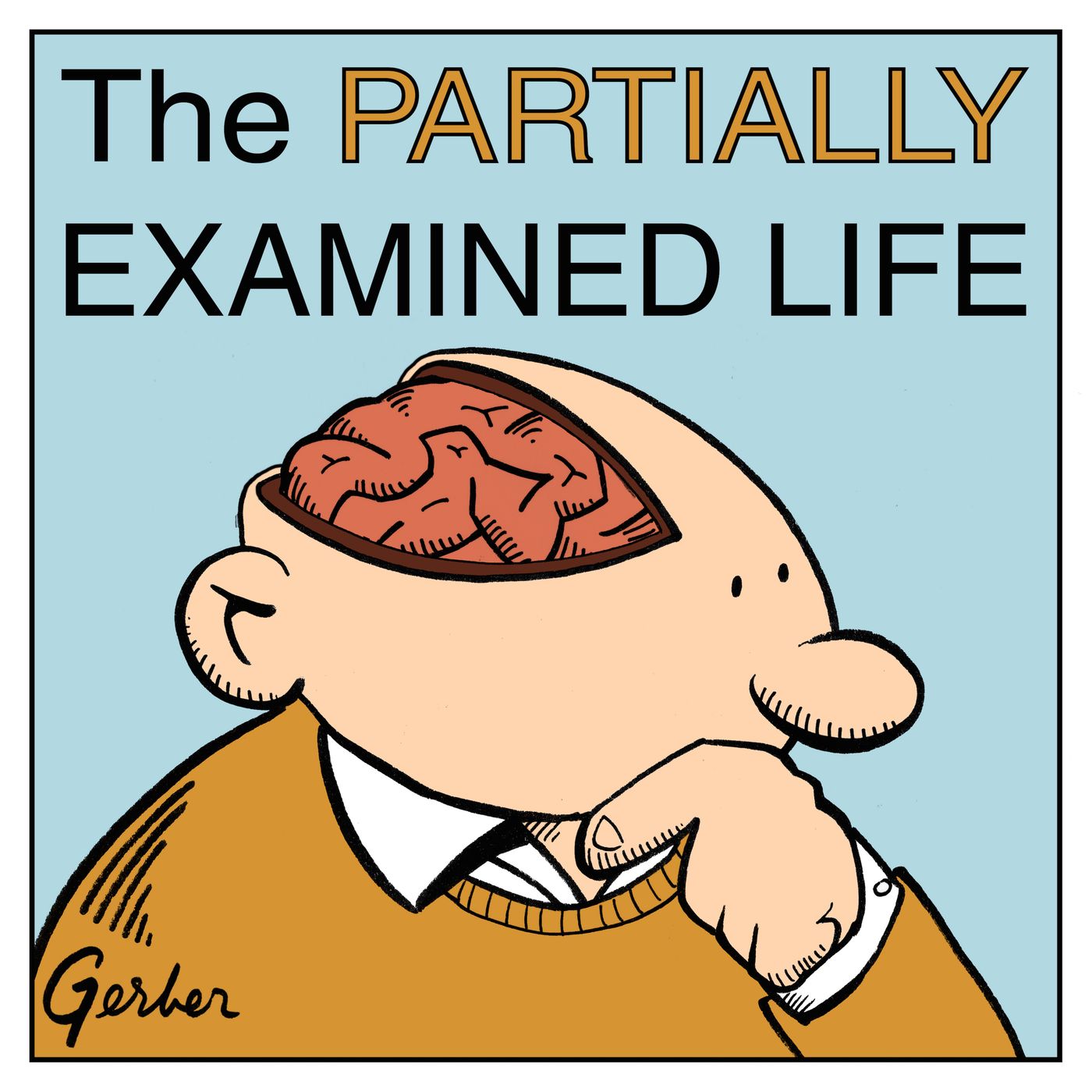
The Partially Examined Life Philosophy Podcast
The Partially Examined Life is a podcast by some guys who were at one point set on doing philosophy for a living but then thought better of it. Each episode, we pick a short text and chat about it with some balance between insight and flippancy. You don't have to know any philosophy, or even to have read the text we're talking about to (mostly) follow and (hopefully) enjoy the discussion. For links to the texts we discuss and other info, check out www.partiallyexaminedlife.com. We also feature episodes from other podcasts by our hosts to round out your partially examined life, including Pretty...
Where to listen?
Podcasts in the app Replaio Radio Coming soonPodcasts are coming to the app soon. Install now and be the first to see a whole new take on podcasts
 Install for free
Android 5M+ downloads · 4.8 rating
iOS soon
Install for free
Android 5M+ downloads · 4.8 rating
iOS soon
Episodes
PREMIUM-Ep. 271: Johan Gottlieb Fichte's Transcendental Idealism (Part Two) 14.06.2021 10:19
Continuing on The Vocation of Man (1799), Book II. In this preview, we clarify whether Fichte is trying to keep the notion of a "real world" beyond our experience or not. It's part of the progression of the text that while at first he assumes that there must be something real behind this experienced world we as individuals create, he gives up that notion in the middle of Book II. So how does he ge...
Ep. 271: Johan Gottlieb Fichte's Transcendental Idealism (Part One) 07.06.2021 51:11
On The Vocation of Man (1799), Books I and II. What is reality? Fichte's armchair journey starts him considering nature and thus himself as determined, but then he backtracks to say that actually, experience doesn't tell us whether we're determined or free. In Book II, he argues that since our experience is always of something going on in ourselves, then causality, the external world, the self, et...
PREMIUM-Ep. 270: Classical Indian (Vedanta and Nyaya) Design Arguments for God (Part Two) 31.05.2021 11:30
Continuing (without Stephen Phillips) on God and the World's Arrangement: Readings from Vedanta and Nyaya Philosophy of Religion. What does this treatment give us that's fundamentally different than the Western version of the design argument? We talk about these readings in the context of liberation and reflect on reason vs. revelation in this milieu. To hear that full second part , you'll need to...
Ep. 270: Classical Indian (Vedanta and Nyaya) Design Arguments for God w/ Stephen Phillips (Part One) 24.05.2021 59:58
On God and the World's Arrangement: Readings from Vedanta and Nyaya Philosophy of Religion with one of its translators, Stephen Phillips . Does nature require an intelligent designer? Śaṅkara (710 CE) and Vācaspati Miśra (960 CE), commenting on the Brahma-sūtra (ca. 200 CE) and Nyāya-sūtra (ca. 200 BCE), argue that it does against atheistic Buddhists, Sāṃkhya believers in a primordial matter that...
PREMIUM-Ep. 269: Arendt on Totalitarianism (Part Two) 17.05.2021 11:12
Continuing on two of Hannah Arendt's 1953 essays on totalitarianism. We further discuss its logic and in the full episode get into its relevance for contemporary political movements. To hear that full second part , you'll need to go sign up at partiallyexaminedlife.com/support . Sponsor: See headspace.com/PEL for a free month's access to a library of guided meditations. Try The Class X Podcast on...
Ep. 269: Arendt on Totalitarianism (Part One) 10.05.2021 47:58
On "On the Nature of Totalitarianism" and On the Origins of Totalitarianism ch. 13 (both from 1953). Is totalitarianism just an especially virulent form of tyranny, or something unique to the modern age? Arendt says that unlike other forms of government, totalitarianism is not animated by an active psychological principle that motivates its participants. Instead terror is designed to make citizens...
PREMIUM-Ep. 268: Neil Postman's "Amusing Ourselves to Death" (Part Two) 03.05.2021 14:03
Continuing on Amusing Ourselves to Death: Public Discourse in the Age of Show Business with guest Brian Hirt. Is the written word really so much more suited for providing context than television? To hear the full second part , you'll need to go sign up at partiallyexaminedlife.com/support .
Ep. 268: Neil Postman's "Amusing Ourselves to Death" (Part One) 26.04.2021 45:23
On Amusing Ourselves to Death: Public Discourse in the Age of Show Business (1985) with guest Brian Hirt. How does the form in which we receive media affect how we think? Education theorist Postman (building on Marshall McLuhan) claimed that television has eroded our capacity to reason and given us the expectation that everything in the world must entertain. Is this a viable piece of social constr...
PREMIUM-Ep. 267: Avicenna on God and Soul w/ Peter Adamson (Part Two) 19.04.2021 10:25
Continuing on Avicenna's arguments for the existence of God and on the soul's immateriality. What metaphysical and epistemological picture grounds these views? To hear the full second part , you'll need to go sign up at partiallyexaminedlife.com/support .
Ep. 267: Avicenna on God and Soul w/ Peter Adamson (Part One) 12.04.2021 57:09
On selections and commentary about Avicenna's argument from around 1020 C.E. for the existence of God as a necessary being, plus arguments to prove that God has the person-like properties that Islam imputes to him, and his "flying man" argument for the soul's essential independence from matter. Featuring Mark, Dylan, and our guest Peter Adamson from the History of Philosophy podcast . Part two of...
PREMIUM-Ep. 266: Jonathan Lear's Plato: Psyche and Society (Part Two) 05.04.2021 11:32
Continuing on Lear's Open Minded: Working Out the Logic of the Soul (1988). Our highlight is about the relation between the three parts of the soul: which (if any) is basic? To hear the full second part , you'll need to go sign up at partiallyexaminedlife.com/support .
Ep. 266: Jonathan Lear's Plato: Psyche and Society (Part One) 29.03.2021 52:15
On essays from Lear's Open Minded: Working Out the Logic of the Soul (1988): "Inside and Outside the Republic," "Eros and Unknowing: The Psychoanalytic Significance of Plato's Symposium," and "An Interpretation of Transference," which compares Socrates' questioning with psychotherapy. Is Plato's analogy between mind and state in The Republic a good one? What can we learn from it about what makes f...
PREMIUM-Ep. 265: Plato's "Phaedo": Philosophy as Training for Death (Part Two) 22.03.2021 11:34
Continuing on the Phaedo, we start with a point from Plato's physics that's supposed to hep prove the immortality of the soul, then lay out his theory of Forms. To hear the full second part , you'll need to go sign up at partiallyexaminedlife.com/support .
Ep. 265: Plato's "Phaedo": Philosophy as Training for Death (Part One) 15.03.2021 43:26
On Plato's middle dialogue depicting the death of Socrates (390 BCE) depicting the death of Socrates. Should philosophers fear death? In the course of giving arguments for the immortality of the soul, we get an elaboration of the recollection theory of knowledge (from the Meno) into Plato's first full account of Forms. But how literally are we supposed to take the words of Socrates as he comforts...
PREMIUM-Ep. 264: Plato's "Timaeus" on Cosmology (Part Two) 08.03.2021 10:37
Continuing on the Timaeus, we consider some quotes and details starting at the beginning of the dialogue where Plato argues for differences between the perceived, created, impermanent world and its perfect model. To hear this second part , you'll need to go sign up at partiallyexaminedlife.com/support .
Ep. 264: Plato's "Timaeus" on Cosmology (Part One) 01.03.2021 42:47
On the later Platonic dialogue from around 360 BCE. How is nature put together? Plato speaks through the fictional Timaeus (not Socrates) to give a "likely story" about the universe, physics, and biology involving a Craftsman (Demi-Urge) who created everything based on a pre-existing perfect model (the Forms!). Timaeus derives his whole story from the principle that the world is good, and so the C...
PREMIUM-Ep. 263: Lise Van Boxel's "Warspeak" on Strategies for Valuing (Part Two) 22.02.2021 13:32
Continuing on Warspeak: Nietzsche's Victory Over Nihilism with guests Jeff Black and Michael Grenke. To hear this second part , you'll need to go sign up at partiallyexaminedlife.com/support .
Ep. 263: Lise Van Boxel's "Warspeak" on Strategies for Valuing (Part One) 15.02.2021 41:56
On Warspeak: Nietzsche's Victory Over Nihilism (2020) with Dylan, Seth, and guests Michael Grenke and Jeff Black. What's a viable counter-ideal to the asceticism that Nietzsche thought is so pervasive? Lise's book works out strategies for re-valuing that emphasize Nietzsche's positive comments about the feminine and the power of words. Part two of this episode is only going to be available to you...
PREMIUM-Ep. 262: Nietzsche on Self-Denial (Part Two) 08.02.2021 13:01
More on essay three of Nietzsche's Genealogy of Morals on the meaning of ascetic ideals. How does asceticism fit into N's overall morality, and how does he use it to critique scientists? To hear this second part , you'll need to go sign up at partiallyexaminedlife.com/support .
Ep. 262: Nietzsche on Self-Denial (Part One) 01.02.2021 46:48
On Friedrich Nietzsche's The Genealogy of Morals (1887), "Third essay: what do ascetic ideals mean?" Self-regulation, where we tamp down certain aspects of our personality, is necessary for disciplined action, but it can clearly go too far. Nietzsche uses this concept of asceticism to analyze both geniuses and the masses. It is a chief tool of the will to power, highly dangerous to human flourishi...
PREMIUM-Ep. 261: Derek Parfit on Personal Identity (Part Two) 25.01.2021 13:32
More on Parfit's Reasons and Persons (1984), ch. 10-13. In this preview, we consider how Parfit deals with Bernard Williams' materialist thought experiment to show that the whole concept of personal identity doesn't make sense. Also, split brains! To hear this second part , you'll need to go sign up at partiallyexaminedlife.com/support .
Ep. 261: Derek Parfit on Personal Identity (Part One) 18.01.2021 51:53
On Reasons and Persons (1984), ch. 10-13. What makes a person persist over time? After using various sci-fi examples to test the Lockean (personhood=psychological continuity), physicalist (same brain=same person), and Cartesian (same soul=same person) theories, Parfit concludes that the whole notion is incoherent and isn't actually what we care about when wondering "will I die?" Part two of this e...
PREMIUM-Ep. 260: Locke on Moral Psychology 11.01.2021 20:29
One last take on John Locke's Essay Concerning Human Understanding (1689), covering Book II, ch. 21 and 28. What makes a moral claim true? Do we have free will? What makes us choose the good, or not? In this coda to our long treatment of Locke's opus, we bring together all he has to say about morality, which is strangely modern yet also just strange. This is but a preview, less than a third of wha...
Ep. 259: Locke Clarifies Misleading Complex Ideas (Part Two) 04.01.2021 1:05:40
More on Book II (ch. 22-33) of John Locke's Essay Concerning Human Understanding. On relations, then personal identity, with more on substances (spiritual and material), the various ways in which ideas can go wrong, and how mental association can entrench irrationality that disrupts clear thinking. Listen to part one first, or get the unbroken, ad-free Citizen Edition , which will also get you th...
Ep. 259: Locke Clarifies Misleading Complex Ideas (Part One) 28.12.2020 43:09
On Book II (ch. 22-33) of John Locke's Essay Concerning Human Understanding (1689). Simple ideas get complex quickly when you put them into words, and can give rise to various philosophical problems that are either easily cleared up when you figure out how the complex idea is built out of simple ideas, or if they can't be so broken down, then we really don't know what we're talking about and shoul...
Similar podcasts





Listen to the The Partially Examined Life Philosophy Podcast podcast in Replaio
Radio and podcasts in one app - free, with no sign-up. Install today and do not miss the launch
Replaio is not a podcast publisher; show names, artwork and audio belong to their authors and are distributed through public RSS feeds.