Maria
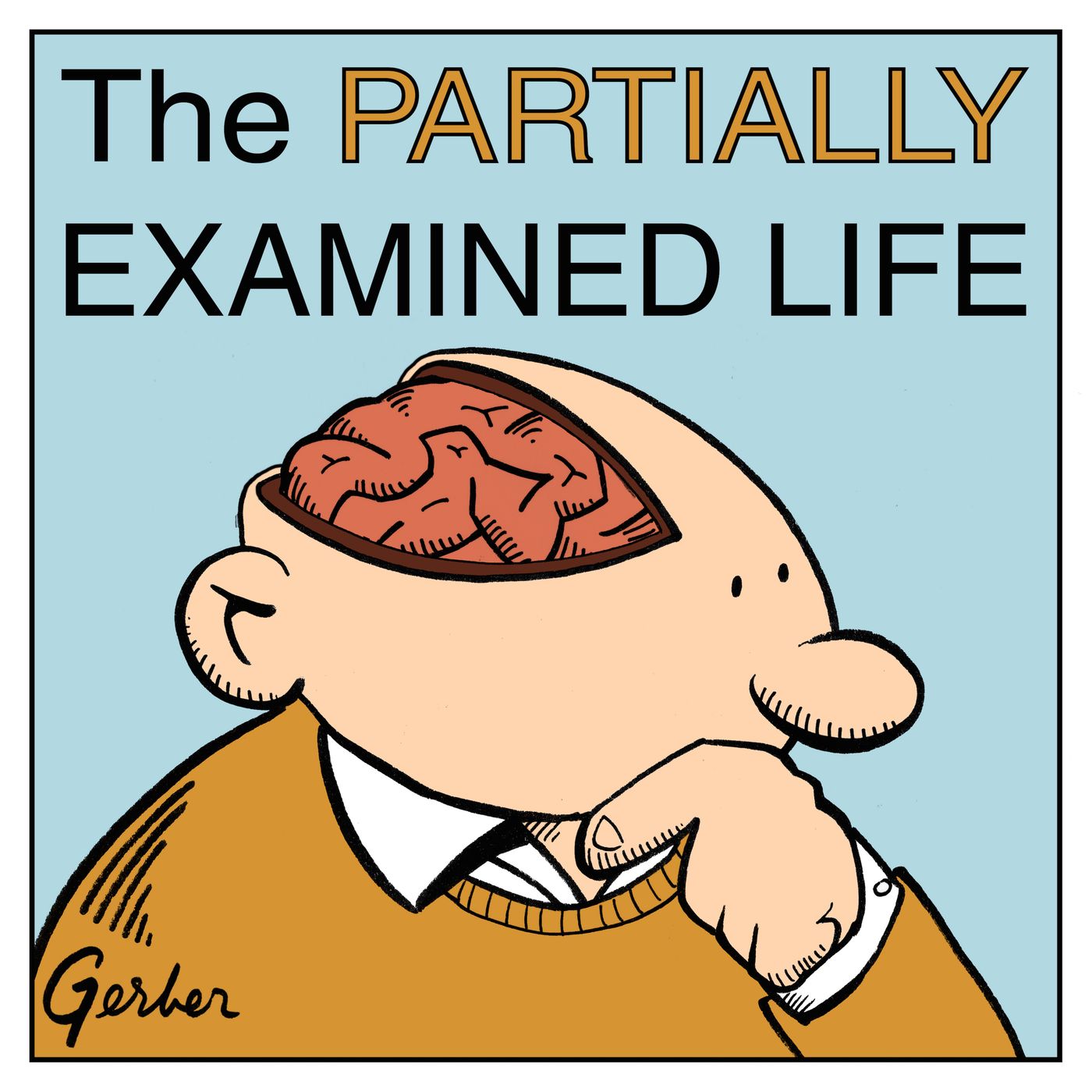
The Partially Examined Life Philosophy Podcast
The Partially Examined Life is a podcast by some guys who were at one point set on doing philosophy for a living but then thought better of it. Each episode, we pick a short text and chat about it with some balance between insight and flippancy. You don't have to know any philosophy, or even to have read the text we're talking about to (mostly) follow and (hopefully) enjoy the discussion. For links to the texts we discuss and other info, check out www.partiallyexaminedlife.com. We also feature episodes from other podcasts by our hosts to round out your partially examined life, including Pretty...
Where to listen?
Podcasts in the app Replaio Radio Coming soonPodcasts are coming to the app soon. Install now and be the first to see a whole new take on podcasts
 Install for free
Android 5M+ downloads · 4.8 rating
iOS soon
Install for free
Android 5M+ downloads · 4.8 rating
iOS soon
Episodes
Ep. 293: Donna Haraway on Feminist Science (Part One) 09.05.2022 55:14
On "Situated Knowledge" (1988), "A Cyborg Manifesto" (1985), etc. featuring guest Lynda Olman. What is scientific objectivity? Haraway rejects both relativism and traditional, "god's eye" objectivism in favor of a "cyborg" view that looks for alternate ways of seeing and acknowledges the ways that science and technology are tied to politics. Part two of this episode is only going to be available t...
PREMIUM-Ep. 292: Langer on Symbolic Music (Part Two) 02.05.2022 15:40
Concluding on Susanne Langer's Philosophy in a New Key (ch. 8-10). We continue discussing whether and how music is symbolic. Sing along with us! If you're not hearing the full version of this part of the discussion , sign up via one of the options described at partiallyexaminedlife.com/support .
Ep. 292: Langer on Symbolic Music (Part One) 25.04.2022 48:27
On Susanne Langer's Philosophy in a New Key (1942), ch. 8-10. Is music (the supposedly non-representational artform) a language? If it's "expressive," what exactly does it express? Part two of this episode is only going to be available to you if you sign up at partiallyexaminedlife.com/support or via Apple Podcasts .
PREMIUM-Ep. 291: Cassirer and Langer on Myth and Ritual (Part Two) 18.04.2022 13:47
Continuing our discussion on the symbolic value of religion and its antecedents, primary at this point discussing Susanne Langer's Philosophy in a New Key, ch. 7. If you're not hearing the full version of this part of the discussion , sign up via one of the options described at partiallyexaminedlife.com/support .
Ep. 291: Cassirer and Langer on Myth and Ritual (Part One) 11.04.2022 44:47
On Ernst Cassirer's An Essay on Man (1944), ch. 6-7, and Susanne Langer's Philosophy in a New Key (1942), ch. 6-7. Why do people produce ritual, mythology, and religion? According to our authors, these are spontaneous, symbolic modes of self-expression. They're not opposed to rational, scientific thought, but are necessary preconditions for it. Part two of this episode is only going to be availabl...
PEL Presents NEM#170: Bob Mould From Hüsker Dü to Sugar to Now 11.04.2022 1:04:37
Bob has released 20+ albums since the early '80s. We discuss "Forecast of Rain" from Blue Hearts (2020), "I Don't Know You Anymore" from Beauty & Ruin (2014), "JC Auto" by Sugar from Beaster (1993), and "In A Free Land" by Hüsker Dü, 1982 singe remixed for Savage Young Du (2017). End song: the title track to his new acoustic EP, The Ocean . Intro: "If I Can't Change Your Mind" by Sugar from C...
PREMIUM-Ep. 290: Susanne Langer on Our Symbol-Making Nature (Part Two) 04.04.2022 13:31
Continuing on Philosophy in a New Key (1942), ch. 1-5. Is symbolism the software running on the hardware of our senses, or are symbols baked even into that hardware? We talk pictures vs. symbols, types of symbol-pictures, and what it means for experience to be symbolic. If you're not hearing the full version of this part of the discussion , sign up via one of the options described at partiallyexam...
Ep. 290: Susanne Langer on Our Symbol-Making Nature (Part One) 28.03.2022 49:47
On Philosophy in a New Key (1942), ch. 1-5, plus as background most of us looked at Ernst Cassirer's An Essay on Man (1944), ch. 1-5. What does it mean to say that humanity is homo symbolicus, the symbol-making creature? Part two of this episode is only going to be available to you if you sign up at partiallyexaminedlife.com/support or via Apple Podcasts .
PREMIUM-Ep. 289: Aesthetic Sense Theory: Hume (Part Two) 21.03.2022 14:10
We get into more detail on David Hume's "The Standard of Taste" (1760). How does he resolve the paradox that it seems both that beauty is in the eye of the beholder, yet some judgments about beauty are obviously wrong? If you're not hearing the full version of this part of the discussion , sign up via one of the options described at partiallyexaminedlife.com/support .
Ep. 289: Aesthetic Sense Theory: Shaftesbury, Hutcheson, Hume (Part One) 14.03.2022 52:33
How do we know what opinions about beauty are correct? We read The Moralists: A Philosophical Rhapsody (1709) by Anthony Ashley-Cooper, aka the third Earl of Shaftesbury, Part III section 2 "Beauty," and An Inquiry Concerning Beauty, Order, Harmony, Design (1725) by Francis Hutcheson, and "The Standard of Taste" by David Hume (1760). Part two of this episode is only going to be available to you i...
PEL Presents Philosophy vs. Improv #28: Enhanced Interrogation w/ Adal Rifai 11.03.2022 1:10:23
Today's episode is about questioning: how one might question, what sets the parameters for a proper answer, and how to give those answers in an informative and/or dramatically effective way. Watch out for dream pigs! Also, how to get into the VIP room at Stuckey's. Perhaps a pair of paralegals can help. In the post-game, included JUST THIS ONCE for public enjoyment, we reflect on improv in the rea...
PREMIUM-Ep. 288: Scruton on Ethical Art (Part Two) 07.03.2022 12:27
Concluding on Beauty (2009). Why would we be attracted to beauty if on Scruton's account it takes so much work? We consider the form/function distinction as it applies to architecture and human beauty. If you're not hearing the full version of this part of the discussion , sign up via one of the options described at partiallyexaminedlife.com/support .
Ep. 288: Scruton on Ethical Art (Part One) 28.02.2022 46:58
On Roger Scruton's Beauty (2009), ch. 5-9. Scruton argues against aesthetic relativism on moral grounds: That the "flight from beauty" in modern art and the crassness of popular art deny important things about being human. Part two of this episode is only going to be available to you if you sign up at partiallyexaminedlife.com/support or via Apple Podcasts .
PREMIUM-Ep. 287: Roger Scruton on Beauty (Part Two) 21.02.2022 12:08
Continuing on Beauty (2009), ch. 1-4. Does apprehending beauty really have to involve reason, or can it be merely sensory? If you're not hearing the full version of this part of the discussion , sign up via one of the options described at partiallyexaminedlife.com/support .
Ep. 287: Roger Scruton on Beauty (Part One) 14.02.2022 48:30
On Beauty (2009), ch. 1-4. What truths about beauty does any theory of beauty have to acknowledge? Scruton argues that appreciating beauty is a cognitive act: something we argue about, and not just "in the eye of the beholder." Part two of this episode is only going to be available to you if you sign up at partiallyexaminedlife.com/support or via Apple Podcasts .
PREMIUM-Ep. 286: Malebranche on Causality and Theology (Part Three) 07.02.2022 14:25
Concluding on On Dialogues on Metaphysics and Religion (1688), with consideration of his explanation for why we can't prove the existence of the external world, but that we can reasonably take this on faith. Also, theodicy! If you're not hearing the full version of this part of the discussion , sign up via one of the options described at partiallyexaminedlife.com/support .
PREMIUM-Ep. 286: Malebranche on Causality and Theology (Part Two) 31.01.2022 12:32
Continuing on Dialogues on Metaphysics and Religion (1688), dialogue 7 where he gets into his occasionalist theory of causality. How does this relate to mind-body interaction and concepts in physics like inertia? What is the metaphysical relation of natural law to things in the world? If you're not hearing the full version of this part of the discussion , sign up via one of the options described a...
Ep. 286: Malebranche on Causality and Theology (Part One) 24.01.2022 51:00
On Dialogues on Metaphysics and Religion (1688), dialogues 5-7. We get clearer on M's rationalist epistemology and into his occasionalist theory of causality. Is M's theory as archaic as its theology makes it sound? Part two of this episode is only going to be available to you if you sign up at partiallyexaminedlife.com/support or via Apple Podcasts .
PREMIUM-Ep. 285: Nicolas Malebranche on Knowledge (Part Two) 17.01.2022 13:10
Continuing on Dialogues on Metaphysics and Religion (1688), ch. 1-4. We talk about the character of the intelligible world, how we generate general concepts, the existence of God, seeing God, original sin, and more. If you're not hearing the full version of this part of the discussion , sign up via one of the options described at partiallyexaminedlife.com/support .
Ep. 285: Nicolas Malebranche on Knowledge (Part One) 10.01.2022 48:33
On Dialogues on Metaphysics and Religion (1688), ch. 1-4. We walk through M's rationalist (post-Descartes, pre-Leibniz) epistemology with its surprising implications for the metaphysics of causality and the role of God in nature. Part two of this episode is only going to be available to you if you sign up at partiallyexaminedlife.com/support or via Apple Podcasts .
PEL Special: Nightcap New Year's Party to Welcome 2022 02.01.2022 48:06
Welcome to an extra special, intentionally public edition of Nightcap to catch you up on what Mark, Wes, Seth, and Dylan are all up to personally and intellectually and hash out what we want to potentially cover on the show over the next year.
PREMIUM-Ep. 284: Mark Twain's Philosophy of Human Nature (Part Two) 27.12.2021 11:35
Continuing on "What Is Man" (1905). We work through Twain's metaphors for human nature, say what he means by "instinct," contemplate his notion of identity and why he thinks you are apparently different from your body-machine, and gauge the practical upshot of his stances. If you're not hearing the full version of this part of the discussion , sign up via one of the options described at partiallye...
Ep. 284: Mark Twain's Philosophy of Human Nature (Part One) 20.12.2021 40:49
On "What Is Man" (1905). Twain describes a person as a machine. We have no free will and always act to win our own self-approval. This was a bleak enough picture that the essay was not printed until after Twain's death. Part two of this episode is only going to be available to you if you sign up at partiallyexaminedlife.com/support or via Apple Podcasts .
PREMIUM-Ep. 283: Alain Badiou on Love (Part Two) 13.12.2021 11:29
Continuing on "What Is Love?" (1992). We consider B's account of love as resolution of a paradox: The positions of man and woman in no way overlap, yet all truth is generic, i.e. accessible to everyone. Love makes it happen! If you're not hearing the full version of this part of the discussion , sign up via one of the options described at partiallyexaminedlife.com/support .
Ep. 283: Alain Badiou on Love (Part One) 06.12.2021 44:56
On "What Is Love," which is ch. 11 of Conditions (1992). We see what it means to call love a "truth procedure": It's a new way of seeing, through the eyes of the Two, not the merger of two souls or the loving of god through another. Does B's pseudo-mathematical language about this make sense? Part two of this episode is only going to be available to you if you sign up at partiallyexaminedlife.com/...
Similar podcasts





Listen to the The Partially Examined Life Philosophy Podcast podcast in Replaio
Radio and podcasts in one app - free, with no sign-up. Install today and do not miss the launch
Replaio is not a podcast publisher; show names, artwork and audio belong to their authors and are distributed through public RSS feeds.