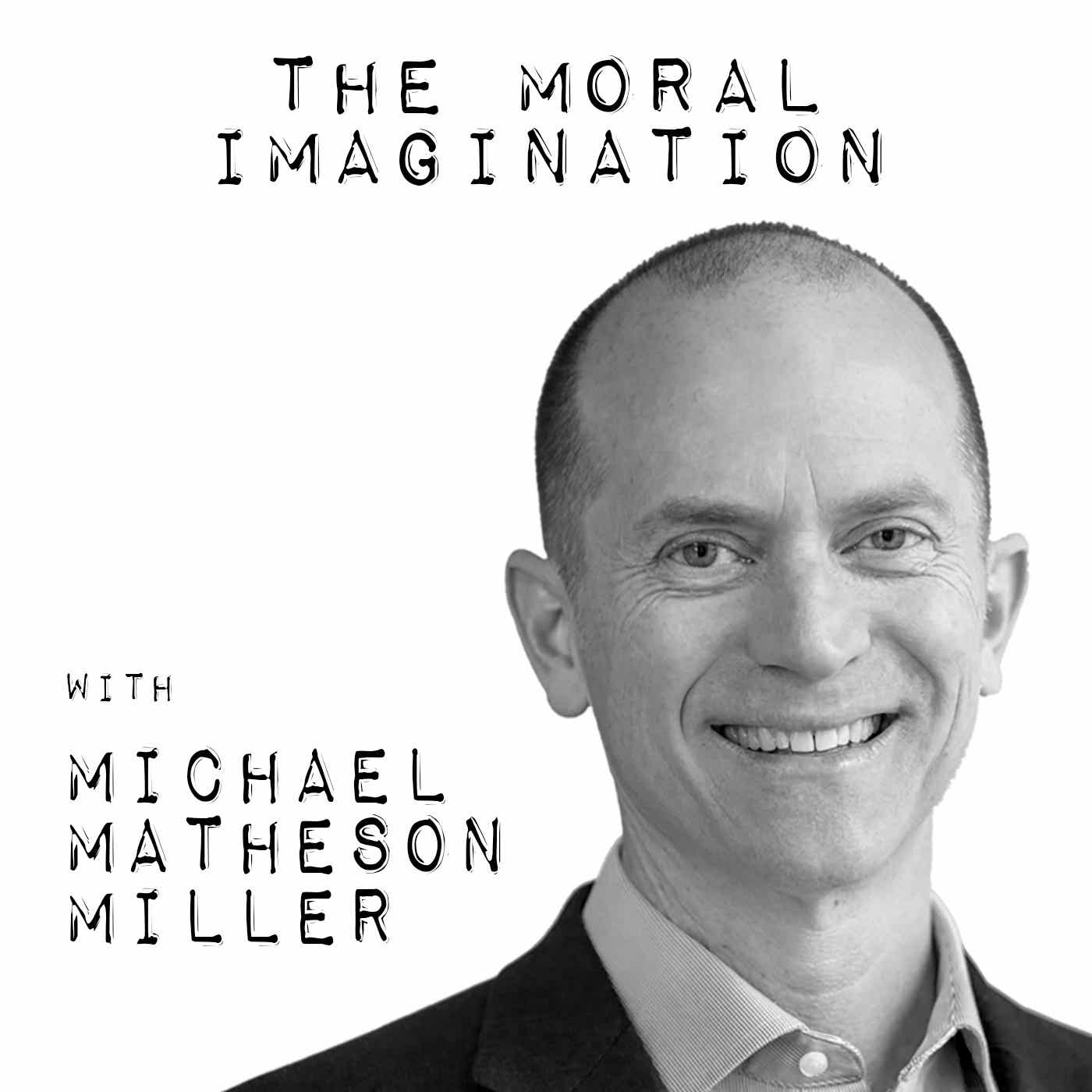
Michael Matheson Miller
The Moral Imagination
Welcome to the Moral Imagination Podcast. The overarching theme of my podcast is what it means to be a human person and what makes for a meaningful and good life. We will discuss philosophy of the human person, culture, religion, social philosophy, and many other related topics, like education, learning, economics, food, technology, artificial intelligence, and intellectual history. My goal is to interact with ideas and people whose work I find challenging, and intellectually and socially important. www.themoralimagination.com
Be sure to visit the podcast's website and support the creator: www.themoralimagination.com
Author
Michael Matheson Miller
Category
Podcast website
Latest episode
Jul 2, 2026
Where to listen?
Podcasts in the app Replaio Radio Coming soonPodcasts are coming to the app soon. Install now and be the first to see a whole new take on podcasts
 Install for free
Android almost 10M downloads · 4.8 rating
iOS soon
Install for free
Android almost 10M downloads · 4.8 rating
iOS soon
Episodes
Ep. 38: Dr. Margarita Mooney Nicaraguan Journey: From Technocracy to Solidarity through Small Acts of Love 23.03.2022 1:05:36
In the episode, I speak with Professor Margarita Mooney about her time in Nicaragua and how these experiences shaped her scholarly work and teaching at the intersection of sociology and philosophy. Margarita tells a story of her time in Nicaragua and how a weekend trip to a political rally in a small community where she almost was kidnapped challenged her assumptions about elite education in the...
Ep. 37: James Poulos: Digital Politics & Spiritual War 11.03.2022 55:11
In this episode, I speak with James Poulos about his book, Human, Forever: The Digital Politics of Spiritual War . We discuss a wide variety of themes including technology, human memory, what it means to be an embodied person. James argues that instead of worrying about an impending crisis, we need to realize that it has already happened — Digital entities have taken over. We need to recognize thi...
Ep. 36: Carter Snead: Law, Power, and Bioethics: What it Means to Be Human, 01.09.2021 1:52:57
In this episode, I speak with Professor Carter Snead about his book, What it Means to be Human: The Case for the Body in Public Bioethics . We discuss how the dominant view of the human person forgets the body and ignores our social nature, and how this plays out in law which further shapes our moral lives and cultural attitudes. Snead argues that contemporary law in bioethics around issues like a...
Ep. 35: Jessica Hooten Wilson, Ph.D.: Literature and Totalitarianism 23.08.2021 1:07:08
In this episode, I speak with Professor Jessica Hooten Wilson about her writing and research on literature and totalitarianism. We discuss how both violence and entertainment and distraction are used a tools of state control. We discuss Fahrenheit 451 by Ray Bradbury, some of the writings of Alexander Solzhenitsyn, and Julia Alvarez's novel, In the Time of Butterflies, about life under the Trujill...
Ep. 34: Heidi White: What is Classical Education? 04.08.2021 1:31:05
What is education for? In the episode, I speak with Heidi White about classical education and human flourishing. We discuss why classical education is important to pass down a cultural memory and why reading good literature and classic texts matters on multiple levels. We discuss the difference between a modern, contemporary education and a classical vision of education, the relationship between c...
Ep. 33: Elizabeth Corey, Ph.D.: Life Beyond Politics 21.07.2021 1:44:51
In this episode, I speak with Elizabeth Corey about life beyond politics, friendship, learning, and the work of Michael Oakeshott. We discuss a wide range of issues, including rationalism and politics, the value of the reading of classic texts, and Oakeshott's idea of different modes of engaging with the world: the practical, scientific, historical, and poetic. We discuss Eric Voegelin, Russell Ki...
Ep. 32: James Madden, Ph.D.: The Recovery of the Self: Embodied and Embedded Persons 14.07.2021 1:39:18
In this episode, I speak with James Madden about his book, "Mind, Matter, and Nature", about philosophy of mind, and what it means to be an embodied and an embedded person. We discuss how the loss of a sense of ourselves as embodied and embedded leads to a loss of contact with the world and ultimately to nihilism. We discuss competing visions of the person—materialism, dualism and Aristotle's and...
Ep. 31: Titus Techera and Flagg Taylor: Communism and Film: Deceit, Privacy, Art, and the Effects of Tyranny on the Soul 29.03.2021 2:14:57
In this episode, I speak with Titus Techera and Flagg Taylor about several films that address communism and the effects of tyranny and deceit on the human soul. We discuss themes of courage, freedom, privacy, shame, the purpose and role of art, and how we can become comprised over time by assenting to falsehood. We discuss how these films portray the challenges for regular people and how the exper...
Ep. 30: Jay Richards: Fasting, Prayer, and Ketosis: How Modern Science and Ancient Christian Tradition Support a Fasting Lifestyle & Help Us Put Food in its Proper Place 18.03.2021 1:30:36
In this episode, I speak with Jay Richards about his book "Eat, Fast, Feast: Heal Your Body While Feeding your Soul". We discuss how modern science and ancient Christian tradition support a fasting lifestyle for healthy living and help us put food in its proper place. We discuss a number of issues including fasting, prayer, the ketogenic diet, and metabolic flexibility. We discuss the benefits of...
Ep. 29: Noelle Mering: Awake Not Woke: A Personalist Alternative to Thinking About Social Justice 06.03.2021 1:51:38
In this episode, I speak with Noelle Mering about her new book, Awake Not Woke: A Christian Response to the Cult of Progressive Ideology . Noelle analyzes the concept of "woke" and identifies four characteristics of the contemporary social justice movement and how they influence the way we think about justice and society: 1. Group over Person 2. Will over Reason 3. Power over Authority 4. The Crow...
Ep. 28: George Gilder: Crypto vs Google: Blockchain, Cryptocurrency, Decentralized Computing, and Life After Google and Big Data 25.02.2021 1:20:16
In this episode, I talk with George Gilder about "Life After Google: The Fall of Big Data & The Rise of the Blockchain Economy" and his newest book on Gaming AI. We discuss blockchain technologies, cryptocurrency, Bitcoin, and decentralized computing. We also discuss artificial intelligence, information theory, neuroscience, and the problems of materialism and closed systems. Gilder argues that th...
Ep. 27: Decentralization, Localism, and Mutual Aid: The Thought of Robert Nisbet 19.02.2021 1:01:20
This episode features a lecture of mine from 2011 on the thought of Robert Nisbet. Nisbet is an important figure and his thought is very relevant to our time. I discuss the main themes of his work on community, authority, social change, and more. Visit https://www.themoralimagination.com/episodes/michael-matheson-miller-2-nisbet for show notes and resources. Get full access to The Moral Imaginatio...
Ep. 26: David Deavel Ph.D: What Happiness are We Pursuing? Solzhenitsyn and American Culture 05.02.2021 1:32:32
A British journalist asked Alexander Solzhenitsyn: can free people desire to be slaves? He answered Yes. The West is "full of such people". In this episode, I speak with David Deavel about the book he co-edited with Jessica Hooten Wilson, "Solzhensityn and American Culture: The Russian soul in the West". We discuss how some of the key themes of Solzhenitsyn apply to our contemporary life, includin...
Ep. 25: David Clayton: Beauty and the Cosmos 28.01.2021 1:43:55
What is beauty? Does it have an objective character, or is it merely subjective and in the eye of the beholder? How do we experience beauty, and how do we communicate it to others. In this episode, I discuss the nature of beauty with David Clayton, a painter, iconographer, and author. We discuss the role of consensus and tradition, classical art, contemporary gallery art, popular and folk art, and...
Ep. 24: Andreas Widmer: Principled Entrepreneurship: Why Business is Always Personal 22.01.2021 1:20:36
In the episode, I speak with Andreas Widmer about his work on principled entrepreneurship. Andreas argues that many of the challenges we are seeing in business and commerce today can be addressed by seeing business and entrepreneurship as a moral enterprise focused on the human person. We discuss Widmer's five principles for how businesses should be run, as well as a path to become not just succes...
Ep. 23: Flagg Taylor Ph.D: Living in Truth: Vaclav Havel on Existential Dissent & the Re-discovery of Conscience 14.01.2021 1:50:35
In this episode, I speak with Flagg Taylor about the writing and life of Vaclav Havel. We discuss his essays, plays, and other works. We also discuss Havel's idea of dissent as living in the truth. Dissent for Havel is not primarily political, but existential dissent from ideology, politicization of life, and consumerism. Visit https://www.themoralimagination.com/episodes/flagg-taylor for show not...
Ep. 22: Luke Sheahan: Suppressing Dissent: Why Freedom of Association and Decentralization Matter for Liberty, Community, Innovation, and Human Flourishing 06.01.2021 1:24:28
Alexis de Tocqueville wrote that the tyrant doesn't care if you love him, as long as you don't love one another. In this episode, I speak with Luke Sheahan about his book, "Why Associations Matter: The case for First Amendment Pluralism". Free associations are essential for political liberty, human flourishing, and for genuine community; but Sheahan argues that recent judicial decisions are increa...
Ep. 21: Luke Burgis: The Economy of Desire: Rene Girard on Commerce and our Everyday Life 17.12.2020 1:12:50
In this episode, I speak with Luke Burgis about Rene Girard, the mimetic cycle, imitation, desire, and scapegoating, and how these things play out in business, commerce and everyday life. We discuss his forthcoming book, Wanting: The Power of Mimetic Desire in Everyday Life. Themes include how are desires our shaped by others, the leveling of desire through social media, the problem of scapegoatin...
Ep. 20: What is the Moral Imagination? + 15 Ways to Build it and Recover Our Humanity 10.12.2020 1:02:38
What is the moral imagination? Why is it important? In this episode, I discuss the concept of the moral imagination and 15 ways to develop it. I discuss the origin of the term in Edmund Burke's critique of the French Revolution and his worry that the reductionist Enlightenment view of reason would lead to what C.S. Lewis called "the abolition of man." It would diminish our fundamental human experi...
Ep. 19: Carrie Gress, Ph.D: Theology of Home: Family, Motherhood and the Alternative to Dominant Feminism 04.12.2020 56:40
In this episode, I speak with the Carrie Gress about her book "Theology of Home". We discuss themes of the value of homemaking, the hearth, family, motherhood, and some of her critiques of dominant feminism. Carrie is a philosopher, an entrepreneur, a prolific writer, and the mother of five children that she homeschools. She is the online editor of the woman's magazine "Theology of Home". She has...
Ep. 18: Chris Arnade: Dignity, Poverty, Faith, & Seeking Respect in Back Row America 25.11.2020 1:40:38
In this episode, I speak with Chris Arnade about his book "Dignity: Seeking Respect in Back Row America". We discuss themes from his book including poverty, addiction, racism, and the value of home and place, the role of faith, and the role of McDonalds as a respite and community center. Visit https://www.themoralimagination.com/episodes/chris-arnade for show notes and resources. Get full access t...
Ep. 17: Obianuju Ekeocha: Ideological Colonialism and Resisting the Cultural Annexation of Africa 19.11.2020 49:14
In this episode, I speak with Obianuju Ekeocha about the problem of ideological colonialism in Africa in the 21st Century. We discuss how Western governments, international aid agencies, and NGOs impose western, secularist ideas about life, family, and marriage on Africa. Obianuju argues that what we are seeing is a type of cultural annexation of Africa by Western elites that is a new type of colo...
Ep. 16: Dr. Michael Egnor: Does Neuroscience Refute Free Will? 12.11.2020 1:22:06
Does neuroscience prove there is no free will? Is consciousness reducible to a neural network? Are we determined by our brains? In this episode, I speak again with neurosurgeon, Dr. Michael Egnor. We discuss Sam Harris arguments against free will, and examine not only the philosophical problems with Harris' argument, but Dr. Egnor also argues that Harris incorrectly interprets the work of Benjamin...
Ep. 15: Gary Saul Morson Ph.D: Thinking Like Lenin 04.11.2020 1:04:40
In this episode, I speak with Professor Gary Saul Morson about the thought of Vladamir Lenin and how Lenin's ideas and way of seeing the world influences us today. We discuss his New Criterion essay, "Leninthink" and some of the key aspects of Lenin's thought, including Who-Whom: adherence to all politics and life as a win-lose, zero-sum game, the rejection of truth, Party-ness and ideological com...
The Triumph of the Yuppie: Carlo Lancellotti on Augusto del Noce, Secularization, Revolution, and the Crisis of Modernity 28.10.2020 1:24:36
In this episode, I speak with Professor Carlo Lancellotti about the late Italian philosopher Augusto Del Noce and the Crisis of Modernity. Del Noce died in 1989, but his writings are very relevant and help explains much of our contemporary situation. In this wide ranging conversation, we talk about totalitarianism, the religious nature of revolution, consumerism, the hybrid of Marxist anthropology...
Similar podcasts






Listen to the The Moral Imagination podcast in Replaio
Radio and podcasts in one app - free, with no sign-up. Install today and do not miss the launch
Replaio is not a podcast publisher; show names, artwork and audio belong to their authors and are distributed through public RSS feeds.