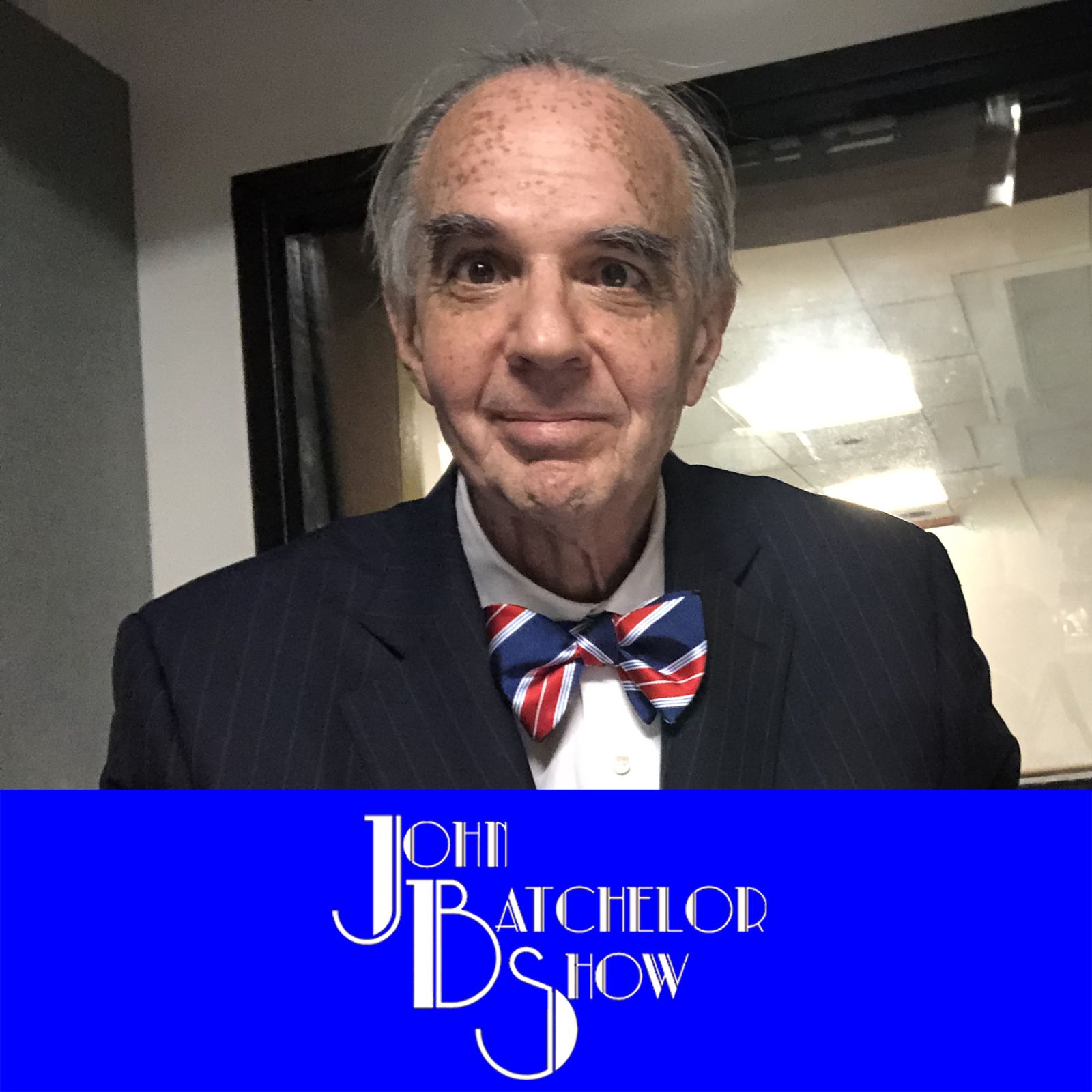
John Batchelor
The John Batchelor Show
The John Batchelor Show is a hard news-analysis radio program on current events, world history, global politics and natural sciences. Based in New York City for two decades, the show has travelled widely to report, from the Middle East to the South Caucasus to the Arabian Peninsula and East Asia.
Be sure to visit the podcast's website and support the creator: substack.com
Where to listen?
Podcasts in the app Replaio Radio Coming soonPodcasts are coming to the app soon. Install now and be the first to see a whole new take on podcasts
 Install for free
Android almost 10M downloads · 4.8 rating
iOS soon
Install for free
Android almost 10M downloads · 4.8 rating
iOS soon
Episodes
S8 Ep1086: Daniel Rood, author of In the Shadow of the Great House, reveals that the University of Georgia's Baldwin Hall was built over an unacknowledged burial ground for enslaved people. Although the university initially claimed the remains were Eu 04.07.2026 5:02
Daniel Rood , author of In the Shadow of the Great House , reveals that the University of Georgia's Baldwin Hall was built over an unacknowledged burial ground for enslaved people. Although the university initially claimed the remains were European, DNA analysis and archival research proved they were of African descent. This attempt to "re-bury the history" illustrates the ongoing need to escape t...
S8 Ep1086: Daniel Rood, author of In the Shadow of the Great House, traces how the plantation system evolved globally, with Cuba becoming a sugar powerhouse using industrial steam technology after the Haitian Revolution. In modern Brazil, multinational co 04.07.2026 14:37
Daniel Rood , author of In the Shadow of the Great House , traces how the plantation system evolved globally, with Cuba becoming a sugar powerhouse using industrial steam technology after the Haitian Revolution . In modern Brazil , multinational corporations like BP and Cargill run "mammoth sugar farms" using unfree contract labor for ethanol production. Similarly, California's agricultural boom r...
S8 Ep1086: Daniel Rood, author of In the Shadow of the Great House, recounts how, during the Civil War, General Sherman targeted "great houses" like that of Confederate politician Howell Cobb for destruction to cripple the planter class. Field Order 15 in 04.07.2026 5:26
Daniel Rood , author of In the Shadow of the Great House , recounts how, during the Civil War, General Sherman targeted "great houses" like that of Confederate politician Howell Cobb for destruction to cripple the planter class. Field Order 15 initially provided a path for land reform by settling refugees on abandoned plantations, but the policy was reversed by Andrew Johnson after Lincoln's assas...
S8 Ep1086: Daniel Rood, author of In the Shadow of the Great House, explains that enslaved people like Suki provided the essential "intellectual labor" and agricultural expertise required for successful plantations. Despite this, the domestic slave trade 04.07.2026 12:23
Daniel Rood , author of In the Shadow of the Great House , explains that enslaved people like Suki provided the essential "intellectual labor" and agricultural expertise required for successful plantations. Despite this, the domestic slave trade treated two million people as speculative property between 1820 and 1860. Charles Dickens famously witnessed the heartbreak of families being separated on...
S8 Ep1086: Daniel Rood, author of In the Shadow of the Great House, describes how, during the Siege of Yorktown, Cornwallis prioritized British sugar profits in Jamaica over the lives of thousands of black refugees, pushing them out to starve or face reca 04.07.2026 7:58
Daniel Rood , author of In the Shadow of the Great House , describes how, during the Siege of Yorktown , Cornwallis prioritized British sugar profits in Jamaica over the lives of thousands of black refugees, pushing them out to starve or face recapture. In contrast, the American "patriots" used human property as a military recruitment tool, offering poor white soldiers land and "one healthy sound...
S8 Ep1086: Daniel Rood, author of In the Shadow of the Great House, explains that American founders like Thomas Jefferson lived in a state of "incoherence," advocating for liberty while fearing a genocide of white people if slaves were freed. Early Virgin 04.07.2026 11:42
Daniel Rood , author of In the Shadow of the Great House , explains that American founders like Thomas Jefferson lived in a state of "incoherence," advocating for liberty while fearing a genocide of white people if slaves were freed. Early Virginia history shows a decline in freedom, as African-born men like Anthony Johnson initially owned land before legal opportunities were narrowed. Nathaniel B...
S8 Ep1086: Daniel Rood, author of In the Shadow of the Great House, argues that the modern link between race and slavery was a conscious creation by planters to secure a lifelong, reproductive workforce. Philosopher John Locke codified this in Carolina's 04.07.2026 6:14
Daniel Rood , author of In the Shadow of the Great House , argues that the modern link between race and slavery was a conscious creation by planters to secure a lifelong, reproductive workforce. Philosopher John Locke codified this in Carolina's founding documents, granting freemen absolute authority over black slaves regardless of their religion. This prevented enslaved people from using Christia...
S8 Ep1086: Daniel Rood, author of In the Shadow of the Great House, recounts how, in 1933, agronomist Wofford Camp led the Associated Farmers of California to violently suppress cotton worker strikes in the Central Valley. This conflict represented the "c 04.07.2026 11:35
Daniel Rood , author of In the Shadow of the Great House , recounts how, in 1933, agronomist Wofford Camp led the Associated Farmers of California to violently suppress cotton worker strikes in the Central Valley . This conflict represented the "cutting edge" of plantation capitalism, which Rood traces back to 17th-century Barbados . Figures like John Yeamans established the model of using manufac...
S8 Ep1086: Fitzhugh Brundage, author of A Fate Worse Than Hell, reflects on how the remains of prisoners became symbols of uneasy national memory, with many sites like Camp Douglas in Chicago resulting in unmarked mass graves. At Andersonville, nearly 14, 04.07.2026 4:48
Fitzhugh Brundage , author of A Fate Worse Than Hell , reflects on how the remains of prisoners became symbols of uneasy national memory, with many sites like Camp Douglas in Chicago resulting in unmarked mass graves. At Andersonville , nearly 14,000 Union soldiers perished, a death toll exceeding the Union losses at Gettysburg . Thanks to a secret list kept by a prisoner, Clara Barton and others...
S8 Ep1086: Fitzhugh Brundage, author of A Fate Worse Than Hell, describes how Andersonville became a death camp where 35,000 men were crammed into a space with no shelter and polluted water. Commander Henry Wirz oversaw a site where over 100 men died dail 04.07.2026 14:51
Fitzhugh Brundage , author of A Fate Worse Than Hell , describes how Andersonville became a death camp where 35,000 men were crammed into a space with no shelter and polluted water. Commander Henry Wirz oversaw a site where over 100 men died daily from starvation and disease. After the war, Wirz was prosecuted for war crimes, arguing unsuccessfully that he was only following orders from superiors...
S8 Ep1086: Fitzhugh Brundage, author of A Fate Worse Than Hell, describes how Andersonville became a death camp where 35,000 men were crammed into a space with no shelter and polluted water. Commander Henry Wirz oversaw a site where over 100 men died dail 04.07.2026 7:26
Fitzhugh Brundage , author of A Fate Worse Than Hell , describes how Andersonville became a death camp where 35,000 men were crammed into a space with no shelter and polluted water. Commander Henry Wirz oversaw a site where over 100 men died daily from starvation and disease. After the war, Wirz was prosecuted for war crimes, arguing unsuccessfully that he was only following orders from superiors...
S8 Ep1086: Fitzhugh Brundage, author of A Fate Worse Than Hell, explains that following the Battle of Gettysburg, the breakdown of exchanges necessitated large-scale prisoner concentration. Andersonville was established in remote Georgia to alleviate the 04.07.2026 10:23
Fitzhugh Brundage , author of A Fate Worse Than Hell , explains that following the Battle of Gettysburg , the breakdown of exchanges necessitated large-scale prisoner concentration. Andersonville was established in remote Georgia to alleviate the burden on Richmond's food supply and reduce guard requirements. Prisoners like N. Burch endured grueling train transports without hygiene or food to reac...
S8 Ep1086: Fitzhugh Brundage, author of A Fate Worse Than Hell, describes how Union administrator William Hoffman managed Northern prisons with a focus on extreme cost-savings, even diverting ration funds into camp improvements. Meanwhile, the Lieber Code 04.07.2026 7:21
Fitzhugh Brundage , author of A Fate Worse Than Hell , describes how Union administrator William Hoffman managed Northern prisons with a focus on extreme cost-savings, even diverting ration funds into camp improvements. Meanwhile, the Lieber Code (General Order 100) was drafted to codify humane treatment for POWs and civilians. However, it included a "military necessity" loophole that allowed comm...
S8 Ep1086: Fitzhugh Brundage, author of A Fate Worse Than Hell, details how Confederate official John Winder, a West Pointer from Maryland, supervised the detention of Union prisoners in Richmond. He oversaw the conversion of industrial structures, like t 04.07.2026 12:18
Fitzhugh Brundage , author of A Fate Worse Than Hell , details how Confederate official John Winder , a West Pointer from Maryland , supervised the detention of Union prisoners in Richmond . He oversaw the conversion of industrial structures, like the Libby Prison tobacco warehouse, into overcrowded holding pens for Union officers. These facilities lacked basic amenities, including latrines and pr...
S8 Ep1086: Fitzhugh Brundage, author of A Fate Worse Than Hell, explains that prisoner exchanges were based on 18th-century European customs that sought to prevent the execution or enslavement of captured enemies. Armies used a calculus to trade soldiers, 04.07.2026 6:18
Fitzhugh Brundage , author of A Fate Worse Than Hell , explains that prisoner exchanges were based on 18th-century European customs that sought to prevent the execution or enslavement of captured enemies. Armies used a calculus to trade soldiers, such as equating one colonel to twenty privates to ensure equity. When capture numbers were uneven, the parole system allowed surplus soldiers to return...
S8 Ep1086: Fitzhugh Brundage, author of A Fate Worse Than Hell, discusses the capture of three black sailors from the Isaac Smith in 1863, which forced the Confederacy to decide if black men in uniform were POWs or runaway slaves. While white sailors were 04.07.2026 11:31
Fitzhugh Brundage , author of A Fate Worse Than Hell , discusses the capture of three black sailors from the Isaac Smith in 1863, which forced the Confederacy to decide if black men in uniform were POWs or runaway slaves. While white sailors were quickly exchanged, the Confederacy refused to trade black captives, viewing them as participants in a servile insurrection. A smuggled letter from the...
S8 Ep1085: Jim McTague discusses the bustling July 4th tourism in Lancaster County despite a sweltering heat dome. He explores rising inflation at local diners, erratic shopping patterns, and a robust yet nerve-wracking labor market. McTaguehighlights how 03.07.2026 9:26
Jim McTague discusses the bustling July 4th tourism in Lancaster County despite a sweltering heat dome. He explores rising inflation at local diners, erratic shopping patterns, and a robust yet nerve-wracking labor market. McTague highlights how residents navigate high costs while tourism remains solid and regional vacationers are staying local. 1900 WILLIAM PENN HOUSE
S8 Ep1085: Preview: Historian Fitzhugh Brundage analyzes sixteen enigmatic photographs taken by Andrew Riddle at Andersonville prison in 1864. These rare images became iconic through later etchings published in news journals. Brundage emphasizes their his 03.07.2026 2:19
Preview: Historian Fitzhugh Brundage analyzes sixteen enigmatic photographs taken by Andrew Riddle at Andersonville prison in 1864. These rare images became iconic through later etchings published in news journals. Brundage emphasizes their historical importance as unique visual evidence documenting the grim conditions within the Confederacy's most notorious prisoner of war camp. 1865 RICHMOND
S8 Ep1085: Preview: Professor Fitzhugh Brundage examines the descent of Civil War prisons into systemic brutality. Focusing on Richmond's Libby Prison, a repurposed tobacco warehouse, he explains how the initial intent of civilized exchanges failed. Brund 03.07.2026 2:57
Preview: Professor Fitzhugh Brundage examines the descent of Civil War prisons into systemic brutality. Focusing on Richmond's Libby Prison , a repurposed tobacco warehouse, he explains how the initial intent of civilized exchanges failed. Brundage details how the experiences of literate Union officers helped spread early accounts regarding these notorious Confederate facilities. 1865 RICHMOND VA
S8 Ep1085: Preview: Professor Daniel Rood explores the early American plantation system through the life of Anthony Johnson. Arriving in 1619, Johnson successfully achieved freedom and land ownership before racial enslavement laws were fully articulated. 03.07.2026 2:37
Preview: Professor Daniel Rood explores the early American plantation system through the life of Anthony Johnson . Arriving in 1619, Johnson successfully achieved freedom and land ownership before racial enslavement laws were fully articulated. Rood highlights how subsequent legal shifts narrowed opportunities, leading to declining freedom for Johnson's descendants over successive generations. 175...
S8 Ep1085: Preview: Professor Daniel Rood discusses Charles Dickens' historical American tour and his observations of the brutal overland slave trade. Rood describes Dickens' harrowing account of witnessing a mother and children separated from their famil 03.07.2026 1:41
Preview: Professor Daniel Rood discusses Charles Dickens' historical American tour and his observations of the brutal overland slave trade. Rood describes Dickens' harrowing account of witnessing a mother and children separated from their family by sale. This poignant encounter illustrates the profound human suffering inherent within the expanding southern plantation economy. 1850 LOWELL MASS
S8 Ep1085: ### **HEADLINE: Pacific Watch: From Newsom's Political Ambitions to California’s Animal Crossings and Culinary Diplomacy** ### **GUESTS** * **Jeff Bliss:** Pacific Watch correspondent and guide on West Coast matters. * **Michael Vlahos (re 03.07.2026 53:51
1905 LA SPRING STREET HEADLINE: Pacific Watch: From Newsom's Political Ambitions to California’s Animal Crossings and Culinary Diplomacy GUESTS Jeff Bliss: Pacific Watch correspondent and guide on West Coast matters. Michael Vlahos (referred to as Germanicus): Expert on historical parallels and international relations. SUMMARY This special broadcast of the John Bachelor Show examines the intersect...
1085: SCHEDULE OF JBS 7-3-2026. 03.07.2026 6:54
SCHEDULE OF JBS 7-3-2026. 1913 WILSON OPENIG DAY Colonel Jeff McCausland discusses John Buford's arrival at Gettysburg , identifying key terrain like Cemetery Hill . Buford sent urgent messages to John Reynolds , urging him to bring infantry forward quickly. Reynolds trusted Buford's assessment, leading Union forces to occupy positions just as the Confederate attack began. (1) Colonel Jeff McCaus...
S8 Ep1084: Michael Vorenberg describes how Ulysses S. Grant found himself caught between the warring factions of the Johnson administration. After witnessing Johnson's disastrous "swing around the circle" tour, Grant realized the President was unfit for l 03.07.2026 5:46
Michael Vorenberg describes how Ulysses S. Grant found himself caught between the warring factions of the Johnson administration. After witnessing Johnson's disastrous "swing around the circle" tour, Grant realized the President was unfit for loyalty. Grant eventually sided with Secretary of War Stanton , facilitating his 1868 presidential run. (16) 1896
S8 Ep1084: Michael Vorenberg explains that on August 20, 1866, Johnson proclaimed the insurrection over to strip Congress of its war powers. Despite ongoing massacres in Memphis and New Orleans, Johnson tried to suppress reports of violence to maintain a 03.07.2026 13:53
Michael Vorenberg explains that on August 20, 1866, Johnson proclaimed the insurrection over to strip Congress of its war powers. Despite ongoing massacres in Memphis and New Orleans , Johnson tried to suppress reports of violence to maintain a "peace" narrative. The Supreme Court later affirmed this technical end date. (15) 1865 TRIAL
Similar podcasts







Listen to the The John Batchelor Show podcast in Replaio
Radio and podcasts in one app - free, with no sign-up. Install today and do not miss the launch
Replaio is not a podcast publisher; show names, artwork and audio belong to their authors and are distributed through public RSS feeds.