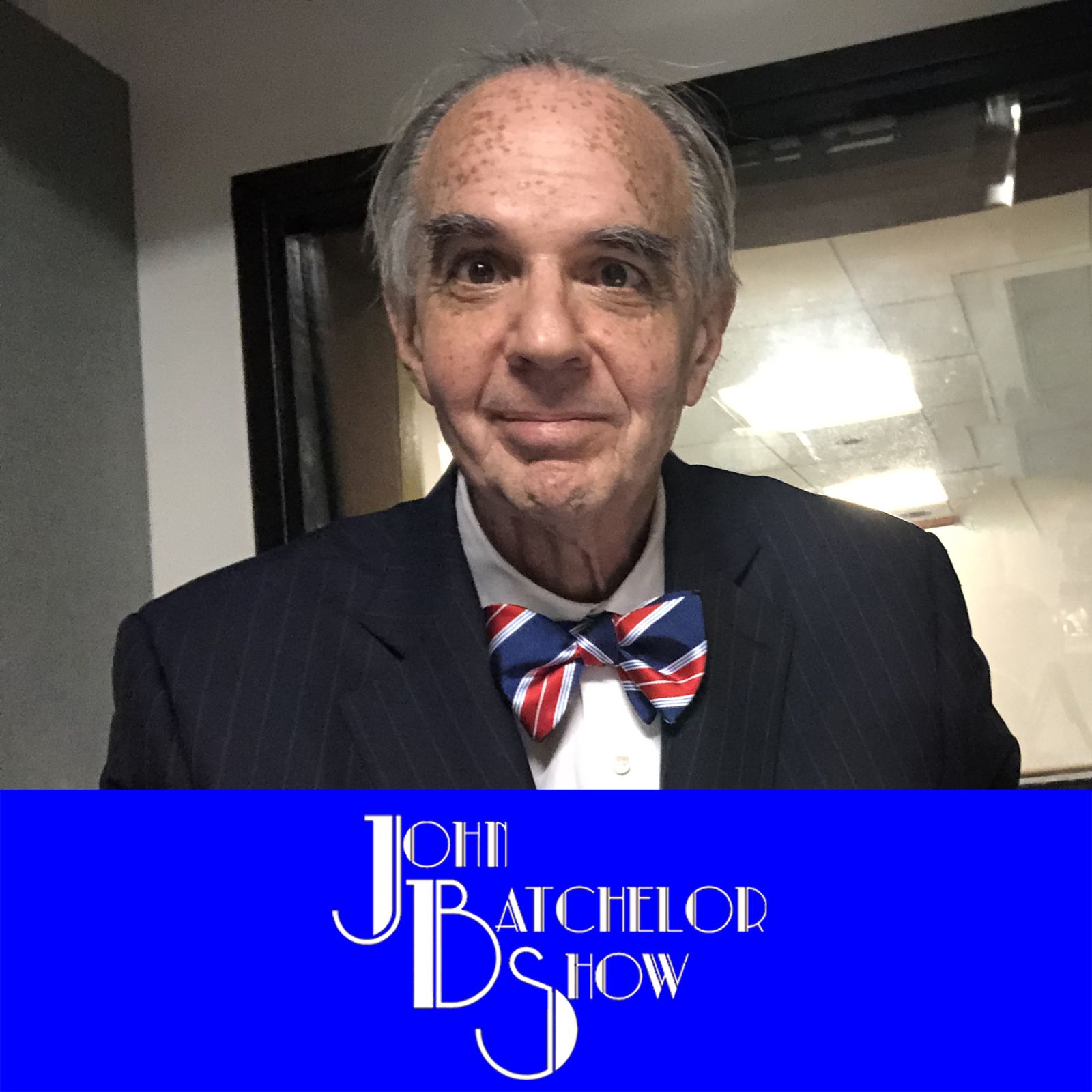
John Batchelor
The John Batchelor Show
The John Batchelor Show is a hard news-analysis radio program on current events, world history, global politics and natural sciences. Based in New York City for two decades, the show has travelled widely to report, from the Middle East to the South Caucasus to the Arabian Peninsula and East Asia.
Be sure to visit the podcast's website and support the creator: substack.com
Where to listen?
Podcasts in the app Replaio Radio Coming soonPodcasts are coming to the app soon. Install now and be the first to see a whole new take on podcasts
 Install for free
Android almost 10M downloads · 4.8 rating
iOS soon
Install for free
Android almost 10M downloads · 4.8 rating
iOS soon
Episodes
S8 Ep1094: Professor William Taubman, guest author, explains that LBJ deeply admired McNamara's efficiency, often summoning his family to the White House for "barbecue" meetings or demanding his presence while swimming. During the 1964 Gulf of Tonkin inci 06.07.2026 9:50
Professor William Taubman , guest author, explains that LBJ deeply admired McNamara's efficiency, often summoning his family to the White House for "barbecue" meetings or demanding his presence while swimming. During the 1964 Gulf of Tonkin incidents, McNamara and Johnson withheld the full truth from Congress regarding the lack of evidence for a second attack, using the resulting resolution as a l...
S8 Ep1094: Professor William Taubman, guest author, recounts how the assassination of JFK forged a deep, "opaque" bond between McNamara and Jackie Kennedy, as he spent the night following the murder sitting at her feet while she recounted the tragedy. Des 06.07.2026 8:20
Professor William Taubman , guest author, recounts how the assassination of JFK forged a deep, "opaque" bond between McNamara and Jackie Kennedy , as he spent the night following the murder sitting at her feet while she recounted the tragedy. Despite his grief, he immediately transitioned to serving Lyndon Johnson , who relied on McNamara's "tone for action" to justify the escalation of the Vietna...
S8 Ep1094: Professor William Taubman, guest author, describes how, after the war, McNamara joined the "Whiz Kids" at Ford Motor Company, rising to become president through his mastery of data and safety innovations like seat belts. In 1960, he was recruit 06.07.2026 11:25
Professor William Taubman , guest author, describes how, after the war, McNamara joined the "Whiz Kids" at Ford Motor Company , rising to become president through his mastery of data and safety innovations like seat belts. In 1960, he was recruited by the Kennedy administration, initially resisting the call before accepting the role of Secretary of Defense on the condition that he could manage the...
S8 Ep1094: Professor William Taubman, guest author, explains that McNamara's intellectual journey began at Berkeley and Harvard Business School, where he was consistently recognized as the "smartest guy" in his class, excelling in economics and mathematic 06.07.2026 8:25
Professor William Taubman , guest author, explains that McNamara's intellectual journey began at Berkeley and Harvard Business School , where he was consistently recognized as the "smartest guy" in his class, excelling in economics and mathematics. During a 1939 trip to Europe, he notably failed to realize that WWII was imminent even after hearing Hitler speak in Berlin , an admission that contras...
S8 Ep1094: Professor William Taubman, guest author, recounts how, in March 1945, Robert McNamara served on Guam as a statistical advisor to General Curtis LeMay, where he played a pivotal role in shifting B-29 bombing tactics to low-altitude strikes. This 06.07.2026 9:24
Professor William Taubman , guest author, recounts how, in March 1945, Robert McNamara served on Guam as a statistical advisor to General Curtis LeMay , where he played a pivotal role in shifting B-29 bombing tactics to low-altitude strikes. This strategy led to the devastating firebombing of Tokyo , killing approximately 100,000 civilians and prompting McNamara to later admit that they would have...
S8 Ep1093: George Black, guest author, concludes with the ongoing effort to address the war's legacy, which reached a milestone in 2019 with a bipartisan gathering at Bien Hoa airbase to launch a massive cleanup project. This initiative, supported by fi 06.07.2026 7:00
George Black , guest author, concludes with the ongoing effort to address the war's legacy, which reached a milestone in 2019 with a bipartisan gathering at Bien Hoa airbase to launch a massive cleanup project. This initiative, supported by figures like Patrick Leahy and Charles Bailey , demonstrates that aid for disabled victims should be a humanitarian rather than a political issue. The human im...
S8 Ep1093: George Black, guest author, describes how, in the late 1990s, the Canadian organization Hatfield Associates collaborated with the Vietnamese 1080 Committee to conduct a comprehensive study of dioxin contamination. They chose the A Shau Valley a 06.07.2026 12:40
George Black , guest author, describes how, in the late 1990s, the Canadian organization Hatfield Associates collaborated with the Vietnamese 1080 Committee to conduct a comprehensive study of dioxin contamination. They chose the A Shau Valley as a study site because its lack of industrialization proved that any dioxin found must have originated from Agent Orange . The study revealed that while di...
S8 Ep1093: George Black, guest author, explains that the mid-1990s marked a turning point as Bill Clinton moved toward diplomatic normalization with Vietnam in 1995, supported by key veteran senators like John McCain and John Kerry. This political cover w 06.07.2026 7:45
George Black , guest author, explains that the mid-1990s marked a turning point as Bill Clinton moved toward diplomatic normalization with Vietnam in 1995, supported by key veteran senators like John McCain and John Kerry . This political cover was essential to overcome fierce opposition in Congress . During this time, Chuck Searcy returned to Vietnam and co-founded Project RENEW to address the pe...
S8 Ep1093: George Black, guest author, recounts how, in the aftermath of the war, the United States struggled with the trauma of its first major defeat, often looking for scapegoats like the media or "faithless civilians." This bitterness manifested in th 06.07.2026 10:05
George Black , guest author, recounts how, in the aftermath of the war, the United States struggled with the trauma of its first major defeat, often looking for scapegoats like the media or "faithless civilians." This bitterness manifested in the MIA/POW issue, which became a massive political obstacle to normalizing relations with Vietnam . A legend persisted that living American prisoners were b...
S8 Ep1093: George Black, guest author, describes how Manus Campbell's experience in the mountains of I Corps was defined by the arbitrariness of death and survival. His unit frequently walked into triangular ambushes set by elite North Vietnamese regulars 06.07.2026 7:00
George Black , guest author, describes how Manus Campbell's experience in the mountains of I Corps was defined by the arbitrariness of death and survival. His unit frequently walked into triangular ambushes set by elite North Vietnamese regulars, resulting in horrific firefights where survival had little to do with skill. Campbell witnessed companions die in his place due to random movements, a pr...
S8 Ep1093: George Black, guest author, introduces two central protagonists, Manus Campbell and Chuck Searcy, who arrived in Vietnam in June 1967. Campbell, a young Marine from New Jersey, was driven by a desire to prove himself to his demanding father and 06.07.2026 12:40
George Black , guest author, introduces two central protagonists, Manus Campbell and Chuck Searcy , who arrived in Vietnam in June 1967. Campbell , a young Marine from New Jersey , was driven by a desire to prove himself to his demanding father and joined the elite Marines to become a hero. He was assigned to the first battalion of the fourth Marines and deployed to I Corps , the most dangerous co...
S8 Ep1093: George Black, guest author, explains that by 1965, the United States escalated the conflict by deploying Marines to Da Nang to protect the airfield. This period marked the expansion of Operation Ranch Hand, a campaign focused on using technolog 06.07.2026 6:55
George Black , guest author, explains that by 1965, the United States escalated the conflict by deploying Marines to Da Nang to protect the airfield. This period marked the expansion of Operation Ranch Hand , a campaign focused on using technology to defeat the natural advantages of the Vietnamese terrain. The American military utilized herbicides to defoliate the dense triple-canopy jungles and d...
S8 Ep1093: George Black, guest author, recounts how, in May 1959, the North Vietnamese leadership held a critical meeting in Hanoi to determine the future of their revolutionary struggle. While figures like Ho Chi Minh and Vo Nguyen Giap were cautious abo 06.07.2026 10:55
George Black , guest author, recounts how, in May 1959, the North Vietnamese leadership held a critical meeting in Hanoi to determine the future of their revolutionary struggle. While figures like Ho Chi Minh and Vo Nguyen Giap were cautious about provoking the United States, Le Duan , the rigorous head of the Vietnamese Communist Party , pushed for a more militant approach to liberate the South....
S8 Ep1092: Geoffrey Wawro, guest author, concludes that after the 1973 peace deal, the NVA rebuilt their forces, confident that a distracted US government—weakened by Watergate and the oil crisis—would not intervene again. When the final 1975 offensive b 06.07.2026 8:44
Geoffrey Wawro , guest author, concludes that after the 1973 peace deal, the NVA rebuilt their forces, confident that a distracted US government—weakened by Watergate and the oil crisis—would not intervene again. When the final 1975 offensive began, President Ford did not react, and the ARVN , suffering from slashed funding and ammunition shortages, rapidly collapsed. President Thieu's decision to...
S8 Ep1092: Geoffrey Wawro, guest author, describes how Nixon's "Vietnamization" policy aimed to prepare the South Vietnamese army (ARVN) to fight independently through massive equipment transfers. However, the 1971 invasion of Laos (Lam Son 719) proved a 06.07.2026 11:01
Geoffrey Wawro , guest author, describes how Nixon's "Vietnamization" policy aimed to prepare the South Vietnamese army ( ARVN ) to fight independently through massive equipment transfers. However, the 1971 invasion of Laos ( Lam Son 719 ) proved a disaster, revealing that the ARVN lacked the leadership and staff work to execute complex operations without American ground support. In 1972, Nixon re...
S8 Ep1092: Geoffrey Wawro, guest author, explains that in 1970, Nixon ordered an incursion into Cambodia to destroy NVA supply dumps and the Ho Chi Minh Trail extensions. While US forces captured significant materiel, the NVA simply withdrew deeper into t 06.07.2026 6:56
Geoffrey Wawro , guest author, explains that in 1970, Nixon ordered an incursion into Cambodia to destroy NVA supply dumps and the Ho Chi Minh Trail extensions. While US forces captured significant materiel, the NVA simply withdrew deeper into the interior and rebuilt their supply lines shortly after the Americans left. This widening of the war triggered unprecedented domestic protests, most notab...
S8 Ep1092: Geoffrey Wawro, guest author, details how Richard Nixon derailed peace talks in 1968 through Anna Chennault, promising South Vietnamese President Thieu a "better deal" to prevent a "November surprise" for Hubert Humphrey. This move resulted in 06.07.2026 10:59
Geoffrey Wawro , guest author, details how Richard Nixon derailed peace talks in 1968 through Anna Chennault , promising South Vietnamese President Thieu a "better deal" to prevent a "November surprise" for Hubert Humphrey . This move resulted in the war continuing for four more years, costing 28,000 additional American lives for essentially the same peace terms available in 1968. Under Nixon , th...
S8 Ep1092: Geoffrey Wawro, guest author, recounts how, in January 1968, the Tet Offensive was launched by the NVA and Viet Cong to deliver a knockout blow to the South Vietnamese government. While the communists suffered massive tactical losses, they achi 06.07.2026 9:16
Geoffrey Wawro , guest author, recounts how, in January 1968, the Tet Offensive was launched by the NVA and Viet Cong to deliver a knockout blow to the South Vietnamese government. While the communists suffered massive tactical losses, they achieved a strategic victory in information warfare by shattering the American public's illusion of progress. This shift was cemented by Walter Cronkite's broa...
S8 Ep1092: Geoffrey Wawro, guest author, describes how Westmoreland's strategy consisted of three phases: a massive logistical buildup, crushing search-and-destroy operations, and eventually handing the war over to a capable South Vietnamese army. However 06.07.2026 10:24
Geoffrey Wawro , guest author, describes how Westmoreland's strategy consisted of three phases: a massive logistical buildup, crushing search-and-destroy operations, and eventually handing the war over to a capable South Vietnamese army. However, the plan faltered because the vast majority of operations never made contact with the enemy, who chose to protract the war to exhaust American patience....
S8 Ep1092: Geoffrey Wawro, guest author, explains that General Westmoreland introduced the "search and destroy" concept, aiming to use superior US mobility and technology to annihilate North Vietnamese Army (NVA) forces. The Battle of Ia Drang in November 06.07.2026 7:58
Geoffrey Wawro , guest author, explains that General Westmoreland introduced the "search and destroy" concept, aiming to use superior US mobility and technology to annihilate North Vietnamese Army ( NVA ) forces. The Battle of Ia Drang in November 1965 became a pivotal test for this strategy, featuring Hal Moore's 7th Cavalry . As US troops deployed, the NVA responded by escalating to regular regi...
S8 Ep1092: Geoffrey Wawro, guest author, explores the Gulf of Tonkin incident in August 1964, which served as a political catalyst for the Vietnam War. Lyndon Johnson and Robert McNamara sought an incident to galvanize domestic support against conservativ 06.07.2026 9:52
Geoffrey Wawro , guest author, explores the Gulf of Tonkin incident in August 1964, which served as a political catalyst for the Vietnam War. Lyndon Johnson and Robert McNamara sought an incident to galvanize domestic support against conservative critics accusing them of a "no-win" policy. Though the attack was largely concocted or provoked by covert CIA operations, it provided the "blank check" n...
S8 Ep1091: Colonel Jeff McCausland reflects on how, following the battle, the war's brutality is mirrored by civil unrest, specifically the deadly 1863 draft riots in New York City, highlighting deep internal divisions within the North. While General 05.07.2026 9:01
Colonel Jeff McCausland reflects on how, following the battle, the war's brutality is mirrored by civil unrest, specifically the deadly 1863 draft riots in New York City , highlighting deep internal divisions within the North. While General Meade celebrates his victory, President Lincoln remains despondent over the missed opportunity to end the war by failing to capture Lee's army. In November 186...
S8 Ep1091: Colonel Jeff McCausland recounts how, on July 3, Robert E. Lee initiates a bold assault aimed at the Union center on Cemetery Ridge, though faulty assumptions regarding troop strength and coordination plague the plan. A massive two-hour artille 05.07.2026 11:41
Colonel Jeff McCausland recounts how, on July 3, Robert E. Lee initiates a bold assault aimed at the Union center on Cemetery Ridge , though faulty assumptions regarding troop strength and coordination plague the plan. A massive two-hour artillery barrage—the largest in North American history—precedes the infantry advance but proves largely ineffective due to defective fuses and heavy smoke obscur...
S8 Ep1091: Colonel Jeff McCausland explains that by July 2, the Union Army establishes a formidable "fishhook" defensive formation from Culp's Hill to the Round Tops, benefiting from interior lines that allow General Meade to reposition forces much faster 05.07.2026 9:55
Colonel Jeff McCausland explains that by July 2, the Union Army establishes a formidable "fishhook" defensive formation from Culp's Hill to the Round Tops , benefiting from interior lines that allow General Meade to reposition forces much faster than General Lee . Lee seeks to break this line, but delays in General Longstreet's advance push the primary assault into late afternoon. A significant ta...
S8 Ep1091: Colonel Jeff McCausland describes how, on the morning of July 1, 1863, Union General John Buford's cavalry identifies Confederate infantry advancing from the west toward the vital crossroads of Gettysburg. Recognizing the critical nature of the 05.07.2026 8:40
Colonel Jeff McCausland describes how, on the morning of July 1, 1863, Union General John Buford's cavalry identifies Confederate infantry advancing from the west toward the vital crossroads of Gettysburg . Recognizing the critical nature of the terrain, Buford deploys his men on McPherson's Ridge and Oak Hill to delay the advance, sending an urgent request to General John Reynolds for infantry su...
Similar podcasts




Listen to the The John Batchelor Show podcast in Replaio
Radio and podcasts in one app - free, with no sign-up. Install today and do not miss the launch
Replaio is not a podcast publisher; show names, artwork and audio belong to their authors and are distributed through public RSS feeds.