Dave Broker
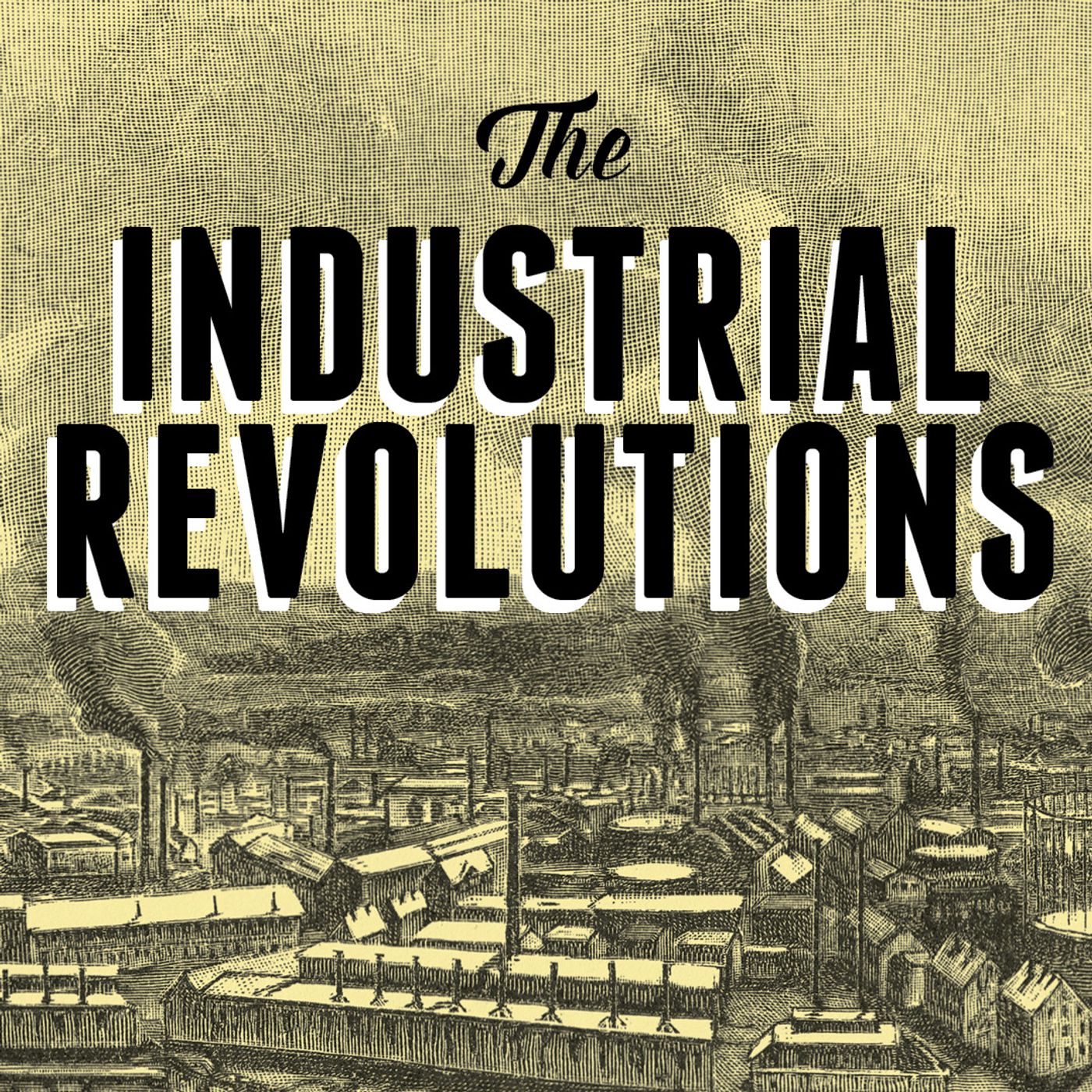
The Industrial Revolutions
The story of how a primate species created a world full of skyscrapers, airplanes, nuclear weapons, and vaccines. From the mass production of cotton weaving in the first industrial revolution of the 18th Century, to the digital revolution of today, this podcast will explore the ways our world has rapidly changed.
Author
Dave Broker
Category
Podcast website
Latest episode
Dec 2, 2024
Where to listen?
Podcasts in the app Replaio Radio Coming soonPodcasts are coming to the app soon. Install now and be the first to see a whole new take on podcasts
 Install for free
Android 5M+ downloads · 4.8 rating
iOS soon
Install for free
Android 5M+ downloads · 4.8 rating
iOS soon
Episodes
Chapter 22: Industry on the Post-Napoleonic Continent 23.07.2019 37:58
First came the French, led by Napoleon, ending feudal economic traditions across Europe. Then came the British, bringing their knowledge of new, industrial production methods and business practices. And as a result, the first Industrial Revolution spread to pockets of France, the Low Countries, Germany, and Eastern Europe. Characters in this episode include: John Holker, a former Jacobite who spie...
Chapter 21: The French Revolution and Empire 16.07.2019 41:59
If you compare the histories of Great Britain and France in the 16th through 18th Centuries, you see how they led to very different transitions into modernity. For Britain it was the Industrial Revolution. For France it was the French Revolution and the rise of Napoleon. This is what Eric Hobsbawm called the “dual revolution.” Today, we explore Hobsbawm further as we step over to France and see ho...
Chapter 20: America's First Great Debate 02.07.2019 33:02
As the first President of the United States, George Washington appointed two cabinet secretaries who went to war with each other. Alexander Hamilton and Thomas Jefferson fought on many fronts, but perhaps the most significant front was Hamilton’s economic agenda. Looking to the recent success of Great Britain, Hamilton tried to bring the Industrial Revolution to America – and Jefferson tried to s...
Chapter 19: The American Revolution 25.06.2019 37:53
In this episode, we explore the underlying intellectual reasons for the American Revolution, and how that Revolution reshaped those ideas into a philosophy that would take over the world as industrialization spread.
Chapter 18: Men of Faith (Part 2: Religious Upheaval) 11.06.2019 36:13
In the late 18th Century, increasing religious freedom led to violent rioting in London and Birmingham. The Quakers, meanwhile, kicked a gun manufacturer out of their denomination. And without knowing it, Enlightenment thinkers started to develop a brand-new religion – a religion that most of the world believes in today.
Chapter 17: Men of Faith (Part 1: The Great Awakening) 04.06.2019 30:37
After the suppression of the Puritans, religiosity died down in Great Britain and British America. Then, in the mid-18th Century, a revival of nonconformist churches swept over the English world. And it had a profound impact on the coming Industrial Revolution. In this week’s episode, we’ll talk about the two main Protestant forces behind this first Great Awakening – the Baptists and the Methodist...
Chapter 16: Men of Science 28.05.2019 43:52
As the first Industrial Revolution was beginning to turn the world upside down, the Age of Enlightenment produced scientists whose breakthroughs helped shape that upside-down world. Today we discuss three of them: Antoine Lavoisier; Dr. Edward Jenner; and Sir Humphrey Davy.
Chapter 15: We Got Chemistry 17.05.2019 31:30
The Industrial Revolutions were made possible thanks to the Scientific Revolution, which began centuries earlier as militaries needed to invest in new ways to gain an edge in battle. With it came the Scientific Method and advancements in chemistry. Starting in the mid-18th Century, a few individuals took those chemistry lessons out of the laboratory and applied them to industry. These are their st...
Chapter 14: The Machine Makers 10.05.2019 27:32
To support the National Alliance on Mental Illness: NAMI.orgWhen Joseph Bramah hired Henry Maudslay to help him make locks, little did he know his assistant would go on to change the world. Maudslay hired and trained a new generation of engineers who gave us everything from standardized tools to the powerful industrial machines of the future.
Chapter 13: The Factory System 03.05.2019 43:59
To support the Independent Labrador Retriever Rescue of Southern California (or to adopt a dog if you live there): http://www.indilabrescue.org - To get your favorite team’s apparel AND support the podcast, use this link: https://industrialrevolutionspod.com/fanatics - The principles of mass production at large worksites – through a combination of technological innovations and improved methods of...
Chapter 12: The Steamboat 26.04.2019 33:50
Creating the world’s first vessels of powered transportation was no joke. Several competitive inventors put everything on the line to be the first to build profitable steamboats. For most of them, the pursuit ended in failure. It was the most unlikely one – an American painter – who got the job done, and in the process, changed the course of world history. In this episode we’ll cover Denis Papin’s...
Chapter 11: Canal-Mania 12.04.2019 31:55
From the 1760s to the 1830s, Great Britain went crazy for canals. America did too. These waterways helped speed up trade and fuel industrialization in the age before trains and highways. In the process, they created all kinds of new jobs and opportunities. Characters covered in this chapter include: Thomas Steers, the engineer who modernized river navigation in Lancashire; The Duke of Bridgewater,...
Chapter 10: Economic Ideas (Part 2: Adam Smith) 05.04.2019 32:45
This week we discuss the life and times of the Father of Economics, including his native Scotland, his early years and education, his intellectual influences, his career, and his magnum opus: The Wealth of Nations.
Chapter 9: Economic Ideas (Part 1: The Oldies) 29.03.2019 28:44
At the dawn of the First Industrial Revolution, a new academic field emerged: Economics. (Well, something called “Political Economy” anyway.) But centuries of economic thought had to be supplanted first. In this Chapter, we review some of the ideas that permeated Europe leading up to the Industrial Revolutions. We’ll discuss the works of Plato and Aristotle, the Scholastics, the Mercantilists, Qu...
Chapter 8: Mill Towns Become Mill Cities 22.03.2019 25:46
Nearly half the world’s population today lives in an urban area. Before the first Industrial Revolution, only about 3% did. Industrialization created urbanization. Not only did it create incentives for people to pack themselves into dense cities, it also created the means to overcome the challenges of density. What’s most amazing about this process is that many new metropolises were seemingly crea...
Chapter 7: The Steam Engine 15.03.2019 43:20
The steam engine was the product of centuries of experimentation, economic necessities, strong business acumen, and colorful personalities. This is how it happened.
Chapter 6: Agriculture, Metal, and Mining 08.03.2019 43:23
During the 18th Century, the British came up with many innovations that allowed them to get more out of the land. Not only did the increased production of food, iron, and coal make the first industrial revolution possible, but many innovations had indirect applications for new technologies. In this episode, we’ll cover: Jethro Tull’s seed drill; Turnip Townshend’s crop rotations; The resistance of...
Chapter 5: The Textile Industry 22.02.2019 38:01
We’ll never know the names of the first farmers of the Neolithic Revolution, but we do know the names of the inventors who kick-started the Industrial Revolutions. Their simple innovations gave us a new world of nearly constant, explosive economic growth and a total restructuring of society everywhere and forever. This is how it happened. In this episode, we’ll cover: The growth of the global cott...
Chapter 4: Creating Utopia 15.02.2019 36:02
Are we living in Thomas More’s Utopia? In this chapter, we’ll explore his book and his life to chart the path toward the industrialized world we inhabit today, including: The rise of cottage industry; Mechanical innovations; Increasing specialization; The war industry’s impact on mass production; The impact of the Protestant Reformation.
Chapter 3: The Rise of the Global Empires 08.02.2019 42:00
Beginning in the 1300s, a rivalry between two kingdoms on the Iberian Peninsula led to a whole lot of exploring, trading, and conquering. Before long, other European powers were getting in on the action. Not only did it transfer the gravity of the world’s political and economic power toward Europe, it set Europe on a path toward industrialization. In this episode, we’ll explore: The early days of...
Chapter 2: Europe in the Middle Ages 01.02.2019 28:56
Europe was (rightly or wrongly) considered the backwater of the civilized world for most of history. So how is it the Europeans built global empires and changed the world with industrialization? In this 25-minute episode, I’m going to run through the developments of the Middle Ages and the circumstances of life in Europe that gradually led to a new world order. Topics include: The impact of Ancien...
Chapter 1: Genesis 31.01.2019 40:10
In this episode, we cover the origins of human society, which remained relatively unchanged until the Industrial Revolutions: How we evolved into “smart man” How we stopped foraging and started farming How we started building cities How we developed trade and money How we developed government and religion How we invented writing How we developed a system of social inequality How our ideas spread o...
Introduction 07.01.2019 3:46
When the founding fathers wrote the U.S. Constitution in the 1780s, life on planet earth had changed very slowly over the previous 10,000 years. Life in 1780 wasn’t all that different from life in 1500. Life in 1500 wasn’t all that different from life in 1250. Life in 1250 wasn’t all that different from life in 1000. And so on, and so on. But then the human experience changed completely: Where we...
Similar podcasts







Listen to the The Industrial Revolutions podcast in Replaio
Radio and podcasts in one app - free, with no sign-up. Install today and do not miss the launch
Replaio is not a podcast publisher; show names, artwork and audio belong to their authors and are distributed through public RSS feeds.