Richard G Backus
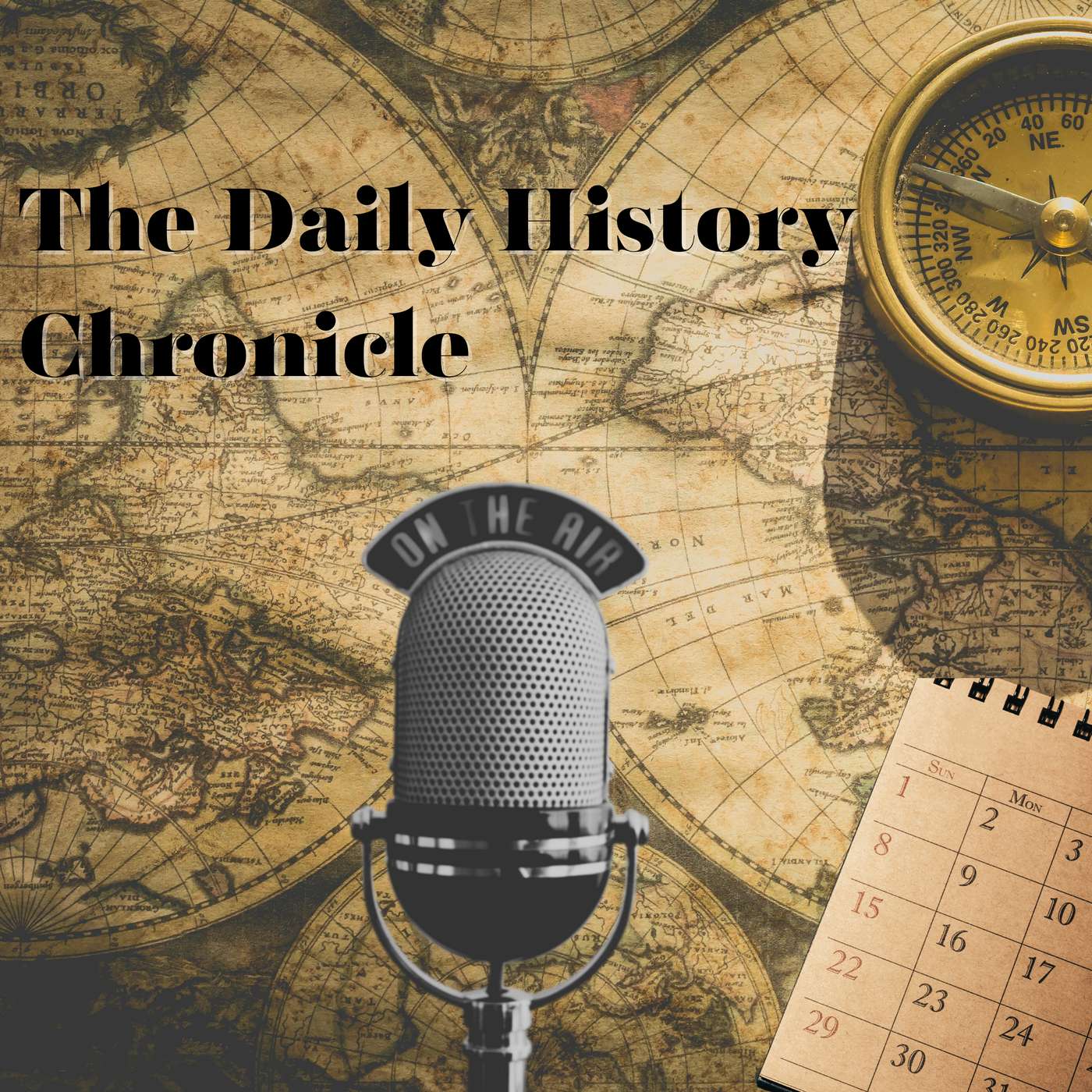
The Daily History Chronicle
Every date on the calendar marks a moment that changed everything. Welcome to The Daily History Chronicle, where host Richard Backus, publisher of University Teaching Edition, brings history to life through compelling 15-minute stories that connect the past to our present. Each day, we travel back to explore a pivotal moment in history, from revolutions and discoveries to tragedies and triumphs. But these aren't just dates and facts. They're stories of courage, conflict, innovation, and consequence that continue to echo through our lives today. What makes The Daily History Chronicle different?...
Author
Richard G Backus
Category
Podcast website
Latest episode
Jul 11, 2026
Where to listen?
Podcasts in the app Replaio Radio Coming soonPodcasts are coming to the app soon. Install now and be the first to see a whole new take on podcasts
 Install for free
Android 5M+ downloads · 4.8 rating
iOS soon
Install for free
Android 5M+ downloads · 4.8 rating
iOS soon
Episodes
The Day the Future Became Tiny - December 23, 1947 23.12.2025 17:57
On December 23, 1947, three Bell Labs physicists, William Shockley, John Bardeen, and Walter Brattain, demonstrated the first working transistor, a tiny device that looked insignificant but enabled the entire digital revolution. Richard Backus examines why this breakthrough came from systematic collaborative research rather than a lone genius, how Bell Labs' patient long-term investment in fundame...
When the Earth Shook and Corruption Was Revealed - December 22, 1972 22.12.2025 17:38
On December 22, 1972, a massive earthquake struck Managua, Nicaragua, killing thousands and destroying most of the capital city. But the tragedy was compounded when dictator Anastasio Somoza embezzled millions in international aid meant for victims, turning disaster relief into personal profit. Richard Backus examines both the earthquake itself and the systematic corruption that followed from the...
When Terror Fell From the Sky - December 21, 1988 21.12.2025 18:17
On December 21, 1988, Pan Am Flight 103 was destroyed by a terrorist bomb over Lockerbie, Scotland, killing all 259 aboard and 11 on the ground. Richard Backus examines not just the attack itself but the systemic failures that enabled it: warnings existed but weren't adequately heeded, security was insufficient, and intelligence coordination was lacking. From his perspective and law enforcement ba...
The Day We Bought Half a Continent - December 20, 1803 20.12.2025 18:14
On December 20, 1803, the United States officially took possession of the Louisiana Territory, completing the Louisiana Purchase that doubled the nation's size for $15 million. Richard Backus examines why this moment requires holding multiple truths: it was a brilliant strategy that secured American independence and enabled westward expansion, AND it was constitutional overreach by Jefferson, who...
When Impeachment Became a Weapon - December 19, 1998 19.12.2025 17:01
On December 19, 1998, the House of Representatives impeached President Bill Clinton for perjury and obstruction of justice related to his affair with Monica Lewinsky. Richard Backus examines both Clinton's serious character failure of lying under oath as president and how the impeachment process itself became corrupted by partisan warfare. From his investigator's perspective and law enforcement ba...
The 13th Amendment Abolishes Slavery - December 18, 1865 18.12.2025 23:26
On December 18, 1865, Georgia became the 27th state to ratify the 13th Amendment, providing the three-quarters majority needed to make it law. After 246 years of slavery and a Civil War that killed 600,000, the Constitution finally prohibited slavery, but with a crucial exception: "except as a punishment for crime." In this episode, we explore why the Civil War didn't start as a war to end slavery...
The Day Humans Learned to Fly - December 17, 1903 17.12.2025 17:54
On December 17, 1903, Orville Wright flew 120 feet in twelve seconds at Kitty Hawk, the first powered, controlled, sustained flight in human history. But Richard Backus examines why this matters more than the flight itself: two bicycle mechanics with no formal engineering training succeeded where better-funded, better-credentialed competitors failed because they were systematic problem-solvers who...
The Day Winter Became a Weapon - December 16, 1944 16.12.2025 18:04
On December 16, 1944, Germany launched its final major offensive through the Ardennes Forest in what became the Battle of the Bulge. Richard Backus's father was a combat infantryman in the 102nd "Ozark" Infantry Division who fought in this battle, making this episode deeply personal. Richard examines the surprise attack, the brutal winter conditions, and what it took for ordinary soldiers to hold...
When Resistance Died on a Cold Morning - December 15, 1890 15.12.2025 18:40
On December 15, 1890, Sitting Bull, the legendary Lakota leader who defeated Custer at the Battle of the Little Bighorn, was killed during an arrest attempt on the Standing Rock Reservation. But Richard Backus examines the deeper tragedy: Sitting Bull was killed by Indian Police, Native officers working for the government that had systematically destroyed their way of life. From his investigator's...
The Day We Reached the End of the Earth - December 14, 1911 14.12.2025 17:12
Roald Amundsen, South Pole, Robert Falcon Scott, Antarctic exploration, December 14, 1911, race to the pole, polar exploration, preparation vs improvisation, Indigenous knowledge, Inuit expertise, methodical preparation, Scott's tragedy, exploration history, learning from experts, manhauling, Norwegian expedition, British expedition, survival methodology, noble failure, systematic success
The Last Footprints - December 13, 1972 13.12.2025 15:25
On December 13, 1972, Gene Cernan became the last human to walk on the moon, completing Apollo 17's final lunar exploration. But this story isn't just about achievement it's about why we stopped going, what that says about us, and whether we've learned anything from fifty years of staying home.
The Day Canada Fought Over a Piece of Cloth - December 12, 1964 12.12.2025 19:23
On December 12, 1964, Canadian Parliament began one of its most bitter debates: should Canada replace the Red Ensign (featuring the British Union Jack) with a new, distinctly Canadian flag? Richard Backus examines why this fight over a "piece of cloth" consumed Parliament for weeks. Veterans felt the change betrayed wartime sacrifices, while others saw the Union Jack as a colonial symbol excluding...
The Day a King Chose Love Over Duty - December 11, 1936 11.12.2025 18:01
On December 11, 1936, King Edward VIII signed the Instrument of Abdication, giving up the British throne to marry Wallis Simpson. But Richard Backus examines why this wasn't just a romantic story; it was a constitutional crisis that exposed the fundamental conflict between personal happiness and institutional duty. From his investigator's perspective, he explores the impossible position Edward fac...
When a Merchant of Death Tried to Buy Redemption - December 10, 1901 10.12.2025 17:22
On December 10, 1901, the first Nobel Prizes were awarded, launching the world's most prestigious recognition of human achievement. But Richard Backus examines the complicated origins: Alfred Nobel, haunted by being called a "merchant of death" after inventing dynamite, tried to rewrite his legacy by celebrating peace and knowledge instead of destruction. From his investigator's perspective, he ex...
The Day One Woman Broke Through - December 9, 1921 09.12.2025 17:13
On December 9, 1921, Agnes Macphail became the first woman elected to Canada's House of Commons, the only woman among 234 men. Richard Backus examines not just her achievement, but what she faced once she broke through: extraordinary scrutiny, impossible standards, and the burden of representing all women. From his investigator's perspective, he explores why breaking barriers isn't the same as cha...
When the Music Stopped - December 8, 1980 08.12.2025 16:56
On December 8, 1980, John Lennon was shot and killed outside his New York apartment by Mark David Chapman, a man who claimed to be a fan. Richard Backus examines not just the murder, but the systems that failed to prevent it: mental health systems that couldn't identify someone in crisis, celebrity culture that creates obsessive parasocial relationships, and weapon access that enabled the violence...
The Day We Weren't Looking - December 7, 1941 07.12.2025 18:25
On December 7, 1941, Japanese aircraft attacked Pearl Harbor in a "surprise" assault that killed over 2,400 Americans and pulled the U.S. into World War II. But Richard Backus investigates why it wasn't really a surprise: there were warning signs, intelligence was available, and multiple indicators were present. The failure was that we were looking in the wrong direction, preparing for expected th...
When Two Ships Changed Everything - December 6, 1917 06.12.2025 18:07
On December 6, 1917, two ships collided in Halifax Harbour, triggering the largest man-made explosion before the atomic bomb. Nearly 2,000 people died because warning systems failed and emergency protocols didn't exist. Richard Backus investigates the cascade of small failures that led to catastrophe, from poor communication between ships to the lack of evacuation plans, and examines why these sam...
The Day America Admitted It Was Wrong - December 5, 1933 05.12.2025 17:07
On December 5, 1933, Utah became the 36th state to ratify the 21st Amendment, ending Prohibition and marking one of the few times America admitted a constitutional policy was a catastrophic failure. Richard Backus investigates why Prohibition failed so completely creating black markets, empowering organized crime, corrupting law enforcement, and making alcohol more dangerous. But this episode goes...
The Mystery That Launched a Thousand Theories - December 4, 1872 04.12.2025 17:25
On December 4, 1872, the crew of the Dei Gratia found the Mary Celeste sailing abandoned in the Atlantic, seaworthy, cargo intact, but not a soul on board. Richard Backus investigates what the evidence actually tells us versus the sensational theories that have accumulated over 150 years. From his investigator's perspective, he examines the most likely explanation and explores why we prefer dramat...
The Night the Gas Came - December 3, 1984 03.12.2025 16:54
On December 3, 1984, forty-two tons of toxic gas leaked from a Union Carbide pesticide plant in Bhopal, India, killing thousands in a single night and injuring hundreds of thousands more. Richard Backus investigates how systematic cost-cutting degraded multiple safety systems, creating a preventable disaster. But this episode goes beyond the technical failures to examine the uncomfortable question...
The Day America Drew a Line in the Sand - December 2, 1823 02.12.2025 15:10
On December 2, 1823, President James Monroe announced a doctrine that would shape American foreign policy for two centuries but the United States didn't actually have the power to enforce it. Richard Backus explores how Monroe's bold declaration worked through British backing, how it evolved from defensive policy to justification for intervention, and why every major power today wants its own Monr...
The Day Canada Learned to Argue Together - December 1, 1867 01.12.2025 14:20
On December 1, 1867, Canada's first Parliament opened in Ottawa, but this wasn't a celebration of unity. It was an experiment in whether people who deeply disagreed could learn to govern together. Richard Backus explores how the parliamentary system was deliberately designed to contain differences without eliminating them and why that choice remains profoundly relevant today. When democracy feels...
The Day the Sky Fell on Ann Hodges - November 30, 1954 30.11.2025 22:28
Ann Hodges became the only confirmed person struck by a meteorite when an eight-pound rock crashed through her roof a story about astronomical odds, human responses to extraordinary events, and how trauma can be compounded by attention.
A Vote That Changed the Middle East - November 29, 1947 29.11.2025 23:43
The UN's partition plan for Palestine tried to resolve competing Jewish and Arab claims but triggered a war that created refugees and established facts on the ground that remain unresolved nearly eight decades later.
Similar podcasts







Listen to the The Daily History Chronicle podcast in Replaio
Radio and podcasts in one app - free, with no sign-up. Install today and do not miss the launch
Replaio is not a podcast publisher; show names, artwork and audio belong to their authors and are distributed through public RSS feeds.