Selenius Media
The American Presidents
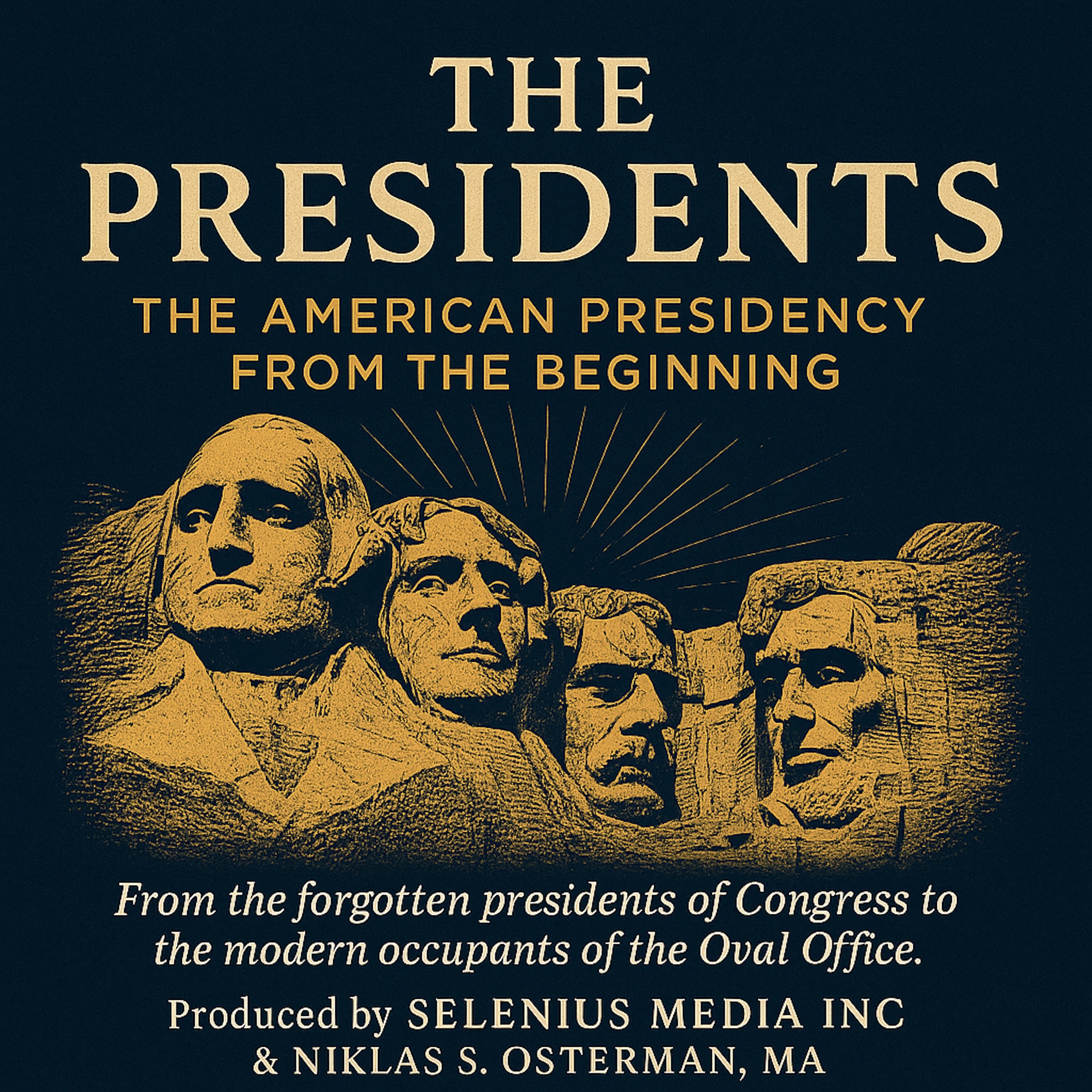
“The Presidents” is a long-form narrative project that tells the American story through the people who carried its executive power before it had a president and after the office had a name. We start where most textbooks don’t—inside the dim rooms of the Continental Congress—then move through the Articles era and into the modern Oval Office, treating each figure not as a bust on a mantel but as a decision-maker inside a living system. Every chapter asks the same unforgiving questions: What did this person actually do? What did they refuse to do? Who paid for their choices, and who prospered bec...
Be sure to visit the podcast's website and support the creator: rss.com
Where to listen?
Podcasts in the app Replaio Radio Coming soonPodcasts are coming to the app soon. Install now and be the first to see a whole new take on podcasts
 Install for free
Android almost 10M downloads · 4.8 rating
iOS soon
Install for free
Android almost 10M downloads · 4.8 rating
iOS soon
Episodes
John Hancock (again) – Elected but largely nonresident/absent (1785–1786) 19.11.2025 24:37
The second time John Hancock’s name was lifted to the top of Congress, it was less a summons to govern than a bet on the power of a signature. The war was over; the treaty had been ratified; the chair in the national chamber had begun to pass each year to a different steward who kept the papers moving and the façade intact. In that rotation, which felt at once ceremonial and necessary, the delegat...
Arthur St. Clair – President of Congress (1787) 19.11.2025 29:50
Arthur St. Clair’s year in the chair feels like a hinge cut out of iron: heavy, cold to the touch, load-bearing in a way that is easy to miss if you only glance at the door it is holding up. In February 1787 he took his seat as President of the United States in Congress Assembled at a moment when the Confederation government had very nearly taught the country to stop expecting anything from it. Th...
Cyrus Griffin – Final President of Congress (1788–1789) 19.11.2025 27:31
Cyrus Griffin – Final President of Congress (1788–1789) Cyrus Griffin’s season in the chair arrives like the last careful breath before a long swim—measured, deliberate, and entirely aware that the air he is gathering must carry more than just himself. When he takes up the gavel as President of the United States in Congress Assembled, the Confederation is already living in the tense quiet after a...
John Jay – President of the Continental Congress (1778–1779) 19.11.2025 26:04
John Jay – President of the Continental Congress (1778–1779) On a gray December afternoon in 1778, a slender man with a narrow, thoughtful face and a faint scar along his cheekbone took the chair at the front of a crowded hall in Philadelphia. Outside, the city still bore the marks of recent occupation: broken shutters, gouged doorframes, the memory of redcoats. Inside, the delegates of the Contin...
Henry Laurens – President of the Continental Congress (1777–1778) 19.11.2025 28:17
Henry Laurens – President of the Continental Congress (1777–1778) In the hard winter of 1777, when the wind off the Susquehanna cut through wool and warmed breath froze to mustaches, a cluster of men in borrowed rooms tried to keep a country alive with ink. Philadelphia had fallen to the British; Congress had fled first to Lancaster for a day and then to York, a market town that suddenly found its...
Thomas McKean – President of Congress (1781) 19.11.2025 10:22
Thomas McKean – President of Congress (1781) Thomas McKean entered those working days with the blunt tools of a self-made lawyer and the stubbornness of a border man. Born in 1734 in the Pennsylvania backcountry to parents of Ulster-Scots stock, he learned early that order was something you built, not something given. He read law in New Castle, Delaware, gathered clients one case at a time, and mo...
Thomas Jefferson 18.11.2025 24:20
Thomas Jefferson arrives in the American story as the author of a sentence so large that it keeps upstaging the life that wrote it. A young lawyer with a delicate voice and a ferocious pen composed a claim about equality that outgrew his century and then outgrew him. He spent the remainder of his days as its chief editor, annotator, evader, devotee, and sometimes defendant. He could make a paragra...
John Adams 18.11.2025 27:25
John Adams comes into focus first as a man made of sentences—short, vigorous, argumentative—and only then as a public officer stitched to a perilous decade. He was not a figure of placid charisma. He had a lawyer’s appetite for the exact word, a farmer’s suspicion of fashionable nonsense, and a temperament that took offense more quickly than it forgave. But running beneath the volatility was the h...
George Washington 18.11.2025 28:06
Under the weight of later monuments it is easy to forget that George Washington began as a boy who learned to read the land before he learned to read the law. In the tidewater mornings of Virginia the light rises off water and climbs through trees in a way that makes distance look like promise rather than peril, and a clever boy with a compass and a chain can turn that promise into a profession. B...
John Hancock – President of the Second Continental Congress (1775–1777) 15.11.2025 25:32
John Hancock – President of the Second Continental Congress (1775–1777) In May of 1775, when John Hancock rose from his seat and walked slowly to the front of the chamber in Philadelphia, he was walking into a role that did not quite exist yet. The Second Continental Congress had reconvened under a new sky. Between its first and second sessions, there had been gunfire at Lexington and Concord, blo...
Henry Middleton – Second President of the First Continental Congress (1774) 15.11.2025 22:38
Henry Middleton – Second President of the First Continental Congress (1774) On a humid afternoon in the fall of 1774, when the air in Philadelphia still held a faint memory of summer, the delegates to the First Continental Congress returned from dinner to find that something had shifted. Peyton Randolph, the Virginian who had presided over their sessions with grave, measured calm, was gone—summone...
Peyton Randolph – First President of the First Continental Congress (1774) 15.11.2025 18:28
In the autumn of 1774, long before anyone could imagine a “President of the United States,” a group of men gathered in Philadelphia and improvised a government. They did not call it that, not yet. They called it a Congress, a meeting of colonies that still—at least officially—claimed loyalty to George III. They were petitioners, not revolutionaries, or so they told themselves. Inside the long, ech...
Similar podcasts







Listen to the The American Presidents podcast in Replaio
Radio and podcasts in one app - free, with no sign-up. Install today and do not miss the launch
Replaio is not a podcast publisher; show names, artwork and audio belong to their authors and are distributed through public RSS feeds.